Volume 152 — SCHOOL.
Reading edition
During the past week there has taken place, almost without our knowledge, a great migration of boys. From their homes, out on to the roads and railways, has been pouring a flood of big boys, middle-sized boys, small boys, old boys, new boys, all tending towards the various schools where they are supposed to make all the best parts of human knowledge their own and to live a life of dignified abstraction from the troubles of the world, in the midst of their own argot and their own special traditions.
Of the big boys and the middle-sized boys I have little to say. They are already imbued, if one may say so, with the influence of their school, and can hold their own with the masters and their fellow-boys. Much as they enjoy their holidays, they show no undue reluctance to take up again the burden of their studies at a place which they will afterwards consider as having given them some of the happiest days of their lives. Many of them indeed are already or are in process of becoming the trusted coadjutors of the headmaster and his colleagues in the work of maintaining good order and discipline in the school. They are monitors—tremendous word!—or prefects or præpostors, and their mitis sapientia, no less than their muscular strength, causes them to be feared and venerated.
Of such awful beings one must not speak lightly lest some terrific fate reserved for scoffers overtake one. No, my concern at present is rather with the little boys who have gone up for the first time to their preparatory school, those forlorn scraps of humanity who are beginning a life entirely new to them in all its details. Hitherto, except for visits to the seaside with their parents and family, they have not spent a night away from home. Now they are separated from their parents and plunged into a world of perfect strangers. Everything is done to make them at ease and comfortable in their new surroundings; the headmaster is kindness itself, the matron beams on them with smiles and fortifies them with encouragement; but just at first the wrench for the little fellows is great. In a day or two, however, they will begin to acclimatise themselves; the strangeness will begin to wear off; and having borne up bravely against their first sense of loneliness in the midst of a crowd they will gradually become parts of the machine to the making of which many gentle and sympathising hands for years past have contributed.
"Schools are not what they were," says one of my friends. "There is no bullying nowadays and little roughness of any kind. Masters are not looked upon as the natural enemies of boys. Corporal punishment, except for the gravest offences, is abolished. Whereas, formerly, little boys were at once sucked into the vortex of a Public School, there are now Preparatory Schools, where Tommie and Dickie and Harry, aged from nine to ten, learn the business of Public Schooling in a manner suited to their age and capacity. When we were boys," he continues, "these admirable buffer states were so few that they might almost be said not to exist at all; they now flourish everywhere. The path of the little boy is thus made easier for him."
"But," I said, "is a little boy, then, never brought to a sense of his unimportance by being physically, if not morally, kicked? Is he to pass his life in a condition of Sybaritic softness?"
"You need not," he said, "worry about that. Softness makes no appeal to the average English boy."
When therefore, on a day in last week, it happened to me to take a little boy I happen to know to his Preparatory School on his first day of his first term there, I did so with no undue depression. "Be a good boy," I said to him; "never tell a lie, never push yourself forward, and don't swank about yourself." It was good advice so far as it went, but it did not make any great impression on him, for he only answered, "Of course," or "Of course I shan't," to every item that I put before him. I wonder how many fathers have recently inculcated these and similar high-toned principles on their little boys, only to meet with the same uninterested acquiescence. And even our parting was not so dejected as it might have been, for by that time another new boy had come upon the scene, and he and mine had been irresistibly drawn to one another, and were chatting gaily when it was time for me to go.
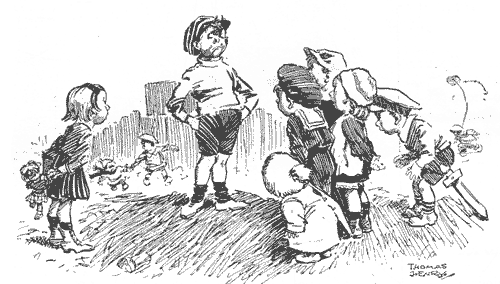
THE CELEBRITY.
THIS IS BILLY SMIFF, 'IM WOT REMEMBERS THE TIME WHEN THERE WASN'T NO WAR.
CHILDREN'S TALES FOR GROWN-UPS.
IX.
THE UNWRITTEN TREATY.
"Be careful," said the worm to the slug, "there is one of those nasty birds over there. What ugly things they are!"
"Not half so ugly as men. Ugh!" said the slug.
"Men are big, not ugly. They don't eat worms."
"But they cut them in two with spades."
"Only by accident. There is nothing so ugly as a bloated over-grown bird eating a slender delicate worm."
"Except," said the slug, "a monstrous man crushing a tender slug under his clumsy hoofs. Birds I can tolerate. They are not so big as men."
"But they hop quicker and eat more for their size," said the worm.
"Not slugs, they don't eat slugs. We have a treaty with the birds, you know."
"Was it signed?" asked the worm.
"There was no need. You see it is a matter of convenience. We don't get eaten, and the birds don't get their beaks slimy."
"Convenience is a great thing," said the worm, "but it isn't everything. Well, good-bye; I am going in till the bird goes."
"And I am staying out till the man comes."
"Slugs are nasty slimy things," said the thrush, "but in these hard times one must eat what one can get," and he swallowed the slug with a wry face.
Well-Meant.
Extract from a New Zealand school-boy's letter:—
"We also had songs, the College song, and the Harrow School song, for the special benifit (sic) of the Governor, who is an Etonian."
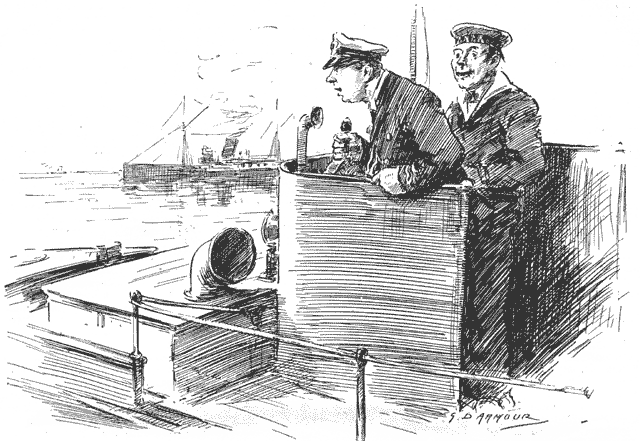
Motor-Launch Officer (who has rung for full-speed without result). "WHAT'S THE MATTER?"
Voice from below. "ONE OF THE CYLINDERS IS MISSING, SIR."
Commander. "WELL, LOOK SHARP AND FIND THE BALLY THING—WE WANT TO GET ON."