Volume 152 — HINTS TO GROSVENOR HOUSE.
Reading edition
Mr. Punch is not more free from correspondents who know how to solve the food problem than other papers are.
The following six letters have been selected with care from some thousand and three received during the week. The others are at the service of any enterprising editor, or Lord DEVONPORT can have them if he will send a waggon to take them away. They should make pleasant week-end reading.
AN EXCELLENT SUGGESTION.
SIR,—What we plain men want to know and what we are entitled to know is—What does Lord DEVONPORT eat? What does Mr. KENNEDY-JONES eat? What does Mr. ALFRED BUTT eat? It would make a vast difference to the success of the food campaign if each of these administrators was visible at his meals, doing himself extremely ill. I suggest that a prominent shop window should be taken for each, and they should have their luncheon and dinner there in full view of the public.
Yours, etc., COMMON SENSE.
THE POWER OF BRITISH HUMOUR.
SIR,—If the Food Economy posters were more carefully thought out the trick would be done. I suggest, for example, something really pithy and witty, such as—
IT IS NOT ENOUGH FOR ONE OR TWO DAYS TO BE MEATLESS DAYS. YOU SHOULD SEE THAT ALL DAYS ARE EAT-LESS DAYS.
Something like that would soon drive the fear of England into the [unprintable word] Germans.
Yours, etc., DOWNRIGHT.
TO MASTER THE ROLLS.
SIR,—My experience is that all rolls are too big. I personally can get through a meal comfortably with only half the fat roll that is automatically put before me at most of the restaurants. Let Lord DEVONPORT decree a roll just half the size, and the difference both in consumption and waste will be enormous. At a dinner-party which I attended the other evening, not, Sir, a hundred miles from your own office, the excessive size of the rolls was the subject of much comment. No one should be given the opportunity of leaving any bread. It should be doled out in the smallest doses.
Yours, etc., OBSERVER.
THE USE OF ABUSE.
SIR,—The real trouble with the food economy campaign is that ordinary people, who perhaps, not unnaturally, have got into the habit of not believing the daily papers, do not realise what their enemy and the chief enemy of the country at this moment is—I mean the German submarine. In order to get this fact into their intelligence I suggest that free classes in objurgation are at once instituted, in which, instead of the common "You beast!" "You brute!" "You blighter!" and so forth, the necessity of saying nothing but "You (U) boat!" in every dispute or quarrel is insisted upon. The young might also be thus instructed.
Yours, etc., FAR SIGHTED.
WRIT SARCASTIC.
SIR,—I have an infallible plan for diminishing the consumption of good food, at any rate among Members of the Government. Let them give up all other forms of nutriment and eat their own words. The PRIME MINISTER might begin. I am,
Yours, etc., ORGANISED OPPOSITION.
"FOOD HOGS" SUPERSEDED.
SIR,—I am told that there are people so lost to shame that they are still, in spite of the KING'S Proclamation and all the other appeals to their patriotism, eating as usual. I suggest that they be branded as the "Alimentary Canaille."
Yours, etc., DISGUSTED.
"Sir G. Cornewall Lewis made the best speeches in the moist manner."—British Weekly.
We had always understood till now that he was one of our dry speakers.
"Mr. R. M'Neill was surprised that the hon. member should have thought it worth while to make a point of that sort. Surely he knew the rule 'Qui facit peralium facit perse.'"—The Times.
The maxim seems to have jammed.
"Mr. Bonar Law replied: 'The Imperial War Cabinet is both executive and consultative, its functions being regulated by the nature of the subject of the Bandman Opera Coy.'"—The Empire (Calcutta).
As one of the subjects of the Company (according to its advertised programme) is a piece entitled "The Rotters," we feel confident that Mr. BONAR LAW has been misreported.
TROOP HORSES.
Through lingering long months idle They have kept you ready and fit, All shining from hock to bridle, All burnished from hoof to bit; The set of your silk coat's beauty, The lie of its lightest hair, Was an anxious trooper's duty And a watchful captain's care. Not the keenest eye could discover The sign of the sloth on you, From the last mane-lock laid over To the last nail tight in the shoe; A blast, and your ranks stood ready; A shout, and your saddles filled; A wave, and your troop was ready To wheel where the leaders willed. "Fine-drawn and fit to the buckle!" Was your confident Colonel's pride, And the faith of the lads—"Our luck'll Come back when the Spring winds ride;" And, dropping their quaint oaths drolly, They dragged their spurs in the mire, Till the Western Front woke slowly And they won to their hearts' desire. They loose you now to the labours That the needs of the hour reveal, And you carry the proud old sabres To cross with a tarnished steel; So, steady—and keep position— And stout be your hearts to-day, As you shoulder the old tradition And charge in the ancient way! W.H.O.
MORE ZOO NOTES.
Raw sugar, Captain BATHURST states, cannot be sold on account of the presence of the sugar louse. It is thought that Mr. POCOCK, who has so successfully brought the Zoo's rations into conformity with war conditions, might probably persuade the animal to live on hemp seed.
"Changes in the Zoo's dietary," says Mr. POCOCK, "were effected without difficulty." The rumour that the hippopotamus demanded a pailful of jam with its mangel-wurzels, in the belief that they were some kind of homoeopathic pill, appears to have been baseless.
In order to assist the many fine specimens of moth in the Insect House, it is reported that several actor-managers owning fur coats have offered them a good home.
The birds of paradise are no longer fed on beetroot. Since the all-red root has been denied them they protest against being called birds of paradise, and wish to be known simply as "birds."
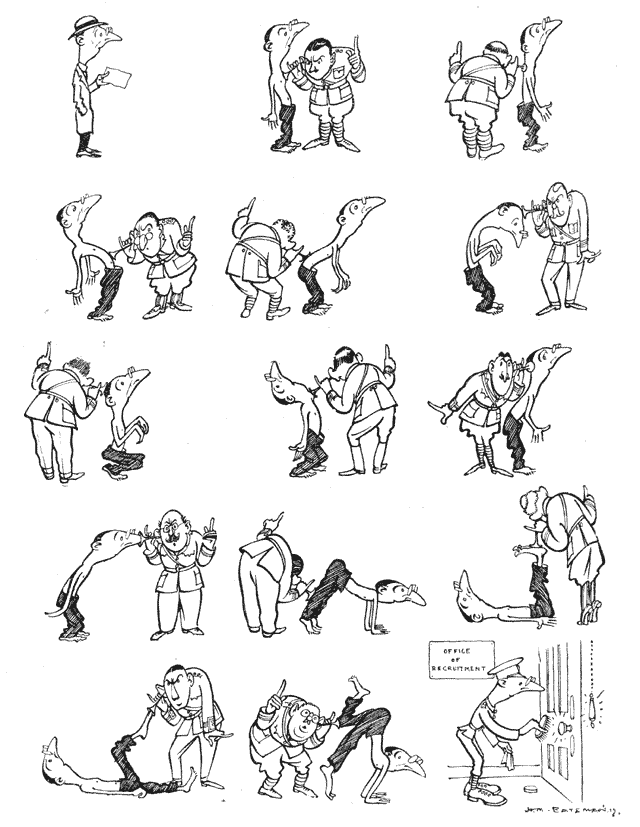
OUR PERSEVERING OFFICIALS;
OR, THE RECRUIT THAT WAS PASSED AT THE THIRTEENTH EXAMINATION.
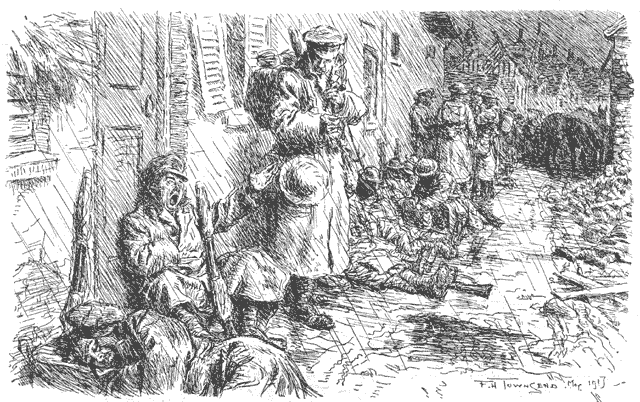
Private Saunders (whose battalion, having been sent back from the front line for "rest," is compelled to spend the night in the street, its billets being still occupied by other troops—to cheery pal, who breaks into song). "'USH, GINGER—YOU'LL GIVE THE TOWN A BAD NAME."