Volume 152 — THE MINIATURE.
Reading edition
When I left her, Celia had two photographs, a British warm and an accidental coffee-stain, by which to remember me. The coffee-stain was the purest accident. By her manner of receiving it, Celia gave me the impression that she thought I had done it on purpose, but it was not so. The coffee-cup slipped-in-me-'and-mum, after which the law of gravity stepped in, thus robbing what would have been a polite deed of most of its gallantry. However, I explained all that at the time. The fact remains that, in whatever way you look at it, I had left my mark. Celia was not likely to forget me.
But she was determined to make sure. No doubt mine is an elusive personality; take the mind off it for one moment and it is gone. So I was to be perpetuated in a miniature.
"Can it be done without a sitting?" I asked doubtfully. I was going away on the morrow.
"Oh, yes. It can be done from the photographs easily. Of course I shall have to explain your complexion and so on."
"May I read the letter when you've explained it?"
"Certainly not," said Celia firmly.
"I only want to make sure that it's an explanation and not an apology."
"I shall probably put it down to a bicycle accident. Which is that?—No, no," she added hastily, "Kamerad!"
I put down the revolver and went on with my packing. And a day or two later Celia began to write about the miniature.
The stars represent shells or months, or anything like that; not promotion. I came back with just the two—one on each sleeve.
We talked of many things, but not of the miniature. Somehow I had forgotten all about it. And then one day I remembered suddenly.
"The miniature," I said; "did you get it done?"
"Yes," said Celia quietly.
"Have you got it here?"
"Yes."
"Oh, I say, do let me see it."
Celia hesitated.
"I think we had better wait till you are a little stronger," she said very gently.
"Is it so very beautiful?"
"Well—"
"So beautiful that it almost hurts? Celia, dear, let me risk it," I pleaded.
She fetched it and gave it to me. I gazed at it a long time.
"Who is it?" I asked at last.
"I don't know, dear."
"Is it like anybody we know?"
"I think it's meant to be like you, darling," said Celia tenderly, trying to break it to me.
I gazed at it again.
"Would you get me a glass?" I asked her.
"A looking-glass, or with brandy and things in it?"
"Both ... Thank you. Promise me I don't look like this."
"You don't," she said soothingly.
"Then why didn't you tell the artist so and ask him to rub it out and do it again?"
Celia sighed.
"He has. The last was his third rubbige."
Then another thing struck me.
"I thought you weren't going to have it in uniform?"
"I didn't at first. But we've been trying it in different costumes since to—to ease the face a little. It looked awful in mufti. Like a—a—"
"Go on," I said, nerving myself to it.
"Like an uneasy choir-boy. I think I shall send it back again and ask him to put it in a surplice."
"Yes, but why should my wife dangle a beneficed member of the Established Church of England round her neck? What proud prelate—"
"Choir-boy, darling. You're thinking of bishops."
As it happened my thoughts were not at all episcopal. On the contrary, I looked at the miniature again, and I looked at myself in the glass, and I said firmly that the thing must go back a fourth time.
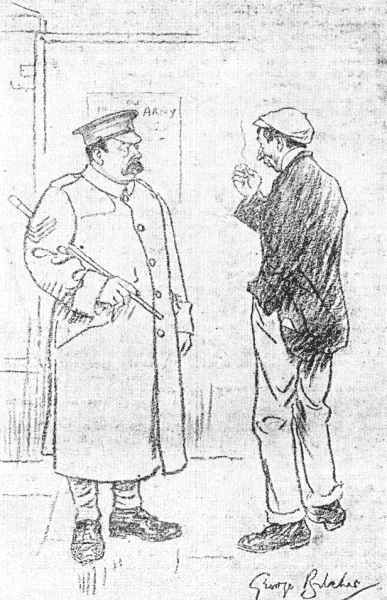
Recruiting Sergeant. "WHAT ARE YOU FOR?"
Recruit. "FOR THE DURATION OF THE WAR, OR LONGER IF IT DOESN'T END SOONER."
"You can't wear it. People would come and ask you who it was and you couldn't tell them. You'd have to keep it locked up, and what's the good of that?"
"I can't write again," said Celia. "Poor man! Think of the trouble he's had. Besides I've got you back now. It was really just to remind me of you."
"Yes, but I shall frequently be out to tea. You'd better have it done properly now."
Celia was thoughtful. She began composing in her mind that fourth letter ... and frowning.
"I know," she cried suddenly. "You write this time!"
It was my turn to be thoughtful....
"I don't see it. How do I come in? What is my locus standi? Locus standi," I explained in answer to her raised eyebrows, "an oath in common use among our Italian allies, meaning—What do I write as?"
"As the owner of the face," said Celia in surprise.
"Yes, but I can't dilate on my own face."
"Why not?" said Celia, bubbling. "You know you'd love it."
I looked at the miniature and began to think of possible openings. One impossible one struck me at once.
"Anyway," I said, "I'll get him to close my mouth."
The stars represent something quite simple this time—my brain at work.
"Celia," I said, "I will write. And this time the miniature shall be criticised properly. To say, as you no doubt said, 'This is not like me,' I mean not like my husband—well, you know what I mean—just to condemn it is not enough. I shall do it differently. I shall take each feature separately and dwell upon it. But to do this modestly I must have a locus—I am sorry to have to borrow from our Italian allies again—a locus standi apart from that of owner of face. I must also be donor of miniature. Then I can comment impartially on the present which I am preparing for you."
"I thought you'd see that soon," smiled Celia.
A.A.M.
FASHIONS IN BOOK-WEAR.
["Rose of Glenconnel. A first book by Mrs. Patrick MacGill, telling of the adventures in the Yukon and elsewhere of Rosalie Moran. With coloured jacket. Price 5s. net."—Advt. in "Times Literary Supplement."
Extract from "Belle's Letters":—"Other smart books I noticed included Mrs. BARCLAY'S Sweet Seventy-one, looking radiantly young and lovely in a simple rose-pink frock embellished with rosebuds, and Mr. CHARLES GARVICE'S Marriage Bells, utterly charming in ivory satin trimmed with orange blossom. On another shelf I saw Mr. KIPLING'S The Horse Marines, looking well in a smartly-cut navy blue costume with white facings, and not far away was Mr. ARNOLD BENNETT'S Straphanger, in smoked terra-cotta, and the pocket edition of DICKENS in Mrs. Harris Tweed. Mr. Britling's new book, Mr. Wells Sees it Through the Press, was looking rather dowdy in a ready-made Norfolk jacket, but Mr. and Mrs. WILLIAMSON'S The Petrol Peeress was very chic in a delightfully-cut oil-silk wrap; and so was Sir GILBERT PARKER'S This Book for Sale, in a purple bolero. Academic sobriety characterised the gown worn by the POET LAUREATE'S The Sighs of Bridges, while Mr. A.C. BENSON'S Round My College Dado was conspicuous in a Magdalene blouse with pale-blue sash."
"This was followed by a banquet in which Bro. W.S. Williams took a prominent part."—Daily Chronicle (Kingston, Jamaica).
Still, was it quite kind to call attention to it?