Volume 152 — THE FOLLOW-UP METHOD.
Reading edition
When you respond to an advertisement offering a booklet or a sample free, you are pestered by the proprietor of the commodity advertised with numerous communications importuning your custom, until in sheer self-defence you make a purchase. Now I had occasion to answer an announcement advertising for the services of a person with attainments approximating to my own, decided that, in the event of my application attracting no response, I would adopt the methods indicated above. For the benefit of others I give below a record of my procedure and the result.
My first letter detailed my qualifications, which were very exceptional; explained that my intelligence and industry were far above the average; that I was morbidly conscientious, and willing to sacrifice all my own interests for the needs of the firm; that the reason for leaving my last position was solely a matter of circumstances over which I had no control, and that at an interview, which I craved, I would explain everything to everybody's satisfaction and prove my perfect eligibility for the post. And so forth.
I waited a fortnight. There was no reply. I therefore despatched a follow-up letter. I explained my regret at receiving no response to letter No. 1, and suggested that perhaps it had been inadvertently overlooked, or had gone astray in transit. Alternatively I hinted that perhaps the firm regarded the list of my qualifications as incredibly pretentious, and I assured them that it in no way exaggerated my good points. I had indeed become, if possible, even more conscientious and industrious since I had last written, and having recovered from a cold in the head from which I was then suffering I was actually in better physical condition than before. I reminded the firm that in granting me a preliminary interview they incurred no liability whatsoever.
Another two weeks went by, and still no answer. So I despatched Follow-up Letter No. 2.
This briefly referred to my two previous communications, and asked whether it was not clear to them that, by securing my services while I was in possession of all my faculties and the full vigour and strength of my being, there were advantages they could not possibly acquire with me in, say, another thirty years, when I should probably be suffering from rheumatism, chronic dyspepsia, deafness, dim sight, loss of memory and certainly from approaching old age. I concluded by offering them three days' free trial (I always do best in the first three days); if I failed to give satisfaction by the end of that period they could return me without incurring any obligation whatsoever.
Again two weeks passed away, and there was still no answer. So I sent Follow-up Letter No. 3.
In this I announced a Special Offer, viz., a reduction of twenty pounds sterling (£20) on the salary originally asked if the firm engaged me within ten days from the date of the offer.
I gave them twelve days in which to respond, but still received no answer, so, after allowing a further two days' grace, I despatched Follow-up Letter No. 4, stating that as they had evidently been prevented from replying to my special offer I had decided to extend the period for acceptance by fourteen (14) days, reckoning from the date of the present communication. At the end of that period the salary demanded would be increased by ten pounds (£10) over and above that asked in my first application. Thus, by accepting the existing offer of twenty pounds (£20) reduction, they would really be securing me at thirty pounds (£30) less than my market price.
I waited patiently for a further fourteen days, and then sent Follow-up Letter No. 5.
This letter was quite brief. It made no attempt to disguise the fact that I was hurt at the firm's silence, and it hinted at enquiries from other employers of labour whose needs would have to be considered. It intimated also that I could not possibly hold myself at the firm's disposal indefinitely, and that unless a prompt reply was received I could not guarantee acceptance. By way of a crushing suggestion of niggardliness on their part I enclosed a stamped addressed envelope.
An answer came by return of post as follows:—
DEAR SIR,—In reply to your letter, we beg to say that the vacancy to which you refer was filled some ten (10) weeks ago.
Yours faithfully, etc.
Now I know where I am. Without this persistence, which is the essence of the following-up business, I should simply be where I am without knowing it.
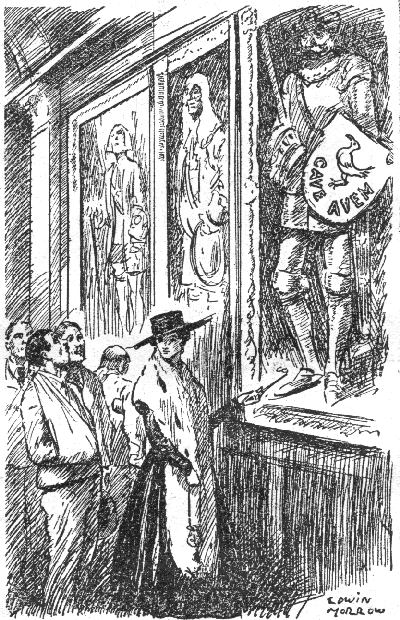
Lady Cynthia (showing wounded Tommies the ancestral portraits). "AND THIS IS THE FIRST EARL IN FULL FIGHTING KIT."
Tommy. "HE'S GOT HIS IDENTIFICATION DISC ALL RIGHT, MA'AM."
Bacchus at the Front.
Extract from a speech by the KAISER as reported by The Sun (Vancouver, B.C.):—
"The campaign ... had been conducted according to the brilliant plans of Field-Marshal von Hindenburg.... The old god of bottles directed. We were his instruments and we are proud of it."
"Among some of the best-informed bankers in the City the view taken in this respect is one which it may be well for the public at large to have repeated for their own guidance. The new War Loan, they say, will either be the last before the Allies impose on the enemy their own terms of peace, or it will not."—The Times.
We had already formed the same opinion, but we are glad to have it confirmed on such high authority.
"Barrow magistrates decided that Ideas must not be sold after the closing hour."—Daily Sketch.
Unfortunately this will not prevent the bore from continuing to give you his gratis.
Demand—
"Elderly English Girl wanted as companion to young lady for afternoon."—Egyptian Gazette.
and supply—
"The age limit for Girl Guides was formerly 18 years, but it has now been raised to 81 years by general request."—British Paper.
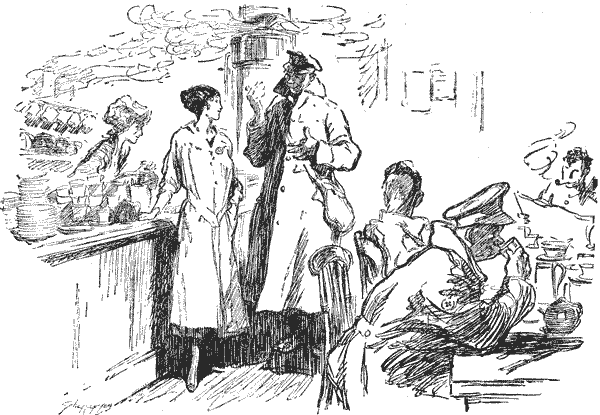
Tommy. "SOMETHIN' TO DHRINK, IF YE PLAZE, MISS."
Helper. "CERTAINLY. WILL YOU HAVE TEA OR COFFEE?"
Tommy. "NEITHER, THANK-YE." Helper. "COCOA, THEN, OR BOVRIL?"
Tommy. "NO, NO. NONE OF THEM FOR ME, MISS."
Helper (with asperity). "WELL, WE'VE NOTHING ELSE EXCEPT WATER."
Tommy (earnestly). "AN' I DAREN'T TOUCH THAT. D'YE SEE, MISS, WHEN ME FATHER LAY DYIN'—GOD REST HIS SOWL!—HE SEZ TO ME, 'I'VE GIVEN YE AN IRON CONSTITUTION, ANNYWAY, AN' LET YE SEE TO IT THAT YE NIVER TAKE ANNYTHING THAT 'UD RUST IT ON YE.'"
THE QUEST OF KNOWLEDGE.
MR. BLAIR, the L.C.C. Education Officer, is dissatisfied, according to The Daily Chronicle, with the questions put at school examinations, on the ground that they do not test the thoughtfulness and ingenuity of the pupil. The "Why" as well as the "What" should be developed, and to illustrate the value of the method proposed Mr. BLAIR suggests various sample questions, e.g.:—
"How do you account for the density of the population in Staffordshire?
"Find out from your atlas the distance from London to Glasgow. How long would it take you to go there by train? What would the third-class fare be at a penny a mile?
"How can we discover the minimum conditions necessary for the germination of a bean?
"ARISTOTLE remarked that a bee will visit one type of flower only during one journey from the hive. Find out if this is true, and, if true, point out its significance from the point of view of the flower."
As Mr. BLAIR remarks, a quest is better than a question. We agree, and venture to start a few more quests:—
"Find out from Who's Who the literary productions of Miss MARIE CORELLI and Mr. HALL CAINE, and trace their effect on the density of the population of Warwickshire and the Isle of Man respectively.
"ARISTOTLE remarked that one swallow does not make a summer. Find out whether this is true, and, if true, explain its bearing on the thirst of the swallower.
"Find out on your map the distance from Madrid to Jaffa, and state what would be the cost of a cargo of Spanish onions and Jerusalem artichokes delivered in the London Docks.
"What is the minimum time necessary for the incubation of a Scarlet Pimpernel?
What are the statutory dimensions of a gigantic gooseberry? Have you ever seen one, and if not why not?"
Our Youthful Heroes.
"C.Q.M.S.E.A. ——, brother of Mr. W.M. ——, Falmouth, spent his third birthday in the trenches on the 8th inst."—Royal Cornwall Gazette.
"One or two of the Councillors are on war service, and their places will be kept warm for them.... Councillors —— and J.R. —— have not once been able to sit since they donned khaki."—Southern Times.
We infer that the Councillors in question are training for the cavalry.
"The British fleet bombarded Skarvika and Semuntoltos, south of Orfano. Marshall's 7, Martyn's 2. Wakefield (3), Stone (2), Cripps, and Turbyfield scored for the winners."—Gloucestershire Echo.
We like this idea of recording the names of the successful marksmen at once, without waiting for the formal despatches.