Volume 152 — LETTERS FROM MACEDONIA.
Reading edition
II.
MY DEAR JERRY,—No doubt you think from the light-hearted tone of my last letter that life here is a bed of roses. In reality we have our flies in the ointment—nay, our shirt-buttons in the soup. The chief of the flies is artillery, both our own and that of the people opposite; and the worst of the shirt-buttons is jam. It sounds strange, but it is true.
There was a time in the olden days when we welcomed gunner-officers, but those days are unhappily past since we met Major Jones. Learn then the perfidy of the Major and ex uno disce, omnes.
I had a nice little 'ouse up in the front line, well hidden by trees. It wasn't a house, Jerry, I wish you to understand; it was merely a little 'ouse standing in its own grounds like, with a brace or so of chickens and a few mangel-wurzels a-climbin' round the place. You know what it's like.
Well, Major Jones, who had been my guest several times in this little 'ouse of mine, came round a few days ago with a worried look and an orderly.
"I want you to come and look at my telephone," he said hurriedly.
"What is it? Is anything wrong?" I asked sympathetically.
"I fear the worst. Something terrible may happen in five minutes," he replied darkly.
I gripped his hand silently, and he returned the pressure with emotion. In silence we walked the two hundred yards which lay between my place and his observation post, and I watched while his orderly got busy with the telephone.
"Is Number One gun ready?" demanded the Major.
It appeared that Number One was itching to be at it.
"Fire!" said the Major.
"Fire!" said the orderly.
A moment later there was a terrific explosion.
"Number One fired, Sir," observed the orderly.
"It is well you told us," I said sweetly, "otherwise I could never have believed it."
But the Major heeded me not. He was staring over my shoulder.
"Good shot, by Jove!" he yelled. "A perfect beauty! Holed out in one!"
I turned to see what had caused his sudden joy. But where was my little 'ouse? Had it suddenly turned into that nasty cloud of dust? Even as I looked my water-bucket reached the ground again.
"Awfully sorry, old man," said the Major, with a ghastly, pretence of sympathy. "You see it was in our way."
I brushed aside his proffered hand (rather good that, Jerry. Let's have it again. I say I brushed aside his proffered hand), and strode back dismally to what had once been my home from home.
Now I live in a little dug-out beneath the ground, chickenless and mangel-wurzelless, awaiting with resignation the day when the Sappers shall find that I am in their way and blow me up.
Another little game of the gunners is called "Artillery Duels."
In the good old days, when a man wanted a scrap with his neighbour, he put a double charge of powder into his blunderbuss, crammed in on top of it two horse-shoes, his latch-key, an old watch-chain, and a magnet, and then started on the trail. It was very effective, but of course some busy-body "improved" on it. Nowadays our gunners ring up the enemy's artillery.
"Hallo! Is that you, strafe you? What about an artillery duel, eh?"
"Oh, what fun!" says the enemy. "Do let's." And then they start.
"A hearty give-and-take, that's what I like," remarks a cheery gunner officer.
A moment later he rushes to the telephone.
"Is that you, enemy?" he asks. "I say, dash it all, old man, do be careful! That last one of yours was jolly near my favourite gun."
"By Jove, I'm awfully sorry, old thing," calls back the enemy. "What about shortening the fuses a bit, eh?"
"Good idea! Waken up the foot-sloggers too. They need it sometimes."
Then for fifteen minutes large shells rebound from the bowed head and shoulders of the unfortunate infantryman.
Which reminds me of George.
George had a strafe-proof waistcoat procured by him from a French manufacturer. He showed it to us proudly, and also the advertisement, which stated that the waistcoat would easily stop a rifle-bullet, whilst a "45" would simply bounce off it. It was beautiful but alarming to see his confidence as he stood up in a shower of shells, praying for a chance of showing off the virtues of his acquisition.
We were very pleased to send to his hospital address to-day a postcard bearing the maker's explanation that a .45 revolver bullet, and not a 45 millimetre shell, was meant.
As regards the jam question, Jerry, the fault of the jam is that it is never jam, but always marmalade. I feel too sore on the question to write much, but I may just hint that we have heard that Brother Bulgar sometimes gets real strawberry. It is just possible, therefore, that you may hear of a raid soon.
Yours ever, PETER.
THE CONVERT.
["One striking result of the War has been its humanising effect on woman."—Daily Paper.]
The barbed shaft of Love hath pierced thy heart, Fair Annabelle; distracting is thy lot; Long hast thou thought thyself a deal too smart To be ensnared in Cupid's toils—eh, what? The ways of other maids, less intricate, Filled thee with pity to the very core; Kisses were unhygienic, out of date, And man a most unutterable bore. But now with young Lieutenant Smith, V.C., Thou roamest, gazing shyly in his face; Nay, did I not surprise thee after tea Defying Hygiene in a close embrace? Shall I recall that old sartorial jest, The mannish coat which never seemed to fit, The bifurcated skirt and all the rest, Not half so pretty as thy nursing kit? All no! Thine happiness I will not vex, For thou art Woman once again I find; And Woman, though she cannot change her sex, Has always had the right to change her mind.
The Primrose Path for Flappers.
"WANTED, Two experi. MAKERS-UP (Females); also a few Girls to learn; good wages paid."—Evening Paper.
Another Impending Apology.
From an obituary notice:—
"In civil life he was employed as an attendant on those inflicted with weak minds. He joined the regiment at —— Camp and was at once employed as Colonel ——'s servant."—Burma Paper.
"Mars is the name of a star so far off it would take a million years to walk there in an express train."
"A miracle is anything that someone does that can't be done."
"People who have always used tooth-brushes and who know the thing to do never use any but their own."
"The Pagans were a contented race until the Christians came among them."—Hawaii Educational Review.
If The Review can maintain this form the consciously comic journals of the American Empire will have to look to their laurels.
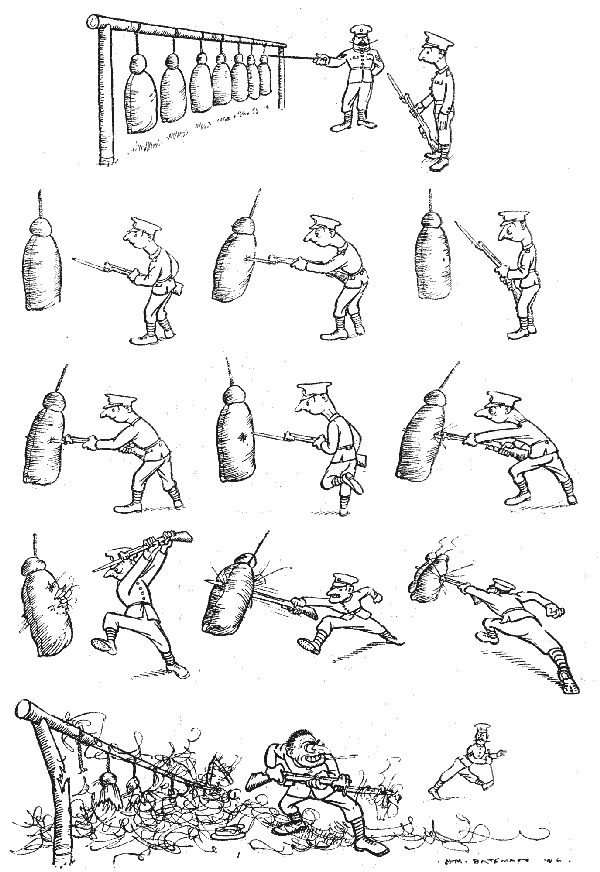
THE RECRUIT WHO TOOK TO IT KINDLY.
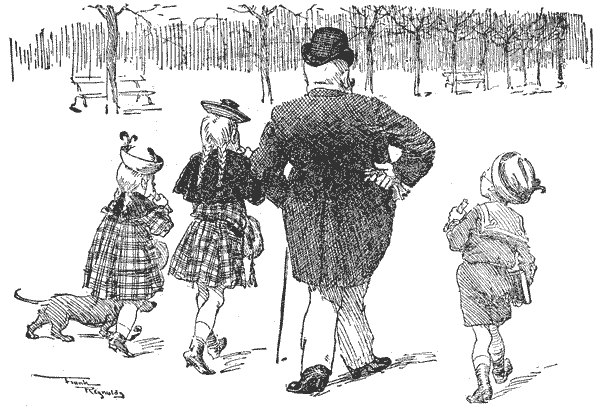
Super-Boy. "BUT, FATHER, IF WE HAVE ALREADY CONQUERED, WHY DOES THE WAR GO ON?"
Super-Man. "BE SILENT AND EAT YOUR HINDENBERG ROCK."
WAR'S SURPRISES.
THE TRANSFORMATION OF "TAY PAY."
[The Daily Chronicle alludes to a recent article by Mr. T.P. O'CONNOR, M.P., as "a frigid survey of the situation."]
The War has done many astonishing things; It has doubled the traffic in trinkets and rings; It has reconciled us to margarine And made many fat men healthily lean. It has answered the critics of Public Schools And proved the redemption of family fools. It has turned golf links to potato patches And made us less lavish in using matches. It has latterly paralysed the jaw Of the hitherto insuppressible SHAW. It has made old Tories acclaim LLOYD GEORGE, Whose very name once stuck in their gorge. It has turned a number of novelists Into amateur armchair strategists. It has raised the lowly and humbled the wise And forced us in dozens of ways to revise The hasty opinions we formed of our neighbours In view of their lives and deaths and labours. It has cured many freaks of their futile hobbies, It has made us acquainted with female bobbies. It has very largely emptied the ranks Of the valetudinarian cranks, By turning their minds to larger questions Than their own insides or their poor digestions. It has changed a First Lord into a Colonel, Then into a scribe on a Sunday-journal, With the possible hope, when scribbling palls, Of doing his hit at the Music Halls. It has proved the means of BIRRELL'S confounding And given Lord WIMBORNE a chance of re-bounding. But—quite the most wonderful thing of all The things that astonish, amaze or appal— As though a jelly turned suddenly rigid, It has made "TAY PAY" grow suddenly frigid! When rivers flow backwards to their founts And tailors refuse to send in accounts; When some benevolent millionaire Makes me his sole and untrammelled heir; When President WILSON finds no more Obscurity in "the roots of the War"; When Mr. PONSONBY stops belittling His country and WELLS abandons Britling: When the Ethiopian changes his hue To a vivid pink or a Reckitty blue— In fine, when the Earth has lost its solidity, Then I shall believe in "TAY PAY'S" frigidity.
Duration of the War.
"If the bid does not come early in 19717 the evidences of Germany's clamorous needs are strangely false."—Evening Paper.
Are we downhearted? No!
Extract from Army Orders in the Field:—
"When Sections 3 and 4 have opened rapid fire, and the bullets have had time to reach the enemy, but not before, Sections 1 and 2 move up into line with No. 3 and 4."
Aren't the Staff wonderful? They think of everything.
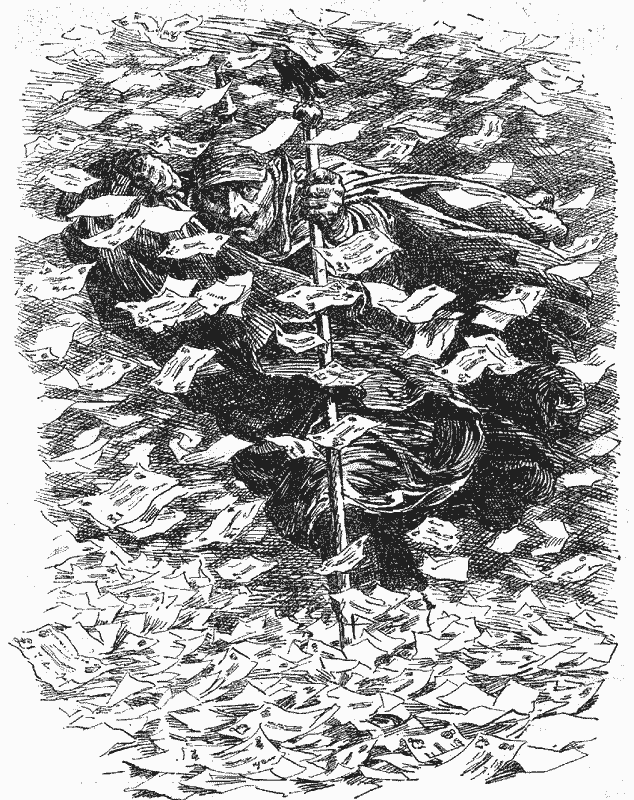
SNOWING HIM UNDER.
A FORECAST OF THE NEW BRITISH WAR LOAN.
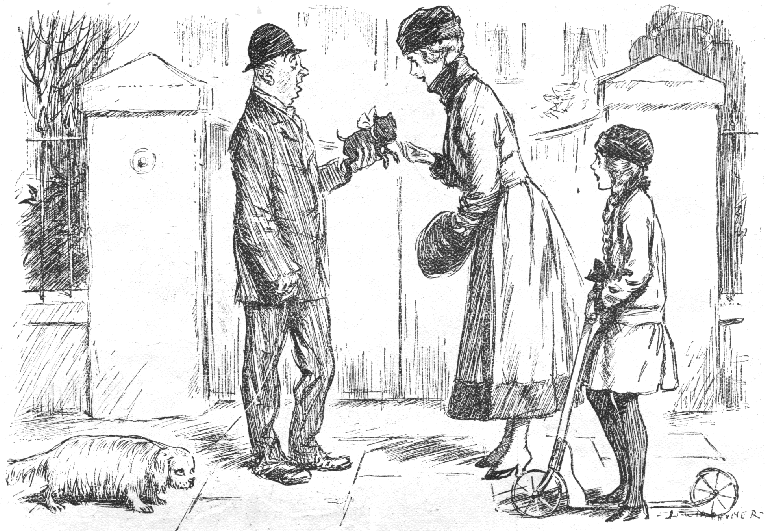
Possible Purchaser. "WHAT SORT OF DOG IS HE?"
Dog-Fancier. "'IM, LIDY? 'E'S A LITTLE PEDIGREE DAWG, 'E IS. AN' THIS IS 'IS MOTHER ON THE LEAD—QUITE ANOTHER TYPE O' DAWG, BUT ALSO A PEDIGREE."