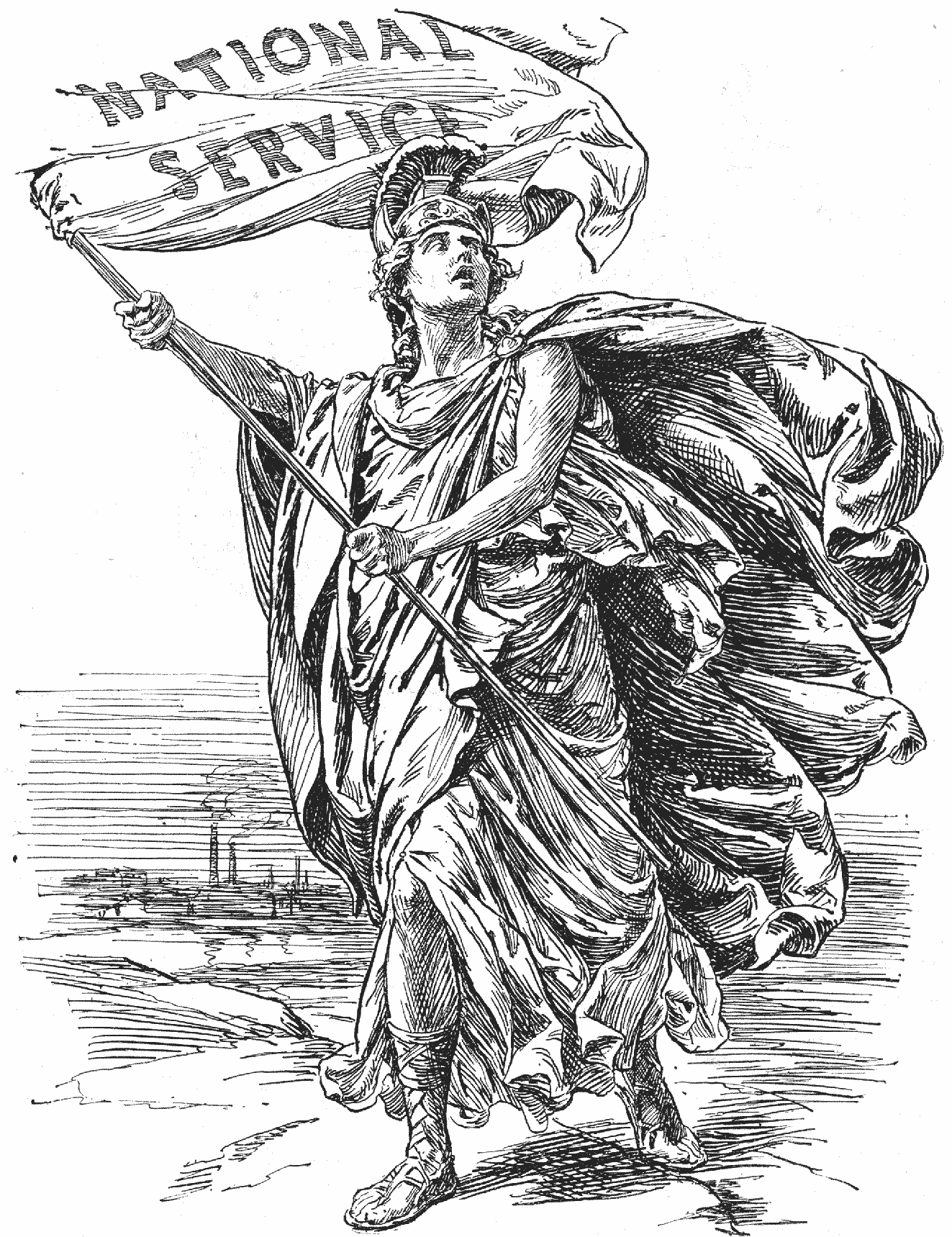
Volume 152 — THE RETORT CELESTIAL.
Reading edition
[China has threatened to break off relations with the German Government on account of its barbarity. It will be recalled that the KAISER once designed an allegorical picture entitled "The Yellow Peril."]
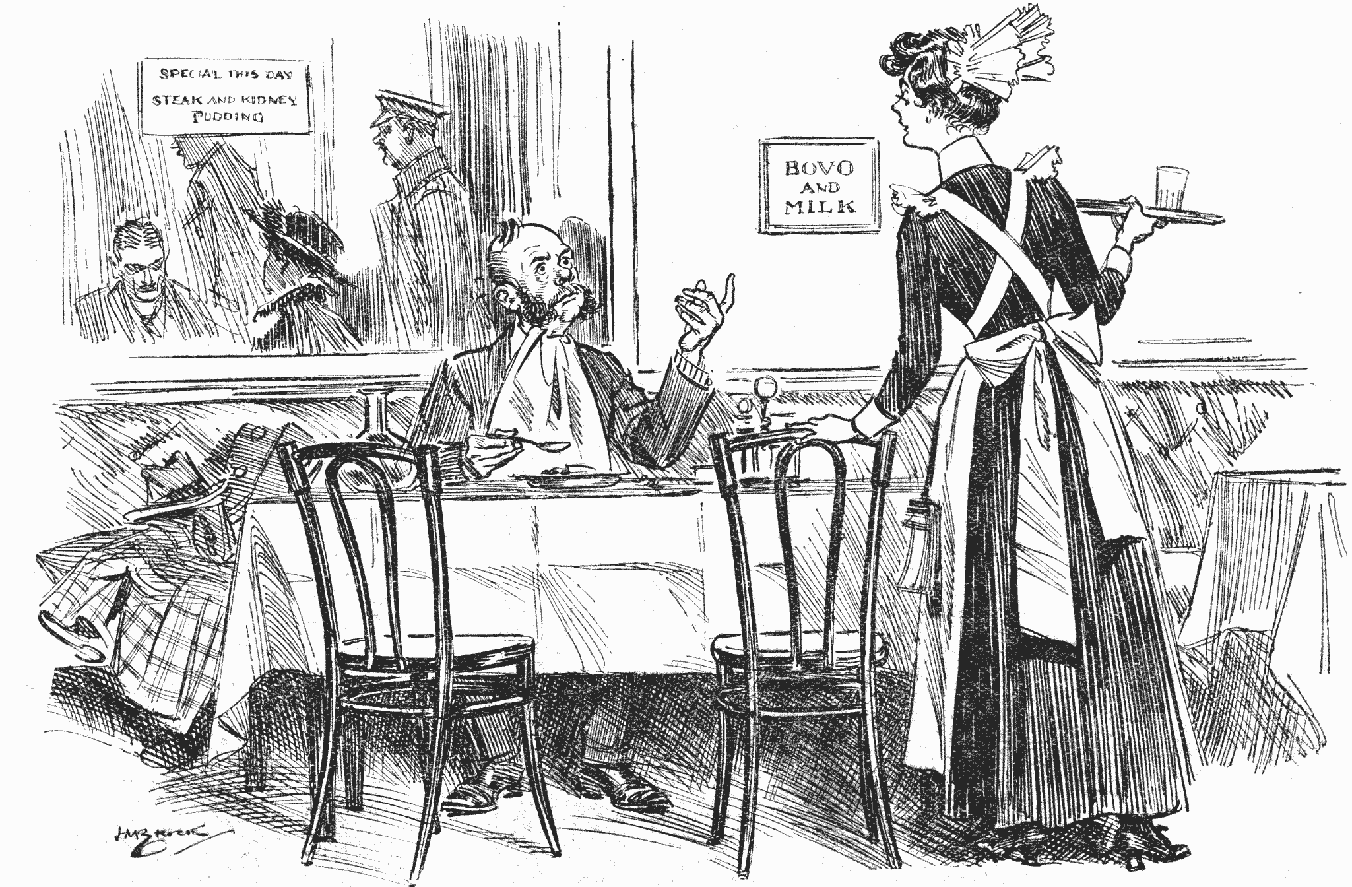
SAUCE FOR THE GANDER.
Grocer. "A LITTLE SUGAR WITH MY TART, PLEASE."
Waitress (late grocer's assistant). "CERTAINLY, SIR, IF YOU WILL ALSO TAKE MUSTARD, PEPPER, SALT, YORKSHIRE RELISH AND SALAD DRESSING."
WEATHER-VANES.
It was 2 A.M. The mosquitoes were singing their nightly chorus, and the situation reports were coming in from the battalions in the line. With his hair sizzling in the flame of the candle, the Brigade Orderly Officer who was on duty for the night tried to decipher the feathery scrawl on the pink form.
"Situation normal A-A-A wind moderate N.E.," it read.
"Great Scott!" said the O.O. "North-East!" (Hun gas waits upon a wind with East in it). "Give me the message book."
Laboriously he wrote out warnings to the battalions and machine gun sections, etc., under the Brigade's control. Then he turned to the next message.
"Situation normal A-A-A wind light S.W."
"South-West?" said the O.O. blankly, viewing his now useless handiwork. "Which way is the wind then?"
The orderly went out to see, and returned presently with a moistened forefinger and the information that it was "blowing acrossways, leastways it seemed like it." The O.O. got out of his little wire bed, searched in his pyjamas for the North Star, and, finally deciding that if there was any wind at all (which was doubtful) it was due South, reported it as such. The responsibility incurred kept him awake for some time, but when the Brigade on the right flank reported a totally different wind he concluded there must be a whirlwind in the line, and, putting up a barrage of bad language, went to sleep.
In due course the matter came to the ears of the Staff Captain, who broached the subject at breakfast as the General was probing his second poached egg.
"This," said the General, who is rather given to the vernacular, "is the limit. A North-South-East-West report is preposterous. Something must be done. Haven't we got a weather-vane of our own? Pass the marmalade, will you?"
Four people reached hastily for the delicacy, and the O.O. feeling out of it passed the milk for no reason. (Generals really get a very good time. People have been known to pass things to them unasked.)
"What about those two vanes in our last headquarters, Sir?" said the Staff Captain brightly—he is very bright and bird-like in the mornings—"the ones the padre thought were Russian fire-guards. Can't we get them? They aren't ours, but then they aren't anybody's—they've been there a year, the old woman told me."
"Where's the Orderly Officer?" (He was there with a mouthful of toast.) "Take the mess limber and fetch 'em back if the Heavy Group Artillery will let you—they're in there now, aren't they?"
"And if you're g-going into the town g-get some fish for dinner," said the Brigade Major; "everlasting ration beef makes my s-stammer worse."
"Why?" said the General.
"Indigestion—nerves, Sir; I can hardly talk over the telephone at all after dinner."
"Good heavens!" said the General; "bring a turbot."
"Fish!" said the B.M. at dinner. "Bong!"
"I brought the vanes, Sir."
"Have any trouble?"
"No, Sir. I saw the A.D.C., and said we had 'left them behind,' which was true, you know, Sir." (The O.O. for once felt himself the centre of interest and desired to improve the occasion). "We did 'leave them behind,' so it wasn't a lie exactly ..."
"I don't care if it was," said the General; "you've got 'em, that's the main thing."
"Where will you have one put, Sir?"
"In the fields," said the B.M.
"Not too low," said the Captain.
"Or too high," said Signals.
"Or too far away," said the attached officer.
"Well, now you know," said the General, "pass the chutney."
They all passed it as well as several other things until he was thoroughly dug-in.
"Another N.S.E.W. report, Sir," said the Staff Captain next morning.
"——!" said the General. (I think I mentioned his partiality for the vernacular). "Where's our vane?"
"It's up, Sir," said the O.O., shining proudly again, "and I—"
"We'll have' a look at it," and out they all went—General, Brigade Major (enunciating pedantically after a fish breakfast), Staff Captain (bright and birdlike), and the O.O. It was a brilliant spectacle.
"North is—there!" said the General in his best field-day manner, "and this is pointing—due East!" He touched the vane gently. It did not budge. He touched it again. A cold sweat broke out on the forehead of the O.O.
"Paralysed," said the B.M.
"Give it a 'stand-east,' Sir," said the Staff Captain.
"It's stiff!" said the General; "wants-oil" (pause); "wants oil!" and the O.O. slid away, returning at once with oil (salad, bottle, one).
"Now pour it over the top—top, boy, top!"
A flood sprayed over the top flange, and the B.M. searched hastily for a handkerchief.
"Making a salad of you?" said the General. "Ha! ha!"
The B.M. smiled a smile (sickly, one).
"That's better!" The General spun it round. "What's it say now? East!"
"Better wait," said the B.M., "it'll change its mind in a minute."
"It's going!" cried the General excitedly. "There! Well, I'm—West!"
"The padre was right—it must be a fireguard, after all," said the Staff Captain.
"Or a s-sundial," muttered the B.M.
I believe the meteorological report was finally entered as: "Wind light to moderate (to strong), varying from East to West (via North and South)."
"Of course," said the General kindly to the O.O., "it's not quite perpendicular, it's a bit too low; wants a stronger prop, wires are a bit slack, the vane itself wants looking to, and the whole thing is in rather a bad position, but otherwise it's all right—quite all right."
"Yes, Sir," said the O.O.
"And there's too much oil," added the General, as he moved off.
"There is," said the B.M., discovering another blob on his shiny boots, "and on m-me!"
The Staff were unaccountably late. The O.O. breakfasted alone. For three days he had been the despair of the small and perspiring body of pioneers, who towards the end had fled at the mere sight of him. But at last the vane was working.
"Well," said the General when he came in, "how's the wind, expert?"
"N.N.E.," said the O.O. proudly. (It was the first thing he had done since he came on the Brigade three weeks before, and he was pleased at the interest the Staff had taken in his little achievement.) "I've had the pioneers working on it, and we've got it up another four feet, Sir, tightened the pole, and wired it on to the supports on every side. It's quite perpendicular now. I've marked out the points of the compass on it, and fixed up a little arrangement for gauging the strength of the wind—that flap thing, you know, Sir—"
"Yes, yes," said the General, who seemed to have lost his first keenness, "I'm glad it's working all right. By the way, we shall be moving from here to-morrow; the division's going back."
The O.O. drained the teapot in silence, and was glad it was strong and bitter.
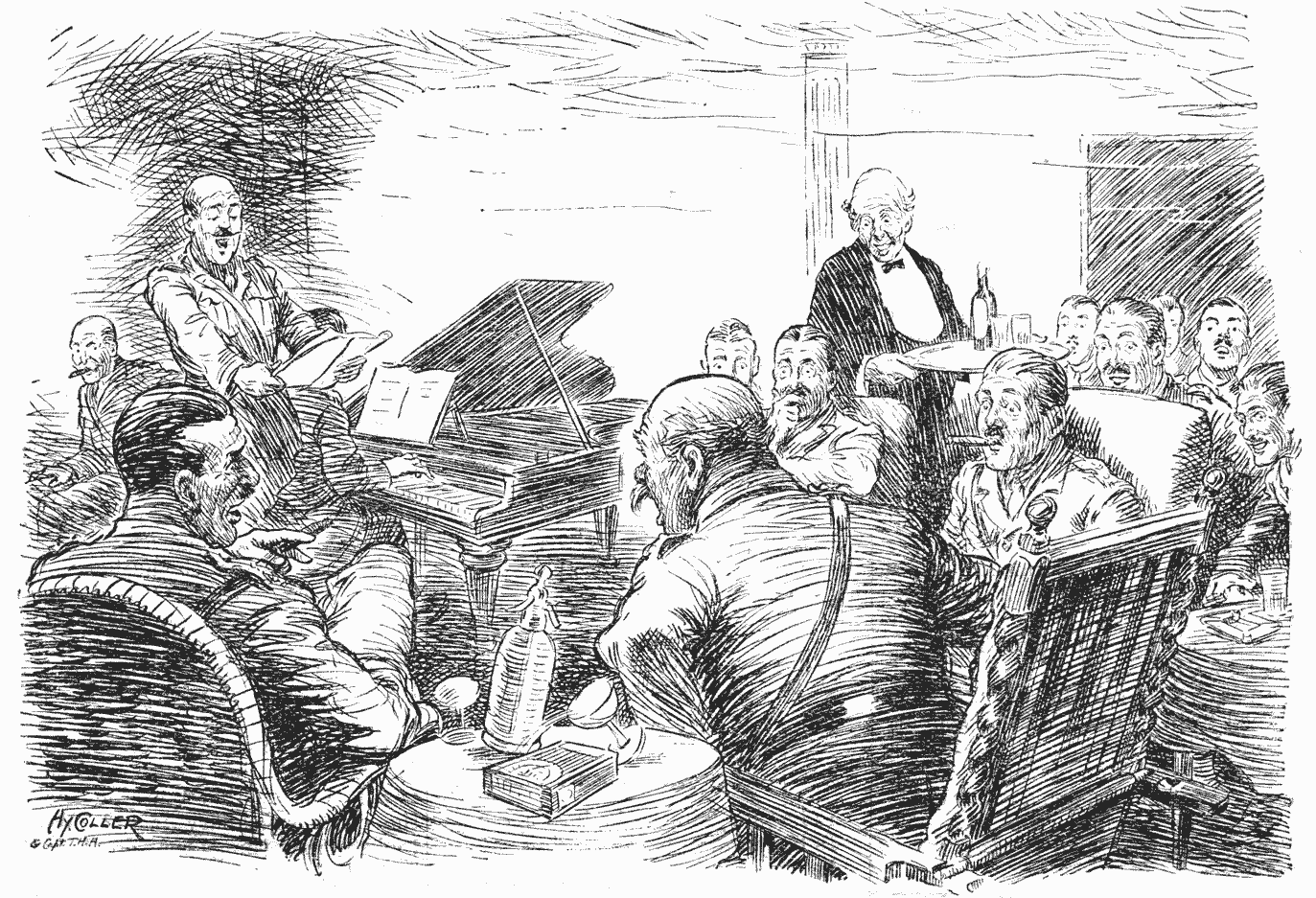
AT OUR COMPANY SMOKER.
The Major (sings). "AND WE DIDN'T CARE A BUTTON IF THE ODDS WERE ON THE FOE TEN—TWENTY—THIRTY—FORTY—"
Colonel (roused from surreptitious snooze). "AS YOU WERE!—NUMBER!"
Result of the Blockade.
Notice on a railway bookstall:—
"MEN AROUND THE KAISER. MUCH REDUCED."
"On the pier a man was arrested who declared excitedly that he was Frederick Hohenzollern, the Kaiser's nephew, but he appeared quite harmless."—Daily News.
Obviously an impostor.
"The khaki-clad boys were as merry as a party of undergraduates celebrating some joyous event at the college tuck-shop."—Yorkshire Herald.
What memories of the Junior Common Room are recalled by this artless phrase.
The Super-Submarine.
"The Lyman M. Law was stopped by a gunshot fired by a submarine, which boarded the American boat, took the names of all on board, and then authorised the continuation of the voyage."—Evening News.
Experiences of Mr. GERARD'S party:—
"Our first surprise on reaching Paris was to find taxi-cabs, and taxi-cubs with pneumatic tyres."—Scots Paper.
We suggest that our M.F.H.'s should import a few of these in time for next season's cubbing. They give an excellent run for the money—a mile for eightpence or so.
THE MISSING LEADER.
What is Master WINSTON doing? What new paths is he pursuing? What strange broth can he be brewing? Is he painting, by commission, Portraits of the Coalition For the R.A. exhibition? Is he Jacky-obin or anti? Is he likely to "go Fanti," Or becoming shrewd and canty? Is he in disguise at Kovel, Living in a moujik's hovel, Making a tremendous novel? Does he run a photo-play show? Or in sæva indignatio Is he writing for HORATIO? Fired by the divine afflatus Does he weekly lacerate us, Like a Juvenal renatus? As the great financial purist, Will he smite the sinecurist Or emerge as a Futurist? Is he regularly sending HAIG and BEATTY screeds unending, Good advice with censure blending? Is he ploughing, is he hoeing? Is he planting beet, or going In for early 'tato-growing? Is he writing verse or prosing, Or intent upon disclosing Gifts for musical composing? Is he lecturing to flappers? Is he tunnelling with sappers? Has he joined the U-boat trappers? Or, to petrify recorders Of events within our borders, Has he taken Holy Orders? Is he well or ill or middling? Is he fighting, is he fiddling?— He can't only be thumb-twiddling. These are merely dim surmises, But experience advises Us to look for weird surprises, Somersaults, and strange disguises.
Thus we summed the situation When Sir HEDWORTH MEUX' oration Brought about a transformation. Lo! the Blenheim Boanerges On a sudden re-emerges And, to calm the naval gurges, FISHER'S restoration urges.
A Work of Supererogation.
"At an interval in the evening some carols were sung by members of our G.F.S., and a collection was taken on behalf of a fund for providing Huns for our soldiers."—Parish Magazine.
INFORMATION WANTED.
No one can answer the question, and I have not the pluck—being a law-abiding citizen—to try for myself. But I do so want to know. I ask everyone. I ask my partners at dinner (when any dinner comes my way). I ask casual acquaintances. I would ask the officials themselves, only they are so preoccupied. But the words certainly set up a very engrossing problem, and upon this problem many minor problems depend, clustering round it like chickens round the maternal hen. But I should be quite content with an answer only to the hen; the rest could wait. Yet there is an inter-dependence between them that cannot be overlooked. For example, did someone once do it and meet with such a calamity that everyone else had to be warned? Or is it merely that the authorities dislike us to be comfy? Or is it thought that the public might get so much attracted by the habit as to convert the place into a house where a dance is in progress? I wish I knew these things.
Will not some Member ask for information in the House, and then—arising out of this question—get all the other subsidiary facts? We are told so many things that don't matter, such as the enormous number of Ministers in the new Government, which was formed, if I remember rightly, as a protest against too large a Cabinet; such as the colossal genius of each and every performer in Mr. COCHRANE'S theatrical companies; such as the best place in Oxford Street to contract the shopping habit; such as the breaks made day by day all through the War by billiard champions; such as the departure of Mr. G.B. SHAW on his bewildering and, one would think, totally unnecessary visit to the Front and his return from that experience; such as—but enough. I am told by the informative Press all these and more things, but no one tells me the one thing I want to know.
Perhaps YOU can.
I want to know why we may not sit on the Tube moving staircases, and I want to know what would happen if we did.
What to do with Our Dogs.
"FOR SALE.—Pure Bred Irish Terrier Dog, right thing to wear now. Seamless, comfortable. All Wool."—Bedford Daily Circular.
"Bread embroideries encircle the figure."—Glasgow Citizen.
An appropriate adornment for the bread basket, no doubt, but too extravagant in these times.
BUNNY'S LITTLE BIT.
This scheme of keeping rabbits To fatten them as food Breaks up the kindly habits Acquired in babyhood; For we, as youthful scions, Were taught to love the dears And bring them dandelions And lift them by the ears. We learned how each new litter That came to Flip or Fan Grew finer and grew fitter With tea-leaves in the bran; We learned which stalks were milky And which were merely tough, What grass was good for Silky And what was good for Fluff. Such moral mild up-bringing Now makes me much distressed When little necks need wringing And little paws protest, Lest wraiths from empty hutches Should haunt me, hung in pairs, And ghosts—'tis here it touches— Of happy Belgian hares. However, with my morals I manfully shall cope, And back my country's quarrels, But none the less I hope Before poor Bunny's taken As stuff for knife and fork The hedge-hog will be bacon, The guinea-pig be pork.
W.H.O.
PROBLEMS FOR PÉTROLEUSES.
The Metropolitan Commissioner of Police having decided to sanction women taxicab drivers, we understand that all applicants for licences will be required to pass a severe examination in "knowledge of London." As, however, this will be concerned mainly with localities and quickest routes, we venture to suggest to the examiners a few supplementary questions of a more general character:—
(I.) How far should a cab-wheel revolving at fifteen miles an hour, be able to fling a pint of London mud?
(II.) Has a pedestrian any right to cross a road? and, if so, how much?
(III.) With three toots of an ordinary motor-horn indicate the following:—(a) contempt, (b) rage, (c) homicidal mania.
(IV.) Under what circumstances, if any, should the words "Thank you" be employed?
(V.) Having been engaged at 11.35 P.M. to drive an elderly gentleman, wearing a fur-coat, to Golder's Green, you are tendered the legal fare plus twopence. Express, within ladylike limits, your appreciation of this generosity.
(VI.) On subsequently discovering the same gentleman to be a member of the Petrol Control Committee, revise your answer accordingly.
(VII.) Sketch, within ten sheets of MS., your idea of a becoming and serviceable uniform for a lady-driver.
(VIII.) Who said, and in what connection—
"The hand that stops the traffic rules the world"? "This flag shall not be lowered at the bidding of an alien"?
(IX.) At the top of St. James's Street you are hailed simultaneously by two spinster ladies with hand luggage, wishing to be driven to Euston, and by a single unencumbered gentleman whose destination is the Savoy Grill. Well?
(X.) At what hour do performances at the London theatres end, and which do you consider the best places of concealment in which to secrete yourself at that time?
(XI.) What would be your correct procedure on receiving a simple direction to "The Palace" from—
(a) The PRIME MINISTER? (b) The Bishop of LONDON? (c) Any Second-Lieutenant?
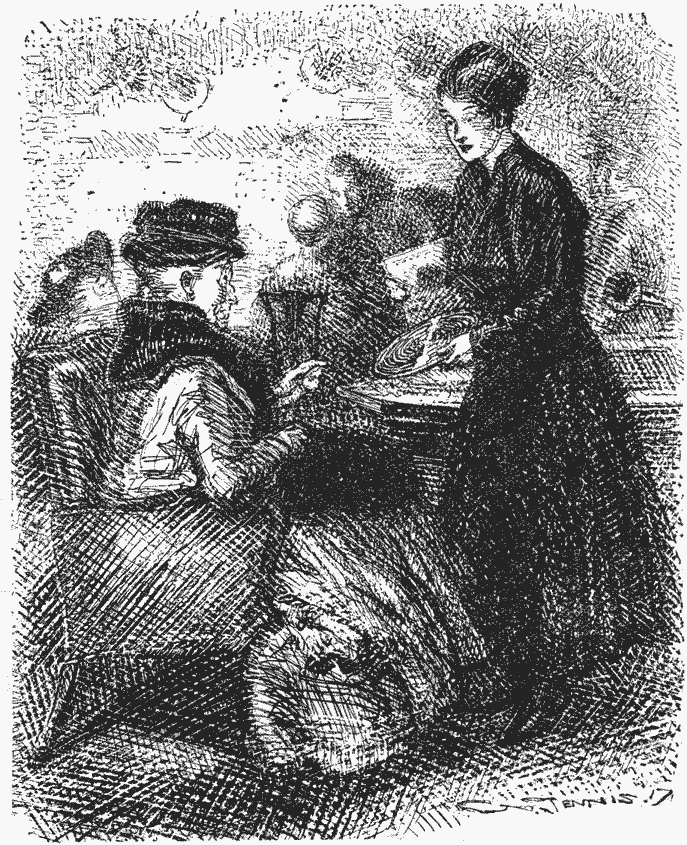
Old Lady (buying records to send to France—to assistant in Gramophone Department).
"IF THAT ONE IS THE SONG CALLED, 'THERE'S A SHIP THAT'S BOUND FOR BLIGHTY,' I'LL TAKE IT. BUT WILL YOU FIRST LET ME KNOW IF IT CONTAINS ANY INFORMATION WHICH COULD BE OF ADVANTAGE TO THE ENEMY?"
A Prophet of Evil.
"SIR EDWARD CARSON ON THE ADMIRALTY'S NEW FIGHTING POLICY.
'IT CAN AND WILL BE DEFEATED.'"—Headlines in "The Daily Chronicle."
From an official circular relating to the British Industries Fair:—
"Information regarding the best means of reaching the Fair from all parts of London will be obtainable at the Fair, but will not be available before the opening day."
You must get there first, if you want to be told how to get there.
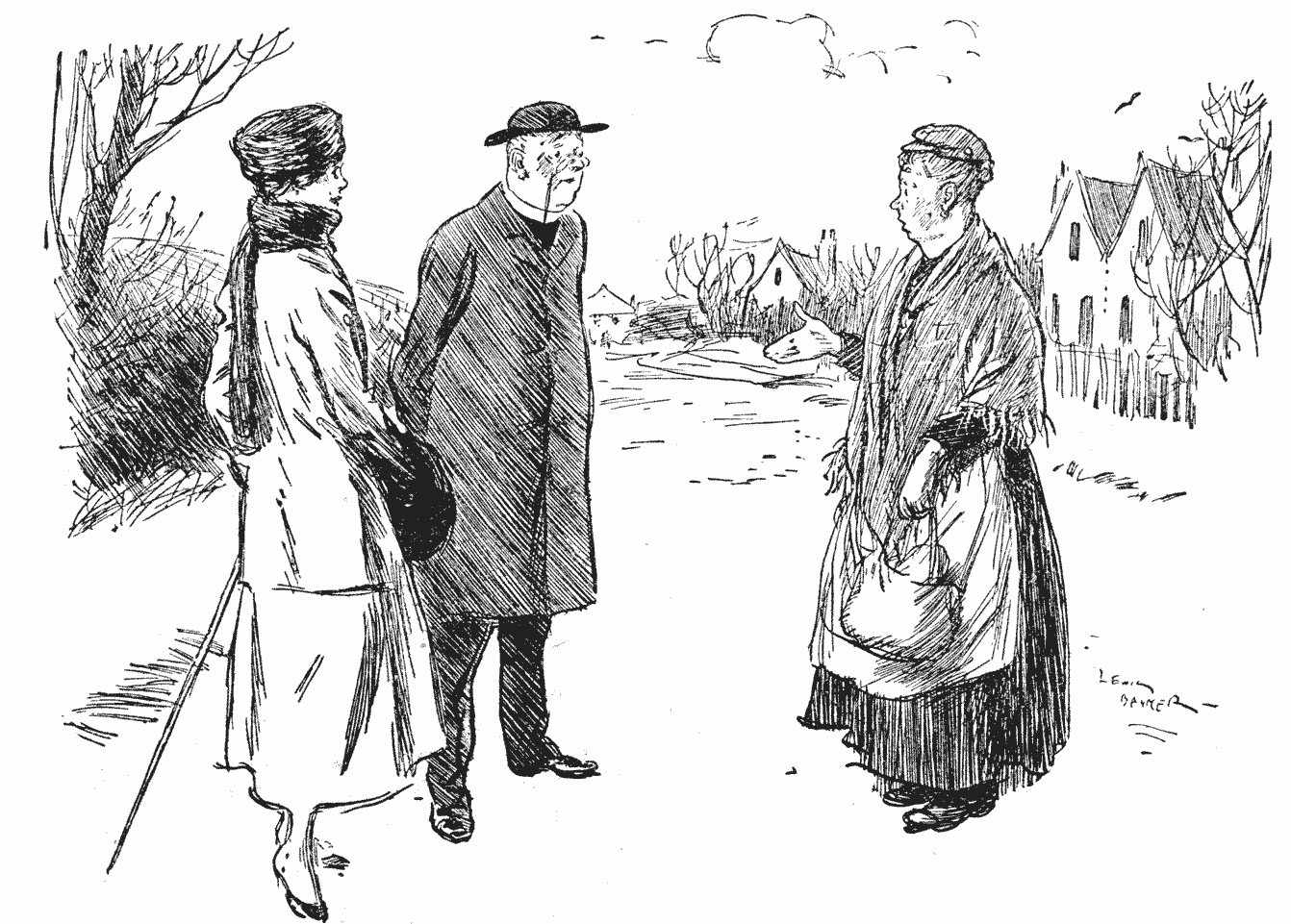
The Vicar (to Mrs. Bloggs, who has been describing the insulting behaviour of the lady next door). "WELL, WELL, IT MUST BE MOST UNPLEASANT BEING SHOUTED AT OVER THE WALL, BUT I SUPPOSE THE BEST THING IS TO TAKE NO NOTICE."
Mrs. Bloggs. "THAT'S WHAT I SHOULD LIKE TO DO, SIR. BUT O' COURSE I 'AS TO GIVE 'ER A ANSWER BACK NOW AND AGAIN—JUST TO KEEP THE PEACE, LIKE."
THE ACTING BOMBARDIER.
When JOOLIUS CÆSAR took 'is guns along the pavvy road An' strafed the bloomin' 'eathens on the Rhine, The men 'oo did 'is dirty work an' bore the 'eavy load Was the men 'ose job did correspond to mine. When NAP. dug in 'is swossung-kangs be'ind the ugly Fosse And made the Prooshians sweat their souls with fear, The men 'oo 'elped 'im most of all to slip it well across Was the men with actin' rank o' bombardier. Oh, the Colonel strafes the Old Man, an' 'e strafes the Capting too, Then to the subs the 'eavy language flows; They comes an' calls their Numbers One an inefficient crew An' down it comes to junior N.C.O.'s; An' then the B.S.M. chips in an' gives 'em 'oly 'ell, An' the full edition's poured into the ear Of the man that's got to be ubeek (an' you be—blest as well), The man with actin' rank o' bombardier. Or, if there's nothin' doin' of a winter afternoon, The Old Man's at 'eadquarters 'avin' tea, The section subs is feedin' up with oysters in Bethoon, The Capting's snorin' out at the O.P.; The Sergeant-Major's cleaned 'is teeth an' gone a prommynard, The N.C.O.s is somewhere drinkin' beer, An' the man they've left to work an' drill an' grouse an' mount the guard Is of course your 'umble actin' bombardier. Oh, I'm the man that takes fatigues for bringin' stores at night, Conductin' G.S. wagons in the snow, An' I'm the man that scrounges round to keep the 'ome fires bright ("An' don't you bloomin' well be pinched, you know"); An' I'm the man that lashes F.P.1.'s up to the gun, An' acts the nursemaid 'alf the ruddy day; An' fifty other little jobs that ain't exactly fun Accompany one stripe (without the pay). But no, we never grouses in the Roy'l Artillerie, Of cheerful things to think there's quite a lot; Old Sergeant Blobbs is goin' 'ome the end of Februree To do instructin' stunts at Aldershot; The S.M.'s recommended ('Eavens!) for commissioned rank, An' little changes means a step up 'ere, So if I keep me temper an' go easy with vang blank, I'll soon drop "actin'" off the "bombardier."