Volume 152 — ESSENCE OF PARLIAMENT.
Reading edition
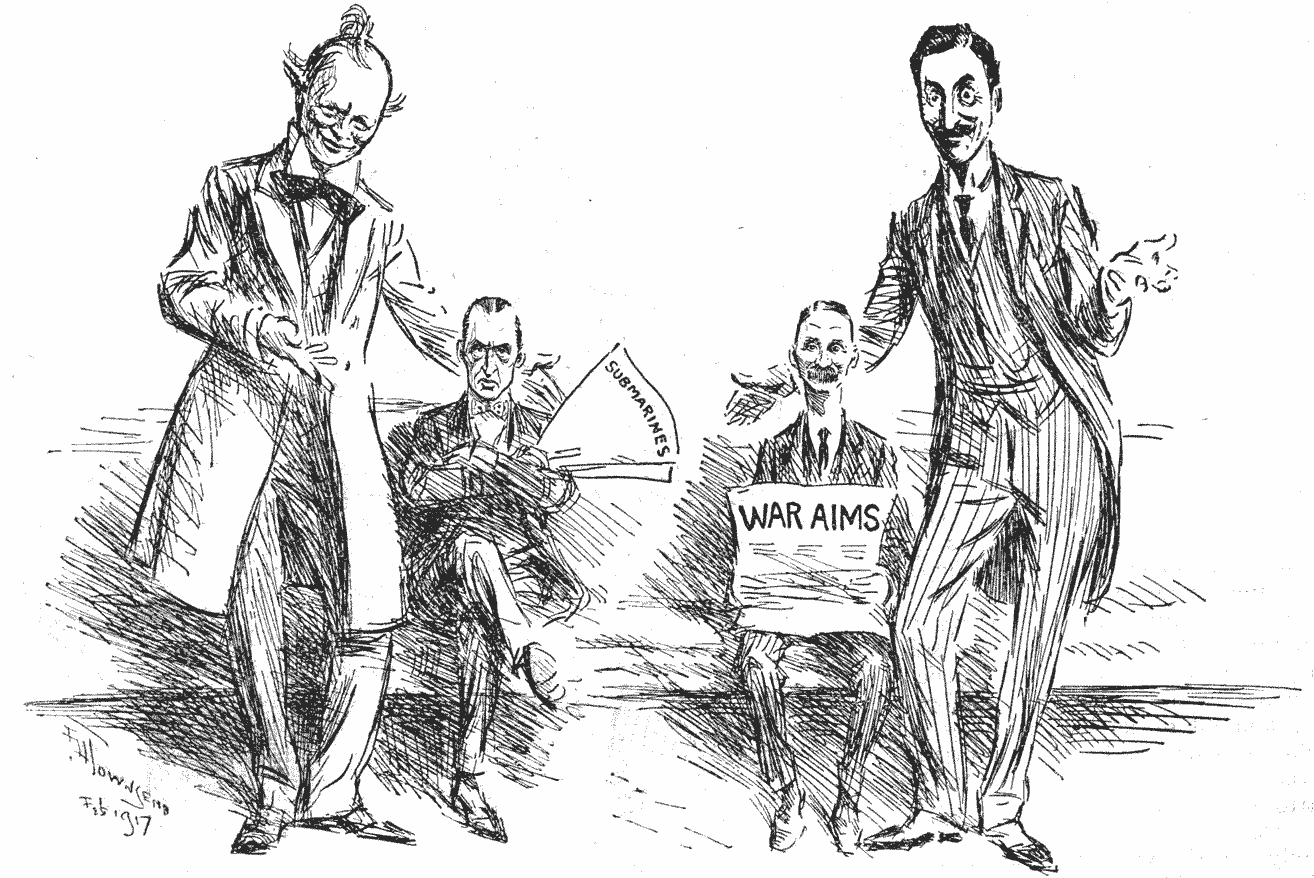
OPPOSITION APPROVAL OF THE NEW BOYS.
MR. WINSTON CHURCHILL (patting Sir EDWARD CARSON on the back) } "HE'S BEEN TALKING SENSE."
MR. HERBERT SAMUEL (patting Mr. BONAR LAW on the back)
Monday, February 19th.—The CHANCELLOR OF THE EXCHEQUER announced that the "new money" subscribed for the War Loan amounted to at least seven hundred millions. Being a modest man he refrained from saying, "A loan, I did it," though it was largely due to his faith in the generosity and good sense of his fellow-citizens that the rate of interest was not more onerous to the State.
Mr. LYNCH thinks it would be a good idea if Ireland were specially represented at the Peace Conference, in order that her delegates might assert her right to self-government. I dare say, if pressed, he would be prepared to nominate at least one of her representatives. Having regard to the Nationalist attitude towards military service Mr. BALFOUR might have retorted that only belligerents would be represented at the Peace Conference, but he contented himself with a simple negative.
There is an erroneous impression that Mr. LLOYD GEORGE sits in his private room scheming out new Departments and murmuring like the gentleman in the advertisement of the elastic bookcase, "How beautifully it grows!" Up to the present, however, there are only thirty-three actual Ministers of the Crown, not counting such small fry as Under-Secretaries, and their salaries merely amount to the trifle of £133,500. It is pleasant to learn that a branch of the Shipping Controller's department is appropriately housed in the Lake Dwellings in St. James's Park; and, in view of Mr. KING'S objection that the members of the Secret Service with whom he has come into contact make no sort of secret about their business (one pictures them confiding in this gentleman), it is expected that the Board of Works will shortly commandeer a strip of Tube Railway to conceal them in.
Tuesday, February 20th.—In one respect the two representatives of the War Office in the House of Commons are singularly alike. When answering their daily catechism both wear spectacles—Mr. FORSTER an ordinary gold-rimmed pair, Mr. MACPHERSON the fearsome tortoise-shell variety which gives an air of antiquity to the most youthful countenance; and each, when he has to answer an awkward "supplementary," begins by carefully taking off his glasses and so giving himself an extra moment or two to frame a telling reply.
This afternoon Mr. MACPHERSON'S spectacles were on and off half-a-dozen times as he withstood an assault directed from various quarters against the refusal of the War Office to admit the profession of "manipulative surgery" to the Army Medical Service. In vain he was informed of wonderful cures effected by this means on generals and admirals, and even members of the Government; in vain Mr. LYNCH sought from him an admission that the life of one private soldier was more valuable than that of the two Front Benches put together. All these attempts at manipulative surgery quite failed to reduce Mr. MACPHERSON'S obstinate stiff neck; and at last the SPEAKER had to intervene to stop the treatment.
The persistence with which a little knot of Members below the Gangway advances the proposition that all Germany is longing to make an honourable peace, and that it is only the insatiate ambition of the Allies which stands in the way, would be pathetic if it were not mischievous. Mr. PONSONBY, Mr. TREVELYAN, and Mr. SNOWDEN once more argued this hopeless case with a good deal of varied ability. A small house listened politely, but was more impressed by a masterly exposé of the facts by Mr. RONALD M'NEILL, and an Imperialist slogan by Sir HAMAR GREENWOOD; while later in the debate Mr. BONAR LAW restated the national aims in the War with a cogency that drew from Mr. SAMUEL a generous pledge "on behalf of those who sit opposite the Government" to give Ministers their whole-hearted support.
Wednesday, February 21st.—The House learned with satisfaction that crews of our river gun-boats in Mesopotamia are to get their hard-lying money; and when the authors of the Turkish communiqués hear of it they are expected to put in a similar claim.
Lord FISHER was in his customary place over the Clock—his friends all tell us that he is superior to Time; Lord BERESFORD was at a suitable—I had almost said respectful—distance from him in the Peers' Gallery; and conspicuous among the Distinguished Strangers was Sir JOHN JELLICOE. They and all of us listened intently while for over an hour Sir EDWARD CARSON, now as much at home on the quarter-deck as ever he was at quarter sessions, discoursed eloquently and frankly on the wonderful and never-ending work of the Senior Service.
He did not underestimate the danger of the submarines, or pretend that the Admiralty had yet discovered any sovran remedy for their attacks. Nor could he say—for reasons which seemed to satisfy the House—how many of them had already been captured or sunk. But he told us enough to convict Admiral VON CAPELLE, who was at that moment declaring that not a single U-boat had been lost since the opening of the new campaign, of being either singularly misinformed or highly imaginative.
Thursday, February 22nd.—A strange sympathy seems to exist between the SPEAKER and Mr. GINNELL. Each, I fancy, has a soft spot somewhere. Mr. LOWTHER'S is in his heart, and makes him go out of his way to help the wayward Member for North Westmeath. Mr. GINNELL, whose soft spot seems to be higher up, wanted to show that he did not approve of Mr. MACPHERSON, and called him an impertinent Minister. Ordered to withdraw the expression, he substituted "impudent." That would not do either, and there seemed danger of a deadlock and another expulsion until Mr. LOWTHER suggested that "incorrect" was a Parliamentary epithet which might suit the hon. Member's purpose. Mr. GINNELL handsomely accepted this variation in the spirit in which it was offered.
Sir GEORGE CAVE is the Ministerial maid-of-all-work. Whenever there is a disagreeable or awkward measure to introduce it falls to the Quite-at-Home Secretary, if I may borrow an expression coined by my friend, TOBY, M.P., for one of Sir GEORGE'S predecessors. So judiciously did he accentuate the good points and soften the possible asperities of the National Service Bill that even Sir CHARLES HOBHOUSE, who had come to condemn, remained to bless.
Friday, February 23rd.—Owing to a variety of causes, we are short of tonnage, and unless we manage to grow more and consume less we shall before very long be within reach of the gaunt finger of Famine. That was the burden of the PRIME MINISTER'S appeal to the Nation. The farmer is to have a guaranteed minimum price for his produce, the agricultural labourer is to be raised to comparative affluence by a minimum wage of 25s. a week, and the rest of us are to go without most of our imported luxuries and a good many necessities. So impressed were Members by the gloominess of the prospect that the moment the speech was over they rushed out to secure what they felt might be their last really substantial luncheon, and Mr. DAVID MASON, who had nobly essayed to fill the breach caused by Mr. ASQUITH'S absence, was soon talking to empty benches.
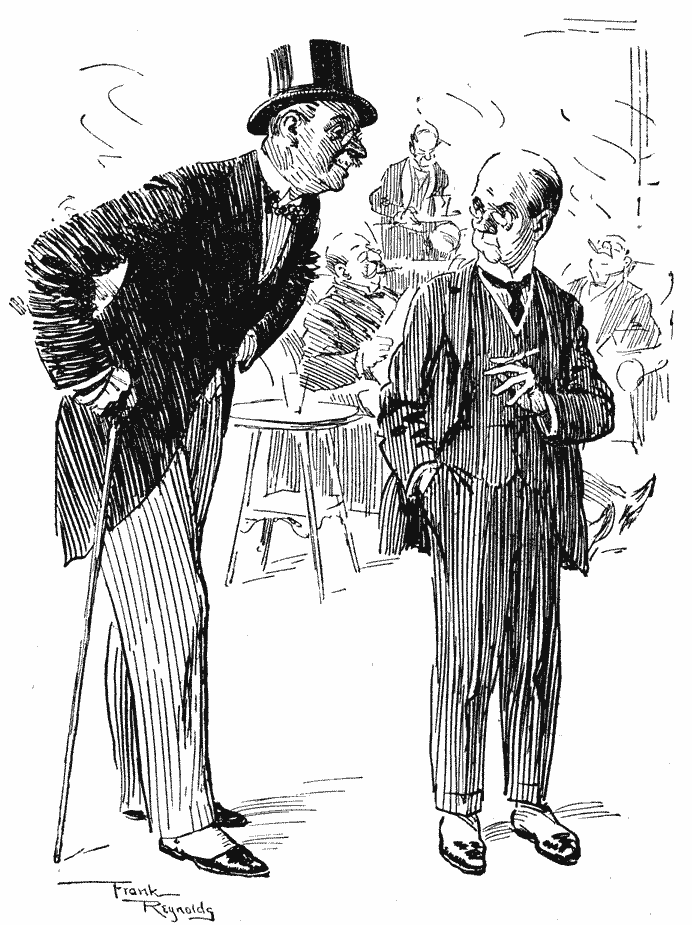
The Big 'Un. "MY DEAR FELLOW! IS IT REALLY TRUE THAT YOU HAVE TO JOIN UP?"
The Little 'Un. "YES; BUT DON'T LET IT GET ABOUT. YOU SEE, THE IDEA IS TO SPRING IT ON THE GERMANS, AS IT WERE, IN MARCH."
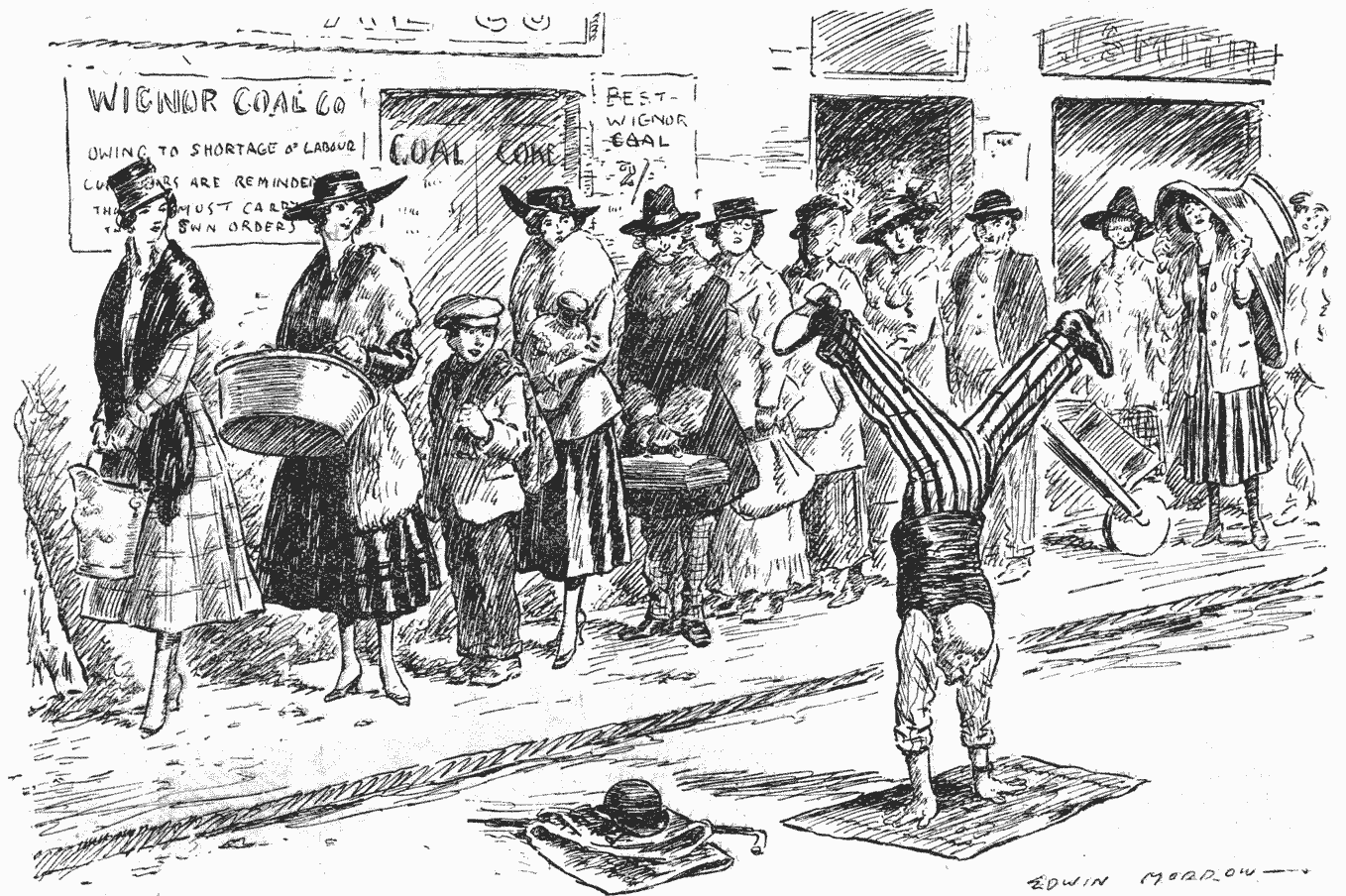
ACROBAT, HAVING BEEN OFFICIALLY INFORMED THAT HE BELONGS TO ONE OF THE NON-ESSENTIAL PROFESSIONS, DETERMINES NEVERTHELESS TO DEVOTE HIS TALENT TO THE CAUSE OF HIS SUFFERING FELLOW-COUNTRYMEN.
THE COMPLIMENT.
We all know the man with a grievance and avoid him. But there is another man with a grievance whom I rather like, and this is his story. I must, of course, let him tell it in the first-person-singular, because otherwise what is the use of having a grievance at all? The first-person-singular narrative form is the grievance's compensation. Listen.
"I am an old Oxonian who joined the Royal Naval Division as an ordinary seaman not long after the outbreak of the War, and being perhaps not too physically vigorous and having a certain rhetorical gift, developed at the Union, I was told off, after some months' training, to take part in a recruiting campaign. We pursued the usual tactics. First a trumpeter awakened the neighbourhood, very much as Mr. HAWTREY is aroused from his coma in his delightful new play, and then the people drew round. One by one we mounted whatever rostrum there was—a drinking fountain, say—and spoke our little piece, urging the claims of country.
"As a rule the audience was either errand-boys, girls or old men; but we did our best.
"Sometimes, however, there would be an evening meeting in a public building, and then the proceedings were more formal and pretentious. The trumpeter disappeared and a chairman would open the ball. The occasion of which I am thinking was one of these meetings in the East End, where the Chairman was a local tradesman. He said that this was a war for liberty and that England could never sheathe the sword until Belgium was free; he told the audience how many of his relations were fighting; and then he made way for our gallant boys in blue who were to address the company.
"Well, we addressed the company, I by no means the least of the orators, and then the Chairman wound up the meeting. He said how much he had enjoyed the speeches and how much he hoped that they would bear good fruit; and indeed he felt confident of that, because 'we 'ere in the East End are plain straight-forward folk, who like plain straight-forward talk, and we would rather listen to the honest 'omely sailors who 'ave been talking to us this evening, than any fine Oxford gentleman.'"
That is the story of my friend with a grievance. And yet, now I come to think about it again, and his manner of telling it, I'm not sure I ought not rather to call him a man with a triumph.
"Farmer's Daughter wanted, to learn daughter Cheddar cheesemaking for 1 month, from March 25th; 25 cows; treated as family."—Bristol Times and Mirror.
A little less than kin and more than kine.
"Washington, Thursday.
The representatives of thirty leading American railways have agreed virtually to an embargo on eastern shipments of freight for export until the present congestion on the eastern sideboard is relieved."—Evening Standard.
This is all very well for the Americans, but what we are concerned about is the depletion of our own sideboard.
From an official advertisement in favour of tillage:—
"An acre of Oats will feed for a week . . 100 people. An acre of Potatoes . . 200 " " " of Beef . . 8 " "— Irish Times.
We understand that Lord DEVONPORT accepts no responsibility for the last statement.
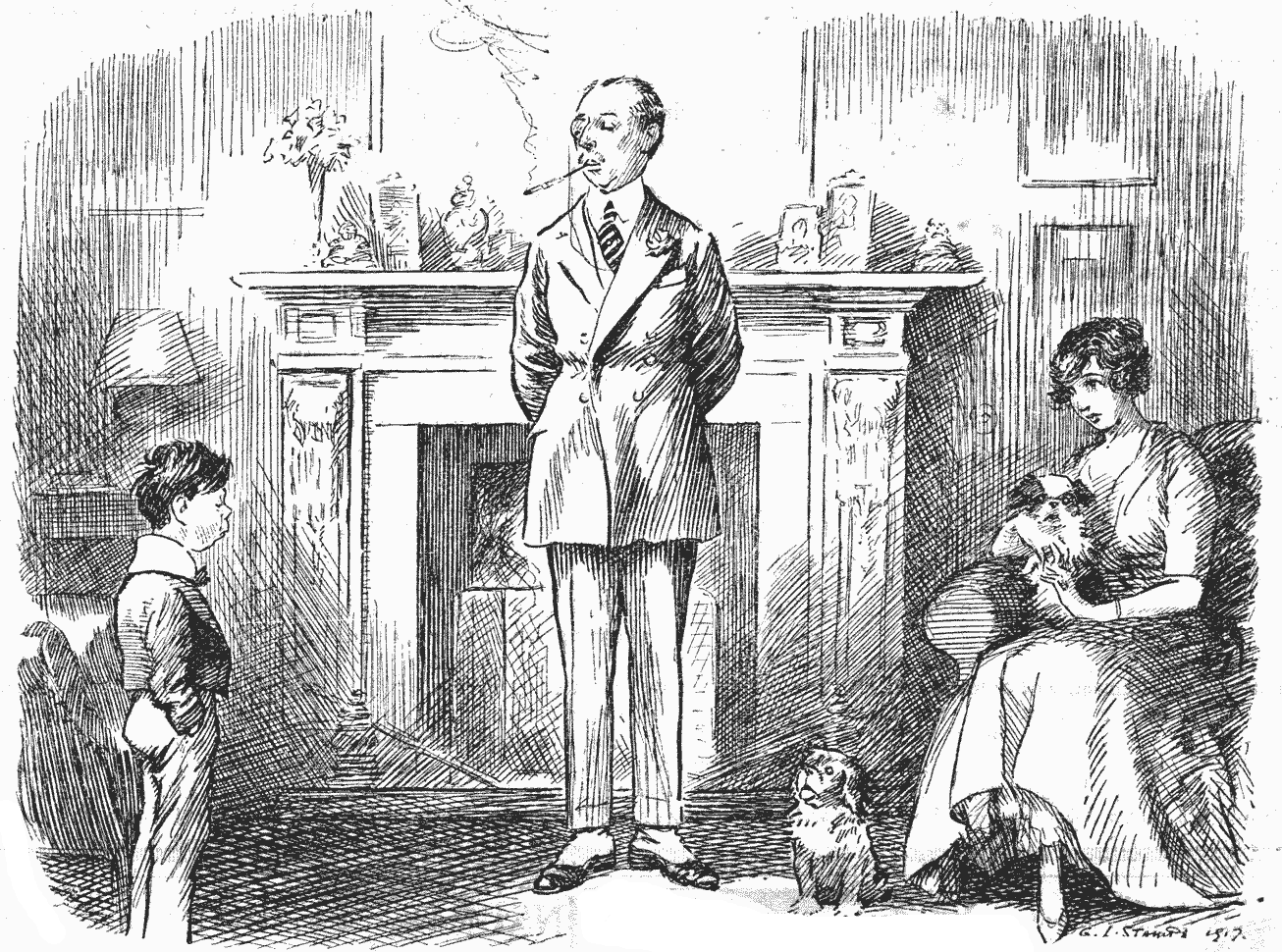
Father. "YOU'RE VERY BACKWARD. THERE'S NORMAN SMITHERS, THE SAME AGE AS YOU, AND HE'S TWO FORMS HIGHER. AREN'T YOU ASHAMED?"
Hopeful. "NO. HE CAN'T HELP IT—IT'S HEREDITARY."
THE MAMMAL-SAURIAN WAR.
A PARABLE OF GERMANY'S COLONIES.
Long ages ere the Age of Man, While yet this earthly crust was thinnish, The War of Might and Right began, Proceeding swiftly to a finish; And this provides in many ways An object-lesson nowadays. The Saurians, clad in coats of mail, Shone with a most attractive lustre; Strong claws, long limbs, a longer tail— They pinned their faith to bulk and bluster; They laid their eggs in every land And hid them deftly in the sand. The Mammals, small as yet and few, Relying less on scales and muscles, Developed diaphragms, and grew Non-nucleated red corpuscles; They walked more nimbly on their legs And learnt the art of sucking eggs. The Saurians, spoiling for a fight, Went off in high explosive fashion; They lashed themselves to left and right Into a pre-historic passion; The Mammals, on the other hand, Ate all their eggs up in the sand. Those precious eggs, a source of pride On which the Saurian hopes depended, Kept all their enemies supplied With life by which their own was ended; And where they fondly hoped to spread The Mammals lived and throve instead. And so the Saurians passed from view, Leaving behind the faintest traces, No longer bent on hacking through, Though looking still for sunny places; Dwarfed to a more convenient size They spend their time in catching flies.
The Non-Stop Linguist.
"To O.C. . . . From . . . Brigade. —— Corps requires services of an officer who can speak Italian fluently for four or five days."
"Under the auspices of the Women's Reform Club, a Ladies' Fancy Dress Ball will be held at the Residential Club, Main Street. No Gentlemen. No Wallflowers. Ladies may appear in mail attire."—Bulawayo Chronicle.
In their "knighties," so to speak?
Another Impending Apology.
"Bosley and district churchmen have thus a gaol set before them which it should be and, no doubt, will be their aim to reach as soon as possible."—Congleton Chronicle.
"A few minutes later, with his suit-case in one hand and his type-writer in the other, he let himself out at the front-door,"—Munsey's Magazine.
Another case of the Hidden Hand.
"Horse (vanner), thick set, 16 hands, 7 years, master 2 tons, reason sale, requires care when taken out of harness."—Birmingham Daily Mail.
Any horse might be excused for kicking up his heels on getting rid of a master of that weight.
"Furnished room wanted; preferable where chicken run."—Enfield Gazette.
Our landlady won't let us keep even a canary in ours.
"BARONY UNITED FREE CHURCH.—Special Lecture—'The Great War Novel, Mr. Bristling Sees it Through.'"—Glasgow Evening News.
Mr. WELLS ought to have thought of this.
HELPING LORD DEVONPORT.
"Francesca," I said, "what are you doing to help Lord DEVONPORT?"
"Lots of things," she said. "For one thing, we're living under his ration-scheme, and we're doing it pretty well, thank you."
"Yes, I know," I said; "I've heard you mention it once or twice. It seems to consist very largely of rissoles and that kind of food."
"Well," she said, "we must use up everything; and, besides, you'd soon get tired of beefsteak if I gave it to you every day."
"Tired of beefsteak?" I said. "Never. The toughest steak would always be a joy to me."
"I've come to the conclusion," she said, "that men really like their eatables tough."
"Yes, they want something they can bite into, you know."
"But you can't bite into our beefsteak, now can you?"
"Perhaps not," I said, "but you can't help feeling it's there, which is a great help when you're being rationed."
"That," she said, "may be all very well for a man, but women don't care for that feeling. They like their food light but stimulating."
"They do," I said, "and they prefer it all brought in on one tray and at irregular hours. Lord DEVONPORT'S scheme is to them a sort of wicked abundance. To a man it is—"
"Plenty and to spare," she said. "Why, you won't have to tighten your belt even by one hole. Now admit, if you hadn't known you were being rationed you'd never have found it out."
"I will admit," I said, "that if the privations we have suffered this last week in the matter of beefsteaks and that kind of food are the worst that can happen to us we shan't have much to complain of—but I should like a chop to-night instead of a rissole."
"You can call it a chop if you like, but it's going to be a cutlet."
"Well, anyhow," I said, "we don't seem to be doing as much as we might for Lord DEVONPORT."
"You're wrong," she said; "I'm keeping hens in the stable-yard."
"Hens? What do you know about hens?"
"For the matter of that, what do you?"
"That's not the question," I said, "but I'll answer it all the same. I know that most hens are called Buff Orpingtons, and that they never lay any eggs unless you put a china egg in their nest just to coax them along and rouse their ambition. Francesca, have you put a china egg where our Buff Orpingtons can see it?"
"Frederick is looking after these domestic details. He seems to think that if he goes to the hen-house every ten minutes or so the laying of eggs will be promoted. Won't you go round with him next time?"
"No," I said, "I've never seen a hen lay an egg yet, and I'm not going to begin at my time of life. Besides, I've already said they never lay eggs even when you don't watch them."
"Wrong again," she said. "We got one egg this morning."
"Francesca," I said, "this is exciting. Did the happy mother announce the event to the world in the usual way?"
"Yes, she screamed and cackled for about a quarter-of-an-hour, and Frederick came along and seized the subject of her rejoicing. You're going to have it to-night, boiled, instead of soup and fish."
"Isn't that splendid?" I said. "At this rate we shall soon be self-supporting, and then we can snap our fingers at Lord DEVONPORT."
"I never snap my fingers," she said. "No well-brought-up hen-keeper ever does. Besides, it's our duty to help the Government all we can, so that Lord DEVONPORT may have so much more to play with."
"Why should he want to play with it?" I said. "He doesn't strike me as being that kind of man at all."
"I daresay he plays in his off-hours."
"A man like that," I said, "hasn't any off-hours. He's chin-deep in his work."
"Anyhow," she said, "I should like him to know that we're pulling up the herbaceous border and planting it with potatoes, and that we've started keeping hens, and that we've already got one egg, and that when the time comes we shall not lack for chicken, roast or boiled."
"Francesca," I said, "how can you allude so flippantly to the tragedies which are inseparable from the possession of Buff Orpingtons? In the morning a young bird struts about in his pride, resolved to live his life fearlessly and to salute the dawn at any and every hour before the break of day. Then something happens: a gardener, a family man not naturally ruthless, comes upon the scene; there is a short but terrible struggle; a neck (not the gardener's) is wrung, and there is chicken for dinner."
"Don't move me," she said, "to tears, or I shall have to countermand your egg. Besides, I don't think I could ever make a real friend of a fowl. They've got such silly ways and their eyes are so beady."
"Their ways are not sillier nor are their eyes beadier than our Mrs. Burwell's, yet she is honoured as a pillar of propriety, while they—no matter; I hope the chicken when its moment comes will be tender and succulent."
"Hark!" said Francesca.
"Yes," I said, "another egg has come into the world, and there's Frederick rushing round like a mad thing with a basket, to find himself once more too late. Never mind," I said, "I can have two boiled eggs to-night with my chop,—I mean cutlet."
"No," she said.
"Yes," I said, "and you can have all the rissoles."
R.C.L.
ON PROMOTION TO FIELD RANK.
I remember a day when I felt quite tall Because of a gift of five whole shillings; I was Johnson major then, I recall, And didn't I swank and put on frillings! Well, we know that children are parents of men; And, now that I'm getting an ancient stager, Here am I pleased with a crown again, And signing myself as Johnson, Major.
"Experienced General disengaged 1st March, one lady; no washing; would take England."—Irish Times.
The advertiser should wire to KAISER, Potsdam.
"During the night an enemy raiding party in the neighbourhood of Gueudecourt was driven off by our baggage before reaching our line."—Continental Daily Mail.
There is no end to our warlike inventions. First the Tanks, and now the Trunks.
"The Tigris, immediately above Kut, runs South-East for about four miles. Then there is a sharp bend, and its course is almost due South for about the same distance. Then against the stream it goes due North for about the same distance."—Glasgow Citizen.
With the river behaving in this unnatural fashion General MAUDE deserves all the greater credit for his success.
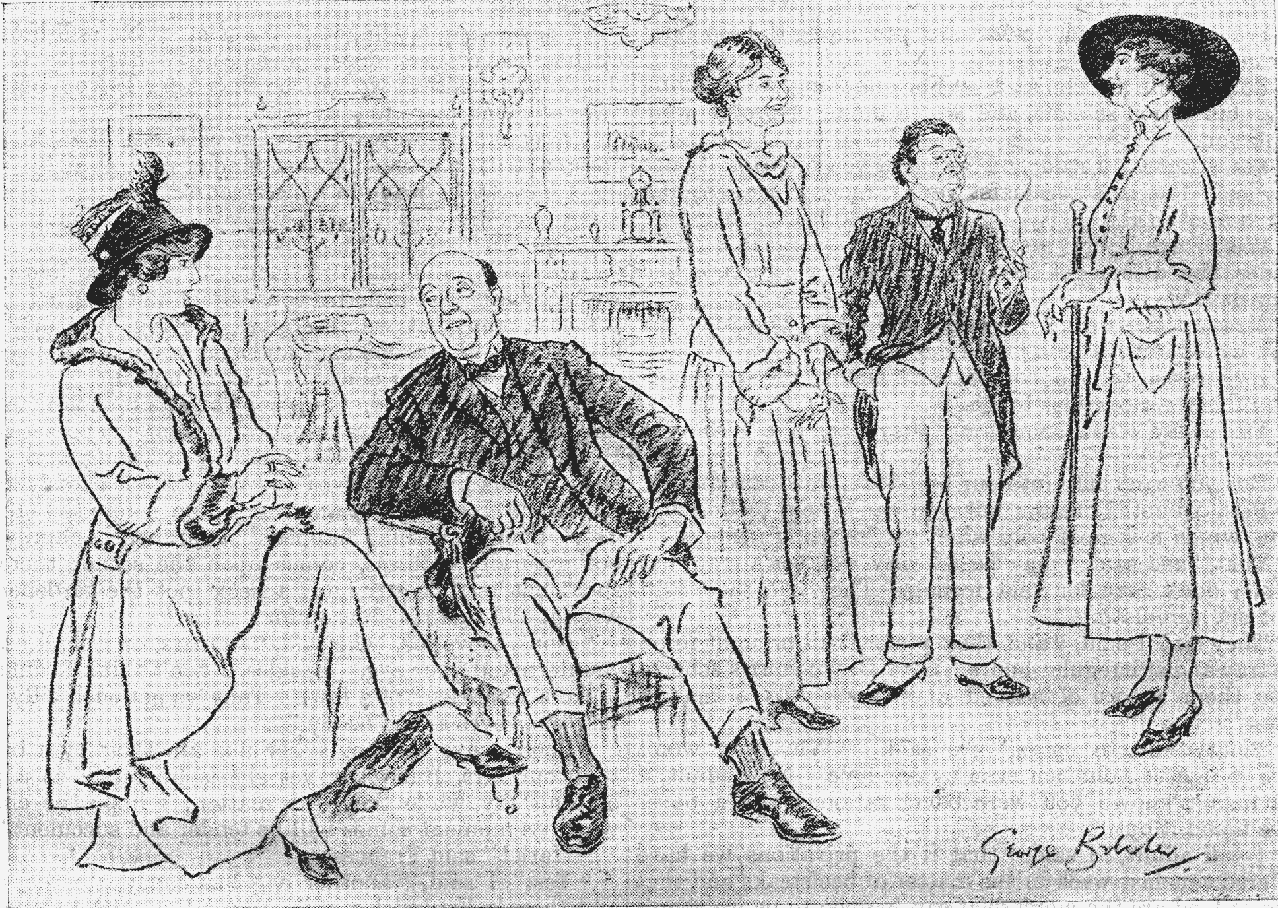
She (referring to host). "YOU KNOW, THERE'S SOMETHING RATHER NICE ABOUT MR. THOMKINS-SMITH."
He. "YES—I THINK IT MUST BE HIS WIFE."
OUR BOOKING-OFFICE.
(By Mr. Punch's Staff of Learned Clerks.)
War and the Future (CASSELL), by Mr. H.G. WELLS, is not a sustained thesis but just jets of comment and flashes of epigram about the War as he has seen it on the French, Italian and British fronts, and has thought about it in peaceful Essex. A characteristic opening chapter, "The Passing of the Effigy," suggests that "the Kaiser is perhaps the last of that long series of crowned and cloaked and semi-divine personages which has included Caesar and Alexander and Napoleon the First—and Third. In the light of the new time we see the emperor-god for the guy he is." Generalissimo JOFFRE, on the other hand, he found to be a decent most capable man, without fuss and flummery, doing a distasteful job of work singularly well. There is some particularly interesting matter about aeroplane work, and the writer betrays a keen distress lest the cavalry notions of the soldiers of the old school should make them put their trust in the horsemen rather than the airmen in the break-through. As for "tanks," he offers the alternative of organised world control or a new warfare of mammoth landships, to which the devastation of this War will be merely sketchy; but I doubt if he quite makes his point here. And finally this swift-dreaming thinker proclaims a vision which he has seen of a new world-wide interrelated republicanism founded on a recognition of the over-lordship of God.... You put the book down feeling you have had a long, desultory and intimate conversation with a very interesting fellow-traveller.
Really, if Mr. ROBERT HICHENS continues his present spendthrift course, whatever Board controls the consumption of paper will have to put him on half rations. I believe that his literary health would benefit enormously by such a régime. This was my first thought in contemplating the almost six hundred pages of In the Wilderness (METHUEN), and it persists, strengthened now that I have turned the last, of them. Here is a direct and moving tragedy of three lives, much of the appeal of which is lost in a fog of superfluous words. Of its theme I will tell you only this, that it shows the contrasting loves, material and physical, of two widely divergent types of womanhood. Probably human nature, rather than Mr. HICHENS, should be blamed for the fact that the unmoral Cynthia is many times more interesting than the virtuous but slightly fatiguing Rosamund. The former is indeed far the most vital character in the tale, a figure none the less sinister for its clever touch of austerity. Possibly, however, her success is to some extent due to contrast; for certainly both Rosamund and Dion, the husband whom she alienated by her unforgiving nature, embody all the worst characteristics of Mr. HICHEN'S creations. Perhaps you know what I mean. Chiefly it is a matter of super-sensibility to surroundings, which renders them so fluid that often the scenery seems to push them about. It is this, coupled with the author's own lingering pleasure in a romantic setting, that delays the conflict, which is the real motive of the book, over long. But once this has come to grips the interest and the skill of it will hold you a willing captive to Mr. HICHENS at his best.
Much as I have enjoyed some previous work by Baroness VON HUTTEN I am glad to say that I consider Magpie (HUTCHINSON) her best yet. It is indeed a long time since I read a happier or more holding story. The title is a punning one, as the heroine's name is really Margaret Pye, but I am more than willing to overlook this for the sake of the pleasantly-drawn young woman to whom it refers and the general interest of the tale. Briefly, this has two movements, one forward, which deals with the evolution of Mag from a fat, rather down-at-heel little carrier of washing into the charming young lady of the cover; the other retrospective, and concerned with the mystery of a wonderful artist who has disappeared before the story opens. I have no idea of clearing up, or even further indicating, this problem to you. But I will say that the secret is so adroitly kept that the perfect orgy of elucidation in the final chapter left me a little breathless. Of course the whole thing is a fairy tale, with a baker's dozen of glaring improbabilities; but I am much mistaken if you will enjoy it the less for that. A quaint personal touch, which (to anyone who does not recall the cast of Pinkie and the Fairies on its revival) might well seem an impertinence, produced in me the comfortable glow of superiority that rewards the well-informed. But I can assure Baroness VON HUTTEN that she is all wrong about the acting of that particular part.
As it is not Mr. Punch's habit to admit reviews of periodical publications, I ought to say that the case of The New Europe (CONSTABLE), whose first completed volume lies before me, is exceptional. In thirty years' experience of journalism I never remember a paper containing so much "meat"—some of it pretty strong meat, too—in proportion to its size. In hardly a single week since its first issue in October last have I failed to find between its tangerine-coloured covers some article giving me information that I did not know before, or furnishing a fresh view of something with which I thought myself familiar. And I take it there are many other writers—and even, perhaps, some statesmen—who have enjoyed the same experience. Dr. SETON-WATSON and the accomplished collaborators who march under his orange oriflamme may not always convince us (I am not sure, for example, that Austria est delenda may prove the only or the best prescription for bringing freedom to the Jugo-Slavs of South-Eastern Europe), but they always furnish the reader with the facts enabling him to test their conclusions; and that in these times is a great merit. My own feeling is that if they had begun their concerted labours a few years earlier the War might never have happened; or at least we should have gone into it with a much more accurate notion of the real aims of the Central Powers, and a much better chance of quickly defeating them. The tragedies of Serbia and Roumania would almost certainly have been averted.
I am unable to hold out much prospect that you will find Frailty (CASSELL) a specially enlivening book. The scope of Miss OLIVE WADSLEY'S story, sufficiently indicated by its title, does not admit of humorous relief. But it is both vigorous and vital. Certainly it seemed hard luck on Charles Ley that, after heroically curing himself of the drug habit, he should marry the girl of his choice only to find her a victim to strong drink. But of course, had this not happened, the "punch" of Miss WADSLEY'S tale would have been weakened by half. Do not, however, be alarmed; the author knows when to stop, and confines her awful examples to these two, thereby avoiding the error of Mrs. HENRY WOOD, who (you may recall) plunged the entire cast of Danesbury House into a flood of alcohol. Not that Miss WADSLEY herself lacks for courage; she can rise unusually to the demands of a situation, and I have seldom read chapters more moving of their kind than those that depict the gradual conquest of Charles by the cocaine fiend, and his subsequent struggle back to freedom. Here the "strong" writing seemed to me both natural and in place; ever so much more convincing therefore than when employed upon the love scenes. I have my doubts whether, even in this age of what I might call the trampling suitor, anyone was over quite so heavy-booted over the affair as was Charles when he carried off his chosen mate from a small-and-early in Grosvenor Square. Fortunately the other parts of the story are less melodramatic, and make it emphatically a book not to be missed.
Happy is the reviewer with a book which gives him so much delightful information that he tries to ration himself to so many pages per day. This is what I resolved to do with In the Northern Mists (HODDER AND STOUGHTON); but I could not keep to my resolution, so attractive was the fare. These sketches are the work of a Grand Fleet Chaplain, and are packed with wisdom from all the ages. If you haven't the luck to be a sailor you will learn a lot from this admirable theologian about the men and methods and the spirit of the Grand Fleet. His book fills me with pride; yet I dare not express it for fear of offending the notorious modesty of the senior service. So shy indeed is our Fleet of praise that I feel my apologies are due to their Chaplain for my perfectly honest commendation of his book. But he seems human enough to pardon the more venial sins.
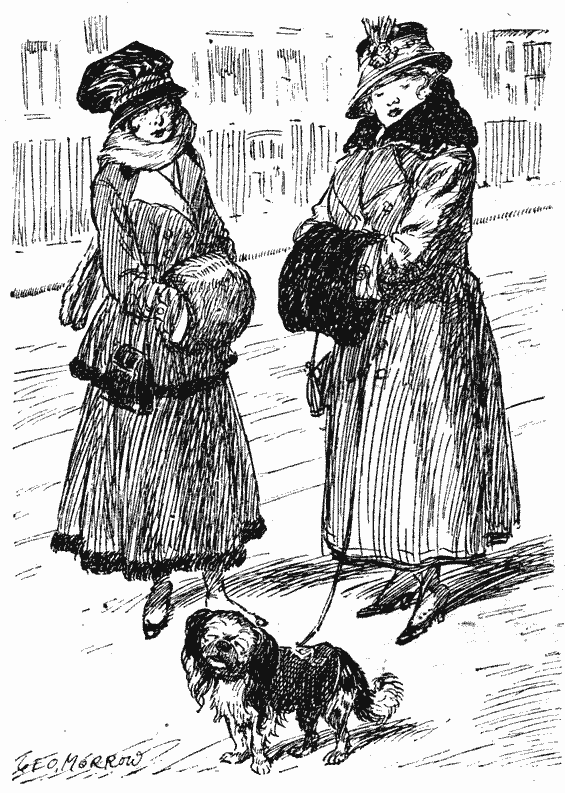
A CASE FOR RATIONING.
"YOUR LITTLE DOG DOESN'T SEEM TO MIND THE WEATHER. I SUPPOSE HIS COAT KEEPS HIM WARM."
"I DON'T THINK IT'S THAT ALTOGETHER. YOU SEE, HE HAS RUM-AND-MILK WITH HIS CUTLET EVERY MORNING BEFORE HE GOES OUT."
"Peterborough's youngest investor was Herbert Trollope Gill, barely three months old, who subscribed the whole of his life's savings. He arrived at the bank with his mother, and there was poured out before the astonished gaze of the officials four hundred threepenny pieces."—Weekly Dispatch.
We congratulate HERBERT on his patriotism and regret that it should have compelled him to go into liquidation.