Volume 152 — February 28th, 1917.
Reading edition
CHARIVARIA.
One of the latest peculiarities of the KAISER is an absolute horror at the thought of being prematurely buried. Several experts however say that this is impossible.
It appears that HINDENBURG accuses the CROWN PRINCE OF BAVARIA of having misunderstood an order, thus losing Grandcourt for the Germans. RUPPRECHT, we understand, retorted that the real culprits were the British.
In a character-sketch of VON BISSING, the Cologne Gazette says, "He is a fine musician and his execution is good." It would be.
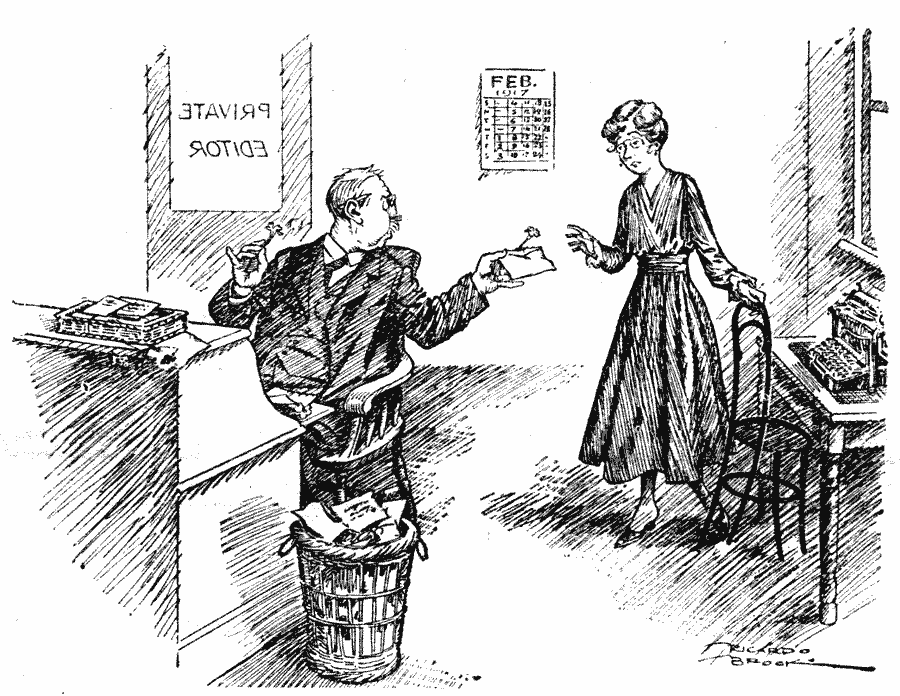
THE PAPER SHORTAGE.
News Editor of "Daily Bugle Blast." "JUST TYPE A SHORT NOTICE THAT FINDERS OF FIRST SNOWDROP, CROCUS, PRIMROSE OR ANY EARLY SPRING PHENOMENA MUST APPRISE WORLD THROUGH OUR ADVERTISEMENT COLUMNS."
No German submarine, says ADMIRAL VON CAPELLE, has been lost since the beginning of the submarine war. This assurance has been received with the liveliest satisfaction by several U-boat commanders who have been in the awkward predicament of not knowing whether they were officially missing.
Captain BOY ED is stated to have returned to the United States disguised. Not on this occasion, we may assume, as an officer and a gentleman.
According to the ex-Portuguese Consul at Hamburg bone tickets are issued for making soup, but the bone must be returned to the authorities. Possibly the hardship of the procedure would be mitigated if ticket-holders were permitted to growl.
A metallurgical engineer at the Surbiton Tribunal said he was forty-one years old, and only missed the age-limit by eighteen hours. It is not thought that he did it purposely.
At the Billericay Tribunal an applicant last week stated that he had nine children, but upon counting them again he discovered that he had ten. There seems to be no excuse for this sort of thing, for Adding machines are now fairly well advertised.
Discussing the latest dress fashion, a lady writer says, "It is a most ridiculous dress. Nothing worse could be conceived." This, of course, is foolish talk, for the lady has not seen next season's style.
Austrian tobacconists are now prohibited from selling more than one cigar a day to a customer. To conserve the supply still further it is proposed to compel the tobacconist to offer each customer the alternative of nuts.
"When I see a map of the British Empire," said Mr. PONSONBY, M.P., "I do not feel any pride whatsoever." People have been known to express similar sentiments upon sighting certain M.P.'s.
"The public must hold up the policeman's hands," said a London magistrate in a recent traffic case. It is astonishing how some policeman are able to hold them up without assistance for several seconds at a time.
The staff of the new Pensions Minister, it is announced, will be over two thousand. It is still hoped, however, that there may be a small surplus which can be devoted to the needs of disabled soldiers.
Several men have been arrested in Dresden for passing counterfeit food tickets. The defence will presumably be that it wasn't real food.
The Royal Engineers are advertising for seamen for the Inland Water Transport Section. The Chief Transport Officer, we understand, has already hoisted his bargee.
Eggs to the number of six million odd have just arrived from China, says a news item, and will be used for confectionery. Had they arrived three months ago nothing could have averted a General Election.
A hen while being sold at a Red Cross sale at Horsham laid an egg which fetched 35s. In the best hen circles, where steady silent work is being done, there is a growing tendency to frown upon these isolated acts of ostentatious patriotism.
The Times, it seems, has not published a complete list of its rivals in the desperate struggle for the smallest circulation. A Finchley Church magazine has increased its price to 1½d. a copy.
Paper bags are no longer being used by greengrocers in Bangor, and their customers are patriotically assisting this economy by unpodding their green peas and rolling them home.
"Bacon, as a breakfast food," says an evening paper, "is fast disappearing from the table." We have often noticed it do so.
"It is pitiful and disgraceful," says the Berliner Tageblatt, "to watch women-folk walking beside their half-starved dogs. There is no room in warfare for dogs." We have all along felt sorry for the poor animals at a time when one half the dachshund does not know how the other half lives.
A Felicitous Juxtaposition.
"EGGS FOR LINCOLN HOSPITAL. COL. —— LAYS A FALSE RUMOUR."—Lincoln Leader.
"PULLETS, laying 3s. 6d. each."—Provincial Paper.
Yet farmers persist in telling us there's no money in fowls.
"The first description of how the German Fleet reached Rome after the battle of Jutland is furnished by a neutral from Kiel."—Johannesburg Daily Mail.
Of all the roads that lead to Rome this is certainly the roughest.
The New Greeting: "Comment vous Devonportez-vous?"
TO GERMANIA
FROM SOMEBODY WHO OUGHT TO BE IN PRISON.
Air—"To Althæa from Prison."
When Peace with wide and shining wings Invades this warring isle, And my beloved Germania brings Wearing her largest smile; When close about her waist I coil And mouth to mouth apply, Not SNOWDEN, patriot son of toil, Will be more pleased than I. When round the No-Conscription board The wines of Rhineland flow, And many a rousing Hoch! is roared To toast the status quo; When o'er the swiftly-circling bowl Our happy tears run dry, Not PONSONBY, that loyal soul, Will be more pleased than I. When sausages and sauerkraut Fulfil the air with spice, And loosened tongues the praise shall shout Of Peace-at-any-price; When German weeds our lips employ And hearts are full and high, Not CHARLES TREVELYAN, blind with joy, Will be more pleased than I. Stone walls do not my feet confine Nor yet a barbed-wire cage; I talk at large and claim as mine The freeman's heritage; And, if this wicked War but end Ere German hopes can die, Not WILLIAM'S self, my dearest friend, Will be more pleased than I.
O.S.
THE BROKEN SOLDIERS.
"Now," I suggested as we left the drapery department, "you've got as much as you can carry." Unfortunately it was impossible to relieve her of the parcels as I had all my work cut out to manipulate those confounded crutches.
"There's only the toy department," returned Pamela, leading the way with her armful of packages. "I do hope you're not frightfully tired." Of course it seemed ridiculous, but I had not been out of hospital many days, and as yet I had not grown used to stumping about in this manner.
"Do you happen," asked Pamela at the counter, "to have such a thing as a box of broken soldiers?"
The young woman looked astonished and even a little hurt, but offered, with condescension, to inquire.
"Do you want them for Dick?" I asked, Dick being Pamela's youngest brother.
"For Dick and Alice," said Pamela. Alice was her sister, younger still.
"Why shouldn't I buy them a box of whole ones?"
"That wouldn't answer the purpose. They have three large boxes already," answered Pamela, as a young man appeared in a frock coat, with a silver badge on the right lapel, "For Services Rendered." In his hand was a dusty cardboard box, and in the box lay five damaged leaden soldiers, up-to-date soldiers in khaki; two without heads, two armless, one who had lost both legs.
"Those will do splendidly," said Pamela, and the young man with the silver badge obligingly put the soldiers into my tunic pocket. It seemed to be understood that they and I had been knocked out in the same campaign.
"Why," I asked on the way home in the taxi, "did you want the soldiers to be broken?"
"I—I didn't," murmured Pamela, with a sigh.
"Why did Dick?" I persisted.
"The children are so dreadfully realistic now-a-days. You see, Father objected to his breaking heads and arms off his new ones. Dick was quite rebellious. He wanted to know what he was to do for wounded; and Alice was more disappointed still."
"I should have thought it was too painful a notion for her," I suggested.
"Oh!" cried Pamela, with a laugh, "Alice is a Red Cross nurse, you know. She's made a hospital out of a Noah's Ark. She only thinks of healing them."
"All the King's horses and all the King's men cannot put Humpty Dumpty together again," I said.
"Poor old boy!" whispered Pamela.
"I wonder whether broken soldiers have an interest for you as well," I remarked ... and Dick and Alice were completely forgotten until they met us clamorously in the hall.
"Did you get any, Pam?" cried Dick.
"Only five," was the answer, as I took the small paper parcel from my pocket and handed it over.
"Is that all?" demanded Alice.
"There's one more," I said.
"Is that for me?" cried Alice; but Pamela shook her head and smiled very nicely as she took my arm.
"No, that's for me," she said.
A TRAGEDY OF THE SEA.
The night was a very dark one, for a cold damp fog hung over the Channel. The few lights we carried reflected in-board only, and, leaning over the rail, it was with difficulty that I could distinguish the dark waters washing below. Shore-ward I could see nothing, though I knew that a good-sized town lay there.
I had soon had enough of the inclement night. Keeping my feet with some difficulty upon the wet boards, I groped my way to a door and, pushing it open, entered.
A strange scene met my gaze. A spruce man in the uniform of a naval officer was seated at a table. Before him stood a tall well-set-up young seaman. His dishevelled head was hatless, but otherwise he looked trim, and his garments fitted him better than a seaman's garments generally do. On each side of him stood an armed guard.
"Have you anything to say for yourself?" asked the officer sternly.
"No, Sir, only that I am innocent," answered the man. He held his head high, almost defiantly. I could not but admire his courageous bearing, and yet there was an air of unreality about the whole thing. I felt almost as if I were dreaming it, but I knew that this was not a dream.
"The evidence against you is overwhelming," said the officer. "I have no alternative but to sentence you to death. The sentence will be carried out at dawn. Remove the prisoner."
The seaman took a step forward. For a moment he seemed to be struggling with himself, anxious to speak, yet forcing himself to silence. Then he bowed his head, and, turning, placed himself between the guards and was marched away.
The officer sighed. "It's a bad business," he said. "He's the best man I ever had on my ship."
He was speaking to himself, and again I had that strange sense of unreality, as indeed I well might, for this was the Third Act of True to the Death, a melodrama in the pavilion at the end of the pier.