AT THE WESTMINSTER PLAY
Reading edition
Plaudite! Bravo! Brave! Domini Quippus et Punnus are very much alive! A fact that may be inferred from just one line (there are more whence this came) in the Westminsterial play, when Davus takes Mysis "the New Woman," for his wife, and exclaims:—
"O Mysis, Mysis, tu mea Missis eris!"
Surely if the punhating Criticus Sagitarius (Mundi) were present he must have staggered out weeping on hearing the Latin-Anglo-modern-classical pun! O shade of 'Arry Stophanes! O Ghost of Terence (the Corkasian)! are our youths at Westminster to start thus on their career, with nothing better than a poor pun not worth a punny in their pockets! Let Sagitarius watch this youthful punster's line of life! He will live to be punished! or to be rewarded as he deserves? After all, Great Pun is not dead; he may be dull, commonplace sometimes, but as he was prehistoric, so is he immortal. There is a great future before the author of the Westminster epilogue.
Robert Louis Stevenson. Born November 13, 1850. Died December 8, 1894. Brave bringer-back of old Romance From shores so few may see, Who oft hath made our pulses dance With thy word-wizardry. We wished, who loved thee long and well, Thy life as endless as the spell Which lured us lingeringly To loiter, like a moon-witched stream, Through thine enchanted world of dream. We mused, with much-expectant smile, On that strange life afar, Flower-girt, in yon Pacific isle, Whereto an alien star Had drawn thee from thy northern home, Scourged by a greyer, chillier foam, Yet dear as the white bar Whose snowy break home-haven marks To battered shore-returning barks. And now across the sundering seas, Delayed, unwelcome, dread, Comes news that breaks our dreamful ease. The Great Romancer dead? It comes like an unnatural blight. That sunny vision quenched in night, That subtle spirit fled? One-half our best soul-life seems gone Out like a spark with Stevenson. Enough for fame that hand had wrought, But not enough for those Who dreamed his dream, who thought his thought, And grieve that so should close Fresh-opened doors to Faëryland Before the poet-Prospero's wand Had wrought the spells he chose. Without him amaranth-blooms to cull The world looks Stygian now, and dull. Teller of Tales, those southern folk Their Tusitala hailed. Samoan hearts may mourn the stroke. We, who must leave unscaled, Save in fond fancy, that high peak Where he is tombed, who, though flesh-weak In spirit never failed More than his stalwart fathers,—we Send half our hearts across the sea. The lighthouse-builder raised no light That shall outshine the flame Of genius in its mellowest might That beacons him to fame. And Pala's peak shall do yet more Than the great light at Skerryvore To magnify his name, Who mourned, when stricken flesh would tire, That he was weaker than his sire. Teller of Tales! Of tales so told That all the world must list. Story sheer witchery, style pure gold, Yet with that tricksy twist Of Puck-like mockery which betrays The wanderer in this world's mad maze, Not blindly optimist, Who wooes Romance, yet sadly knows That Life's sole growth is not the Rose. Dreamer of dreams! Such dreams as draw Glad through the Ivory Gate, In rapt and visionary awe, The soul alert, elate; Eblis obscure, Elysium dim, And a strange Limbo of wild whim, Upon us seem to wait, In solemn pomp, when willing thrall To him who held the keys of all. Thinker of thoughts, fresh, poignant, fine, Wherein no wit may trace That burthen of the Philistine, Chill, barren Commonplace. Who hath not felt the subtle stroke Which can in one choice phrase invoke The soul of charm and grace, Haunting the ear like an old rhyme, A cherished memory for all time? No more, no more! We shall not see Again the glorious show; No more will wake the wizardry, Nor the charmed music flow. Samoa's silence holds it hushed, The voice whereat our cheeks have flushed A hundred times; and lo! For happy hours, for haunted days, We can but pay with sad, proud praise!
Crackers.—Tom Smith, the up-to-date magician, sends forth from his treasure-cave "bright things which gleam," but not "unrecked of"—at least they won't remain so long, especially if any quiet demon of a schoolboy with martial aspirations hears a report of "The Gatling Gun Cracker." The repeating process will be an uncertain pleasure—to others. Then "Snap Shots," taken unawares by a naughty little Cupid—we can imagine the "Surprises!" Knick-knacks are boomed in "Ye Olde Curiosity Shop"—but soft! I will not reveal any further the secrets of the "King of Crackers." Get them—they are an "Open Sesame" to a gaiety of delights.
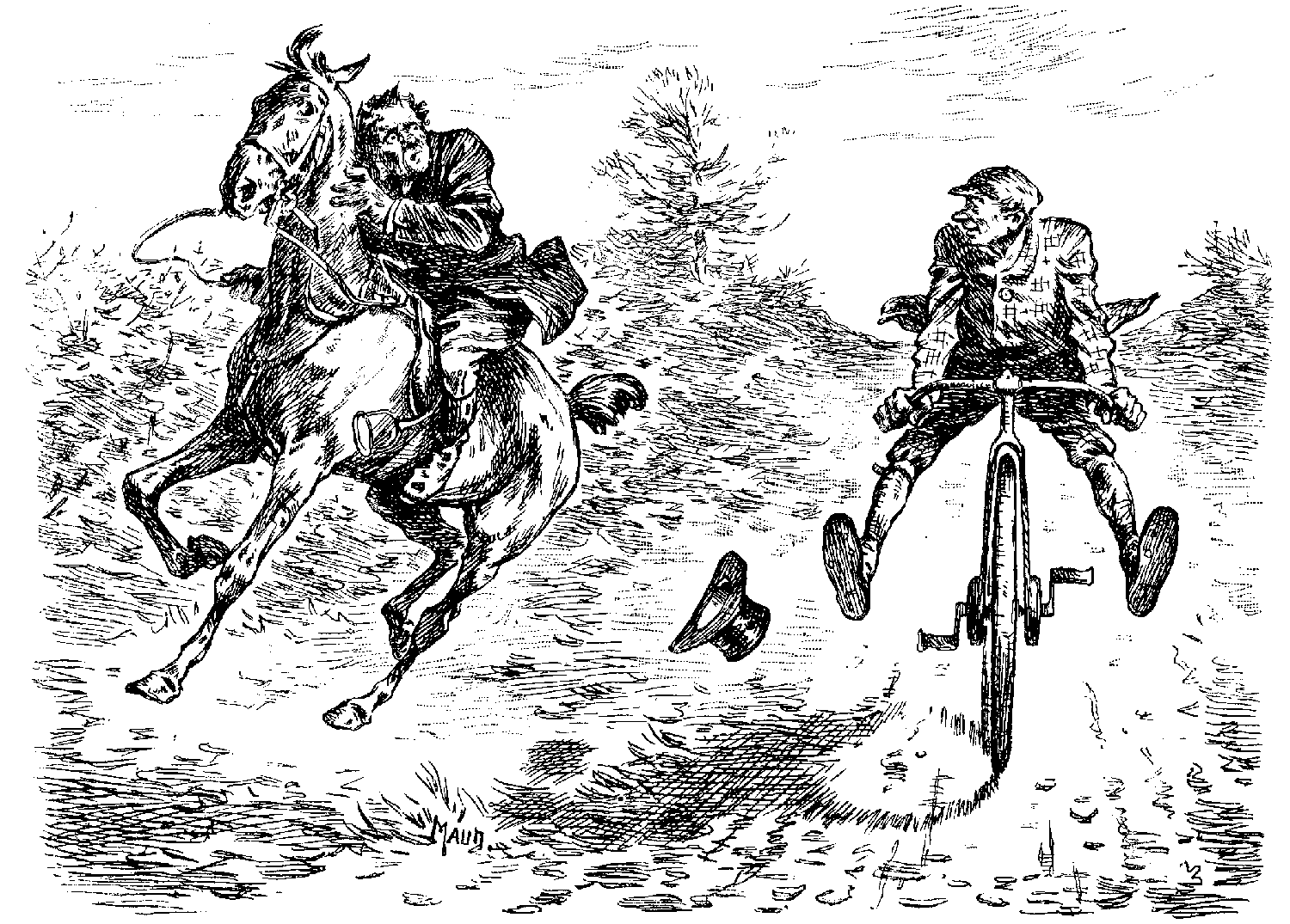
ADDING INSULT TO INJURY.
Cyclist (to Fox-hunter, thrown out). "Oi say, Squoire, 'ave you seen the 'Ounds?"