Volume 103 — INNS AND OUTS.
Reading edition
No. IV.—THE WINDOW-SHUTTERS.
"And efery time he gif a shoomp, he make de winders sound."
I do not allude to the white wooden Venetian work that shades the Grand Hôtel windows. It is of the clique who insist on shutting the windows that I write. Briefly speaking, the inmates of the Grand Hôtel may be divided into two classes—the window-openers and the window-shutters. The former are all British. The same Britons who at the Club scowl at a suspicion of draught, and luxuriate in an asphyxiating atmosphere, band against "the foreigners" in this respect. We have a national reputation to keep up. We are the nation of soap, of fresh air, of condescending discontent; and when we are on the Continent every one else, including the native, is "a foreigner;" we carry our nationality about with us like a camp-stool; we squat on it; we are jealous of it; it is a case of "Regardez, mais ne touchez pas!"
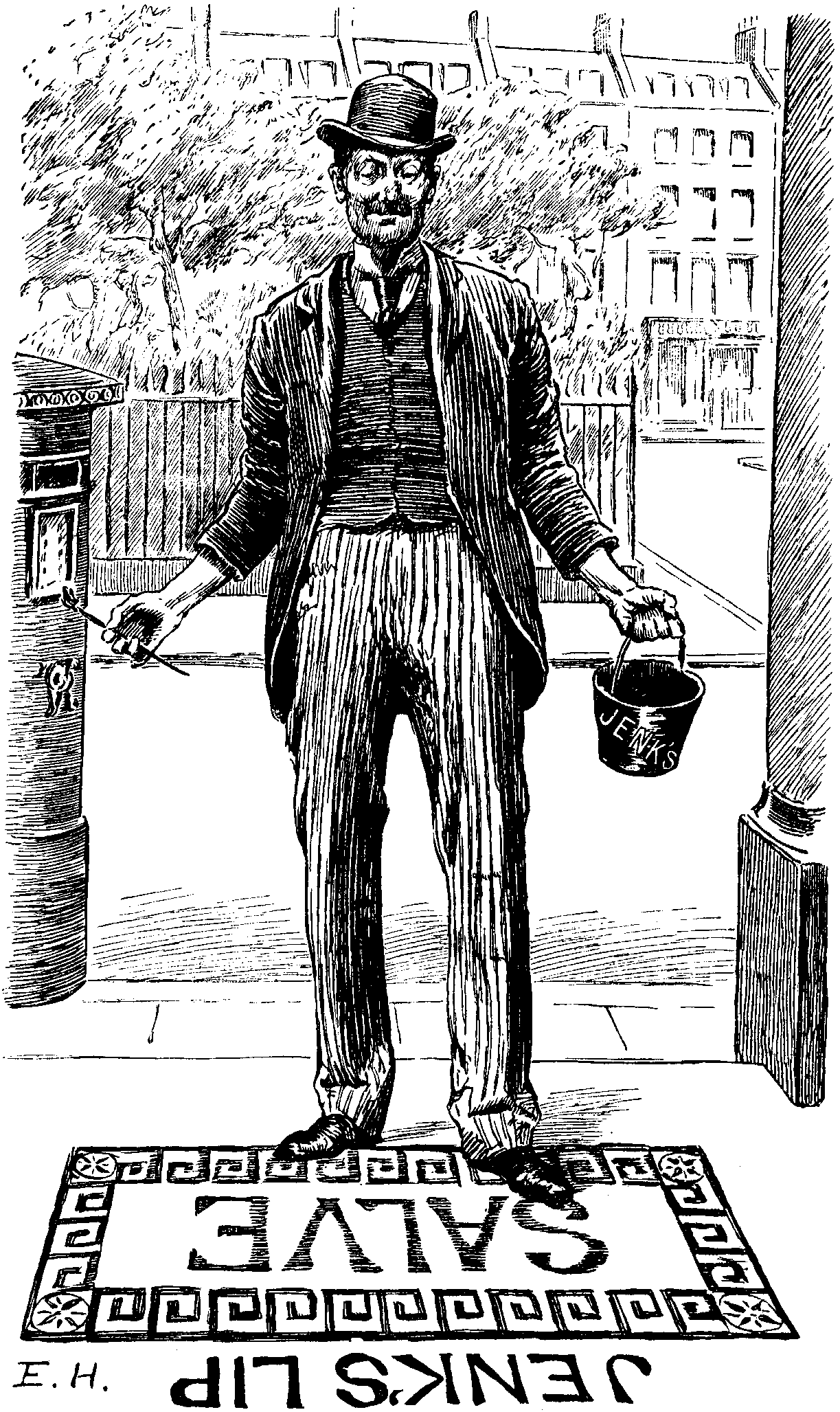
COMMERCIAL INSTINCT.
Original Genius (soliloquising). "Lor, it 'id bin a crool Shame to miss an Opportunity like this 'ere. The gov'nor oughter lemme 'ave Ten Bob on that job!"]
This patriotic obtrusiveness culminates in the Battle of the Windows. It is an oppressive evening. The Table d'Hôte-room is seething like a caldron; a few chosen conspirators and myself open the campaign early; we "tip" ADOLF "the wink." That diplomatist orders the great window to be half-opened. If things go smoothly, he will gradually open out other sources of ventilation. The Noah's Ark procession files in—all shapes and all languages, like the repast itself; DONNERWITZ, TARTARIN, SHIRTSOFF, SCAMPELINI; there is nothing in common between them—save the paper collar; they would hail international declarations of war to-morrow; but the sight of us, and that speck of air leagues them. "Mein Gott, Die Engländer!" coughs DONNERWITZ; "Ce sont de fanatiques enrhumés!" hisses TARTARIN; SHIRTSOFF sneezes the sneeze of All the Russias; "Corpo di Bacco!" cries SCAMPALINI; still nothing is done; the "Potage à la reine,"—so called from the predominance of rain-water—ebbs away in the commingled smacks and gulps of the infuriated Powers; "Saumon du Rhin, sauce Tartare" is being apportioned to the knives of all nations; it is perhaps the sight of his knife, from which soup only is sacred, that nerves the fuming DONNERWITZ to lead the attack. "Hst!" he shouts to the studiously unheeding ADOLF; "'nother bottil Pellell—ver' well sare!" chirrups ADOLF reassuringly to me; DONNERWITZ raises his knife; I fear for the consequences; he brings it down with a clang on the hardened tumbler of the Grand Hôtel; the timid pensionnaire of numberless summers starts and grows pale; SHIRTSOFF looks with peremptory encouragement towards the Teuton; "Ach, gräsglich!" rattles out DONNERWITZ, and strikes again; the cobra-like gutturality of that "Ach" is heart-rending; still no ADOLF; at a gold-fraught glance from my companions, he has ordered another detachment to the front; a fresh current of air invades the room. DONNERWITZ's knife is now brandishing peas; his offended napkin chokes him; with the yell and spring of a corpulent hyena, he rises and rushes to the windows. The timid pensionnaire and her shrinking sisterhood follow him, under the misconception that he is summoning them to admire the sunset; the sunset is their evening excitement, and DONNERWITZ can be sentimental in his calmer moments; but no "Wie wunder, wunderschön!" escapes him; a Saxon word, that even they can understand, is on his lips; the ring on his forefinger gleams luridly; bang, bang, bang; he opens fire; down go the windows, and DONNERWITZ resumes his seat of war, his napkin waving like a standard before him. It is now my turn; I don't like it; but my co-conspirators expect me to maintain the honour of our country: ADOLF cannot be trusted further; I advance furtively; the eyes of Europe are upon me; one by one I open them again and subside; a terrible silence supervenes. What next?—that is the question!
But DONNERWITZ is not only a MOLTKE, he is also a BISMARCK; flushed and moist with exertion, he has foreseen this move; it is the hour of that inevitable "Bavaroise"; the fork has succeeded to the knife: his mouth is at last free to confabulate with his neighbour—the Lady from Chicago.
"Wal, I call that slap-up rude," I hear her remark. "In Amur'ca we should just hev' him removed; but Englishmen are built that way; they fancy, I s'pose, they discovered CO-LUMBUS;" and then DONNERWITZ leans over the table and, grasping the united weapons of fork, knife, and spoon, addresses me with effervescent deliberation. "Pardon,—Mister,—but—dis—leddy,—haf—gatarrh; in a Sherman shentleman's house—most—keep—first—de—leddy zimmer; so!" I don't fully understand, but I feel that my chivalry is impugned. My confederates, too, round upon me; "Of course," they whisper, "had no idea the lady was an invalid." The brutes! I stutter an apology, and "climb down;" the windows are again hermetically sealed; and, as I slink away. I hear "Viva!" "Hoch!" and clinking glasses. Then ADOLF hurries up surreptitiously, and whispers, "Tell you vat, Sare: to-morrer you shoost dine on de terass; dere, plenty breeze, hein?" "Plenty breeze!"—and you pay three francs extra, and catch a cold.
SIGH NO MORE, LOTTIE.
["The disinfecting process has ruined all the dresses of Miss COLLINS."—New York Telegram.]
Sigh no more, LOTTIE, sigh no more, Those gowns have gone for ever; You've cut some capers on that shore That you expected never; Then sigh not so, but let them go, And be you blithe and bonny, Converting all your sounds of woe To Tarara—boom—de nonny. Sing that vile ditty yet once more, And win almighty dollars From Yankees who have spoilt your store Of frocks, frills, cuffs and collars; The air will run in their heads like one O'clock, till it makes the same ache. While on you shines prosperity's sun. Your Tarara-boom-de hay make!
AT THE PATTENMAKERS' BANQUET.—At the Court Dinner of the Pattenmakers, held at the Metropole. the eulogies of the Worshipful Master, Sir AUGUSTUS DRURIOLANUS (now Master of Horse at Drury Lane), were plentiful, and he had a considerable amount of patten on the back from all his guests. The great dish of the evening was Partridge au Patten, an English substitute for Perdrix au chou.
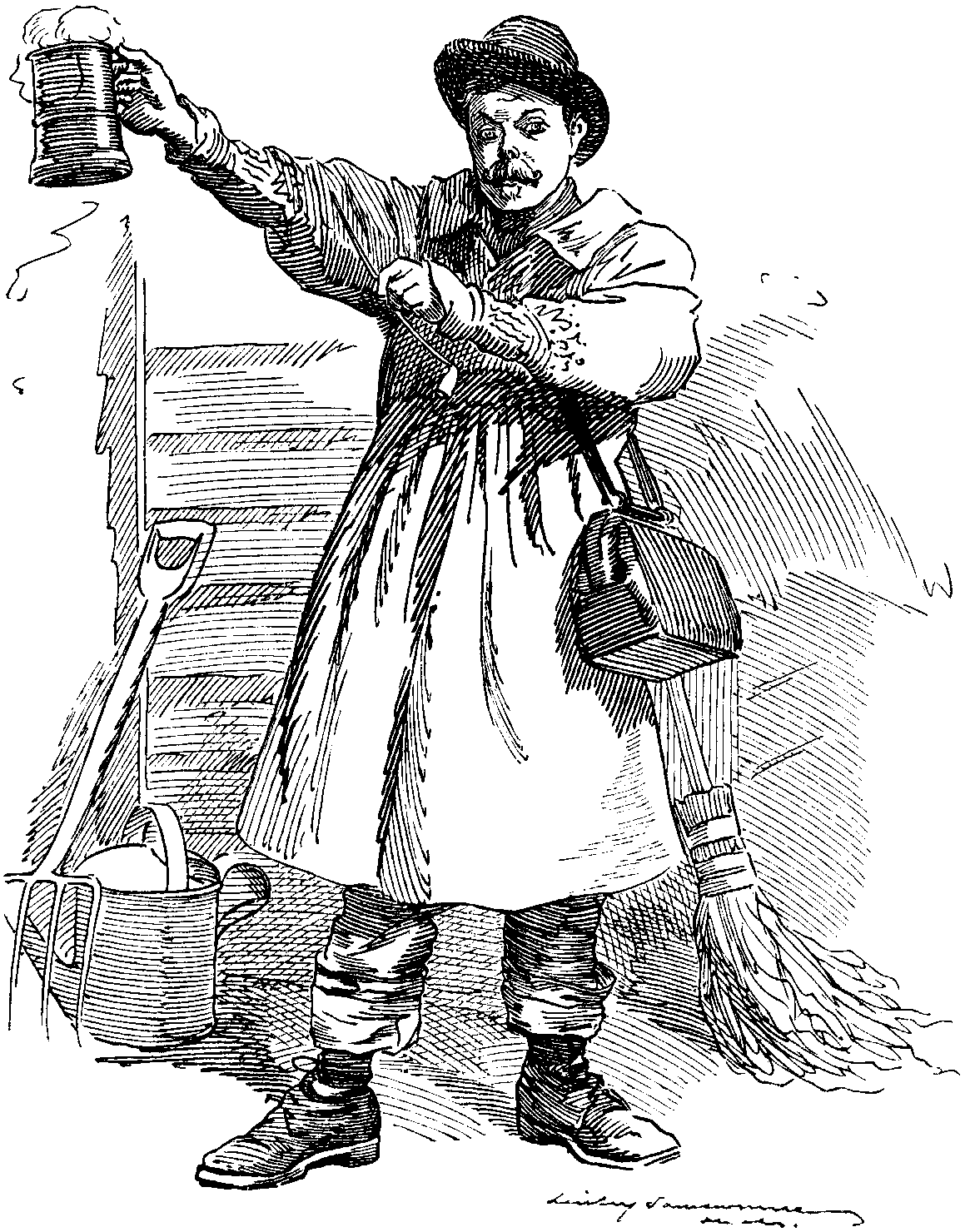
FANCY PORTRAIT.
OUR GRAND YOUNG GARDNER (HERBERT II.),
IN HIS NEW CHARACTER OF THE MINISTER OF AGRICULTURE.
(
With Song
)—"
Here's to the Health of the Parley Mow
!"
SONNET ON CHILLON.
(Where the electric light is now installed in the dungeon of Bonivard.)
Electric lighting, dear to modern mind, Bright in this dungeon! Switzerland, thou art Too mad for things quite fin-de-siècle smart! Surely the trains, that rumble just behind, And Vevey tramcars, in my thoughts consigned To even hotter place, had been enough To scare SAND, HUGO, SHELLEY, in a huff; Make BYRON cast his poem to the wind! Chillon, thy prison may become a place With little marble tables in a row, Where tourists, dressed with artless English grace, May drink their bock or café down below, And foreign penknives rapidly efface The boasted names this light is meant to show.
MUSICAL NOTE.—The most tranquillising, or even somniferous melodies ever composed, must have been those written by the celebrated LULLI. The first thing by LULLI was a "Lulliby."
NEW WORDS TO AN OLD TUNE (AND A SYLLABLE TO SPARE).—Song for the SECRETARY for IRELAND:—"'Tis all for good luck, quoth bould Rory O'Mor-ley."
ALL THE DIFFERENCE—between "Sir G.O.M." and "The G.O.M."