THE BITTER CRY OF THE LONDON RIDER HAGGARD AND JADED.
Reading edition
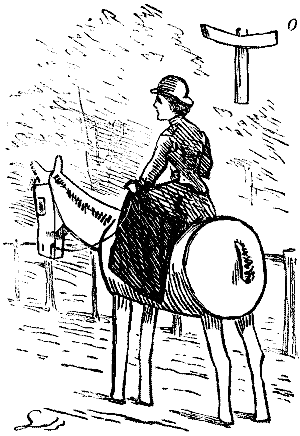
the Chief Commissioners of Works, The Ditto of Police, and to "George" Ranger.
Why not open up rides in Kensington Gardens? Say one good one under the trees from South-West to North-West, and connect Kensington with Bayswater? Will any benefactor to unfortunate Metropolitan Equestrians force this North-West passage?
There is a meagre ride at the side of the road in the Inner Circle, Regent's Park. Why not a good ride right across Park? From considerable observation and experience of Kensington Gardens and Regent's Park, it may be confidently asserted, that such rides as are here proposed, would not interfere with the comfort of a single (or married) nurse or governess with children in her charge. Both places are comparatively unfrequented, and the proposed rides would not infringe upon the recreation of the London boys.
We strongly recommend the Chief Commissioner to visit Paris, and, mounted upon a comfortable horse, let him make the acquaintance of the delightful sentiers laid out as rides in the Bois de Boulogne. This will be a first-rate French exercise for him, and he will learn a great deal from it. The Duke, who is fond of equitation, especially in Battersea Park, must admit that the equestrians of London are very badly off for variety. Up and down Rotten Row, once into the siding by the Barracks, once to the dismal ride on the North side, and once back again by the ride that opens on to the Mausoleum-like Magazine,—which of all London Magazines is the dreariest,—this, and only this, is the daily burden of the patient London rider's song. "How long? How long?" as Mr. Wilson Barrett used to be always exclaiming in The Silver King, or Claudian, or both. How long—will mounted London put up with this, which is the reverse of a merry-go-round?
Then we have to be thankful for the small mercy of a narrow strip of a ride, barely room for one, along Constitution Hill, and for that other strip, a trifle wider, in Birdcage Walk, which is always crowded with children, and one might as well be riding through nursery grounds. Why shouldn't there be here a cut right across the grass, from The Walk of the Birdcages to middle of Piccadilly?
If George Ranger, the Chief Commissioner of Police, and the Chief of the Board of Works would combine, we might get something done which would benefit the riders—riders haggard and jaded—and materially assist the smallest circulation (possessed by those who ride to live) in the world. There is one thing that ought to be put down, and put down with a strong hand,—and that is plenty of gravel at all the gates; but especially round and about the Marble Arch, which is a most dangerously slippery pass.
THE "SILK" EXHIBITION.
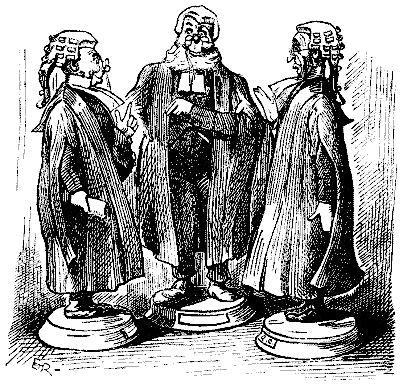
What Our Artist Expected to Find There.
RAILWAY UNPUNCTUALITY REPORT;
Or, What it may probably come to.
That the new Legislation has begun to tell favourably on the conduct of the traffic of the leading lines cannot for a moment be doubted after glancing at the thirteenth Bi-weekly Record, published at the Companies' expense, according to the Provisions of the recent Act, on the back of all their passenger-tickets. It is satisfactory to note how, in something like six weeks, punctuality in the train service seems really almost established, the only train arriving one minute late being one of the Edinburgh Expresses, of which the boiler of the engine blew up at Grantham, thereby causing a little delay, which, however, was picked up before the conclusion of the run by extra steaming. The heavy penal system which the new Legislation has introduced, is, of course, answerable for this delightful change; but a glance at the following table for the six weeks since the Act has come into operation, will show how effectively and rapidly it has worked:—
First week Second, Do. Third, Do. Fourth, Do. Fifth, Do. Sixth, Do. Trains late. Chairmen put in Irons. Directors sentenced to Penal Servitude. Station Masters sentenced to Hard Labour. Other Officials sent to Gaol and Fined.
1725 3 2 1 .... 1 9 1 .. 1 .. 1 95 3 2 1 1* 2 192 17 11 3 .. 5 2004 143 88 15 .. 10
* Precautionary sentence.
The list of officials, as furnished in the above Schedule, undergoing their various periods of punishment, is an encouraging sign to the travelling public, and it is satisfactory to notice that the old unpunctuality that marked the first week, followed up as it was by a rigorous application of the new law, instantly disappeared as if by magic, when the Companies began really to understand their responsibilities and their penalties under the new Act. It is confidently, therefore, to be hoped, that next week's record may possibly be an entirely clean one, and that, the only method of ensuring punctuality, namely, the infliction of a penalty on the Authorities who can control it, may be found in practice to be entirely successful.

Suggestion Gratis.—Why doesn't some enterprising publisher engage Sergeant Palmer of the 19th Knowles's Century Powder Magazine to write a Military Romance? There has been nothing of the sort worth mentioning since Charles Lever. The Sergeant could write under the nom de guerre of Micky Free, Redivivus.
(Signed) Baron de Book-worms.
Q. If several Householders who love peace and quietness on Sunday, should combine to put down the Salvation Army's so-called singing, what Mountains would they resemble?—A. The Hymn Allayers.
THE OPERA-GOER'S DIARY.
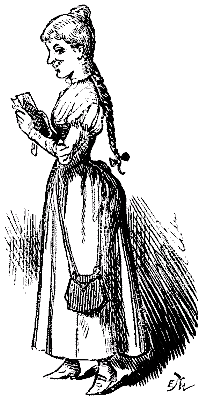
Marguérite Nordica Slybootzen coming home from church.
Monday, May 26.—Faust. Faust-rate performance as far as Jack and Ned de Reszké are concerned. Madame Nordica is far too knowing a Marguérite. The simple Faust, just beginning life, is evidently no match for this guileless young lady. Being "no match for her" is probably the reason for his not marrying her. Nordica charming vocally, but dramatically there is too much of the Becky Sharp about her, and she is merely in a plot with Martha to let in the rich and spoony Juggins called Faust. New man, Franceschetti, as Valentine, not quite the thing: perhaps nervous seeing Dan Drady in front looking at him. Good house for Whit Monday, though of course The Brilliancies are absent. Choruses excellent. What capital match-boxes the old men in the Old Men's Chorus would make! Good contrast between Mlle. Bauermeister as Martha, and Ned de R. as Mephistopheles.
Tuesday.—Glorious Opera, Les Huguenots; French title with Italian names, such as Valentina, Margherita di Valois, Urbano, &c. First appearance of Monsieur Ybos. Why Boss? Always thought Druriolanus was Boss of this Show. Better change name to Y-not-bos, and the answer will come from Druriolanus himself, "Iboss." Monsieur Ybos belongs to the school of Signor Vibrato. Energetic but too angry with Valentina, when she confesses that she loves him. Ella Russell magnificent as sleeveless Queen. Ned de Reszké the best possible Marcello. As Druriolanus, dropping into poetry, observes—
He is the very best Marcello, With a voice like the deepest violoncello.
Monsieur Dufriche as San Bris, "quite the brie," or cheese. Madame Tetrazzini a dramatic Valentina. Dan Drady a first-rate Conte di Nevers-too-late-to-mend. Curfew-Watchman in perfect tune. Soldiers' rataplanatory chorus very nearly perfection at finish, though starting shakily. Little Palladino danced so delightfully as even to bewitch the Hug-me-not soldiers. I've seen this Opera any number of times, and I have been at considerable trouble and expense to master the plot. An idea strikes me. I shall publish Examination Papers on Popular Operas. What the prize will be for the one who answers correctly from memory, without reference to any libretto, is a matter for further consideration. Here is a specimen of examination paper on the Huguenots:—
Act I.—Why is Raoul blindfolded?
What is Miss Valentine doing in somebody else's house?
Why does Raoul's servant come in and sing a hymn?
Why is he apparently pleased when Raoul is blindfolded and taken away?
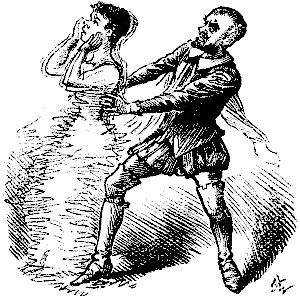
Raoul di Nangis Ybos. "'Tu m'ami!' How dare you! 'Tu m'ami!' I can't tell you how angry I am with you. I'll vibrato you!"
[Shakes himself, and her at the same time.]
Act. II.—Account for the dresses of the bathing-women who come in and dance before the Queen. Where are the machines?
What is the Page's song, "No, no, no, no!" about?
Is Raoul in love with the Queen, or the Queen with Raoul? In either case account reasonably for the subsequent conduct of each of them.
What is the Queen singing about at commencement of Act?
Act III.—What is Valentine doing out in the streets, in a wedding-dress, late at night?
Why do the women turn their backs on the church when they kneel in the streets to say their prayers? Is there no more kneeling-room inside the church? If so, why are people still being admitted while the women are kneeling outside? What service should you say was going on?
Where do the Maritanas with tambourines all come from? And why? Are they the bathing-women in another costume? If so, show their connection with the plot.
After the curfew has sounded, and a man with a lantern has sent everyone to bed, why do all the people suddenly come out of bed again, every one of them all dressed and ready for anything?
What is the Queen doing riding about the town at night on a white horse?
Act IV.—Don't you think the Conspirators are very simple-minded people, not to look behind the curtain where Raoul is hidden? What have the nuns to do with the blessing of the daggers? Wouldn't they be rather in the way in a conspiracy?
On what storey does the action of Act IV. take place, and what is the height from the ground that Raoul has to leap when he jumps out of the window?
There used to be a Fifth Act, with a grand trio and chorale, what has become of it? If played, does anyone stop to hear it? If not played, can audience sue the management, or demand their money back?
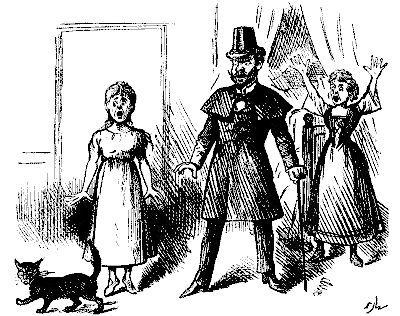
Unexpected effect. Sudden appearance of representative of Katti Lanner.
Thursday.—Memorable for two rentrées and one first appearance. Rentrée of Madame Etelka Gerster, rentrée of Ravelli, and first appearance, on stage, this season, of Covent Garden Cat. Trying position for the sleep-walking heroine in bed-room scene, when the Covent Garden Cat (who was in front last Tuesday night, when she ran round the ledge of the pit tier in humble imitation of little Laurie at Pantomime time) suddenly rushes from under the bed, and after nearly frightening into fits naughty little Lisa Bauermeister, who happens to be hiding there, walks with tail erect quietly across the stage, and makes a good exit R. 2. E. Count Edouard, in commencement-of-nineteenth-century hat and coat, finished off with trousers and patent-leather boots of date A.D. 1890, much amused. Amina supposed to be walking in her sleep, can't possibly take notice of animal, but House in chuckles, as an audience always is, whenever the harmless and quite unnecessary cat appears upon the stage. Rentrée of Ravelli, in first-rate voice. Everyone charmed with him, and with Ned de Reszké. Signor Rinaldino an amusing Alessio, and Madame Sinico tunefully affectionate as the devoted and sympathetic Mamma of the Aminable heroine. Melodies of our childhood, delightful to hear them again; and the good old-fashioned Italian Opera terminations to the choruses admirably rendered.
Friday.—"Dr. Faust, I presume?" I wasn't there. Opera went on, I believe, in my absence.
Saturday.—La Traviata. Ella Russell at her best. Tenor Montariol not quite at his best as that despicable character Alfredo. M. Palermini (why not "Old Pal"?) very good as Giorgio Germont. The magnificently-attired chorus enjoy themselves amazingly at supper in Act I., for Violetta, when she does do the thing, does it well, and there are certainly not less than four bottles of champagne among a hundred guests.
Questions for Examination Paper.—At whose house does this supper-party take place? Why do all the guests leave at once? Why is everyone in a Charles the Second costume except Violetta, who is in fashionable evening dress of 1890? Who is the young lady whom Violetta so affectionately kisses? and what, if anything, has she to do with the plot?
In Act III.—Is it a bal masqué? If not, what is it, and where? What is the simple game of cards which Alfredo plays with such enthusiasm? Who wins? and how much?
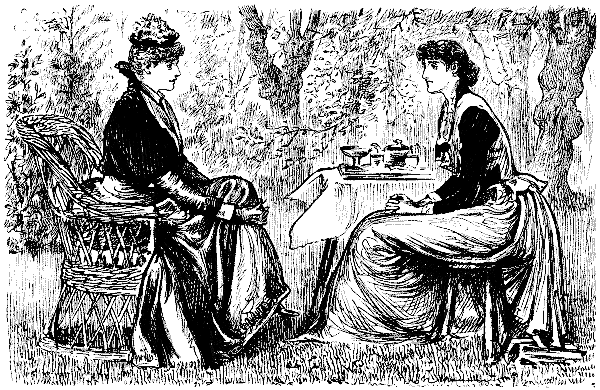
CAUTION.
Married Sister. "And of course, Laura, you will go to Rome or Florence for your Honeymoon?"
Laura. "Oh dear, no! I couldn't think of going further than the Isle of Wight with a Man I know little or nothing of!"
"DOUBTFUL!"
Owner.
Our Stable's a bit out of form (Says more than one usual backer), The pace will be made pretty warm, And the finish will be a rare cracker. By Jove! we must put our best goods in the front, Or possibly we may be out of the hunt.
Trainer.
Come, Sir, don't go talking like that! Cantankerous critics will chatter. Our 'osses can go a rare "bat," Theirs funk it, Sir! That's what's the matter! Eh, Ritchie, my boy? Oh, the crack that you ride Will go, when he once settles into his stride.
Jockey.
My opinion's of little account, But I don't mind admitting, yer honour, I am not dead nuts on my mount. Some say he's as good as a goner. Though the Witlers are on him, of course, to a man, His own brother warn't placed the one time as he ran.
Owner.
The Brother Bung stock, entre nous, All show soft, when it comes to close racing. This horse looks a bit of a "screw,"— There, Goschen, no need for grimacing. I mean no offence; he's well trained, and might win; But—well, backers seem cautious in planking their tin.
Trainer.
Humph! Pencillers have been at work; They'll muck the nag's chance, if they're able. Fatty Caine—the fanatical shirk!— Seems inclined to abandon the Stable. But still Compensation's a horse to my mind. He will finish with fewer before than behind.
Owner.
Ah! but that's not quite good enough, G. Just now what we want's a clear winner. Our new string of cracks numbers three; There's Tithe (who's a timid beginner), Land Purchase, a nailer, and this, your pet nag. The question is, which is the best of the bag?
Land Purchase, now, comes of sound stock (By Tenant-Right out of Coercion), And then I've such faith in his Jock! Nay, Ritchie, I mean no aspersion. You ride very nicely indeed for a "pup;" But Balfour! All's right when the cry's "Arthur's Up!"
Jockey.
Oh! he's a fair scorcher, a brick, With the long legs—and luck—of the "Tinman." But when of the mounts you've the pick, It's hard if you can't score a win, man. You stick me on Land Purchase, guv'nor, and see If the "pup," as you call him, ain't in the first three!
Owner.
Ah, there it is, Goschen, you know; That justifies what I was saying. I fancy this animal's slow, Not sure that his specialty's staying. I think, if we value our Stable—and tin— That we should declare with Land Purchase to win.
[Left discussing it.
DERBY DISAPPOINTMENTS.
To go to Epsom with a view to a day's enjoyment.
To imagine that there is any sport on the road down, and ditto returning.
To believe that a heavy lunch of lukewarm lobster salad and simmering champagne can be taken with impunity.
To fancy that one can get into a train bound for the Downs without losing one's temper.
To think that there is any fun in listening to the ribald songs of street nigger minstrels and Shoreditch gipsies.
To expect that, after taking part in half a dozen drag sweeps, any one of them will turn up trumps.
To presume that you will neither be choked with dust nor drenched with rain before you get home.
Lastly, to back the Winner for £10,000, payable by the Bank of England, to draw the right number at all the West-End Clubs to which you belong, becoming in consequence betrothed to the only and lovely daughter of a millionnaire Duke, and then (on waking) to find it all a dream!
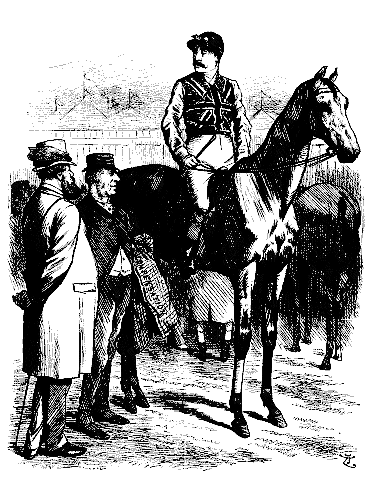
"DOUBTFUL!"
Lord Salisbury (to Trainer). "H'M!—DON'T QUITE LIKE THE LOOK OF HIM. BETTER DECLARE TO WIN WITH LAND PURCHASE!"
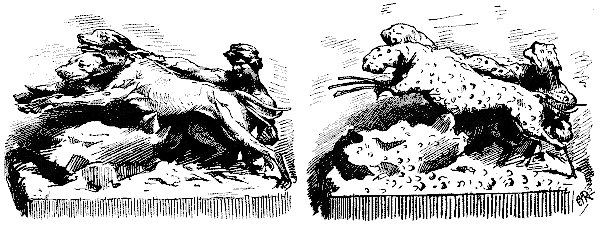
A WARNING IN WAX.
What the Statue looked like when it left the Sculptor's hand for exhibition.
Its appearance when the British Public had ascertained, by experiment, that it really was in wax.