GROSVENOR GEMS. (SECOND VISIT.)
Reading edition
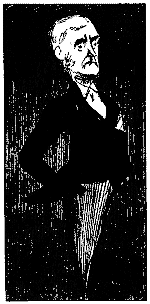
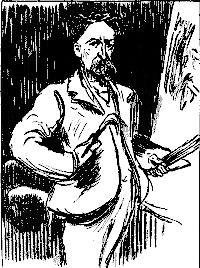
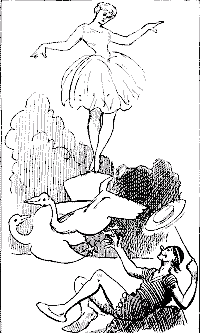
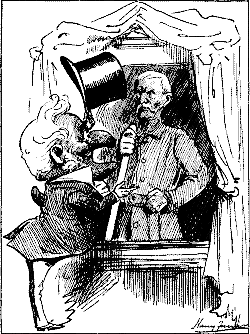
No. 180. Littler and Littler. No. 36. W. Qrious Jaundiceson, R.A. No. 102. Marvellous Acrobatic Feat. No. 140. "Mr. Stanley, I presume?" No. 109. The Dairy Maid and the Butteries.
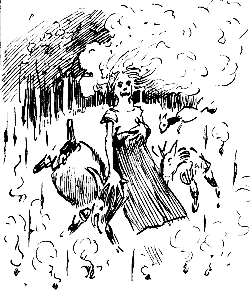
EXCHELSIOR!
Told that I can "assist the progress of Military Science" if I go up in a "War Balloon" at Chelsea. Don't know anything about ballooning, but do want to assist Military Science.
Arrive at Chelsea Exhibition Grounds. See the Balloon being inflated. Disappointed, as a "War Balloon" seems to be exactly the same as a Peace Balloon. Expected it to be armour-plated, or fitted with aërial torpedoes, or something of that sort. Ask Professional Aëronaut if I mayn't take a bomb up with me, and drop it, as practice for war time? Aëronaut scowls fiercely. Asks, "If I want to blow the Balloon to smithereens?" Also asks, "If I have any bombs about me now?" Looks as if he would like to search me! Drop the subject—not the bomb. Still, I should like to know how I can "assist Military Science." Take my place in car nervously.
Somebody shouts, "Let go!" What an extraordinary sensation! Feel as if I had suddenly left digestive portion of my anatomy a mile below me. Have felt same sort of thing in crossing Channel. Look over edge of car. Appalling! Wish I hadn't been such a fool as to come. Ask Professional Aëronaut, "What would happen if a rope broke now?" He replies, sulkily, "your neck would break too." Not comforting. Question is—How long will this last without my being sea-sick?
Also, How am I "assisting progress of Military Science?" Balloon calmer, and not wobbling, thank Heaven! Begin to enjoy the view. How beastly cold it is up here, though! Passing over St. Paul's—suggest to fellow passenger that with a bomb, or better still a pistol, one could "pot" the Dome. Passenger (funny man) says, "Why not try a parashoot?" I laugh heartily, and nearly fall over side. Aëronaut, roughly, "wishes to goodness I'd keep still." I wish to goodness he'd make the Balloon keep still—don't say this, however.
Somewhere over Essex. See distant sea. Aëronaut says, "There's no end of a wind springing up." Heavens! Believe we are drifting out to sea! But I didn't want to "assist progress of Naval Science"—only "Military." Tell Aëronaut this. He says, he's "just going down." Talks as if he were "going down" to breakfast—after "getting up," as we have done! Rather a good joke for mid-air. But is it mid-air? We are descending rapidly. Digestion this time left up in clouds. Tearing along over fields. Balloon pitching and tossing violently. Grapnel thrown out. Catches a cow. Cow runs with us. Idiot! Why can't it stand steady?
Awful crash! Bump, bang, whack! Balloon explodes with fearful report. Yet no reporters present! Remember nothing more. Wake up, and find myself in Hospital of an Essex town. Query—Have I, or have I not, "assisted the progress of Military Science?"
OUR BOOKING-OFFICE.
The Marsh King's Daughter. One of Warne & Co.'s publications for children's amusement, but the illustrations by Jessie Currie are too highly curried, or rather coloured, and the effect is hard and theatrical. By the way, Miss Currie's genius is a trifle wilful; for example, take this situation, which she has chosen to illustrate,—"She ... pointed to a horse. He mounted upon it, and she sprang before him, and held tightly by the mane." Now, asks the Baron, taking for granted the "sprang" is for "sprang up," how would ordinary talent depict this scene? Why, certainly, by showing the girl mounted on the horse, holding on by the mane in front of the man, and the man up behind. Not so Miss Currie. She puts the good man—apparently an Amateur Monk—astride the horse, and she riding behind, holding lightly as it appears, with one hand the broad red crupper, and, with the other, probably, some portion of the Amateur Monk's dressing-gown. But genius must not be fettered.
Æsop Redivivus is delightful, if only for the reappearance of the quaint old woodcuts—some of which, however, the Baron is of opinion, never belonged to the original edition—yet, with a polite bow to Mary Boyle, he would venture to observe that, in his opinion, the revivification is an excellent idea rather thrown away. Whether it would have been better for more or less Boyleing, he is not absolutely certain, but perhaps the notion required a somewhat different treatment. The best of the fables is The Sly Stag, which, according to the woodcut, ought to have been a goat. But there may be some subtle humour in the frequent incongruity between a fable and its pictorial illustration.
The Baron de Book-worms.

Grandolph Victorious.—Rather fresh Easterly-windy weather for racing, last week; glad, therefore, to hear that Grandolph "had a lot on." His Abbesse de Jouarre was not to be stopped by any Father Confessor, and came in first. What will he name his next probable starter? John Wesley?
Recent letters to The Times represent Tangiers to English tourists as the most Tangierble point for a holiday trip.
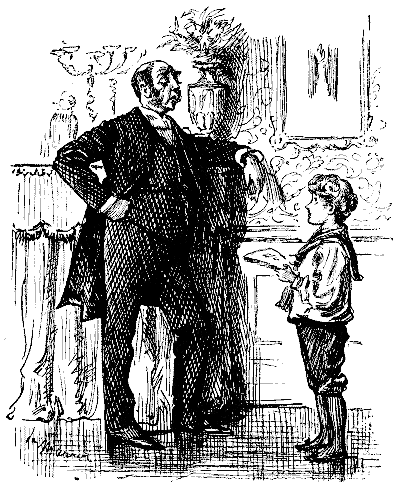
A MINE OF INFORMATION.
"What's a Centaur, Papa?"
"A Centaur, my child, is a Fabulous Creature, now extinct!"
MORE ABOUT TALLEYRAND.
To the Editor of "Punch."
Dear Sir,—You have on many occasions honoured me by inserting my contributions, and consequently it is to you I turn in the present difficulty. A few days since an appeal was made in the columns of one of your contemporaries which it is hard to resist.
À propos of the Talleyrand Autobiography a gentleman, who had given some extracts therefrom, wrote—"What I have quoted shows the charm and interest of the work, but does not discount its publication; and this, I hope, will be enough to enforce on the custodians of the Memoirs the obligation of reflection before continuing to suppress and to frustrate the legitimate curiosity of the public." I have reflected, and, without making any admission, I submit that possibly the following passages may attain the end which the gentleman in question seemingly suggests.
When Talleyrand, in 1801, was at Amiens, assisting Joseph Bonaparte in conducting negotiations with Lord Cornwallis for the final ratification of peace, he had an interview with the representative of England. I give a translation from a paper in my possession:—
"It was already the everlasting opposition of maritime and manufacturing towns that prevented this consummation. When Milor (Cornwallis?) observed, with insular bluntness (bonhomie), 'The outcome will be a new throne (encore une chaise bien décoré) for J. B.' I replied, 'This will certainly not be to the advantage of Son Altesse Joseph (pas pour Josê).'"
Does not this read as if written yesterday? Five years later Talleyrand entered into a direct communication with Fox by letter, and this led to a personal interview with Lord Yarmouth. I make a second quotation:—
"I told Mister-for-laughter (esquire pour rire) that there would be no difficulty in restoring to England Hanover, which was then in possession of Prussia. The Englishman (l'Anglais), who had been imbibing some generous wine (vin ordinaire à dix sous), stammered out that he considered the suggestion piscatorial. 'Milor,' I retorted, with a polite bow, 'to a Yarmouth accustomed to bloaters all things must appear fishy!'"
Considering Talleyrand's flexible mind, and the ease with which he resigned himself to blunders when they did not seem to him dangerous, this judgment, expressed with surprising emphasis, is the most striking condemnation which can be passed on the tone adopted by the British negotiator. With rare skill Talleyrand avoids the dryness usual to memoirs of a personal character. As an instance of this, I give a description of the desertion by the wily diplomatist of Napoleon in 1814, when the Emperor had consented to retire to Elba. That this passage may have additional force, I give it in the original, possibly very original, French:—
"Je n'aime pas lui. Je pensais de cet homme qu'il était un espèce de polichinelle (a quaint sort of puppet), qu'il n'était pas la valeur de son sel (not the value of his salt), et voilà la raison pourquoi je lui vende (why I offered him for sale). Il n'a pu supporter la bienfaisance avec satisfaction, ni les choses bien désagréables avec complaisance."
"He could not bear the things that were disagreeable with complacency." Volumes might be written on that phrase, which at this moment, if we look around us, suggests numerous parallel instances. I have heard a man growl when a plate of soup has been poured by a careless waiter on his dress waistcoat, I have noticed a lady frown when I have myself accidentally torn her train from its body, by treading upon it at an evening party. Talleyrand knew Napoleon—"He could not bear the things that were disagreeable with complacency!" And yet Bonaparte is sometimes called "Le Grand!" (The Great!)
Here I pause, as I feel that I may have already gone too far. It is not for me to say how the document from which I have quoted, came into my possession. But before I satisfy the legitimate curiosity of the public further, I consider it my professional duty to consult the Bar Committee, the Council of the Incorporated Law Society, the President of the Probate, Divorce, and Admiralty Division of the High Court of Justice, and the Lord Chancellor, many of whom are unfortunately still absent, enjoying the Whitsuntide Vacation. I have the honour to be, dear Sir,
Your most obedient Servant,
(Signed) A. Briefless, Junior.
Pump-handle Court, June 2nd, 1890.
A NOVEL WITH A PURPOSE.
Dear Mr. Punch,
How a few hundred pounds may be easily and honestly earned is a problem which daily exercises the imaginations of thousands. I was fortunate enough to hit upon a plan which I now feel it to be my duty to make as widely known as possible for the benefit of those whose need is greater than mine; for, curiously enough, not only did my work bring me in that direct emolument, upon which I not unwarrantably reckoned, but an elderly lady of unstable views was so taken with the chaotic benevolence of my book, that she bequeathed to me a very handsome legacy indeed, and almost immediately enabled me to realise it. Thus does the absolutely unexpected serve as the handmaid of the perfectly unintended, and enterprise retires from the lodgings of struggle to the villa of repose. My plan briefly was to write a quasi-religious Novel with a Purpose. I knew nothing about religion, and had no literary experience, but the purpose I had, and that purpose was, to make enough money to spend six weeks at Herne Bay, a locality to which I am passionately addicted.
A brief sketch of my proceedings will be the best explanation and guide to others. I first bought a sixpenny scrap-album, a pot of paste, and a pair of strong scissors; and a shillingsworth of penny novelettes of various kinds and dates, and a shillingsworth of cheap manuscript-paper completed my outlay. I then took the goods home and got to work. Glancing through the pile of novelettes, I soon found an opening that struck me as most suitable, cut it out, and pasted it in the scrap-book. Now came the chief literary exercise of my task. I had to go carefully through the passage, changing the names of the places and people, and making a few necessary substitutions, e.g., "The cuckoo was calling, and the dove cooing from the neighbouring woodland," would stand in my version "The cuckoo was cuckooing, and the dove calling from the adjacent thicket," while a sky described as "azure" in the original, would figure as "lapis lazuli," or, even blue.
The introduction safely engineered, I took another novelette from the pile, and holding it firmly in the left hand, I grasped the scissors with the thumb and forefinger of the right, cut three or four extracts at random, of rather more than half a column in length, and pasted these in the album, leaving about space enough for a couple of pages of three-volume novel, between each section.
Thus I dealt with my twelve novelettes, and then went through them again, and even again. Then the hard work began. I had to draw up a list of names of my own, and then to go carefully through the extracts, assigning the speeches to the best of my ability to the most suitable of my own characters. This, however, was infinitely less trouble than inventing dialogue, a process for which I always entertained an insuperable aversion. I was also confronted at times by adventures in my extracts which were quite unsuited for the novel with a purpose, which, according to the justest canons, should never get beyond a sprained ankle; and even that has to be handled with the greatest discretion—generally by the wavering curate. So I had in several places to tone down precipices, stay the inflowing tide with more success than King Canute, and stop runaway horses before they had excited alarm in their fair riders, or brought the discarded lover out into the road, saying in a tone of quiet command, "Stop! This cannot be allowed to go any farther."
Next, through the kindness of a friend, who was a householder, I procured a reading ticket for the British Museum Library, and from the writings of Herbert Spencer, Huxley, Emerson, Matthew Arnold, Ruskin, Dr. Momerie, and Mr. Walter Pater, and largely from the more pretentious Reviews and Magazines, I made copious and tolerably bewildering extracts, which I apportioned among the vacant spaces in my story, with more regard to the length than to the circumstances. I next went carefully over the whole, writing in a line here and there to make things smooth and pleasant, and artfully acknowledging the quotations in an incidental manner. The result was a surprisingly interesting and suggestive work, and when I had copied it all out in a fair, clerkly hand, I found no difficulty in disposing of it, to good advantage, to a publisher of repute. The book caught on immensely. I became for one dazzling season a second-rate lion of the first magnitude. I was pointed out by literary celebrities whom nobody knew, to social recruits who knew nobody. I figured prominently in the Saloons of the Mutual-exploitation Societies, and when my name appeared in the minor Society papers among those present at Mrs. Ophir Crowdy's reception, I felt what it was to be famous—and to remain unspoiled.
A word of advice to those who will act upon my suggestions. Pitch your story in the calm domestic key, upon which the depths and obscurities of essayists, philosophers and divines, will come with pleasing incongruity. Thus:—