"GIVEN AWAY WITH A POUND OF TEA!"
Reading edition
A Song of (Imperial) Shop.
Oh, nice little, plump little German boy, Approaching the Counter of B. & Co., You never, most probably, hoped to enjoy In the way of business—a way you know— An opportunity half so good For doing a smart little stroke of trade. Bull's Shopman, you see, is in generous mood, As "wonderful bargains" his wares are arrayed, And treasures,—no wonder you jump with glee! Are "Given away with a Pound of Tea!" Do ut des! That's the motto, of course, The motto of Shop in the Fatherland; It was laid down by Otto with lucid force, And Caprivi its bearings doth understand. But the man at the Counter of John Bull's Stores, The drift of the doctrine seems hardly to grasp; So his Teuton customer collars and scores. He's stolid and 'cute, or he'd stare and gasp To see the possessions of Mr. John B. "Given away with a Pound of Tea!" Pays for 'em? Humph! With a Zanzibar cheque; Like a "Bank of Elegance" counterfeit note, Or a draft on oneself; worth a penny a peck. Such paper as this on the market to float! Giving you what is yours, or at least is not his, In exchange for whatever he happens to want, Is what slangy Sportsmen call "very good biz," For him, though for you, Bull, it looks like a "plant," Have you any more goods, Bull, you'd like to see "Given away with a Pound of Tea?" Kilima Njara, no doubt, was a boon, To the innocent butterfly-hunting boy. (Who sups with the—Teuton, should have a long spoon, For his appetite's eager and dainties don't cloy.) The Hinterland comes in most handy, no doubt, And then that nice bonus of Heligoland! Ah, truly, the Teuton knows what he's about. But Shopman Salisbury, why should he stand And advertise goods of his master J. B. As "Given away with a Pound of Tea?" What's the next article? Pray, do not shrink From "giving a name to it," small German boy; The Shopman so smiles, one might verily think That "parting's" not "sorrow," but what he'll enjoy. "Surrender," and "Scuttle," and all the bad terms Once hurled at "the Shirkers" to roost now return. Where is the last Jingo? One fancies he squirms And invokes Ashmead-Bartlett. Could he Jingos spurn, Do worse—the old Shopman, false W.G.— Than cry, "Given away with a Pound of Tea?" Though a bargain's a bargain, and not a bad stroke When a little good-nature secures a firm friend, Reciprocity all on one side's a poor joke, And a bargain that's bad is a bargain to mend. That German is not yet gone out of the shop, Recall him a moment—to look at that cheque! It may not be one that a banker would stop, But is it "Good Value"? This rede you may reck, Mr. Shopman, sans shame. 'Tis pure fiddle-dedee To give too much away with your Pound of Tea!

HARROW OR HANVER?
From an all-too-brief correspondence in the P. M. G., we learn that Mr. John Addington Symonds is very angry with Mr. Frank Harris for a statement appearing in a Fortnightly Review article of his, that he "went to Hanver at the age of thirteen." Mr. Symonds explains that it was to Harrow that he went at that period of his life, and that he has never been to Hanver at all—which, no doubt, is a matter of great importance to mankind in general. He complains, moreover, that his essay is "villanously ill-edited." Surely this is what Polonius would call "an ill-phrase," and suggests a doubt whether Mr. Symonds cultivated much at Harrow those "ingenuous arts," the study of which "softens the manners and does not permit them to be brutal." Perhaps it is not even now too late for him to pick them up. He might try Hanver.
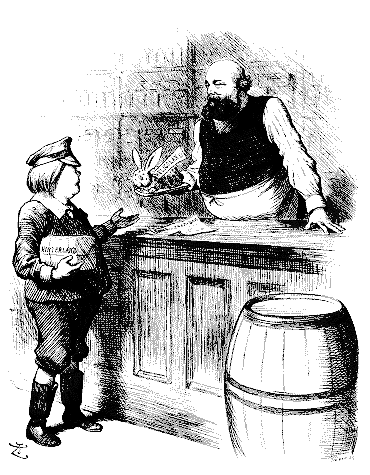
"GIVEN AWAY WITH A POUND OF TEA!!!"
THE LADIES' YEAR.
[Miss Margaret Alford (of Girton) Niece of scholarly Dean Alford, is announced in one of the four "Senior Classes" at Cambridge.
"A Dream of Fair Women"—who shine in the Schools, The Muse should essay ere her ardour quite cools. Come, bards, take your lyres and most carefully tune 'em, For Girton in glory now pairs off with Newnham. Miss Fawcett the latter with victory wreathed, And now, ere the males from their marvel are breathed, Miss Margaret Alford, the niece of the Dean, As a Classical First for the former is seen. Let Girton toast Newnham, and Newnham pledge Girton, And—let male competitors put a brisk "spurt" on, Lest when modern Minerva adds learning to grace, Young Apollo should find himself out of the race!