ESSENCE OF PARLIAMENT.
Reading edition
EXTRACTED FROM THE DIARY OF TOBY, M.P.
House of Commons, Monday, June 16.—"This is something like old times," said Tim Healy, briskly rubbing his hands. "Poor Joseph Gillis! pity he didn't live to see this night."
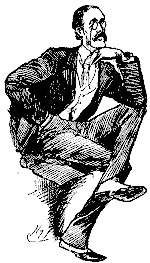
At Bay.
Very like old times, indeed. Seventy questions on the paper, increased fourfold by others put arising out of the answer. Practice is for Irish Members to put question; Prince Arthur reads answer from manuscript supplied from Irish Office; then uprise in succession half-a-dozen other Irish Members, each asking fresh question. Prince Arthur with one leg crossed over other and hand to chin sits looking and listening; presently when there is lull, lounges up to table and makes answer. Fergusson looks on in wonder. "What would become of me," he said, "supposing after I had read out my cut-and-dried answer, half-a-dozen fellows sprang on my back, and with fists in my face demanded reply to quite new question. I'm afraid I'd be lost."
That exceedingly probable. Fergusson's floundering when momentarily adrift from sheet-anchor of his written reply decidedly painful. Prince Arthur saunters up to very mouth of guns of battery opened on him from Irish camp; looks straight down them; fires his shot; and saunters back; often a nasty shot, too; plumps in middle of camp and sets them all a roaring. This takes place every night. To-night lasted an hour. Once threatened repetition of scenes of decade after '74. Would have so happened but for tact and presence of mind of Speaker; cool and collected amid the clash of arms and roar of constant cannonading. John Dillon standing with folded arms and flashing eyes, "Like Napoleon when he couldn't cross the Alps," said Nicholas Wood, looking on from a safe distance.
The Speaker also on his feet with stern cry of "Order! Order!" Long John O'Connor sitting on Bench below, darting straight up and down, with swift regular movement, for all the world like the piston of a steam-engine. Ministerialists bellowing in continuous roar at John Dillon, still on his feet; uprises John O'Connor with intent to offer observation; roar redoubled; reaches demoniac proportions; John O'Connor plops down again; noise partially subsides; suddenly the piston discovered bolt upright; another roar; down it goes; all the while the Speaker crying aloud for "Order!" and John Dillon standing with fiercer frown and arms more tightly folded.
"What was it Napoleon said when he couldn't cross the Alps?" Nicholas whispered, tremulously. "'If the Alps won't come to Mahomet, Mahomet must go to the Alps.' No, I don't think it was quite that; but was something to that effect; and I'm sure something will happen if Dillon doesn't sit down."
Just when matters reaching crisis, Dillon gave way; the piston on the bench below simultaneously ceased its action; and the Speaker, in quiet, grave tones, that had immediately soothing effect, suggested that, if any more information was required, it should be sought in the usual way, by Questions placed on the Paper. Johnston o' Ballykilbeg, who had overheard Gill incidentally allude to Prince Arthur as prone to untruth, wanted the Speaker to take notice of irregularity. But Speaker judiciously deaf. As for John O'Connor, glad of a little rest.
"All I wanted, Toby," he explained, "was to hurl the word 'Crime' in Balfour's teeth."
"Exactly," I said; "nothing more natural or desirable. But you should tone down the tendency towards the steam-engine-piston action, for which, I do not deny, you possess some natural advantages."
Business done.—In Committee on Compensation Bill.
Tuesday.—"What's this I hear about Heligoland?" says Nicholas Wood. Hardly knew him; so changed. A dull, heavy look faded over his usually mobile countenance; his svelte figure puffed out, and bent. "Only fortnight ago, Sage of Queen Anne's Gate proposed to give up Heligoland; barter it for a case of German Sausages, says he. Fergusson very properly angry; me and other good Tories protested against this new Separatist policy. Couldn't find Heligoland on the map."
"Ha!" I say, "but Germany has found it, and taken it, and the Markiss is willin'."
"Very odd," says Nicholas; "can't make it out; like a thing out of a play; never go to a play, you know, but understand this sort of thing is somehow done: first you see it, then you don't; Heligoland British territory; to be sacrificed only with last drop of blood; Radical Separatists rapped on knuckles for suggesting handing over; then we wake up, and find it's been handed over, and by the Markiss! Tell you what it is, Toby, think I shall cut this business; not brought up to politics; find them a little weakening."
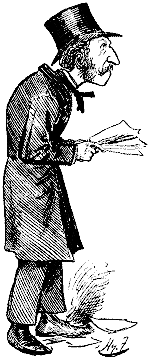
The Ladies' Man.
Old Morality announced programme for remainder of Session. In bulk something exceeding ordinary programme when brought in in February. Now it is the so-called June; every prospect of sitting till October; House groans and growls; terrible charges flying round; Winterbotham darkly accuses Cabinet Minister of keeping a public-house. Hicks-Beach admits soft impeachment, but pleads it's "only a little one, brings me in only £20 a-year rent." "Miserable!" says Newnes, who owns Tit Bits.
General feeling of sympathy with Beach. Winterbotham apologises; if he'd known it was only £20 wouldn't have said anything. Old Morality, in his kind way, presses Beach's hand; has troubles of his own to bear; but a man who owns a public-house and draws only £20 a-year from it, takes precedence in sympathy.
Over stern conflict and cantankerous sitting, Plunket sheds beam of genial humour. Tim Healy asks if there could not be lift arranged to Ladies' Gallery. "Too expensive," says Plunket. "Too dear, he means," murmurs Howorth, who runs Dick Temple close in his devotion to the Ladies. "Why," objects George Campbell, whose eye nothing escapes, "there is already a lift for coal. Why not substitute Ladies for coal?"
"You see," said Plunket, smilingly, "we cannot do either without coal or without Ladies, and it is difficult to combine them in a lift."
George Campbell not sure. When he has time to withdraw his thoughts from Central Asia, will look into the matter.
Business done.—In Committee on Compensation Bill. Ministerial majority reduced to 29.
Thursday.—"I really can't do it," said Maclure. "Oh, you must," said Chaplin; "hard work, I know, but put on a spurt and there you are."
"Wish I was there," said Maclure, mopping his forehead. "All very well for slim young thing like you; but seventeen stun isn't the form for a short spin, especially with these confounded steps." Scene—passage by Cloak-room into House of Commons; time 5·19 P.M.; bell ringing furiously; Division imminent; Penrose Fitzgerald with jacket shorter than ever, trousers turned up with a grace that maddens with envy. Bobby Spencer and Lewisham, on watch at top of staircase.
"Come along!" he shouts; "dividing on First Clause of Compensation Bill; Sage of Queen Anne's Gate sprung a mine on us; got all their men here; ours down at Ascot; wouldn't be you for a quarter's salary, Chaplin. Hurry up! hurry up! Put your best leg forward, Maclure!"
"That's all very well," said Maclure, testily; "but which is my best leg?"
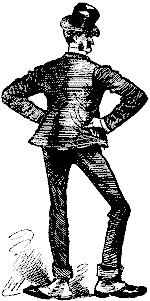
On Outpost Duty.
The two heavy-weights pounded gallantly along; been to Ascot; thought they'd be back in plenty of time for Division; and here's Division-bell at its last shake. Hartington come up with them; striding ahead; wins easily; Chaplin reaches door of House just as it is closing; with tremendous effort, Maclure pulls himself together; throws himself on doorway; nothing could stand rush like that; door bursts open; Maclure and Compensation Bill saved. A very close shave. When Division taken, 228 vote for Government, 224 against; majority Four—the four who raced up the staircase hot from Ascot.
Crowded House in wild excitement. Sage of Queen Anne's Gate consumed in bitterness of spirit. "If we'd divided half an hour ago we should have had majority of 25; a quarter of an hour ago, ten minutes ago, five minutes ago, sixty seconds earlier, we'd have won. But those Irish Shylocks must have their pound of verbosity. Couldn't resist temptation of putting an extra question, even for certainty of defeating Government. When they're once started on subject of shadowing, they go off by the hour."
"Well, never mind," said Gorst; "you know it isn't the first time in history that men have sacrificed the substance for the shadow."
Business done.—The Government's—very nearly.
Friday.—Home Secretary in the Dock; Sir William Harcourt, Q.C., instructed by Mr. Henry Fowler (Messrs. Corser, Fowler, & Langley, Wolverhampton), prosecuted. Prisoner, who was accommodated with a seat, conducted his own defence. After long consultation, Jury could not agree, and were discharged without a verdict.
Business done.—Metropolitan Police Vote agreed to.

THE OPERA-GOER'S DIARY.
Monday.—Carmen. Zélie is the accepted Carmen this season—no better; and Maggie Macintyre as Michaela, which, being an awkward name to pronounce, might be abbreviated to Mickie. Dan Drady the Dramatic, excellent as Escamillo. One singer in a season plays many parts, and one part is played by several singers. How would a theatre succeed conducted on this plan, so that the same play should be produced on certain nights with a different cast? Here is Dan Drady, for example; he plays Escamillo, tragi-comedy, one night; another time he is the noble San Bris in Les Huguenots; another, he is Figaro the loquacious Barber of Seville; another, he is the devil-may-care gallant Don Giovanni; and, though best in serious parts, he is good in all of them. On other occasions, when Carmen is given, the cast will be changed; some other singer will represent Escamillo, or someone will replace Maggie as Mickie; Ravelli the Reliable will have been Don José once, and then Montariol or Ybos (why Boss? Can't yet make this out), or even Jean de Reszké may represent the nincompoop soldier. Suppose A Pair of Spectacles, with a change of cast, Mr. Hare out of it occasionally, and Mr. ... Ah! there's the difficulty, Mr. Who, taking his part. Imagine Faust without Irving as Mephistopheles. What a big Company it would require! No; better leave well alone.
Tuesday.—Faust. Always a safe draw. Same cast as before. Worth noting, that Gounod has given Wagner very little to do in this Opera, and that little not of his best. Evidently Gounod does not possess a strong sense of humour, or he wouldn't have lost such a chance as this. In the Kermesse Scene Wagner should have commenced one of his own Wagnerian strains, in the Wagnerian style, and been immediately stopped by the student's applause.
Wednesday.—Le Nozze di Figaro. Always charming. Should like to see examination paper on the plot of Le Nozze, questions to be answered without any reference to book.
1. Give succinct and clear account of the plot.
2. What connection with plot have Figaro's father and mother?
3. What social position among the Count's guests are the ladies of the ballet supposed to hold?
4. Having stated this, account for their costumes.
5. Why does Mlle. Palladino, the chief dancing guest, take no sort of notice of Il Conte and La Contessa? Are they not on speaking terms? If not, why not?
6. Why is Don Bartolo always made up and costumed as a superior Pantaloon?
Delighted again to see Ella Russell as Susanna. To think that only the other evening she was the graceful and stately Queen Marguerite in Les Huguenots, and now she is a soubrette très piquante. There are other pages in Madame Scalchi's history—the page in the Huguenots, for example, and his twin brother in Lucrezia Borgia—which like me more than her Cherubino. Vocally Dan Drady the Dramatic is all right; but he is too severe for Figaro the barber. Good house considering it is Ascot week, and on this night when such sad rumours are in the air, everyone sincerely delighted at seeing the Marchioness of Lorne in the Royal Box.
Thursday.—Cup Day, Ascot. Roméo et Juliette. Most appropriate: Juliette takes the Cup.
Friday, Don Giovanni; and Saturday, Lucia. This deponent sings, "Not there, not there, my child!" "Eye hath not seen,"—I mean, "I have not seen" these two on these two particular occasions; but I believe that, in consequence of my absence, the Opera went on as usual, and Druriolanus did not have to come before the Curtain and make an apology.