LE 'OCKEY STICK-BALLE FIGHT.
Reading edition
Contributed by Our Own "Sportings-Life" Man.
Mon Cher Monsieur Punch,
I know what interest profound and gracious you have always manifested towards the glorious efforts of the heroic youth of our regenerated athletic France, for have I not read your notices amiable and scientific of les "doings" of our onze at the jeu de Cricquette, and still later of the murderous combat of the veritable "struggle-for-lifers" in le scrimmage of your terrible contest of "Kicke-balle"? But now the valiant youth of our public seminaries have advanced still one more step, and the afternoon of last Tuesday saw, in the leafy arcades of our Bois, a true "stick-balle" fight—in one word, a parti of "Le 'Ockey," played with vrais bâtons, clubs long and terrible, with cruel hooked finish, to the eye of the beholder, and the dangerous white ball, hard as iron, heavy as lead, between a 'ome team and a "side" of strangers, that would have done credit to an "Oxfor-Cambridge" battle or a fight royal, in which Les Roverres de Peckham were themselves engaged.
The costume of the 'ome team, of which I was the General, consisting, as it did, of "knickerbockerres" of pink velvet, jerseys of green and yellow satin in stripes, padded in front and behind, as a protection from les coups de les "stickes," with large feather pillows, and 'igh jack-boots, worn with the same motive, completed, together with a massive iron and wire mask, surmounted with a funereal plume, used to safeguard the head and neck, a costume at once striking and useful. The strangers were, perhaps, not quite so happily arranged, their legs being encased in chain-armour, and their bodies protected by large wicker clothes-washing-baskets; but, though this precautionary costume hampered in some respect the play of their arms, and impeded their swiftness in making "le rush," still, the hardest blow of the death-dealing "stickes" fell on them without pain, and they could meet the approach of the terrible iron-lead ball without the apprehensive tremblings of terror.
The contest, though fierce, was not of long duration, for, after the ninth goal, the iron-lead ball was driven with such furious élan by the victorious side that it dashed into the middle of the spectators, and was swallowed, in the excitement, by the startled horse of an omnibus. Thereupon the Umpire, being appealed to, decided the contest terminated with victory, by three goals to nothing, to the 'ome team, and amidst the prolonged "hurrahs" of the assembled thousands, who represented all the élite of the veritable 'igh and Sporting life of the best Parisian Society, the first day's stick-balle fight that has now introduced "Le 'Ockey" into the arena of our rising National Athletics, came to a brilliant and inspiriting end. I beg you, Mon cher Monsieur Punch, be assured of my highest considerations, as I subscribe myself your very humble serviteur,
The First Champion of Les Sports.

DEFINITIONS.
Mater.—One who finds mates for her daughters.
Check Mate.—A husband with money.
Mrs. R. says:—"My nephew, who has just returned from a long voyage, tells me that in the Red Sea it is so hot that the gentlemen sleep on deck in their bananas."
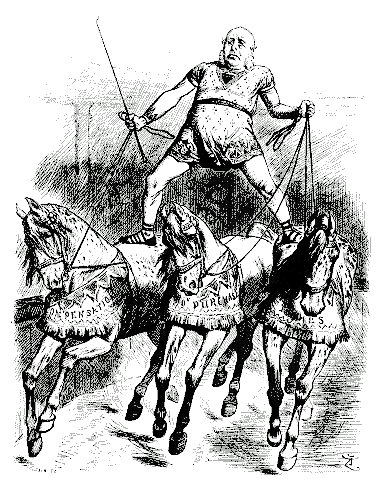
ONE TOO MANY FOR HIM.
Signor W. H. Smithini (sotto voce). "WISH I COULD HAVE KEPT 'EM ALL THREE ABREAST, JUST FOR THE LOOK OF THE THING!"
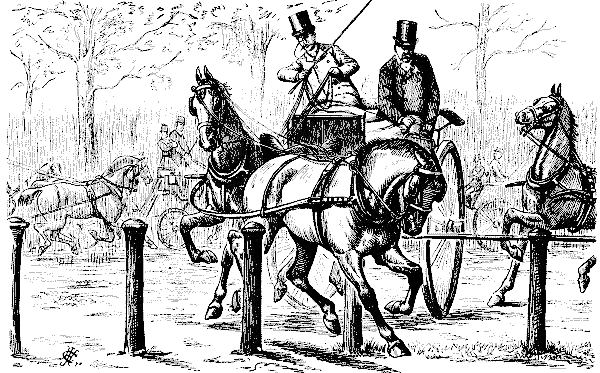
HINTS FOR THE PARK.
Don't try to turn your Tandem at the Trot, particularly if your Leader is of a somewhat wilful disposition.
AFTER "THE MAY."
A Cambridge Song of June.
Out and alas! The "May" is o'er; The polish of the ball-room floor Is streaked and marred by heedless feet, The pretty convoys in the street Stir no more envy, nor make proud The escort of the dainty crowd. No more the archway dark and grim, No more the tortuous staircase dim Wake to a glow of living light, When Jones's sisters, like a flight Of tuneful birds in plumage gay Come into College, in the May. The little girl in grey is gone, Who like a silvery marsh-flower shone What time the long and strenuous train Of eights round Grassy pulled amain. Gone is the musical low voice That made the general heart rejoice, Mazing prim scholars with her wit, Or chattering simply, not a bit Above the sporting schoolboy's range. At that grave dinner, for a change, With just as flattering a charm, She took the formal Tutor's arm, With sparkling eyes, that scattered light On the dark Don's self-centred night. Bare are the windows, flowering then, The cynosure of lingering men, Whence over the darkling court would float The chorus of the College boat; Not shouted with the tuneless zeal Which tells how Undergraduates feel; But by such sweet girl-voices given As might the strictest "gates" have riven, Drawn iron tears down Tutors' cheek, And made Deans grant what loafers seek. And listening oarsmen softly swore To pull as men ne'er pulled before, And, let the next boat do its worst, To make to-morrow's bump, or burst. Out, and alas! May follows May, And other little girls in grey, With hair as bright and eyes as blue, Will hold the torch, pass'd on by you, And none the bygone years recall; For even this May's College pride Will be as dead as flowers that died At some forgotten festival.
Rather Shifty.—"The Members of the Metropolitan Police Force," the Memorial stated, as quoted in the Times of June 13, urged the Government to concede, among other demands, this, which sounds peculiar:—
"Duty to consist of eight hours (in one shift) out of every twenty-four."
The words in brackets are a puzzle. Is "shift" a misprint for "shirt"? Is a Policeman now compelled to wear more than one of these in every twenty-four hours? Is it flannel or linen? We confess that we do not understand this, which we may fairly designate as "The Washerwoman's Clause."
Peregrinus Jocosus writes thus:—"Sir,—I was visiting Tintern Abbey. Admission is by a gateway, close to which is an instruction to ring the bell. How much simpler and pleasanter if the proprietor had written up, 'Tinternabbeylate!'—Yours, much pleased, P. J."
On Army Exams.—As long as Examinations are what they are, cramming is a necessity. Therefore, Mr. Punch has only one retort to present objections to cramming, and that is—"Stuff!"
RECKING THE REDE LECTURE.
"His paramount aim was to make the world better by the humanising influences of literature."—Professor Jebb on Erasmus.
Friend of Colet and of More, Genial wit and learned scholar, Never pedant, prig, or bore. Dulness and the Mighty Dollar Rule too much our world of books; Slang, sensation, crass stupidity; Talk of "oof" and prate of "spooks," Sciolism, sheer aridity; Smartness, which is folly decked In true humour's cast-off raiment, Clap-trap which has never recked Aught save chance of praise and payment; These our literature infest, No Erasmus now arising, Style to purge and taste to test In the way of "humanising." Could you but come back to us, How you'd flay sensation-mongers, Gird at gush, and flout at fuss, Chasten morbid thirsts and hungers: Puncture philosophic sham, "Blugginess," the coarse erotic; Show up callow Cockney "cram," Logic shallow, thought chaotic; Lash our later Euphuism, And the pseudo-Ciceronian; Rottenness of "Realism," Battening in its bogs Serbonian. Thanks, O philosophic Jebb! In this age of advertising, Literature, at a low ebb, Needs a little "humanising."
"On, Stanley!"—The officer whom the explorer did not take with him was his left Tennant.
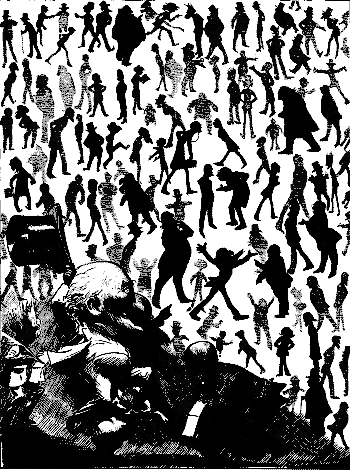
"'SHADOWING' MEMBERS OF PARLIAMENT."
THE MODERN CORNELIA.
[Cornelia, daughter of Scipio Africanus, and wife of Sempronius Gracchus, when a lady displayed her jewels to her, pointed to her two sons, exclaiming, "These are my jewels!"]
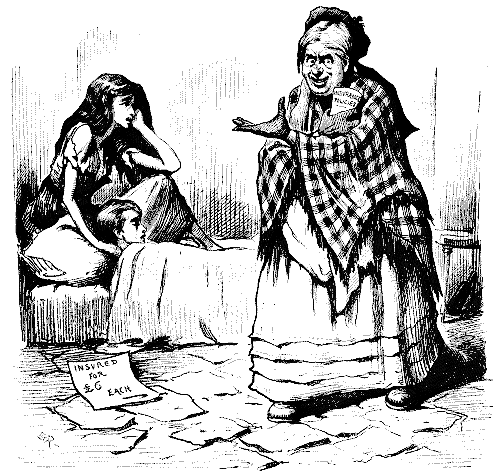
"THESE ARE MY JEWELS."
Timour-Mammon's triumph's full In this grace-abandoned creature. Look at her! A tawdry trull, Blear of eye and blurred of feature From the cult of her god—Drink! Herod's cruel self might shrink From a—Mother, calculating On her children's loss, awaiting With impatience their last breath, And the devilish gains of Death. Such as she, her cronies cry, Are "In luck when children die!" Luck! The luck of willing loss. Children dead bring in the dross. Little Sarah's pale and sickly; Death is near, but comes not quickly, Art may hasten his slow tread. Blows, exposure, hunger, pain, Are auxiliaries of gain, Gain that comes "when Sarah's dead," When to death her "friends" have done her. "We have got four pounds upon her," Babbles little Sarah's brother, Echoing the modern Mother. Wemyss the wise advises "thrift," As the only thing to lift Labour from the Sweater's slough. Laws, he swears, are wholly vain; Thought may scheme, and Love may strain Fruitlessly to raise the brow Of the poor above the slime Of starvation, suffering, crime. Thrift's the thing! Well, here is thrift! Children,—they are fortune's gift. Motherhood to rear them strives? Not so; it insures their lives! Burial Insurance comes As a boon unto the slums. The insurance love may fix At five pounds, or even six; A child's funeral costs a pound, And the balance means—drinks round! Here's the luck of loss, a luck Care may hasten. Blows are struck, Raiment stinted, food denied, Hunger and exposure tried; Infants overlain—by chance! Is it not a Moloch dance? Modern Motherhood, plus Drink, Beats old Moab, will not shrink From child-sacrifice to win, Not a false god's smile, but Gin! Children are possessions, truly, To be sold, and paid for, duly, Pledged like other property, Bringing interest—when they die. Modern Cornelia! That is she, With a semi-drunken glee Aping, all unconsciously, The proud Roman mother's vaunt. "See my jewels! What I want— Dress, and drink, and selfish ease, I can win at will—through these." What was it little Bobby said? "We'll get four pounds when Sarah's dead!" Golden-tongued Peterborough, flay The harpies with your burning breath; And you, brave Waugh, assist to stay This plague of fiends who thrive on death. Cut short the course of callous crime Of this Cornelia of our time!