Volume 159 — TWO STUDIES IN MUSICAL CRITICISM.
Reading edition
(With grateful acknowledgments to "The Times" and "The Morning Post.")
I.
We had quite a hectic time at the Philharmonic—I nearly wrote the Phillemonade—concert last night, what with two Czechs, Dabçik and Ploffskin, slabs of Wagner, and Carl Walbrook's Humorous Variations, "The Quangle Wangle," conducted by Carl himself. If the honest truth be told, we sat down to the Variations with no more pleasurable anticipation than one sits down with in the dentist's chair, preparatory to the application of gags, electric drills and other instruments of odontological torture. (Strange, by the way, that no modernist has translated the horrors of the modern Tusculum into terms of sound and fury!) But we were most agreeably surprised to find ourselves following every one of the forty-nine Variations with breathless interest. Mr. Walbrook is indeed a case of the deformed transformed. We found hardly a trace of the poluphloisboisterous pomposity with which he used to camouflage his dearth of ideas. His main theme is shapely and sinuous, and its treatment in most of the Variations titillated us voluptuously. But, since it is the function of the critic to criticise, let us justify our rôle by noting that the scoring throughout tends to glutinousness, like that of the pre-war Carlsbad plum; further, that a solo on the muted viola against an accompaniment of sixteen sarrusophones is only effective if the sarrusophones are prepared to roar like sucking-doves, which, as Lear would have said, "they seldom if ever do." Still, on the whole the Variations arrided us vastly.
It was a curious but exhilarating experience to hear the Bohemians, the playboys of Central Europe, interpreted in the roast-beef-and-plum-pudding style of the Philharmonic at its beefiest and plummiest. Dabçik survived the treatment fairly well, but poor Ploffskin was simply stodged under. But they were in the same boat with Richard the Elder, whose Venusberg music was given with all the orgiastic exuberance of a Temperance Band at a Sunday-School Treat, recalling the sarcastic jape of old Hans Richter during the rehearsal of the same work: "You play it like teetotalers—which you are not." Yet the orchestra were lavish of violent sonority where it was not required; the well-meaning but unfortunate Mr. Orlo Jimson, who essayed the "Smithy Songs" from Siegfried, being submerged in a very Niagara of noise. Wagner's scoring no doubt is "a bit thick," but then he devised a special "spelunk" (as Bacon says) for his orchestra to lurk in, and there is no cavernous accommodation at the Queen's Hall.
II.
Though fashion considers September as an unpropitious time for the production of novelties, the scheme arranged for the patrons of the Philharmonic Concert last night, under the direction of Sir Henry Peacham, was successful in bringing together an audience of eminently respectable dimensions. The occasion served for the launching under favourable circumstances of what constituted the chief landmark of the programme—a set of orchestral variations with the quaint title of "The Quangle Wangle," from the prolific pen of Mr. Carl Walbrook. It is satisfactory to be able to record the gratifying fact that this work met with cordial acceptance. In the interests of serious art, the borrowing of a title from one of the works of a writer so addicted to levity as Edward Lear may perhaps be deprecated, but there can be no doubt of the ingenuity and sprightliness with which Mr. Walbrook has addressed himself to, and accomplished, his task. If we cannot discover in his composition the manifestation of any pronounced individuality or high artistic uplift, it none the less commands the respect due to the exhibition of a vigorous mentality combined with a notable mastery of orchestral resource and mellifluous modulation. At the conclusion of the performance Mr. Walbrook was constrained to make the transit from the artistes' room to the platform no fewer than three times before the applausive zeal of the audience could be allayed.
The remainder of the scheme was copious and well-contrived. Pleasurable evidence of the friendly interest shown in the fortunes of the Czecho-Slovakian Republic was forthcoming in the performance of two works by composers of that interesting race—Messrs. Dabçik and Ploffskin—of which it may suffice to say that the temperamental peculiarities of the Bohemian genius were elicited with conspicuous brilliancy under the inspiring direction of Sir Henry Peacham. In a vocal item from Siegfried, Mr. Orlo Jimson evinced a sympathetic appreciation of the emotional needs of the situation which augurs favourably for his further progress, and the powerful support furnished him by the orchestra was an important factor in the enjoyment of his praiseworthy efforts. An almost too vivacious rendering of the Venusberg music brought the scheme to a strepitous conclusion. It may, however, be submitted that so realistic an interpretation of the Pagan revelries depicted by the composer is hardly in accordance with the best traditions of the British musical public.
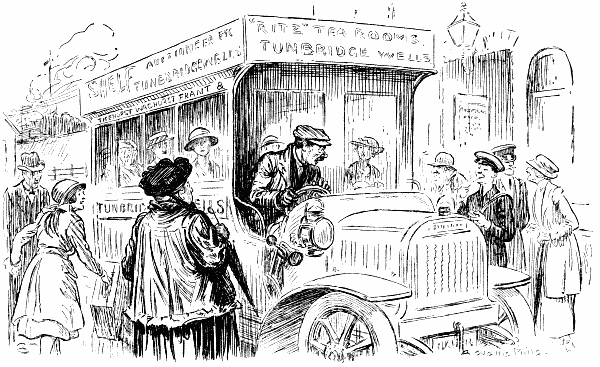
Fussy Old Party (who likes to make sure). "Are you certain you go to Tunbridge Wells?"
Driver (to Conductor). "'Ere, Bill, we are careless. Someone must have pinched the name-boards when we weren't looking."
"There is no such thing as infallibility in rerum naturæ."—Provincial Paper.
Nor, apparently, in journalistic Latin.
"Reward.—Bedroom taken Tuesday, 27th, between Holborn and Woburn-place. A basket and umbrella left."—Daily Paper.
We compliment the victim of this theft on his courtesy in calling the thieves' attention to their oversight.
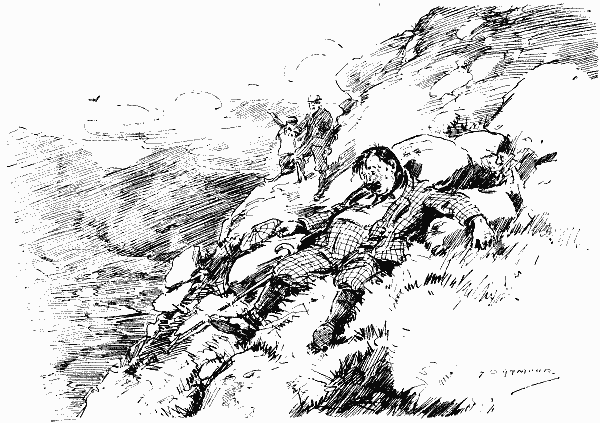
Exhausted War Profiteer. "Deer forests for the 'idle rich' be blowed! The 'new poor' can 'ave 'em for me."