Volume 159 — AT THE PLAY.
Reading edition
"Every Woman's Privilege."
When Dahlia refused the hand of a wealthy middle-aged nut, with faultless knickerbockers and a gift for lucubrated epigrams, preferring to throw in her lot (platonically) with a young and penniless social reformer, we took no notice of those who feared a scandal ("scandals are not what they were," as she said), nor of the girl's assertion that she had no use for the alleged romance of marriage. We were confident that the little god whose image, with bow and arrow, stood in the garden of Dahlia's ancestral home, would put things right for us in the end. Yet we were not greatly annoyed when he made a mess of his business and married her to the wrong man; for in the meantime such strange things had been allowed to occur and the right man had proved such a disappointment that we didn't much care what happened to anybody.
It was the rejected lover, Mortimer Jerrold, who conceived two bright ideas for conquering her independence of mind, apparently for the benefit of his rival. First he contrived to get Harold Glaive, the young socialist, selected as a candidate for Parliament, hoping (if I read the gentleman's motive rightly) that his probable failure would touch the place where her heart should have been. This scheme did not go very well, for he was chosen to contest the seat held by Dahlia's own father (which caused a lot of trouble), and in the result beat him.
Meanwhile Jerrold had had an alternative brain-wave. He thought that if he pinched the latchkey of Dahlia's Bloomsbury flat, broke in at night, and made a show of assaulting her modesty he could prove to her that she was only a poor weak woman after all. Nothing, you would say, could well have been more stupid. Yet, according to Mr. Hastings Turner's showing (and who were we to challenge his authority?) it came off. We were, in fact, asked to believe that a girl who had protested her freedom from all sense of sex was suddenly made conscious of it by the violence of a man whose advances, when decently conducted, had left her cold; and from that moment developed an inclination to marry him. An assault by a tramp or an apache would apparently have served almost as well for the purpose. If this is "Every Woman's Privilege" it is fortunate that so few of them get the chance of exercising it.
Miss Marie Löhr herself came very well out of a play that can hardly add to the author's reputation. Her personality lent itself to a part which demanded a blend of feminine charm with a boyish contempt for romance. And she had a few good things to say. It was not Mr. Hallard's fault if he failed to win our perfect sympathy for a hero whom the heroine addressed as "Spats." As for Mr. Basil Rathbone, who played the part of Harold Glaive, I cannot imagine why he took it on. Apart from his timorous declaration of love, conveyed on a typewriter, there was no colour in it, and nothing whatever to show why his passion petered out. I think that the author, in his surprise at the success of Harold's rival, must have forgotten all about it. Mr. Herbert Ross was excellent as Dahlia's father, a pleasantly futile baronet under the thumb of a sour-tongued managing female, an old-fashioned part in which Miss Helen Rous has nothing to learn. Miss Vane Featherston, as the lady who finally absorbed the baronet, did her little gratuitous piece all right.
I cannot get myself to believe that all these intelligent actors are under any illusion as to the merits of the comedy. With the best wishes in the world for the success of Miss Marie Löhr's enterprises, I am bound to regard it as yet another instance of a play where the attractions of the leading part have a little deranged the judgment of the actor-manager.
O.S.
"The Crossing."
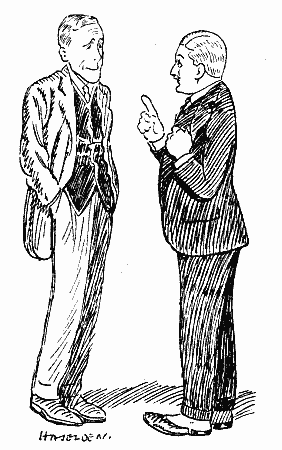
Richard Petafor (Mr. Hubert Harben), the apostle of Materialism and Physical Exercise, trying to convert Antony Grimshaw (Mr. Herbert Marshall), the believer in Mysticism and Armchairs.
Mr. Algernon Blackwood and Mr. Bertram Forsyth (assisted by Mr. Donald Calthrop) present to us in The Crossing a certain Mr. Anthony Grimshaw, a princely egotist of the poetic-idealist type who gets up on the hearth-rug and says to his family, "I am a humanitarian before everything," and things like that, and then wonders why his wife is estranged from him. He has a daughter, Nixie, who is not old enough to know how bad all this is, and together they hear the wind singing glees without words (or in Volapuk, but anyway not intelligible to us poor normals), a thing Mr. Algernon Blackwood has been doing or pretending to do for years without once taking me in.
Anthony is run over and (as we say) dies. After an extraordinarily tiresome conversation in the morning-room with his friend and his son and his mother (who are also what people call dead) it dawns upon him that something odd has happened to himself also. His wife and two children, after his (so-called) death, become blissfully happy and set to work to finish his book, that being, as they think, his wish. Well, I wonder. At any rate in death (as we say) he was not divided—from his egotisms.
One knows well enough, alas, how the temptation to spiritual drug-taking has grown as the result of the accumulated sorrows of these past years, but it is not well that such a treatment of the eternal question should be taken seriously. Is this sort of thing really better than the harp-and-cloud theory? It is not. One looked in vain for any trace of real vision, any true sense of the height and depth of the problem.
Mr. Marshall struggled quite manfully with the part of Anthony, and of course he had his moments. I hope so good a player is not developing the "actor's pause," of which I detected signs. Miss Irene Rooke had nothing in particular to do and did it very well. Mr. Hubert Harben as the impenitent profiteer from Lancashire, Anthony's brother-in-law, was better suited than I have seen him for some time, and provided the very necessary relief. The precocious children infuriated me, but that is purely temperamental. The actors who played the parts of those who had "crossed" were wrapped in such an atmosphere of gloom, to the strains of such meretricious music that (on the evidence) I can only advise people to defer their crossing as long as possible; a thing they will doubtless do, even if they have a friendlier feeling to the new religion than I can command.... I am afraid I proved a bad sailor.
T.