Volume 159 — HONOURS EASY.
Reading edition
I.
Not very long ago the following advertisements appeared in the same column of The Southshire Daily Gazette:
"Lost, a pure black Pekinese dog, wearing a silver badge marked 'Cherub.' Handsome reward offered. F.B., Grand Hotel, Brightbourne."
"Found, a black Pekinese, wearing a silver badge marked 'Cherub.' No reward required. The Limes, Cheviot Road, Brightbourne."
II.
On the same morning the paper was opened and scanned almost simultaneously by Mrs. Frederick Bathurst in the sitting-room which she and her husband occupied at the Grand Hotel, and by Mr. Hartley Friend in the morning-room at "The Limes."
"Oh, Fred," exclaimed Mrs. Bathurst, "Cherub has been found. He's all safe at a house called 'The Limes,' in Cheviot Road. Isn't that splendid?"
"Very good news," said her husband. "I told you not to worry."
"It's a direct answer to prayer," said Mrs. Bathurst. "But—"
"But what?" her husband inquired.
"But I do wish you had taken my advice not to offer any reward. You might so easily have left it open. People aren't so mercenary as all that. It stands to reason that anyone staying at an hotel like this and bringing a dog with them—always an expensive thing to do—and valuing it enough to advertise its loss, would behave properly when the time came."
"I don't know," Mr. Bathurst replied. "Does anything stand to reason? The ordinary dog-thief, holding up an animal to ransom, might be deterred from returning it if no mention of money was made. You remember we decided on that."
"Oh, no, I don't think so. You merely had your way again, that was all. I was always against offering a reward. And the word 'handsome' too. In any case I never agreed to that. You put that in later. Another thing," Mrs. Bathurst continued, "I knew it in some curious way—in my bones, as they say—that the fineness of Cherub's nature, its innocence, its radiant friendliness, would overcome any sordidness in the person who found him, poor darling, all lost and unhappy. No one who has been much with that simple sweet character could fail to be the better for it."
Mr. Bathurst coughed.
"That is so?" his wife persisted.
"Well," said Mr. Bathurst, after helping himself to another egg, "let us hope so, at any rate."
"It's gone beyond mere hope," said his wife triumphantly. "Listen to this;" and she read out the sentence from the second advertisement, "'No reward required.' There," she added, "isn't that proof? I'll go round to Cheviot Road directly after breakfast and say how grateful we are, and bring the darling back."
III.
Meanwhile at "The Limes" Mr. Hartley Friend was pacing the room with impatient steps.
"I do wish you would try to be less impulsive," he was saying to his wife. "Anything in the nature of business you would be so much wiser to leave to me."
"What is it now?" Mrs. Friend asked with perfect placidity.
"This dog," said her husband, "that fastened itself on you in this deplorable way—whatever possessed you to rush into print about it?"
"Of course I rushed, as you say. Think of the feelings of the poor woman who has lost her pet. It was the only kind thing to do."
"'Poor woman' indeed! I assure you she's nothing of the sort. One would think you were a millionaire to be ladling out benefactions like this. 'No reward required.' Fancy not even asking for the price of the advertisement to be refunded!"
"But that would have been so squalid."
"'Squalid!' I've no patience with you. Justice isn't squalor. It's—it's justice. As for your 'poor woman,' listen to this." And he read out the Bathurst advertisement with terrible emphasis on the words "Handsome reward offered." "Do you hear that—'handsome'?"
"Yes, I hear," said his wife amiably; "but that isn't my idea of making money."
"I hope you don't suppose it's mine," said her husband. "But there is such a thing as common sense. Why on earth the accident of this little brute following us home should run us into the expense of an advertisement and a certain amount of food and drink I'm hanged if I can see."
"Well, dear," said his wife with the same amiability, "if you can't see it I can't make you."
IV.
A few minutes later the arrival of "a lady who's come for the Peek" was announced.
"No," said Mr. Friend as his wife rose, "leave it to me. I'll deal with it. The situation is very delicate."
"How can I thank you enough," began Mrs. Bathurst, "for being so kind and generous about our little angel? My husband and I agreed that nothing more charmingly considerate can ever have been done."
At this point Mrs. Friend followed her husband into the room, and Mrs. Bathurst renewed her expressions of gratitude.
"But at any rate," she added to her, "you will permit me to defray the cost of the advertisement? I could not allow you to be at that expense."
Before Mrs. Friend could speak her husband intervened. "No, madam," he said, "I couldn't think of it. Please don't let the mention of money vulgarize a little friendly act like this. We are only too glad to have been the means of reuniting you and your pet."
E.V.L.
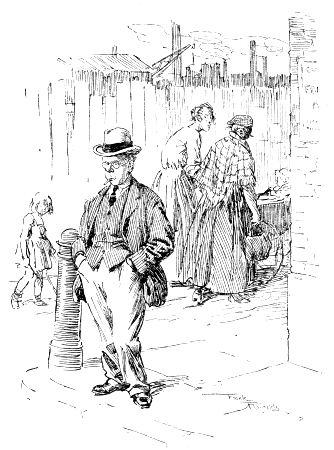
Lady with Pram (who has been pointing out to newcomer the beauties of the neighbourhood, where a strike is threatened). "That's one of the 'Ot 'Eads."
"Rufford Abbey is, of course, a wonderful old place, and all the front, from gable to gable, is genuine tenth-century, built in 1139."—Sunday Times.
It looks as if the ca' canny idea was not so new as we thought it.