Volume 158 — FREUD AND JUNG.
Reading edition
[A reviewer in a recent issue of The Times Literary Supplement asks, "Why should the characters in the psychological novel be invariably horrid?" and is inclined to explain this state of affairs by the undiscriminating study of "the theories of two very estimable gentlemen, the sound of whose names one is beginning to dislike—Messrs. Freud and Jung."]
In Queen Victoria's placid reign, the novelists of note In one respect, at any rate, were all in the same boat; Alike in Richard Feverel and in Aurora Floyd You'll seek in vain for any trace of Messrs. Jung and Freud. They did not fail in colour, for they had their Peacock's tales; Their heroines, I must admit, ran seldom off the rails; They had their apes and angels, but they never once employed The psycho-analytic rules devised by Jung and Freud. They ran a tilt at fraud and guilt, at snobbery and shams; They had no lack of Meredithyrambic epigrams; The types that most appealed to them were not neurasthenoid; They lived, you see, before the day of Messrs. Jung and Freud. (I've searched the last edition of the famous Ency. Brit. And neither of this noble pair is even named in it; Only the men since Nineteen-Ten have properly enjoyed The privilege of studying the works of Jung and Freud.) Their characters, I grieve to say, were never more unclean Than those of ordinary life, in morals or in mien; They had not slummed or fully plumbed with rapture unalloyed The unconscious mind as now defined by Messrs. Jung and Freud. The spiritual shell-shock which these scientists impart Had not enlarged or cleared the dim horizons of their art; They had not learned that mutual love by wedlock is destroyed, As proved by the disciples of the school of Jung and Freud. The hierophants of pure romance, ev'n in its recent mood, From Stevenson to Conrad, such excesses have eschewed; But the psycho-pathologic route was neither mapped nor buoyed Until the new discoveries of Messrs. Jung and Freud. That fiction should be tonic all may readily agree; That its function is emetic I, for one, could never see; And so I'm glad to find The Times Lit. Supp. has grown annoyed At the undiscriminating cult of Messrs. Jung and Freud. Let earnest "educationists" assiduously preach The value of psychology in training those who teach; Let publicists who speak of Mr. George, without the Lloyd, Confound him with quotations from the works of Jung and Freud— But I, were I a despot, quite benevolent, of course, Armed with the last developments of high-explosive force, I'd build a bigger "Bertha," and discharge it in the void Crammed with the novelists who brood on Messrs. Jung and Freud.
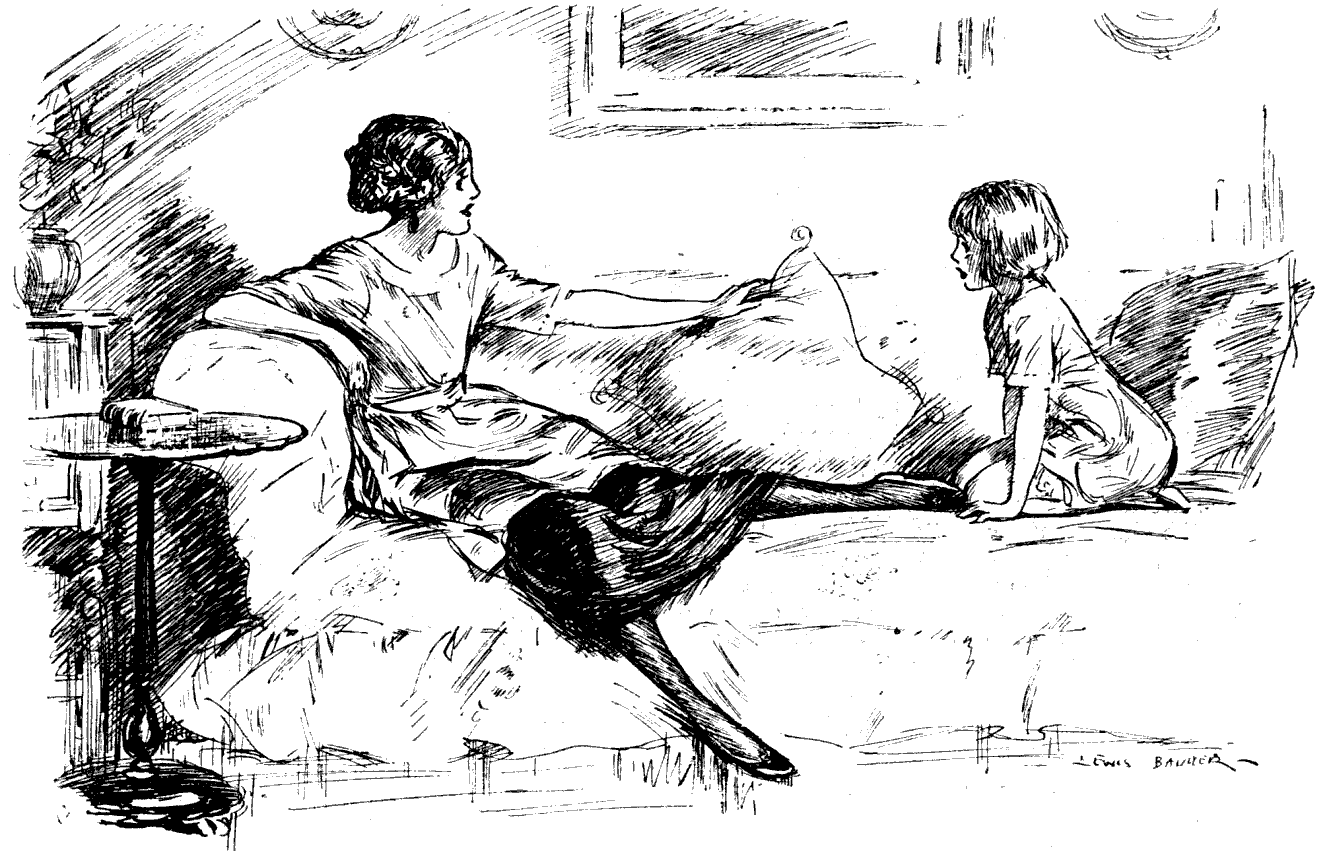
"I s'pose I mustn't go in the garden while you're resting, Mummy?"
"No, dear—it's too damp."
"If I did go in the garden while you're resting, mummy, would you punish me or reason with me?"
OPERATICS.
It has been suggested before now that Opera might be improved if the singing were done behind the scenes and the performance on the stage were carried out in dumb show by competent actors who looked their parts. But the idea that the movements on the stage would correspond with the utterances off it is not encouraged by the present lack of collusion between singers and orchestra—I refer to cases where a performer is required to simulate music on a dummy instrument.
This reflection was forced upon me at a recent performance of Tannhäuser. It is true that Miss Lillian Stanford as the Shepherd fingered her pipe in precise accord with the gentleman who played the music for her. But Mr. Mullings, as Tannhäuser, took the greatest liberties with his harp. He just slapped it whenever he liked, without any regard to the motions of his collaborator. As for Mr. Michael, who played Wolfram, he was content to fill in the vocal pauses with a little suitable strumming; but when he sang he was so distracted by his own voice that he left his harp to play the accompaniment without visible assistance from his hand.
For the fine performance which Mr. Albert Coates conducted I have no word but of praise, except that I could have wished that Miss Elsa Stralia had borne a closer resemblance to what is expected of Elisabeth. She seemed to want to look as much as possible like Venus, whose very opposite she should have been in type as in nature. Her colouring upset the whole scheme of contrast, and one never began to believe in the sincerity of her spiritual ideals or that her death from a broken heart was anything but an affectation.
O.S.
A LEONINE REVIVAL.
Amongst the dead lions of the past, some of us have prematurely reckoned those of Peterborough Court. Matt. Arnold was supposed to have administered, if not the coup de grâce, at any rate a serious blow to their gambollings in Friendship's Garland.
It is therefore a matter for unfeigned rejoicing to find that they are not only alive but rampant, with all their old splendid command of polysyllabic periphrasis. One need only turn to the notice of "The John Exhibition" in last Thursday's Daily Telegraph, from which we select the following page:—
"It [the exhibition] is a display of purposeful portraiture that helps one to realise the effect which Theotokopoulos produced upon his watchful contemporaries, and to understand why the Cretan continued to walk alone on his way. If some insist on finding modern El Greco versions of Inspectors and Inquisitors-general in this John gathering, compounded of comparatively innocuous personalities, the privilege is, of course, permissible, and incidentally brightens conversation in irresponsible circles."
But a higher level of full-throated bravura is attained later on:—
"If reiteration may also be the mark of the best portraiture, pace Lord Fisher, commendation should be given to Mr. John for continuing to visualize the great seaman as Jupiter Tonans flashing in gold lace."
How delightful it is, after the arid methods of the modern critics, bred up on Benedetto Croce, to hear the old authentic leonine ecstasy of Sala, "monarch of the florid quill!" Mr. Punch, once hailed by the D.T. as "the Democritus of Fleet Street," on the strength of his "memorable monosyllabic monition," in turn salutes the immortal protagonist of the purple polysyllable.
WITCHCRAFT.
(A Mediæval Tragedy.)
"I want," said the maiden, glancing round her with tremulous distaste at the stuffed crocodile, the black cat and the cauldron simmering on the hearth, "to see some of your complexion specialities."
"You want nothing of the kind," retorted the witch. "Why prevaricate? A maid with your colour hath small need even of my triple extract of toads' livers. What you have really come for is either a love-potion—" she paused and glanced keenly at her visitor—"or the means to avenge love unrequited."
The maiden had flushed crimson. "I wish he were dead!" she whispered.
"Now you are talking. That wish is, of course, the simplest thing in the world to gratify, if only you are prepared to pay for it. I presume Moddam would not desire anything too easy?"
"He had promised,", broke out the maiden uncontrollably, "to take me to the charity bear-baiting matinée in aid of unemployed ex-Crusaders. The whole thing was arranged. And then at the last moment—"
"Precisely as I had supposed. A case for one of our superior wax images, made to model, with pins complete. Melted before a slow fire ensures the gradual wasting of the original with pangs corresponding to the insertion of each pin."
The customer's fine eyes gleamed. "Give me one."
"I will sell you one," corrected the witch. "But I should warn you. They are not cheap."
"No matter."
"Good. I was about to observe that since our sovereign liege King Richard granted peace to the Saracen the cost both of material and labour hath so parlously risen that I am unable to supply a really reliable article under fifty golden angels."
"I have them here."
"With special pins, of course, extra."
"Take what you will." The maiden flung down a leathern wallet that chinked pleasingly. The witch, having transferred the contents of this to her own pocket, proceeded to fashion the required charm, watched by her client with half-repelled eagerness.
"Hawk's eye, falcon's nose, raven's lock, peacock's clothes," chanted the crone, following the words with her cunning fingers.
"How—how know you him?" Panic was in the voice.
The other laughed unpleasantly. "Doth not the whole district know the Lord Œil-de-Veau by reputation?" She held out the image. "Handle him carefully and use a fresh pin for each record."
The maid snatched it from her hands and was turning towards the door of the hut when a low tap on its outer surface caused her to shrink back alarmed. The witch had again been watching her with an ambiguous smile. "Should Moddam wish to avoid observation," she suggested, "the side exit behind yonder curtain—" In an instant she was alone. Flinging the empty wallet into the darkest corner the witch (not without sundry chuckles) slowly unbarred the entrance.
On the threshold stood a slim female figure enveloped in a cloak. "The love potion I had here last week," began a timid voice, "seems hardly satisfactory. If you stock a stronger quality, no matter how expensive—"
"Step inside," said the witch.
Some couple of months later the ladies of the house-party assembled at Sangazure Castle for the Victory jousts were gathered in the great hall, exchanging gossip and serf-stories in the firelight while awaiting the return of their menkind.
"Hath any heard," lisped one fair young thing, "how fareth the Lord Œil-de-Veau? They tell me that some mysterious ailment hath him in thrall."
At the words the Lady Yolande Sangazure (whom we have met before) was aware of a crimson flood mounting swiftly to her exquisite temples. Strange to add, the same phenomenon might have been observed in a score of damosels belonging to the best families in the district. The hall seemed suffused in a ruddy glow that was certainly not reflected from the exiguous pile of post-Crusading fuel smouldering on the great hearth.
"Tush!" broke in the cracked voice of a withered old dame, "your news is old. Not only hath the so-called fever vanished but my lord himself hath followed it."
"Gone!" The cry was echoed by twenty voices; twenty embroidery-frames fell from forty arrested hands, while nine-and-thirty dismayed eyes fixed themselves upon the maliciously-amused countenance of the speaker. Only one, belonging to the Lady Beauregarde, who squinted slightly, remained as though unmoved by the general commotion.
"Moreover," continued the old dame, "report saith that with him went his leman, who, having some art in necromancy, transformed her beauty to the semblance of a witch and provided her own dowry by the sale, to certain addle-pated wenches, of charms for which her lover himself prepared the market."
"But—his fever?" an impetuous voice broke in.
"Cozening, no doubt. Of course the tale may be but idle babble; still, if true, one would admit that such credulous fools got no more than they deserved."
She ceased, well satisfied. "I fancy," observed the Lady Yolande coldly, "that I hear our lords returning." And in the eloquent silence a score of fair young minds slowly assimilated the profound truth (as fresh to-day as eight hundred years ago) that Satan finds some mischief still for the impecunious demobilised.
TO JESSIE
("one of the Zoo's most popular elephants," now deceased).
Jessie of the melting eye, Wreathed trunk and horny tegum- Ent, whom I have joyed to ply With the fugitive mince-pie And the seasonable legume, Youth has left me; fortune too Flounts my efforts to annex it; Still, I occupy the view, Bored but loath to leave, while you Make the inevitable exit. Ne'er again for blissful rides Shall our shouting offspring clamber Up your broad and beetling sides; Ne'er again, when eventide's Coming turns the skies to amber And the fluting blackbirds call, Poised above a bale of fodder In your well-appointed stall Will you muse upon it all, Patient introspective plodder. Once, an anxious mother's care, Day by day you roamed the jungle, Felt the sunshine, sniffed the air; Life, methinks, was passing fair; But of that no mortal tongue'll Tell. Perhaps you never thought If it bored you or enraptured Till the wily hunter caught You and all your friends and brought Home to England, bound and captured. Jessie, fairest of your race, Now you're gone and few will miss you; There will come to take your place Creatures less replete with grace; Elephants of grosser tissue Will intrigue the public sight; That, old girl, 's the common attitude. Still, these few poor lines I write May preserve your memory bright, Since the pen is dipped in gratitude. Algol.
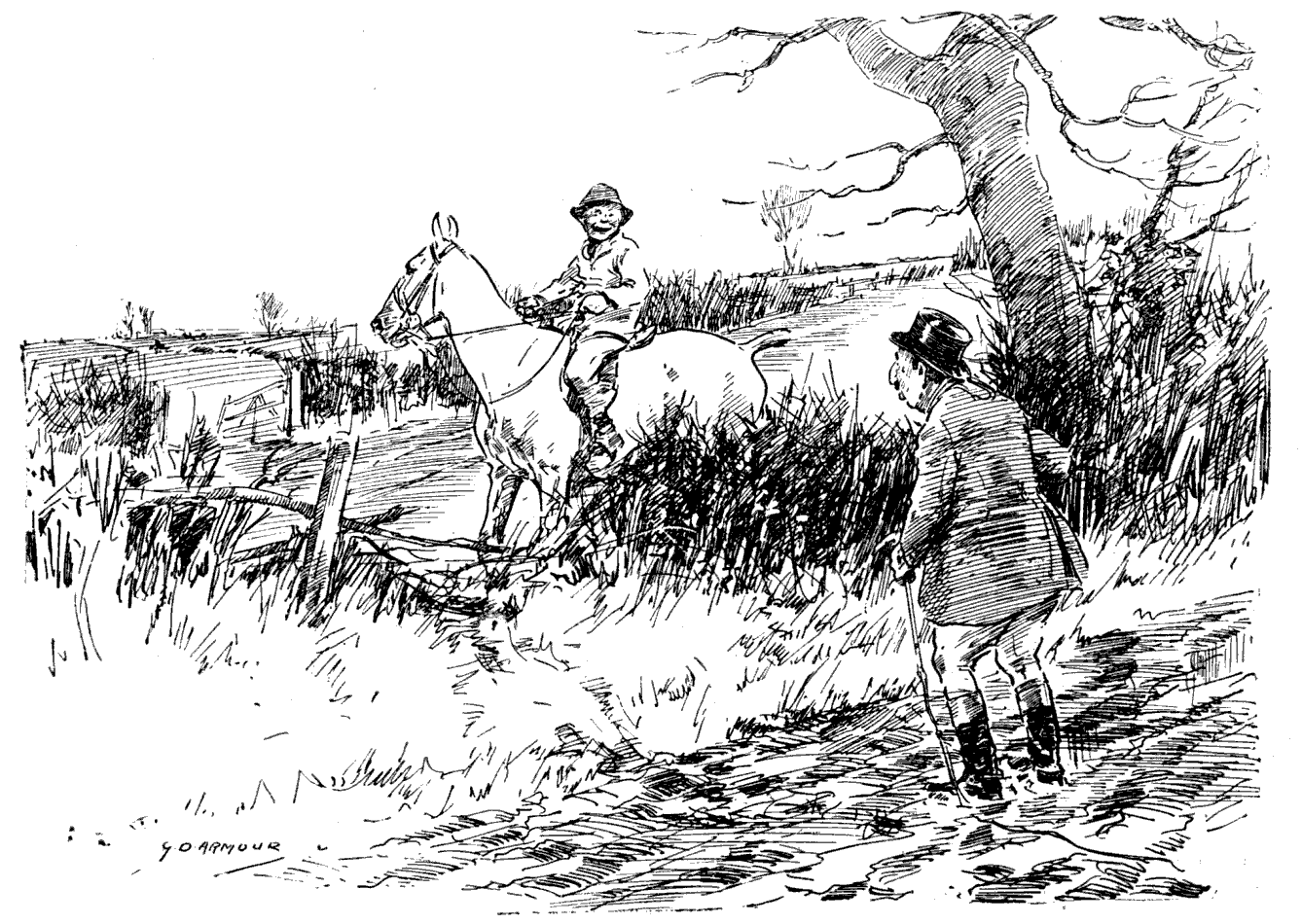
MORE ADVENTURES OF A POST-WAR SPORTSMAN.
P.-W.S. (having struggled over many ploughed fields). "Now then, my lad, fetch 'im over 'ere and I'll give you a tanner."
Bucolic Profiteer. "Noa, ye doan't! Give oi ten bob or oi lets he go again."