Volume 158 — ESSENCE OF PARLIAMENT.
Reading edition
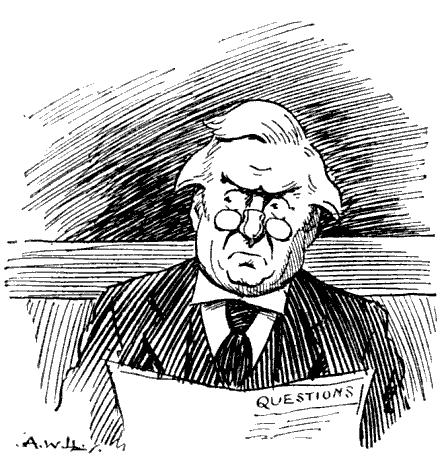
MR. ASQUITH SITS UP AND TAKES NOTICE.
"The Manchester School of Politics is dead and there is no going back to it."—Mr. Neil MacLean.
Monday, March 1st.—Calendar note (extracted from The Wee Free Almanack): "Asquith comes in like a lion."
Everybody wanted to see the victor of Paisley make his rentrée. The Peers' Gallery was so crowded with his former colleagues that Lord Rothermere had scarcely room for the big stick which typifies his present attitude towards the Government. Poor Lord Beaverbrook was quite in the background; but I am told that on historic occasions he always prefers, with characteristic modesty, to be behind the scenes.
As the hero of the hour walked up the floor, escorted by Sir Donald Maclean and Mr. Thorne, his supporters did their best to give him a rousing welcome. But they were too few to produce much effect, and a moment or two later, when Mr. Lloyd George left the Treasury Bench to greet his old chief behind the Speaker's Chair, they were compelled to hear the young bloods of the Coalition "give a louder roar."
Finding the traditional seat of the Leader of the Opposition still in the occupation of Mr. Adamson, Mr. Asquith bestowed himself between the Labour Leader and Mr. Neil Maclean, with whom he entered into conversation. If he was endeavouring to expound for his benefit the moral of Paisley I am afraid he had but a poor success, for in the ensuing debate on food-control the Member for Govan shocked Liberal hearers by declaring that "the Manchester School is dead and there is no going back to it." In opposing the continuance of D.O.R.A. Captain Elliot was again in good form. His best mot, "With the Cabinet a thing is always either sub judice or chose jugée," will take a good deal of beating as a summary of the Ministerial method of answering Questions.
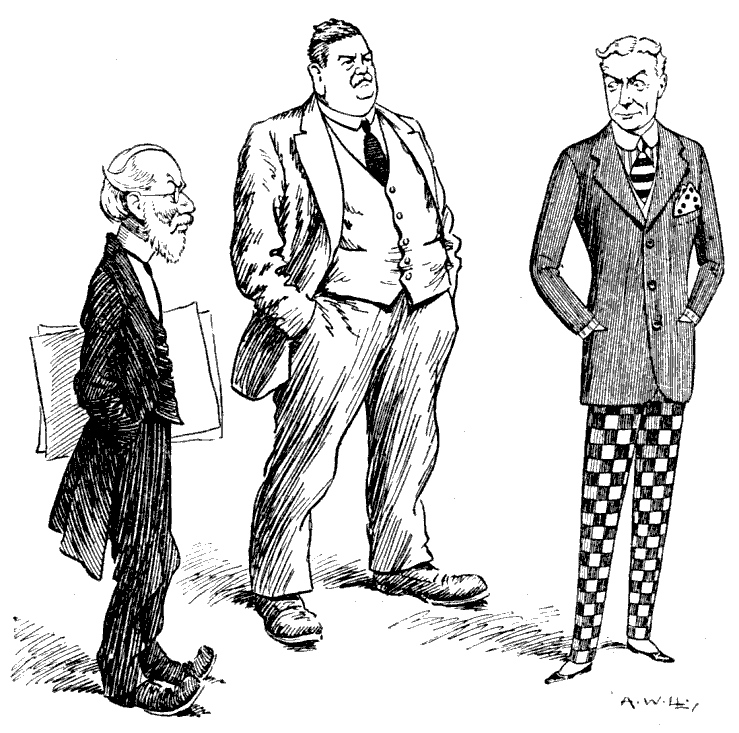
SUPPLEMENTARY QUESTIONS ON THE CLOTHING DIFFICULTY.
Mr. G.R. Thorne to ask Mr. Mallaby-Deeley (Controller of Suitings) what is the price of his latest cut.
Lt.-Col. Will Thorne to ask whether any reduction is made in proportion to quantity of cloth purchased.
I understand that Mr. Mallaby-Deeley disclaims being the customer to whom the Disposals Board sold 577,000 suits of Government clothing. He makes a point of never being over-dressed.
A suggestion that in view of the difficulty of filling diplomatic vacancies the Government should appoint suitable women to some of these posts was declined by the Prime Minister on the ground that it was not practicable at present. I doubt if he would have had the hardihood to make this avowal but that Lady Astor had been ousted from her usual seat by Mr. Pemberton Billing.
Tuesday, March 2nd.—Lieut.-Commander Kenworthy might be described as a pacificist who conducts a persistent offensive. He accused the War Minister of having made a false statement about Conscription in America, and later on made an allusion to General Denikin which Mr. Churchill, to the satisfaction of the House, which does not exactly love the Central Hullaballoonist, described as "a singularly ill-conditioned sneer."
Lord Winterton, once the "baby" of the House, is still one of its most popular figures. Members were quite interested as he proceeded to explain, with an engaging blush, that a "hard case" which he had brought to the notice of the War Minister was his own, and sorry when the Speaker brought the narrative to a sudden stop by observing, "This is not the moment for autobiography."
The First Commissioner of Works was roundly abused for having spent £3,250 on tapestry for Hampton Court Palace. But when it turned out that the panel in question was the long-missing number of a set belonging to Cardinal Wolsey, and that its recovery was largely due to the enterprise and munificence of the right hon. gentleman himself, the House agreed that his completion of "Seven Deadly Sins" was a venial offence.
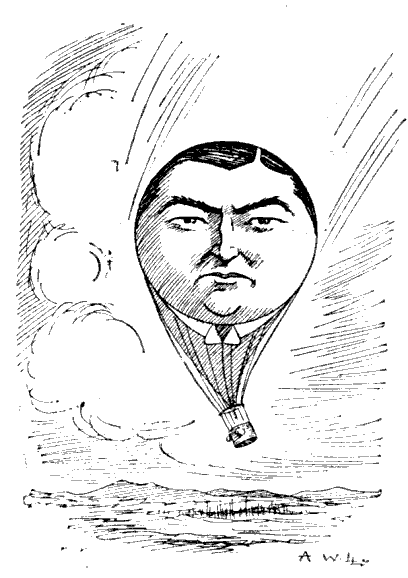
THE HULLABALLOONIST.
Lieut.-Commander Kenworthy.
Other Estimates evoked more healthy criticism. Sir Frederick Banbury was eloquent upon what he called a "hotel for gardeners" at Kew. Mr. Hogge was for rooting up the Royal Botanical Gardens, since they were hardly ever visited by Scotsmen, and Captain Stanley Wilson inveighed against the extravagance with which the British delegates were housed in Paris. Sir Alfred Mond admitted that they "did themselves very well," but pleaded that they could hardly be expected to go to Montmartre—at least not collectively—and pointed out that some of the criticisms should be addressed to other Departments. He was not responsible, for example, for "clothes of typists."
Wednesday, March 3rd.—Among the things that they do better in France, according to Lord Sudeley, is the popularisation of picture-galleries and museums. He instanced the pictures on French match-boxes. But were they always confined to reproductions of Louvre masterpieces? My recollection is that at one time they took a wider range and were distinctly more striking than the matches.
One was reminded of Praed's lines—
"Hume, no doubt, will be taking the sense Of the House on a question of thirteen-pence"—
when the Government very nearly came to grief to-night over a question of five pounds for the Inland Revenue offices in Manchester. In vain Mr. Baldwin pointed out the desirability of giving proper accommodation to the gentlemen who pick our pockets in the interest of the State. The House was still obstinate, until Mr. Bonar Law declared that the Government would resign if they did not get their "fiver." As he undertook, however, not to spend it without further leave, the vote at last went through.
Thursday, March 4th.—Lord Buckmaster's scheme for preventing the bankruptcy of the State is to make everybody invest a portion of his capital in Government securities and to withhold the interest until such time as the State should find it convenient to pay. This, he explained to his own satisfaction, was quite different from that dangerous expedient, a levy on capital. Lord Peel took a more cheerful view of the situation, and indicated that it was quite unnecessary for noble lords to get the wind up, since the Government would have no difficulty in raising it.
Even the most rigid economists will not cavil at the latest addition to our financial burdens. The Pensions Minister announced an addition of close on two millions a year to the annual charge. The increase is chiefly for a much-needed improvement in the allowances made to disabled officers, who have hitherto been but scurvily treated.
Mr. Higham objected to receiving an answer about the telephones from Mr. Pike Pease. He demanded a reply from the Prime Minister, not from a representative of the department impugned. The Speaker, however, pointed out that there were limits to the Premier's responsibilities: "He does not run the whole show." After this descent into the vernacular I half-expected that Mr. Lowther would dam the stream of Supplementaries that followed with, "Oh, ring off!" but he contented himself with calling the next Question.
The debate on the Third Reading of the War Emergency Laws (Continuance) Bill was chiefly devoted to Ireland. Captain Wedgwood Benn, after spending a whole week in that country, is convinced that all the trouble is due to the Government's reliance upon D.O.R.A., and declared that the only people who were not in gaol were the murderers. That would mean that there are some four million assassins in Ireland; which I feel sure is an exaggeration. The two hundred thousand mentioned by the Chief Secretary would seem to be ample for any country save Russia.
Scarcely was this gloomy episode over than the House was called upon to pass a Supplementary Estimate of £860 for "Peace Celebrations in Ireland." As £500 of this sum was for flags and decorations, which, in Mr. Baldwin's phrase, "remain for future use," the Irish outlook may, after all, be not quite so black as it is painted.
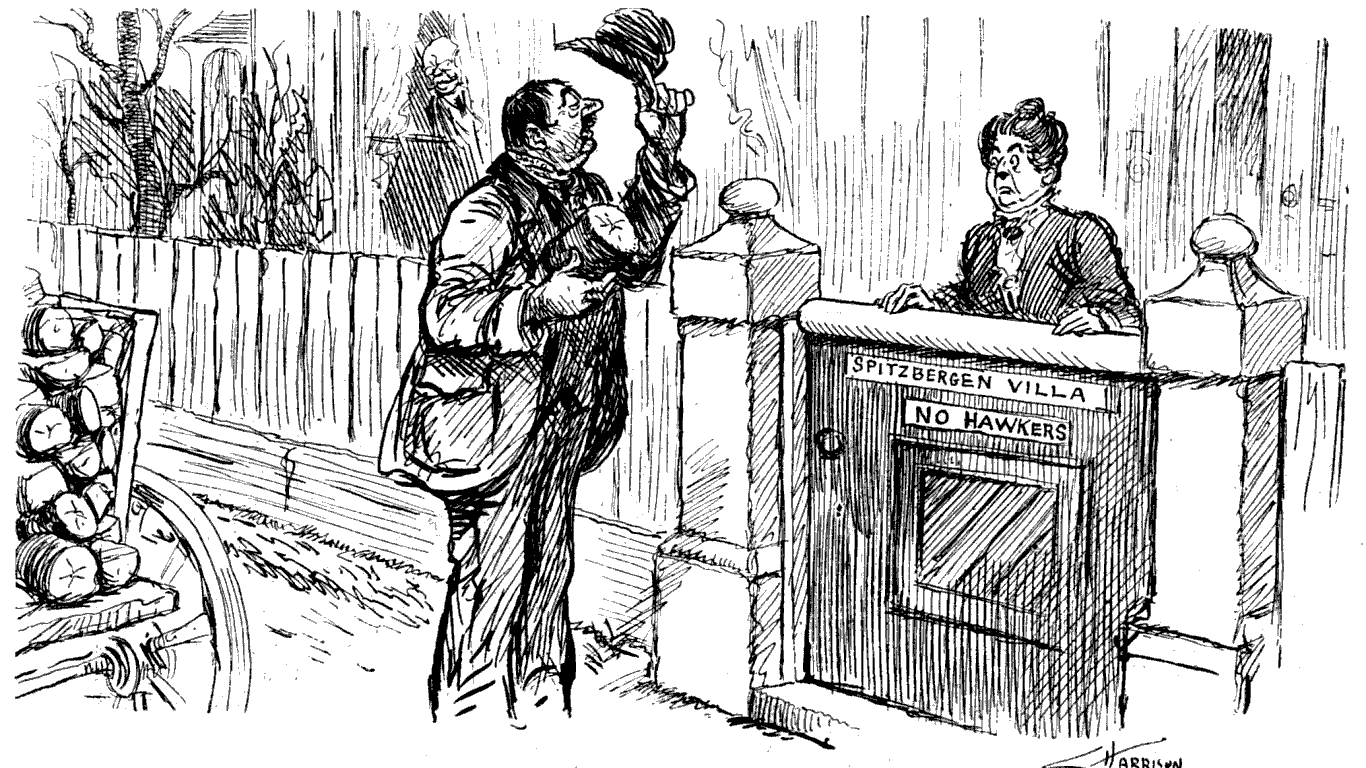
Hawker (to lady who is in bitter need of fuel). "Eager as I am, Madam, to explain the merits of these logs at fourteen shillings a hundred, I cannot ignore the notice emblazoned on your gate, and therefore wish you a very good day."
A BUY ELECTION.
[The excellent precedent set by Mr. Mallaby-Deeley in supplying needed goods at cheap rates may prove a little awkward if adopted by Parliamentary Candidates, as shown in the following anticipatory report.]
Quiet confidence reigned in the ranks of the Muddleboro Labour Party. The action of their Candidate, Mr. Dulham, in arranging for a co-operative milk supply at sixpence per quart, was supposed to have won the hearts of all householders. They had no fear of Mr. Coddem, the representative of the great Bottomley party. It was true that Mr. Coddem had taken over a local brewery and was supplying beer at threepence per pint. But the Labour stalwarts argued that, in the first place, this would lose him the women's and temperance vote, and, in the second place, the electors would drink the brewery dry in double-quick time. All those who failed to get cheap beer would revenge themselves on the Candidate who had failed to keep his promise.
The Wee Free cause was nearly hopeless. Their candidate, Mr. Guff, had made a desperate bid for popularity by offering, in conjunction with The Daily News, cocoa at reduced rates. But the Labour Candidate had put the pointed question, "Who made cocoa dear in the first place?" and Mr. Guff had evaded the question.
When Mr. Stilts, the National Party Candidate, promised the public cheaper honours—urging that, if he were returned, it would be unnecessary to subscribe to party funds to get a title—the voters were quite unmoved. Perhaps they knew that they could get the O.B.E. for nothing, anyhow, and had no higher ambitions.
The Coalition Candidate, Mr. Jenkins, alone said nothing. The Star, that famous organ of the Anti-Gambling Party, proclaimed triumphantly that the odds offered in the constituency were ten to one against Jenkins. But Mr. Jenkins lay low and said nothing. Or rather he achieved the not impossible feat in a Parliamentary contest of saying nothing and saying a good deal.
But the day before the poll Mr. Jenkins's polling cards were delivered. They were headed, "Vote for Jenkins and Kill Profiteering. Give up this card at your polling-station for free samples of silks in my great blouse offer. I sell for 9s. 11¾d. a blouse usually priced at two guineas. Not more than six sold to any one voter. Out Sizes no Extra Charge."
A quarter-mile queue of lady-voters was standing outside the polling booths at eight o'clock. Hundreds of them had their husbands in custody with them. In vain were representations of the Full Milk Jug and the Flowing Pint Pot paraded before them. The Wee Free procession, headed by a Brimming Cocoa Cup, was received with jeers.
When the poll was declared the figures ran—
Jenkins (Coalition) ... 20,428 Coddem (Bottomley) ... 9,344 Dulham (Labour) ... 9,028 Guff (Wee Free) ... 2,008 Stilts (National Party) ... 49
And The Daily News' headline the next day was—
"Corrupt Minority Candidate Carries Muddleboro."
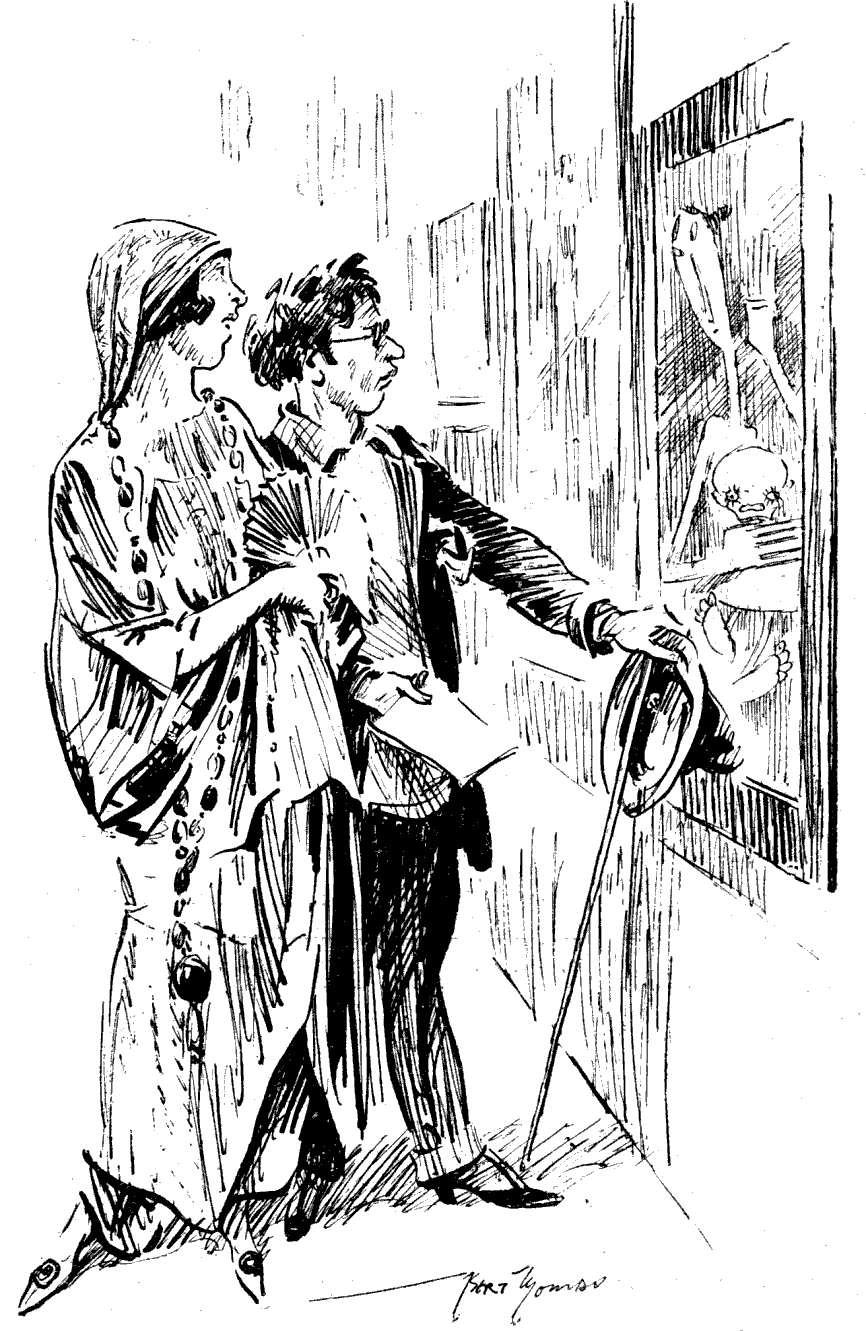
DÉMODÉ.
She. "Somewhat archaic— what?"
He. "Ye—es. All right six weeks ago. Quite academical now."
Commercial Candour.
From a poultry-breeder's advertisement:—
"My strains of Rhodes are only too well known."
"Miss Winnie ——, the charming and talented actress, writes:—'I am quite positive—I owe my present health and spirits to ——.'"—Advt. in Daily Paper.
"Poor Miss Winnie —— has had to retire suddenly from the revue—doctor's orders."—Same paper, same day.
We should have liked to hear the Advertisement Manager's view of the News Editor.
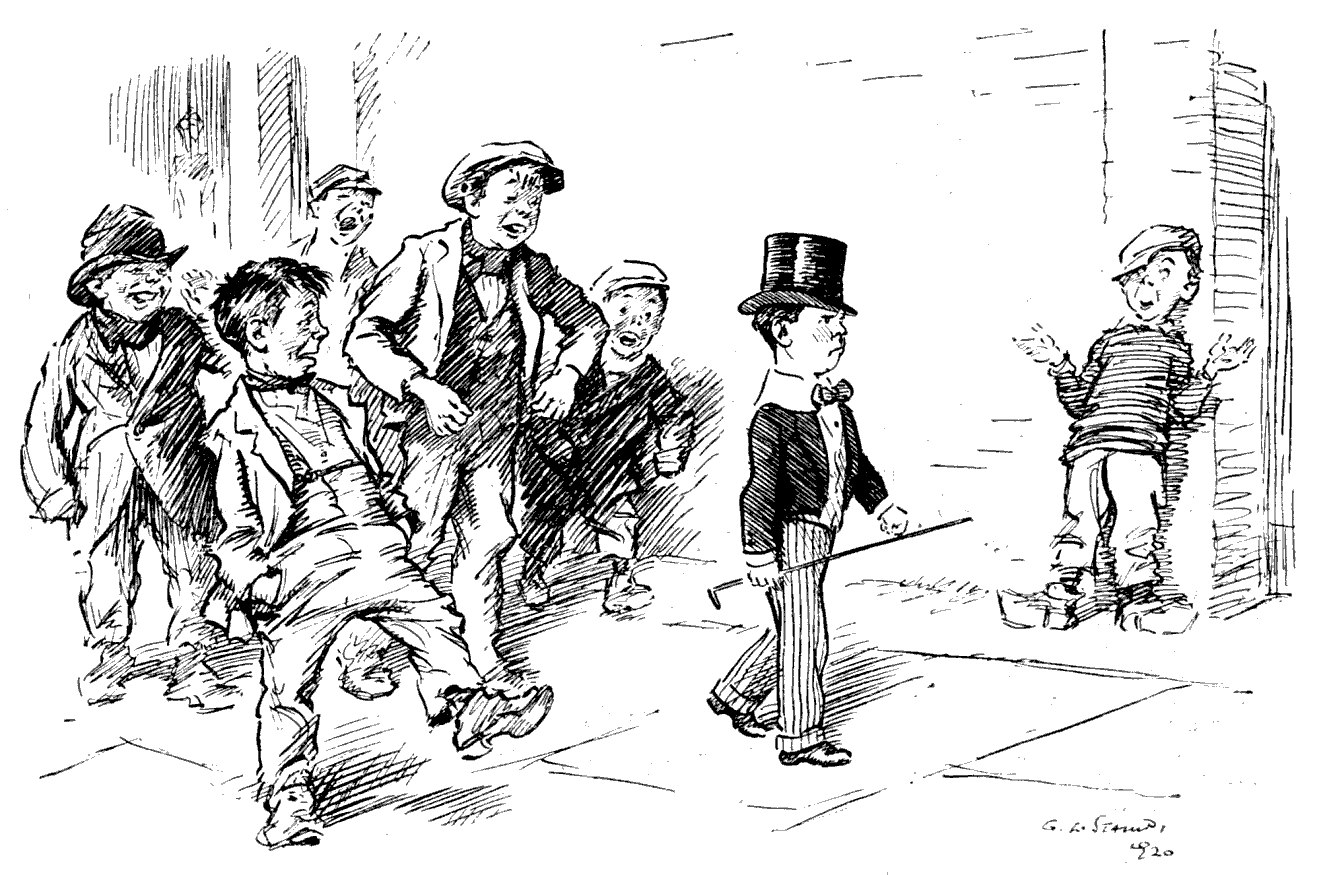
"Oo, Lumme! Wot price Reginald in 'is Mallaby-Deeleys?"