Volume 158 — THE ORDER OF THE B.S.O.
Reading edition
One of the oldest of Mr. Punch's young men thought he would like to hear some orchestral music on Monday week last, so he dropped in at the Queen's Hall to assist at a concert of the new British Symphony Orchestra. The name of the founder and conductor, Mr. Raymond Roze, was already familiar, for Mr. Punch's young man was old enough to remember Mr. Roze's mother, Marie Roze, in her brilliant prime as prima donna of the Carl Rosa Company; and he is glad to know that she is still living in her beloved Paris, where she was decorated by M. Thiers for her gallant conduct during the siege of 1870. So it is pleasant to find her son so actively associated in the good work of finding permanent musical engagements for demobilised soldiers in the British Symphony Orchestra.
The B.S.O. men are not home-keeping soldiers. Every one of them has served over-seas, and it was a pity that their names and the record of their services were not printed in the programme, for it is a fine and inspiriting list, and a striking disproof of the old tradition that musicians must needs be long-haired, sallow and unathletic. Alert and young and vigorous they appealed to the eye as well as to the ear, and they played, as they fought, gloriously, these minstrel boys who had all gone to the War. Strings and woodwind, brass and percussion, all are up to the best professional level.
There is no movement which has a stronger claim on all men and women of goodwill than that for providing employment for demobilized soldiers, and the British Symphony Orchestra is a first-rate contribution to that desirable end. The personnel of the orchestra is all that can be desired. It was bad luck that Mr. Raymond Roze was prevented by illness from conducting last week, but the band was fortunate in securing an admirable substitute in Mr. Frank Bridge. Mr. Punch gives the scheme his blessing without reserve, but with a word of advice. To win for the B.S.O. the success it deserves will need good judgment as well as energy and efficiency. The art of programme-framing has to be studied with especial care in view of the powerful but, we believe, perfectly friendly competition of other established organizations. Last week's programme had its beaux moments, but it had also at least two mauvais quarts d'heure. The men, however, were splendid.
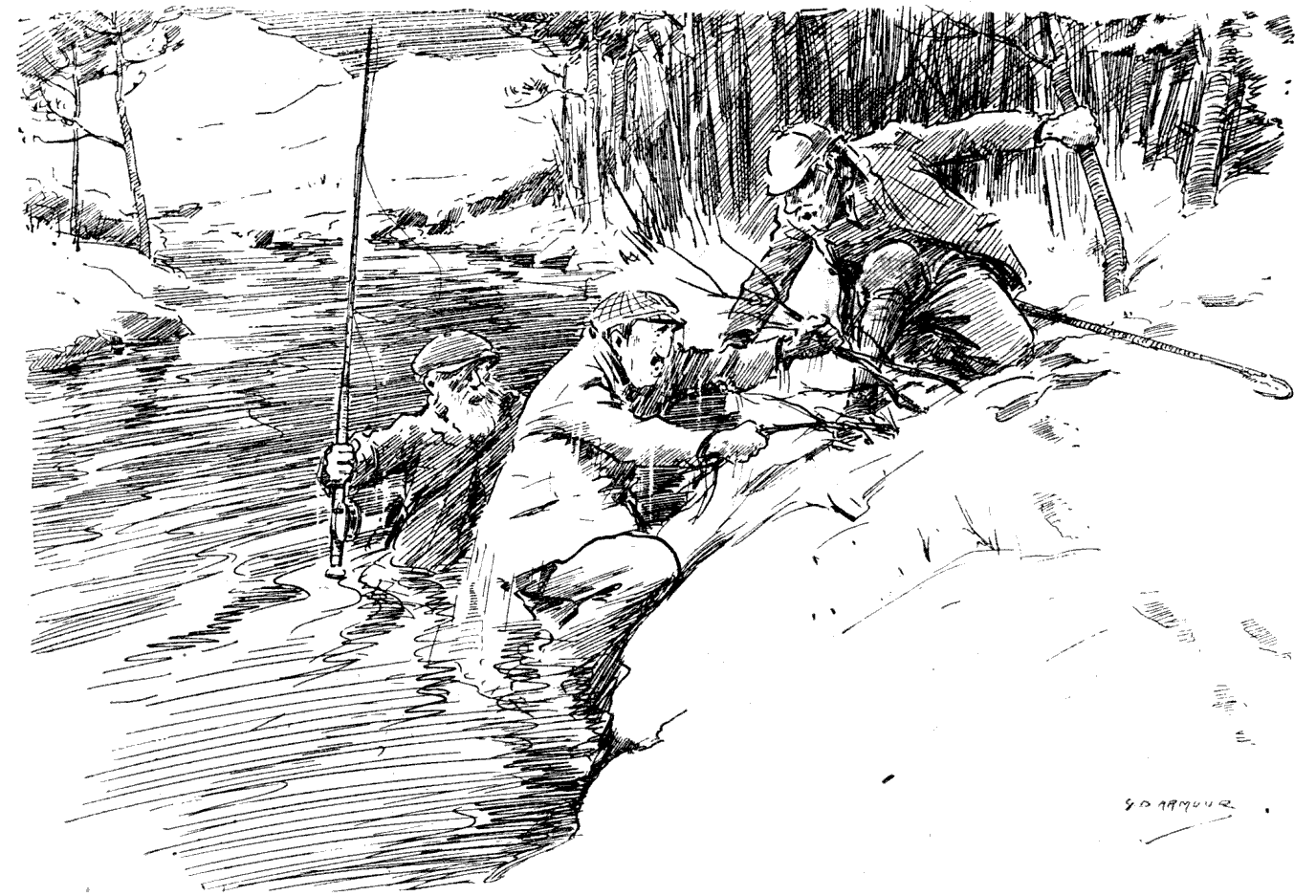
MORE ADVENTURES OF A POST-WAR SPORTSMAN.
P.W.S. (who has taken a Spring fishing). "And this is what I've paid three 'undred quid for!"
The New Colour: Asquithian Rose.
"To-day everything Asquithian has a rosy hue. To begin with, there arrived a horseshoe of white chrysanthemums with the words 'Good luck' worked in green."—Daily Paper.
"Shakespeare's 'Otehllo' has fallen upon evil days."—Evening Paper.
It certainly seems to be having a bad spell.
"The vexed question, 'What is a new-laid egg?' is at present confronting a committee of poultry experts."—Daily Telegraph.
The Committee should invite a hen to sit on it.
An "under-cut":—
"Earl Beatty is setting an example in hustle at the Admiralty. Photographed yesterday hurrying to lunch."—Daily Paper.
His Lordship's example is superfluous. The Admiralty has nothing to learn about hurrying to lunch.
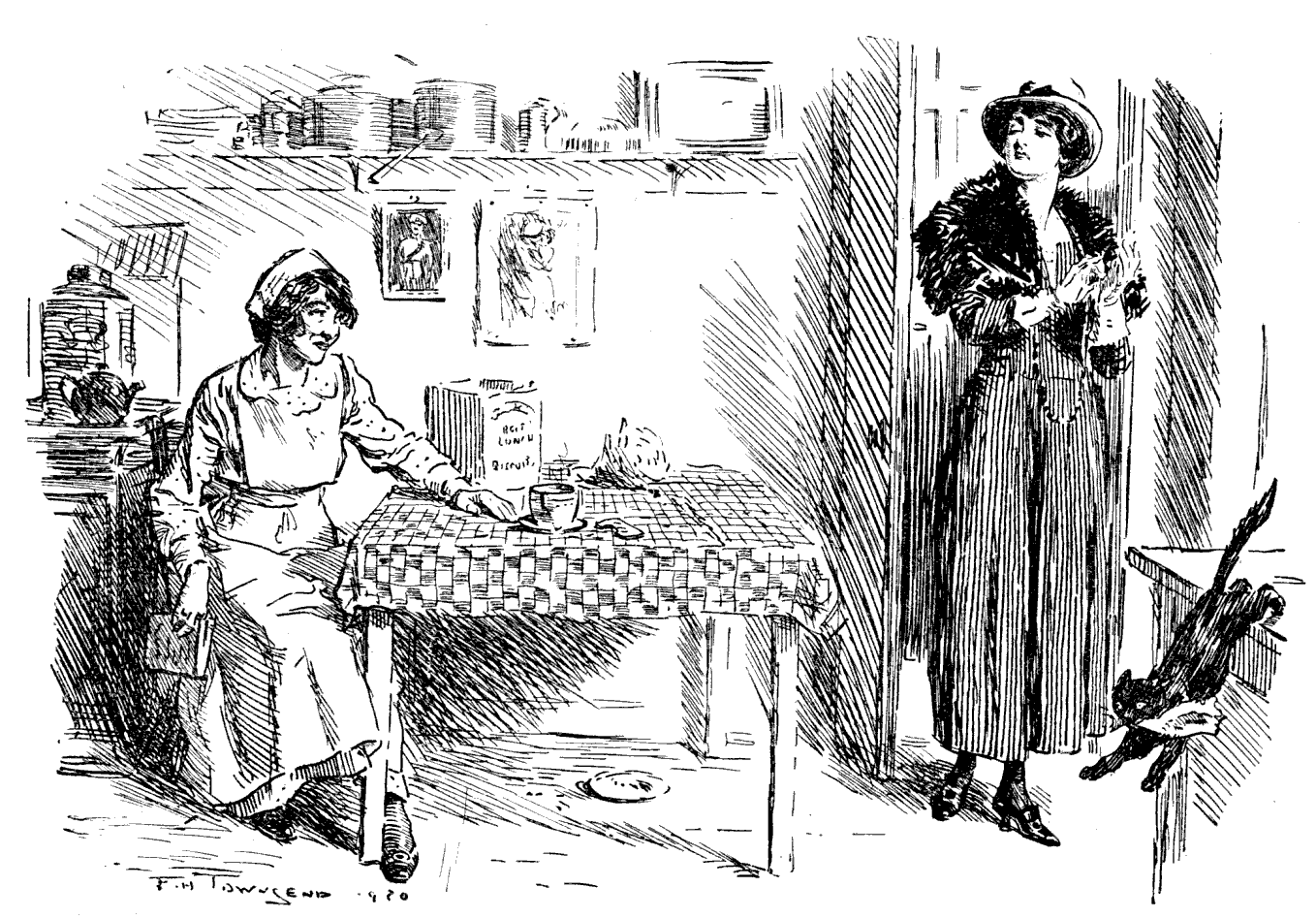
Mistress. "Can you explain how it is, Jane, that whenever I come into the kitchen I always find you reading?"
Jane. "I think it must be them rubber 'eels you wears, Ma'am."