Volume 158 — MARDI GRAS.
Reading edition
(With the British Army in France.)
"Have you reflected, mon chou," said M'sieur Bonneton, complacently regarding the green carnations on his carpet-slippers, "that to-morrow is Mardi Gras?"
"I have," replied Madame shortly.
"One may expect then, ma petite, that there will be crêpes for dinner?"
"With eggs at twelve francs the dozen?" said Madame decidedly. "One may not."
On any other matter M'sieur would probably have taken his wife's decision as final, but he had a consuming passion for crêpes, and was moreover a diplomat.
"La vie chère!" he said sadly; "it cuts at the very vitals of hospitality. With what pleasure I could have presented myself to our amiable neighbours, the Sergeant-Major Coghlan and his estimable wife, and said, 'It is the custom in France for all the world to eat crêpes on Mardi Gras. Accept these, then, made by Madame Bonneton herself, who in the making of this national delicacy is an incomparable artist.' But when eggs are twelve francs the dozen"—he shook his head gloomily—"generous sentiments must perish."
Madame perceptibly softened.
"Perhaps, after all, I might persuade that miser Dobelle to sell me a few at ten francs the dozen," she murmured; and M'sieur knew that diplomacy had won another notable victory.
Curiously enough, at this precise moment the tenants of the premier étage of 10 bis, rue de la République, were also engaged in a gastronomic discussion.
"If almanacs in France count as they do in Aldershot," said Mrs. Coghlan, "to-morrow will be Shrove Tuesday."
"An' what av it?" demanded Sergeant-Major Coghlan of the British Army.
"What of it? As though ye'd not been dreaming of pancakes this fortnight an' more past—fearful to mention thim an' fearful lest I should forget. Well, well, if ye'll bring a good flour ration in the marning I'll do me best."
"I've been thinking, Peggy lass," said the gratified Sergeant-Major, "it wud be the polite thing to make a few for thim dacent people on the ground-flure. I'll wager they've niver seen th' taste av' a pancake in this country."
Thus it was that when Hippolyte Larivière, the cornet-player of the Palais de Cinéma, ascended the stairs to his eerie on the top-floor of 10 bis the following evening the appetising odour of frying batter enveloped him as a garment. He sniffed appreciatively.
"Le gros Bonneton can eat crêpes freely without considering the effect on his temperament," he said. "One sometimes regrets the demands of Art."
Outside the Coghlans' door another idea struck him. "The essence of a present lies not in its value but its appropriateness. A few crêpes on Mardi Gras would be a novel acknowledgment to the Sergeant-Major of his liberality in the way of cigarettes. At present my case is empty."
Retracing his steps he went to the Café aux Gourmets and persuaded the propriétaire to prepare half-a-dozen crêpes with all possible speed and send them piping-hot to his room in exchange for a promise of his influence in getting her on the free list of the Cinema. Then, in a glow of virtue, he returned to prepare his toilette for the evening performance.
It was while Hippolyte was dabbing his cheeks with a damp towel that M'sieur Bonneton and Sergeant-Major Coghlan, having comfortably satisfied their respective appetites with crêpes and pancakes, proceeded to call upon each other, bearing gifts. The dignity of the presentations was impaired by the fact that they almost collided on the stairs.
"Mrs. Coghlan wud like your opinion on these pancakes," said the Sergeant-Major, dexterously fielding one that was sliding from the plate.
"And permit me to beg your acceptance of these crêpes, a dish peculiar to France and eaten as a matter of custom on Mardi Gras," said M'sieur in his most correct English, producing his plate with a flourish worthy of a head-waiter.
"'Tis with all the pleasure in life we'll be tasting thim—" commenced Coghlan. Then his eye fell on the dish and his voice dropped. M'sieur was also showing signs of embarrassment.
"It seems crêpes is but another name for pancakes," said the Sergeant-Major heavily, after a pause.
"But yes—and I am already filled to repletion."
"We've aiten our fill too, Peggy an' me, an' they're spoilt whin they're cowld. It's severely disappointed Peggy will be to find thim wasted."
"And Madame will be desolated to despair."
They stared blankly at each other for a few minutes. Then M'sieur took a heroic resolve.
"We must not hurt the feelings of those excellent women," he said firmly. "There is but one course open to us."
Coghlan nodded assent. Solemnly and without enthusiasm they sat on the stairs and consumed the pancakes to the last crumb. Then, leaden-eyed and breathing hard, they took their empty plates and entered their respective flats.
A few minutes later they again encountered on the stairs. Once more they were laden with comestibles.
"For Monsieur Larivière," explained M'sieur. "Madame insisted. She has a heart of gold, that woman."
"Peggy's sending these up too," said the Sergeant-Major. "I towld her thim pancakes was the greatest surprise you iver tasted."
M'sieur nodded. In response to Hippolyte's invitation they entered the room, and M'sieur took command of the conversation. The Sergeant-Major stood stiffly to attention, feeling that the occasion demanded it.
"Two little gifts," said M'sieur, "of epicurean distinction. The crêpes of Madame Bonneton are an achievement, but the pancakes of Madame Coghlan are irresistible."
"I thank you from the recesses of my heart," said Hippolyte with emotion; "but—you understand me—as the slave of Art I am compelled to forgo such pleasures."
"My friend," said M'sieur sternly, to refuse them would be an affront to the cooking of these excellent ladies. A true housewife esteems her cooking only next to her virtue. You must eat them—while they are hot."
"But my tremolo—my sostenuto will be ruined," said Hippolyte wildly.
"What is your tremolo to a woman's tears?" said M'sieur, with an elegance born of a fear that he might be compelled to eat the pancakes himself. "The laws of hospitality—chivalry—l'entente cordiale itself—demand that you finish them."
When Hippolyte finally yielded, his rapid and efficient despatch of the dainties excited the admiration of his hosts. They had collected their plates and were taking their departure, with expressions of regard, when a knock announced the arrival of a garçon from the Café aux Gourmets, bearing a dish of crisp hot crêpes.
"One moment, Messieurs," said Hippolyte dramatically to his departing visitors. "It must not be said that Hippolyte Larivière lacks in neighbourly feeling. Behold my seasonable gift!"
M'sieur groaned. The Sergeant-Major, being a soldier, concealed his apprehensions. Wild thoughts of surreptitiously disposing of them in a coal-bin whirled through their minds, but Hippolyte apparently divined their thoughts.
"I regret that I must forgo the pleasure I promised myself of asking the ladies to take crêpes with me," he said. "To offer these would be a poor compliment to their superlative efforts. But there is no reason why you should not eat them here."
"I have an excellent reason," said M'sieur, stroking his waistcoat. "And the gallant Sergeant-Major, I imagine, has another."
"Bah! what is a little digestive inconvenience to a breach of courtesy?" cried Hippolyte maliciously. "You must eat them. The law of hospitality demands it."
When M'sieur and the Sergeant-Major stumbled unsteadily downstairs ten minutes later their eyes bulged with the expression of those whose cup of suffering is filled to overflowing.
"But after all," as M'sieur remarked, placing his hand on his heart, whence it insensibly wandered to a point lower down, "it is some satisfaction to know that the feelings of our excellent wives remain unlacerated."
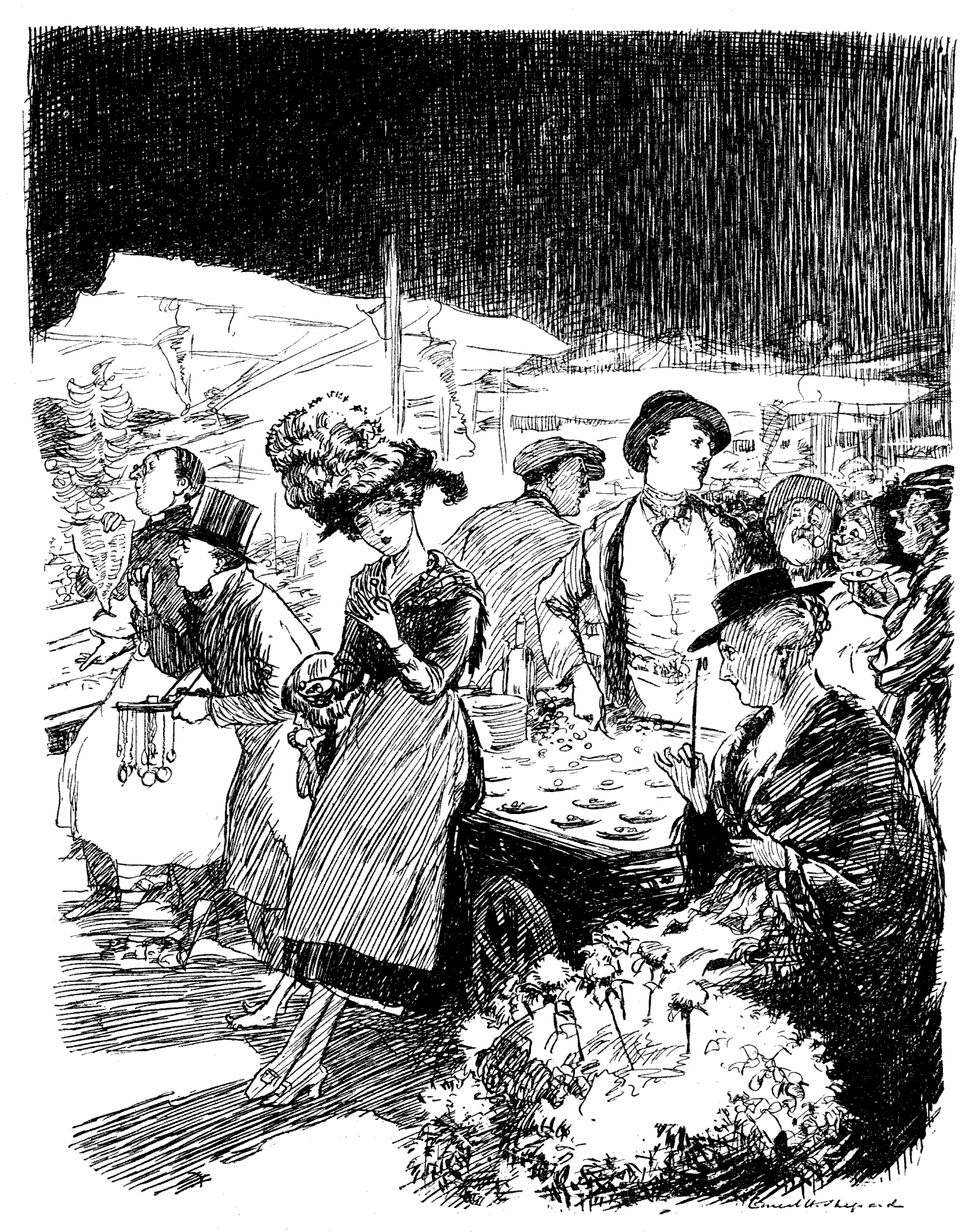
MANNERS AND MODES.
THE NEW POOR MAKE GOOD.
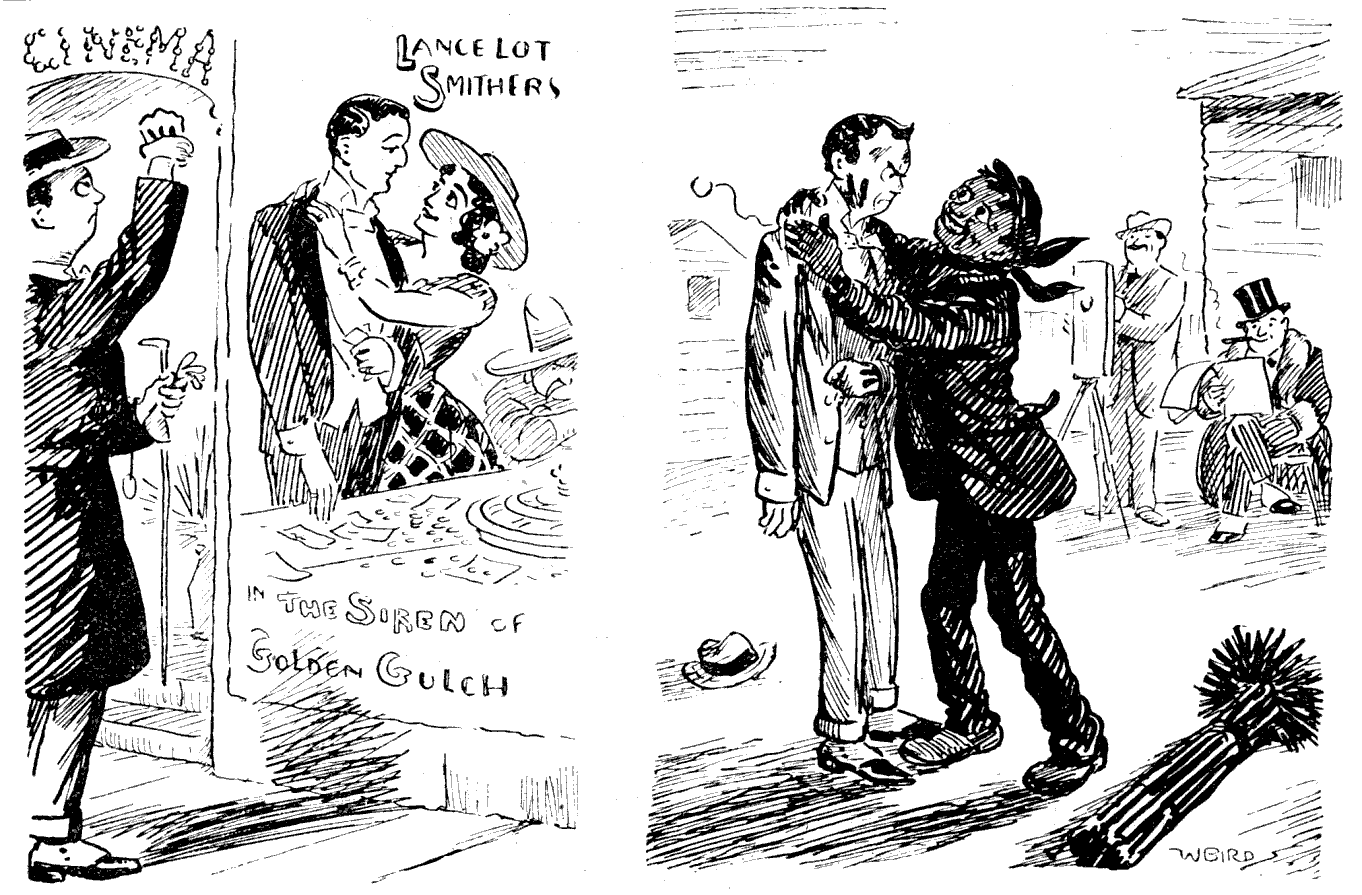
BEHIND THE SCENES IN CINEMA-LAND.
HE SWORE TO BECOME A CINEMA-ACTOR.
AND HE DID.
SHATTERED ROMANCES.
Dear Mr. Punch,—I read in a weekly paper that "plans are well in hand for putting up other Government Department buildings at Acton, which looks to have a future of its own, that of a sort of suburban Whitehall."
Have you considered what this new departure means for those who, like myself, are the writers of political romance? To all intents we have lost the Ball-platz; we have lost the Wilhelmstrasse, and now here is Whitehall going out into the suburbs.... No doubt our leading Ministers, attracted by the more salubrious air, will establish themselves in the environs of the Metropolis, leaving behind them only the lower class of civil servant. Have you considered the devastating effect of this change?
Think what we used to give our readers: "A heavy mist lay over Whitehall. High above the seething traffic the busy wires hummed with the fate of Empires." How, I ask you, will it look when they read: "The busy wires above Lewisham High Street hummed with the fate of Empires"?
Or think of the thrill that was conveyed by this (it comes in three of my most recent books): "He looked, with a little catch in the throat, and read the number, 'Ten'—No. 10, Downing Street, where the finger of fate writes its decrees while a trembling continent waits, where empires are made and unmade—the hub of the universe...." Doesn't that make even your heart beat faster? But who will thrill at this: "He waited for a moment before the bijou semi-detached villa (bath h. and c.), known as Bella Vista, in Rule Britannia Road, Willesden Junction; then with a swift glance up and down he stealthily approached. When the neat maid opened the door, 'Is the Prime Minister in?' he asked?" (He did not hiss. Who could hiss in that atmosphere?)
Or take this from my last book (shall I ever write its like again?): "Men, bent with the weight of secrets which, if known, would send a shiver through the Chancelleries of Europe, could be seen hurrying across the Mall in the pale light and going towards the great building in which England's foreign policy is shaped and formulated." But the Foreign Office at Swiss Cottage, or Wandsworth—I could not write of it. And there will be the India Office at Tooting, or Ponder's End, or at—But how can your "dusky Sphinx-like faces, wrapt in the mystery of the East, be seen passing the purlieus of"—the Ilford Cinema?
But enough, Sir. Let me subscribe myself
A Ruined Man.
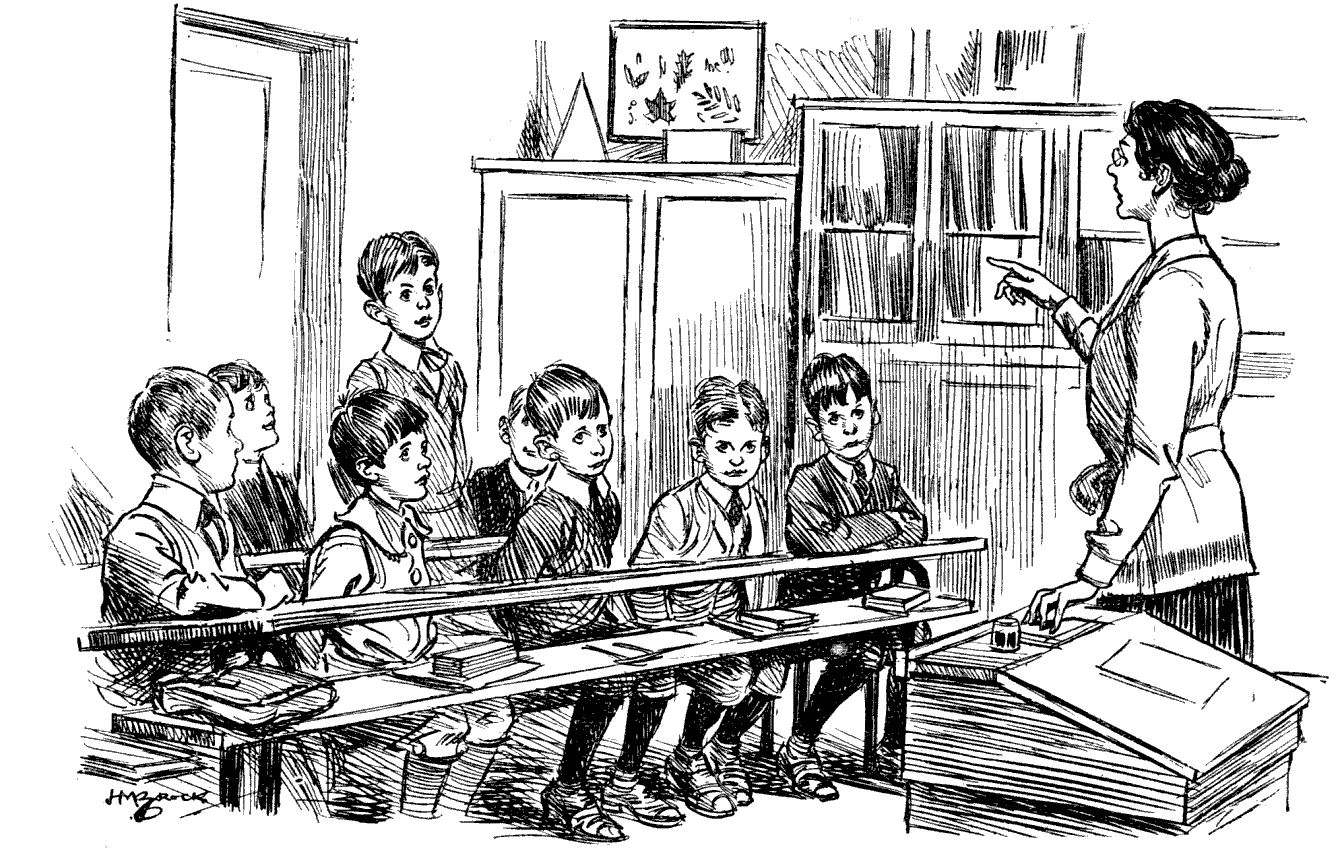
Teacher. "What are elephants tusks made of?"
Smart Boy. "Please, teacher, it used to be ivory; but now it's generally bonzoline."