Volume 158 — A STORY WITH A POINT.
Reading edition
(With Mr. Punch's apologies for not having sent it on to "The Spectator.")
Geoffrey has an Irish terrier that he swears by. I don't mean by this that he invokes it when he becomes portentous, but he is always annoying me with tales, usually untruthful, of the wonderful things this dog has done.
Now I have a pointer, Leopold, who really is a marvellous animal, and I work off tales of his doings on Geoffrey when he is more than usually unbearable.
Until a day or two ago we were about level.
Although Geoffrey knows far more dog stories than I do, and has what must be a unique memory, I have a very fair power of invention, and by working this gift to its utmost capacity I have usually been able to keep pace with him.
As I said, the score up to a few days ago was about even; yesterday, however, was a red-letter day and I scored an overwhelming victory. Bear with me while I tell you the whole story.
I was struggling through the porridge of a late breakfast when Geoffrey strolled in. I gave him a cigarette and went on eating. He wandered round the room in a restless sort of way and I could see he was thinking out an ending for his latest lie. I was well away with the toast and marmalade when he started.
"You know that dog of mine, Rupert? Well, yesterday—"
I let him talk; I could afford to be generous this morning. He had hashed up an old story of how this regrettable hound of his had saved the household from being burnt to death in their beds the night before.
I did not listen very attentively, but I gathered it had smelt smoke, and, going into the dining-room, had found the place on fire and had promptly gone round to the police-station.
When he had finished I got up and lit a pipe.
"Not one of your best, Geoffrey, I'm afraid—not so good, for instance, as that one about the coastguard and the sea-gulls; still, I could see you were trying. Now I'll tell you about Leopold's extraordinary acuteness yesterday afternoon.
"We—he and I—were out on the parade, taking a little gentle after-luncheon exercise, when I saw him suddenly stop and start to point at a man sitting on one of the benches a hundred yards in front of us; but not in his usual rigid fashion; he seemed to be puzzled and uncertain whether, after all, he wasn't making a mistake."
Here Geoffrey was unable to contain himself, as I knew he would be.
"Lord! That chestnut! You went and asked the man his name and he told you that it was Partridge."
"No," I said, "you are wrong, Geoffrey; his name, on inquiry, proved to be Quail. But that was only half the problem solved. Why, I thought, should Leopold have been so puzzled? And then an idea struck me. I went back to the man on the bench and, with renewed apologies, asked him if he would mind telling me how he spelt his name. He put his hand into his pocket and produced a card. On it was engraved, 'J.M. Quayle.' Then I understood. It was the spelling that puzzled Leopold."
THE NEW APPEAL.
We observe with interest the latest development in the London Press—the appearance of the new Labour journal, The Daily Nail.
In the past, attempts to found a daily newspaper for the propagation of Labour views have not always met with success. Possibly the fault has been that they made their appeal too exclusively to the Labour public. We understand that every care will be taken that our contemporary shall under no circumstances be a financial failure.
The Daily Nail is a bright little sheet, giving well-selected news, popular "magazine" and "home" features, and, on the back page, a number of pictures. It has a strong financial section, a well-informed Society column, and a catholic and plentiful display of advertisements, including announcements of many of those costly luxuries which Labour to-day is able to afford.
While in its editorial comments it suggests emphatically that the Government of the day is not and never can be satisfactory, it refrains from embarrassing our statesmen with too many concrete proposals for alternative methods.
We learn that the new Labour daily is substantially backed by a nobleman of pronounced democratic ideals. From his Lordship down to the humblest employee there exists among the staff a beautiful spirit of fellowship unmarked by social distinction.
"Good morning, comrade," is the daily greeting of his Lordship to the lift-boy, who replies with the same greeting, untarnished by servility.
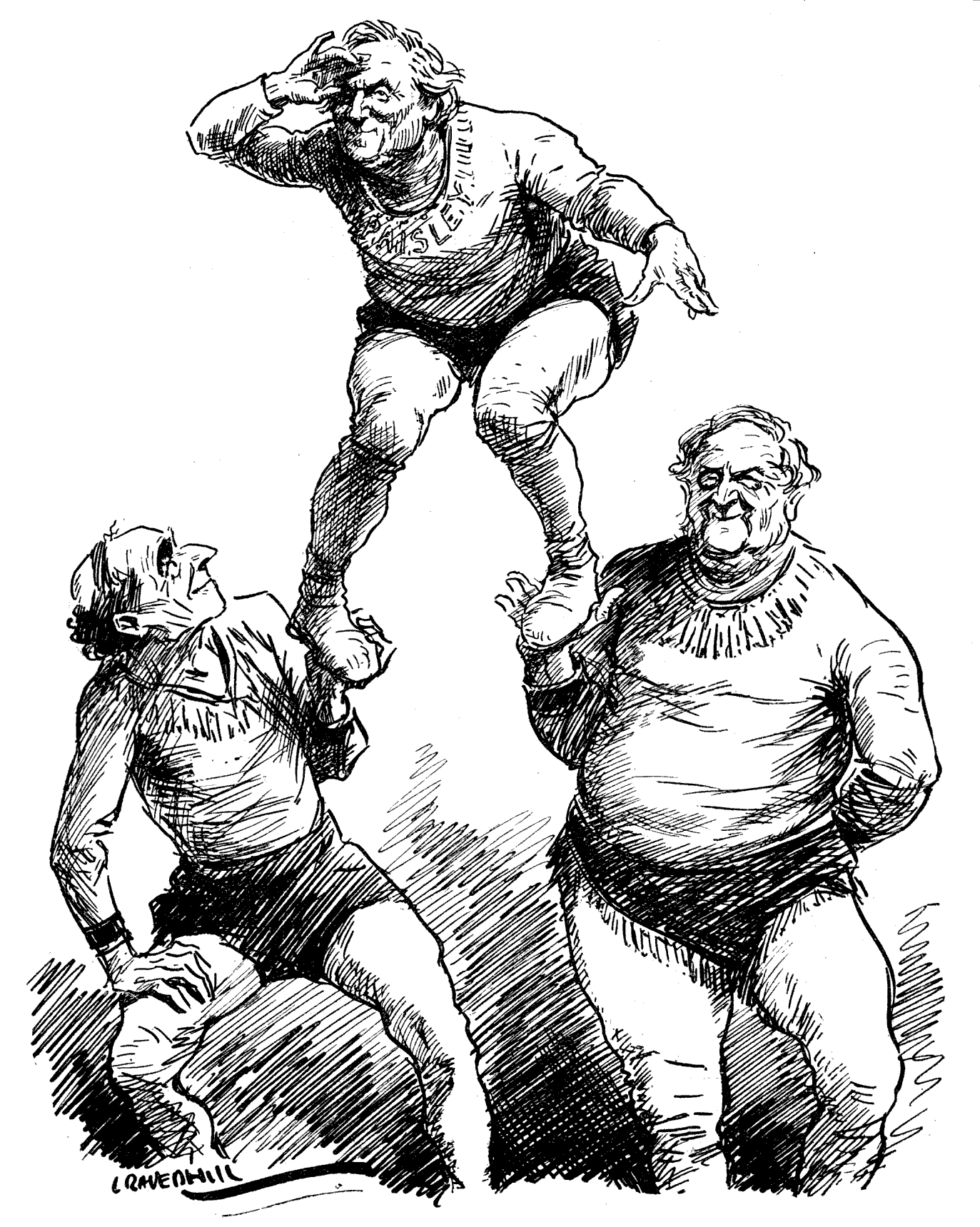
THE NEW COALITION.
Mr. Asquith (to Viscount Chaplin and Lord Robert Cecil). "THANKS, MY FRIENDS—THANKS FOR YOUR LOYAL SUPPORT. DO MY EYES DECEIVE ME, OR DO I SEE BIG BEN?"
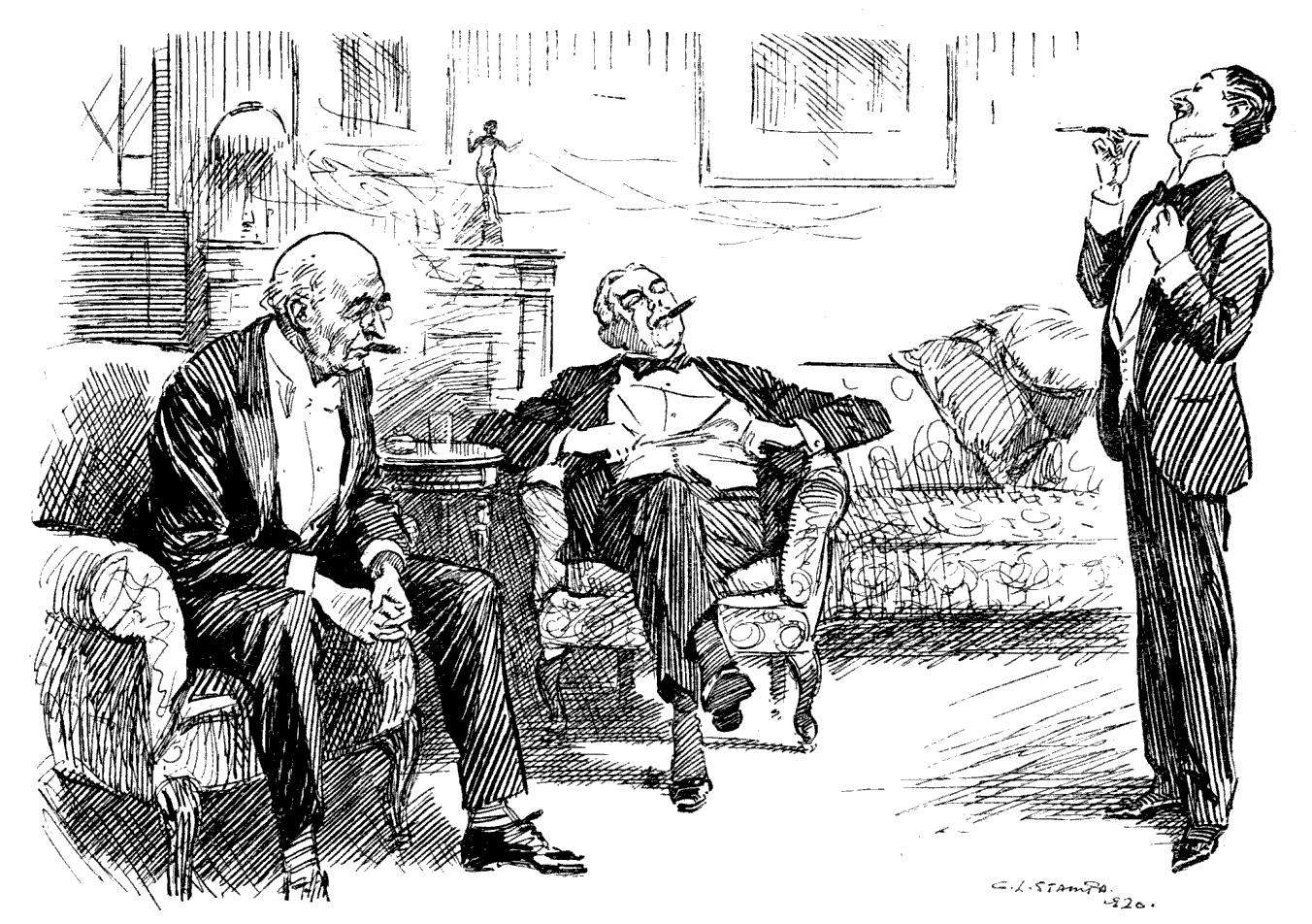
Son of House (entertaining famous explorer and distinguished professor). "It would astonish you fellows if I told you some of the things I've seen and heard— though I'm, comparatively speaking, a young man—twenty-two, to be exact."