Volume 158 — THE RIDING LESSON.
Reading edition
Phillida arrived up to time with her suit-case, a riding-crop and a large copy of D'Aulnoy's Fairy Tales. She was not very communicative as we drove out, and I sought to draw her. You never, by the way, talk down to Phillida. Personally, I don't believe in talking down to any child; but to employ this method with Phillida is to court disaster.
"Pleasant journey?" I inquired casually, flicking Rex's ear.
"'M," responded Phillida in the manner of a child sucking sweets. Phillida was not sucking sweets, and I accepted my snub. We drove on for a bit in silence. Phillida removed her hat, and her bobbed hair went all round her head like a brown busby. I looked round and was embarrassed to find the straight grey eyes fixed on my face, the expression in them almost rapturous.
"Jolly country, isn't it?" I essayed hurriedly, with a comprehensive wave of my whip.
The preoccupied "'M" was repeated with even less emphasis.
Another protracted silence. I decided not to interfere with the course of nature as manifested in one small grey-eyed maiden of eight. Presently there burst from her ecstatically, "Uncle Dick, is this the one I'm going to ride?" So that was it. From that moment we got on splendidly. We discussed, agreed and disagreed over breeds, paces, sizes. I told her the horse she would ride would be twice the size of Rex, and she nearly fell out of the trap when I said we might go together that very afternoon.
"I've not learned to gallop," she remarked with some reluctance; "but of course you could teach me."
I had only heard the vaguest rumours of her riding experience, and she was very mysterious about it herself. However, when she came downstairs at the appointed time, in her brown velvet jockey-cap, top-boots, breeches and gloves complete, she looked so determined and efficient I felt reassured.
I had to make holes in the stirrup leathers eleven inches higher than the top one of all before she could touch the irons; but she settled into the saddle with great firmness and we were off without any fuss. Once on a horse, she had no difficulty in maintaining a perfect continuity of speech, and I soon felt relieved of all anxiety about her safety. If she was not an old and practised hand, she had nerve and balance, and I did not think fit to produce the leading rein which I had smuggled into my pocket.
We trotted a perfect three miles, and she had an eye to the country and a word to say about all she saw. When we turned to come back, I felt Brimstone make his usual spurt forward, but I was not prepared for Treacle's sudden break away. He was off like a rocket. That small child's cap was flung across my eyes in a sudden gust. I had retrieved it in a second, but it was time lost, and, by Jove! she was out of sight round a bend. I followed after, might and main, but the racket of Brimstone's hoofs only sent Treacle flying faster. I caught sight of the small figure leaning back, the bright hair flying. Then they were gone again. My heart beat very fast. "She had never learned to gallop!" At every bend I hardly dared to look for what I might find. I knew Treacle, once started, would dash for home. If the child could only stick it, all might be well. I pounded along, and after a two-mile run I came on them. She had pulled him in and was walking him, waiting for me, a little turned in the saddle, one minute hand resting lightly on his broad back. She was prettily flushed, her hair blown, but she hadn't even lost her crop.
"Did you stop to get my cap?" she said as we came up. "Thanks awfully."
I wanted to hug the little thing, but her dignity forbade any such exhibition.
The only other reference to the afternoon's experience was on a postcard I happened to see written the same night, addressed to her mother.
"Darling Bee" (it ran in very large baby characters),—"I had the most adorable ride to-day I ever had. I learned to galup all by myself. I thaut at first the horse was running away with me, but Uncle Dick soon caut me up. He had my cap.
Your loving Phillida."
I only hope that Isabel will think it was all just as deliberate as that.
BEHIND THE SCENES IN CINEMA-LAND.
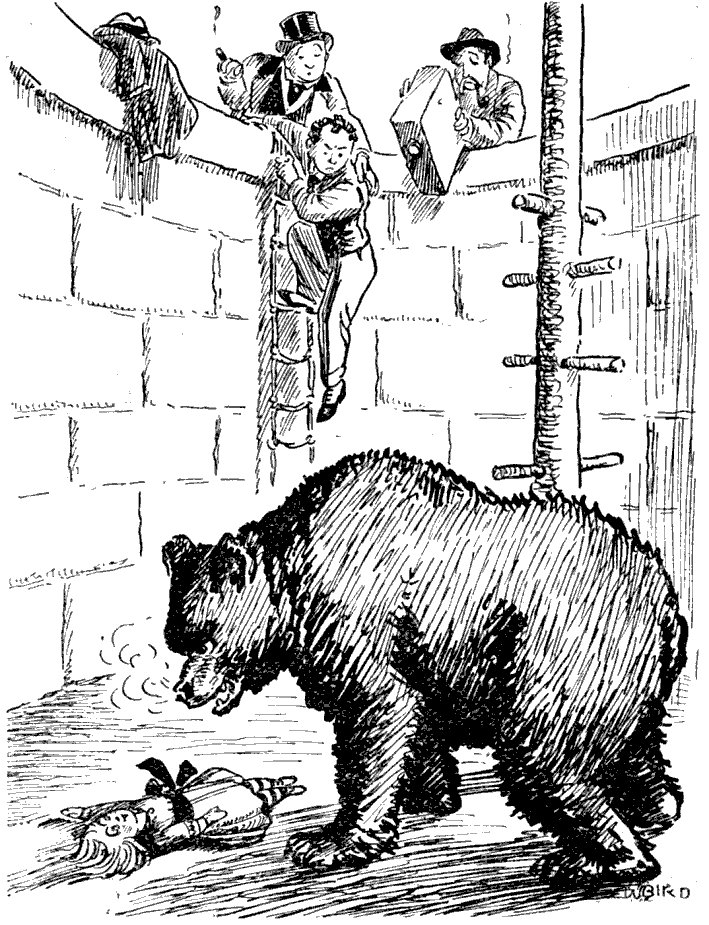
"You needn't be a bit nervous about handling the child, me lad. It's not a real one."
"The Ashton-under-Lyne fight is beginning, and The Daily News comes forward to-day with the suggestion that the Liberal candidate should withdraw.
The practical effect of the candidature of a Liebral may be only to reduce the Labour majority....
In such circumstances we think it matter for great regret that there should be any Libtral candilature....
Upon this the comment at the Liberal headquarters to-day was, 'Well, it is a little difficult to know just where we are, isn't it?'"—Evening Paper.
Yes, or what we are, for that matter.
"Gilbert-Sullivan Operas.
Friday, 'Trial by July.'"—Provincial Paper.
It seems a long remand.
Journalistic Camaraderie.
"The whole of this preliminary business is nauseating, and in real sporting circles it is taboo as a topic of conversation. No wonder The Times devoted a leading article to the matter the other day."—Daily Mail.
How these Northcliffe journals love one another!
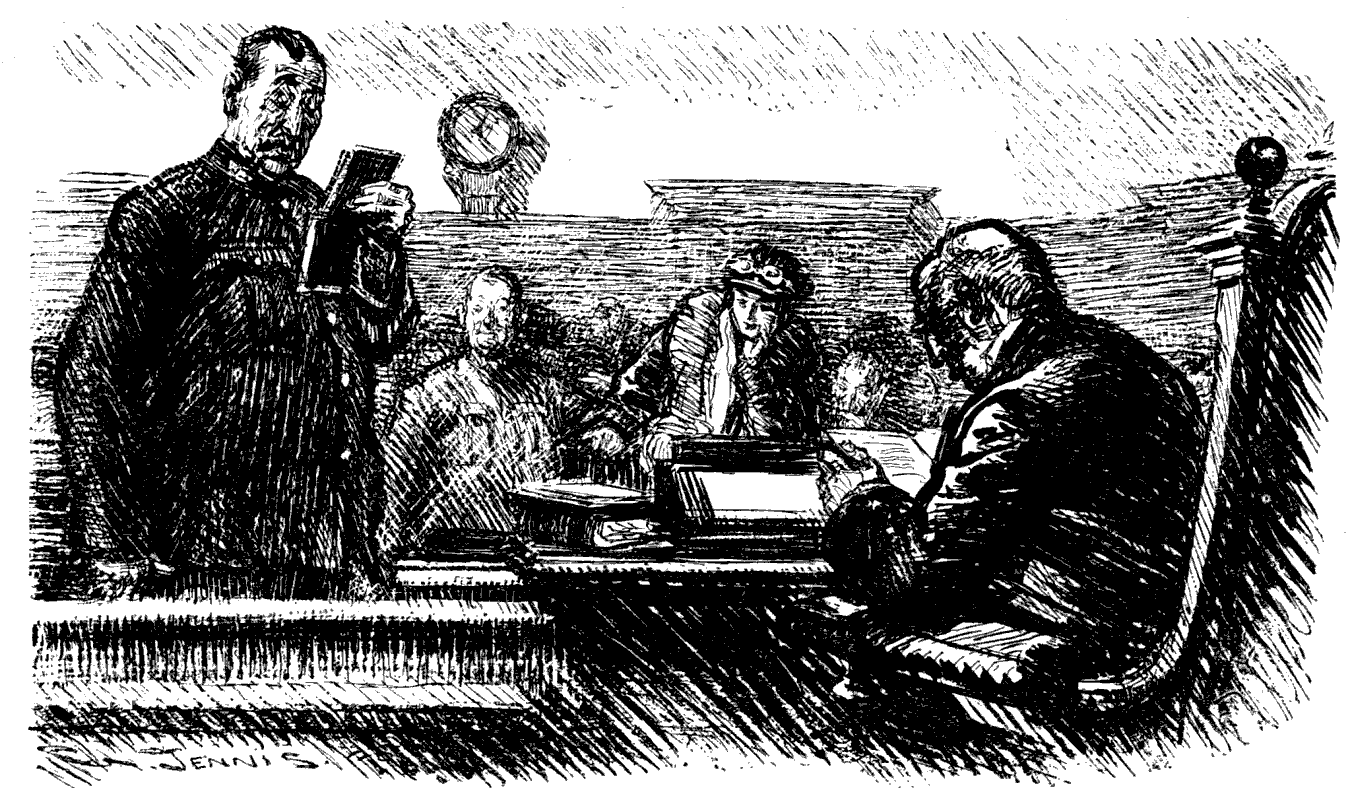
P.C. (referring to notes). "I told 'er she would be reported, your worship, to which she replied, 'Go ahead, my cheery little sunbeam!'"
MORE CHAMPIONSHIPS.
The sporting public is so intrigued by the prospect of a Dempsey-Carpentier match that other impending championship events are in danger of being forgotten.
The present position in the challenge for the World's Halma Championship is this. Mr. George P. Henrun is patriotically endeavouring to secure the contest for Britain, and to that end has put up a purse of half-a-guinea. The Société Halma de Bordeaux has cut in with a firm offer of twenty-two francs, and the matter now remains in abeyance while financial advisers calculate the rate of exchange in order to ascertain which proposal is the more advantageous. The challenger, of course, is Tommy Jupes, aged twelve, of Ashby-de-la-Zouche. His opponent, the champion, has an advantage of three years in age and two inches in reach, but the strategy of Master Jupes is said to be irresistible. Only last week he overwhelmed his mother, herself a scratch player, when conceding her four men and the liberty to cheat twice.
The public will be thrilled to hear that a match has now been arranged between the two lady aspirants for the World's Patience Championship, viz., Miss Tabitha Templeman, of Bath, and Miss Priscilla J. Jarndyce, of Washington. To meet the territorial prejudices of both ladies the contest will take place in mid-Atlantic, on a liner. There will be no seconds, but Miss Templeman will be accompanied by the pet Persian, which she always holds in her lap while playing, and Miss Jarndyce will bring with her the celebrated foot-warmer which is associated with her greatest triumphs. The vexed question of the allocation of cinema royalties has been settled through the tact of Mr. Manketlow Spefforth, author of Patience for the Impatient. One lady wanted the royalties to be devoted to a Home for Stray Cats, and the other expressed a desire to benefit the Society for the Preservation of Wild Bird Life. Mr. Spefforth's happy compromise is that the money shall be assigned to the Fund in aid of Distressed Spinsters.
Bert Hawkins, of Whitechapel, has expressed his willingness, on suitable terms, to meet T'gumbu, the powerful Matabele, in a twenty-ball contest for the World's Cokernut-Shying Championship. There is however a deadlock over details. T'gumbu's manager is adamant that the match shall take place in his nominee's native village of Mpm, but Mr. Hawkins objects, seeing little chance of escaping alive after the victory of which he is so confident. He says he would "feel more safer like on 'Ampstead 'Eaf." Another difficulty is that Mr. Hawkins insists on wearing his fiancée's headgear while competing, and this is regarded by T'gumbu as savouring of witchcraft. Mr. Hawkins generously offers his opponent permission to wear any article of his wives' clothing; but the coloured candidate quite reasonably retorts that this concession is practically valueless. On one point fortunately there is unaniminity: both parties are firm that all bad nuts must be replaced.
Another Asian Mystery.
"Old and Rare Paintings. Exquisite works of old Indian art. Mytholo-Roast Beef or Pork: Bindaloo Sausages gical, Historical, Mediæval."—Englishman (Calcutta).
"Two capable young gentlemen desire Posts in good families as Companions, ladies or children; mending, hairdressing, decorations; willing to travel; in or near London."—Daily Paper.
What did they do in the Great War?
"One of the exquisite features was the presence of the Deacon's wives. We had 83 upon our Roll of Honour, and of these 36 turned up."—Parish Magazine.
The other forty-seven being presumably engaged in looking after the Deacon.
"In addition to the fine work done by the Irish regiments he assured them that many a warm Irish heart beat under a Scottish kilt."—Local Paper.
Surely Irishmen enlisted in Scottish regiments are not so down-hearted as all that!