Volume 158 — THE MOO-COW.
Reading edition
I was getting so tired of the syncopated life of town (and it didn't fit in with my present literary work) that I bribed my old pal Hobson to exchange residences with me for six months, with option; so now he has my flat in town, complete with Underground Railway and street noises (to say nothing of jazz music wherever he goes), and I have his country cottage, old-fashioned and clean, and a perfectly heavenly silence to listen to. Still, there are noises, and their comparative infrequency makes them the more noticeable. There is, for instance, a cow that bothers me more than a little. It has chosen, or there has been chosen, for its day nursery a field adjoining my (really Hobson's) garden. It has selected a spot by the hedge, almost under the study window, as a fit and proper place for its daily round of mooing.
Possibly this was at Hobson's request. Perhaps he likes the sound of mooing, or, conceivably, the cow doesn't like Hobson, and moos to annoy him. But surely it cannot mistake me for him. We are not at all alike. He is short and dark; I am tall and fair. This has given rise to a question in my mind: Can cows distinguish between human beings?
Anyway the cow worries me with its continual fog-horn, and I thought I would write to the owner (a small local dairy-farmer) to see if he could manage to find another field in which to batten this cow, where it could moo till it broke its silly tonsils for all I should care; so I indited this to him:—
My dear Sir,—You have in your entourage a cow that is causing me some annoyance. It is one of those red-and-white cows (an Angora or Pomeranian perhaps; I don't know the names of the different breeds, being a town mouse), and it has horns of which one is worn at an angle of fifteen or twenty degrees higher than the other. This may help you to identify it. It possesses, moreover, a moo which is a blend between a ship's siren and a taxicab's honk syringe. If you haven't heard either of these instruments you may take my word for them. Further, I think it may really assist you if I describe its tail. The last two feet of it have become unravelled, and the upper part is red, with a white patch where the tail is fastened on to the body.
It is only the moo part of the cow that is annoying me; I like the rest of it. I am engaged in writing a book on the Dynamic Force of Modern Art, and a solo on the Moo does not blend well with such labour as mine.
There are hens here at Hillcroft. This remark may seem irrelevant, but not if you read on. Every time one of these hens brings five-pence-halfpenny worth of egg into the world it makes a noise commensurate with this feat. But I contend that even if your cow laid an egg every time it moos (which it doesn't, so far as my survey reveals) its idiotic bellowing would still be out of all proportion to the achievement. Even milk at a shilling a quart scarcely justifies such assertiveness.
My friend Mr. Hobson may, of course, have offended the animal in question, but even so I cannot see why I should have to put up with its horrible revenge; which brings me to the real and ultimate reason for troubling you, and that is, to ask you if you will be so good as to tell the cow to desist, and, in case of its refusal, to remove it to other quarters. If the annoyance continues I cannot answer for the consequences.
Thanking you in anticipation, I am, Yours faithfully, Arthur K. Wilkinson.
The reply ran:—
Deer Sir,—i am not a scollard and can't understand more'n 'alf your letter if you don't lik my cow why not go back were you cum from i dunno what you mean by consequences but if you lay 'ands on my cow i'll 'ave the lor of you.
Yours obedient Henry Gibbs.
I felt that I hadn't got off very well with Henry, and thought I would try again, so wrote:—
Dear Mr. Gibbs,—Thank you so much for your too delightful letter. I am afraid you somewhat misapprehended the purport of mine. I freely admit your right to turn all manner of beasts into your demesne; equally do I concede to them the right to play upon such instruments as Nature has handed out to them; but I also claim the right to be allowed to carry on my work undisturbed. The consequences would be to me, not to the cow, unless laryngitis supervenes. I love cows, and I greatly admire this particular cow, but not its moo; that is all.
Is it, do you suppose, uttering some Jeremiad or prophecy? Can it, for example, be foretelling the doom of the middle classes? Or is it possible that our noisy friend is uttering a protest against some injurious treatment received from its master?
I have discovered that our daily supply of milk is supplied by your herd, and on inquiry I find that our cook is not at all confident that a quart of the same as delivered to us would satisfy the requirements of the Imperial standard of measurement.
If the animal's fog-horn continues I shall take it as an indignant protest against a slight that has been cast on its fertility, and shall seriously think of calling in the Food-Inspector to examine you in the table of liquid measure.
Delightful weather we have been experiencing, have we not?
Believe me as ever, dear Mr. Gibbs, Yours most sincerely, Arthur K. Wilkinson.
I do not know how much my correspondent understood of this letter, but, as the moo-cow was shortly afterwards relegated to fresh pastures, and as we are getting decidedly better measure for our milk money, I gather that he had enough intelligence for my purposes.
The threat which I thus put at a venture may be recommended to anyone suffering from the moo nuisance.
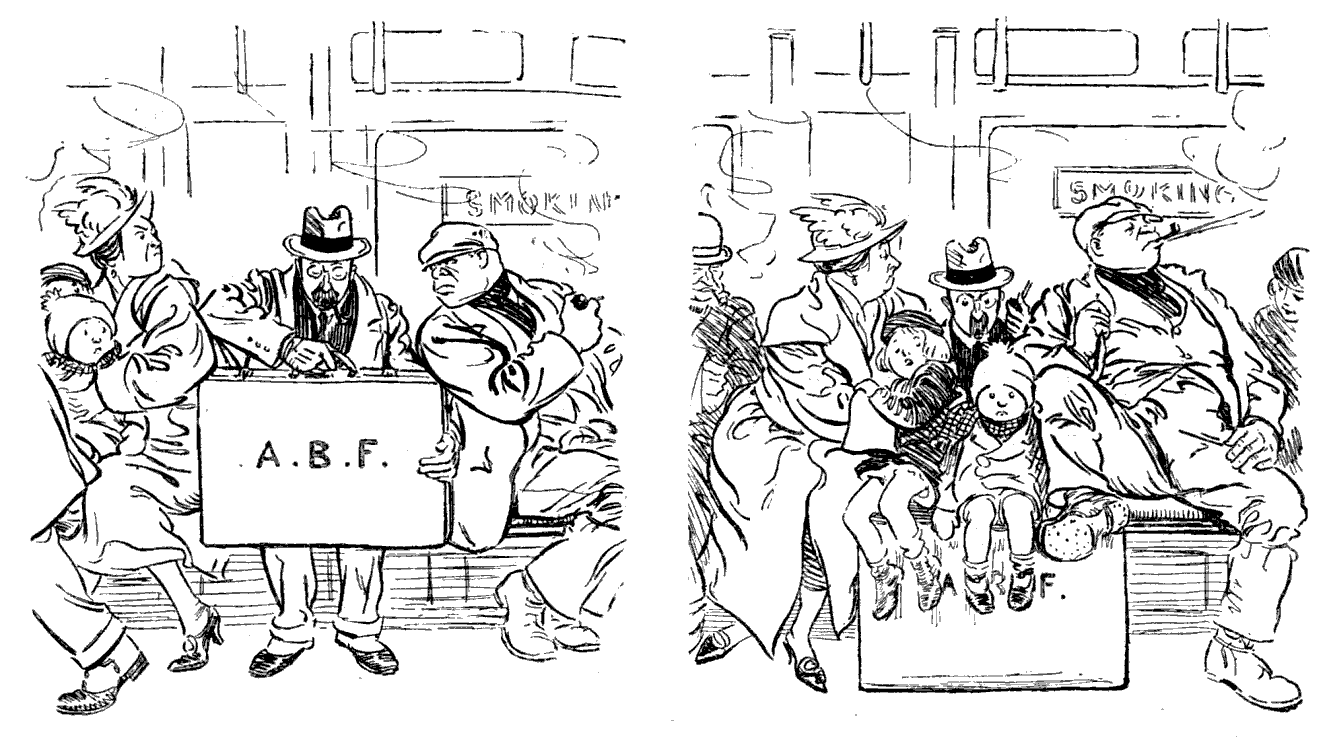
USES OF A TUBE NUISANCE.
"The serious loss to D'Annunzio recently of 300,000 lire, through the disappearance of his cashier, has had a happy sequel. The airman-poet has received a like amount from a rich Milanese lady. The donor remains incognito."—Evening Standard.
It was very clever of the lady to disguise herself as an unknown man.
THE NEW SUBTRACTION.
(By a middle-class Martyr.)
Euclid is gone, dethroned, By dominies disowned, And modern physicists, Judæo-Teuton, Finding strange kinks in space, Swerves in light's arrowy race, Make havoc of the theories of Newton. Yet, mid this general wreck, These blows dealt in the neck Of authors of established reputation, Four methods unassailed Endured and never failed To guide our arithmetic calculations. But now at last new rules Are used in "Council Schools" In consequence of Governmental action; And newspapers abound In praise of the profound Importance of the so-called "New Subtraction." New, maybe, but too well I know its influence fell; The "new subtraction" (which I suffer under) From what I earn or save By toiling like a slave Is just a euphemistic name for plunder.
"At Richmond a discharged soldier was charged with stealing a pillow, valued at 7/6, the property of the Government.... The prisoner, who had a clean sheet, was fined 40/-."—Local Paper.
We can understand his wanting a fresh pillow to go with his clean sheet.
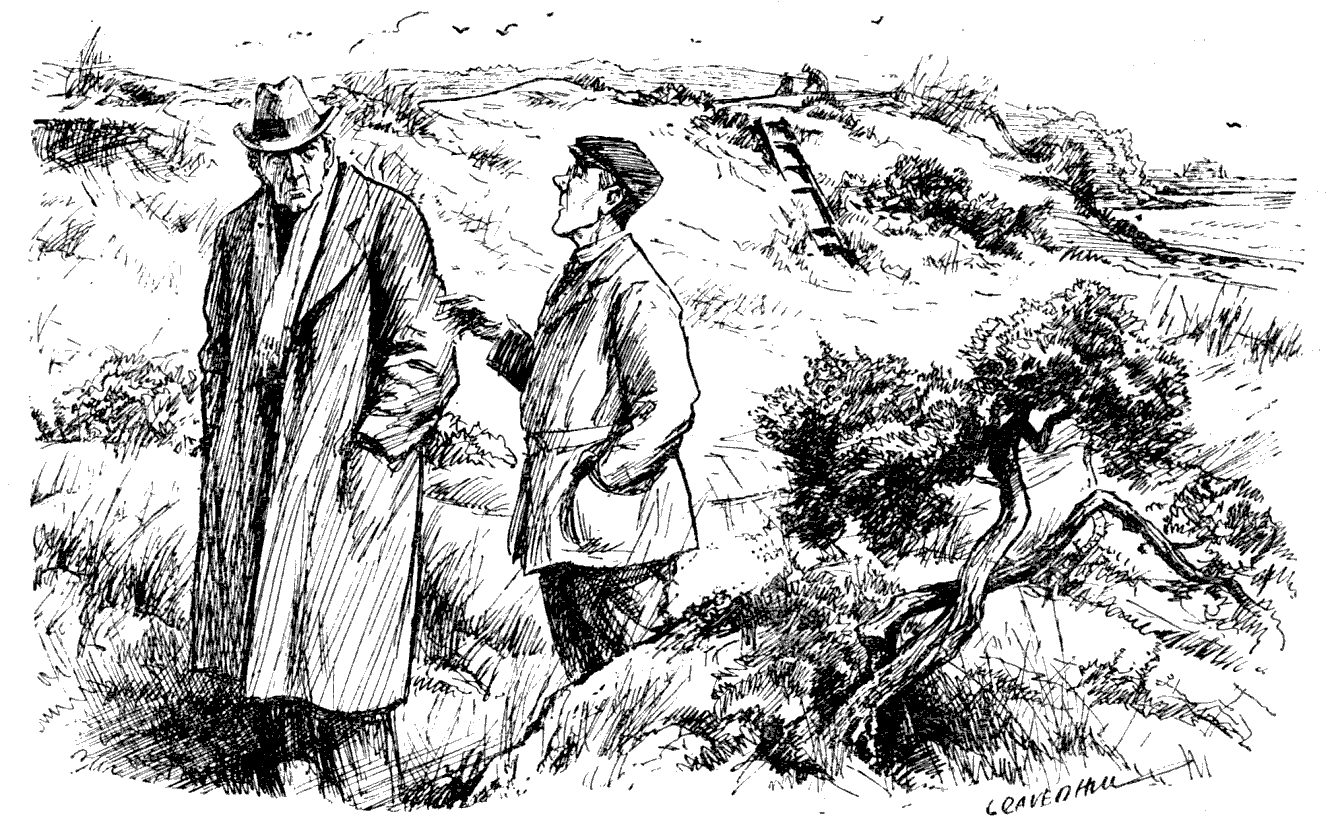
Golf Enthusiast (urging the merits of the game). "—and, besides, it's so good for you."
Unbeliever. "So is cod-liver oil."
GOLDEN GEESE.
The London University Correspondent of The Observer has been deploring the fact that a number of professors and lecturers have lately resigned their poorly-paid academic positions in order to take up commercial and industrial posts at much higher salaries. Among the instances he cites is that of a Professor of Chemistry at King's College, who has been appointed Director of Research to the British Cotton Industry Research Association.
The movement, which the writer denounces as bearing "too obvious an analogy to the killing of the golden goose," is not however confined to London University. From the great seats of learning all over the country the same complaint is heard. We learn, for instance, that Mr. Angus McToddie, until recently Professor of Physics at the John Walker University, N.B., has vacated that post on his appointment as Experimental Adviser to the British Constitutional Whisky Manufacturers' Association.
Past and present alumni of Tonypandy will learn with regret that the University is to lose the services of its Professor of Live Languages, Mr. O. Evans, who is about to assume the responsible and highly-remunerated position of Director of Research to the Billingsgate Fishporters' Self-Help Society.
The Egregius Professor of Ancient History at Giggleswick University will shortly take up his duties as Editor of Chestnuts, the new comic weekly.
Professor Ernest Grubb, who for many years has adorned the Chair of Entomology at Durdleham, is about to enter the dramatic sphere as stage-manager to a well-known troupe of performing insects.
Another recruit to Stage enterprise is Professor Seymour Legge, who has been appointed Chief Investigator to the Beauty Chorus Providers' Corporation. Mr. Legge was formerly Professor of Comparative Anatomy at Ballycorp.
SATURDAYS.
Now has the soljer handed in his pack, And "Peace on earth, goodwill to all" been sung; I've got a pension and my ole job back— Me, with my right leg gawn and half a lung; But, Lord! I'd give my bit o' buckshee pay And my gratuity in honest Brads To go down to the field nex' Saturday And have a game o' football with the lads. It's Saturdays as does it. In the week It's not too bad; there's cinemas and things; But I gets up against it, so to speak, When half-day-off comes round again and brings The smell o' mud an' grass an' sweating men Back to my mind—there's no denying it; There ain't much comfort tellin' myself then, "Thank Gawd, I went toot sweet an' did my bit!" Oh, yes, I knows I'm lucky, more or less; There's some pore blokes back there who played the game Until they heard the whistle go, I guess, For Time an' Time eternal. All the same It makes me proper down at heart and sick To see the lads go laughing off to play; I'd sell my bloomin' soul to have a kick— But what's the good of talkin', anyway?
"If we were suddenly to be deprived of the fast underground train, and presented with a sparse service of steam trains in sulphurous tunnels, the result on our tempers and the rate of our travelling would be—well, electric!"—Pall Mall Gazette.
We have tried to think of a less appropriate word than "electric," but have failed miserably.