Volume 146 — OUR BOOKING-OFFICE.
Reading edition
(By Mr. Punch's Staff of Learned Clerks.)
A reflection that I could not resist after reading Love the Harper (Smith, Elder) was that the Boy appears in this volume as a very indifferent performer upon his instrument. For the muddle into which he plunged the amatory affairs of the inhabitants of Downside was terrible. Downside was a quiet delightful village, as lovingly described by Miss Eleanor G. Hayden, but the number of misplaced attachments it contained seemed, as Lady Bracknell once observed, "in excess of that which statisticians have laid down for our guidance." There was John Harding, the hero, who began by courting Phyllis, and subsequently transferred his suit to Ruth. There was Will, his brother, an even more inconstant lover, whom Phyllis (still nominally betrothed to John) adored at first sight, and who divided his own heart between Ruth, Phyllis and the crippled Miss Mayling. There was also Ruth herself, who thought she had a Past (she hadn't, at least it was all right really; but just in what sense it would be unfair to explain here) and therefore imagined herself for no man. The story begins with a wedding on the first page; and what with one thing and another I began to fear that this was the last consummation we were likely to get. But, of course, in the end—— But I shall not tell you how the couples finally re-sort themselves, because this is the author's secret, and one that she very craftily preserves till the last moment. It is arithmetically inevitable that there must be an odd woman left over in the end; but as to her identity I was entirely wrong, and so probably will you be. This ending is perhaps the best thing—I don't mean the words in an unkind sense—about a pleasant if not very thrilling story of a country that Miss Hayden evidently knows with the knowledge of affection.
Perhaps some of those who remember J. Burgon Bickersteth captaining the Oxford soccer team four years ago may be surprised to find him serving his apprenticeship at sky-piloting in Alberta. And very manfully and sincerely and tactfully he does it, to judge by the account which he modestly renders in The Land of Open Doors (Wells, Gardner). With headquarters at Edmonton he rides and drives or swims (when the floods are out or the bridges down) across this untidy country from shack to shack, holding odd little services in dormitories and kitchens, and evidently making friends with the rough pioneer folk, railway men and small farmers, of his assorted acquaintance. The discouragements of such a task must be immense; indeed, they peep through the narrative, reticently enough, for grousing habits are not in the equipment of this staunch and cheery young parson. His notes of this land of promise and swift achievement are admirably observed. He has the gift of characterisation with humour, is clever at reproducing evidently authentic and entertaining dialogues, and has caught the Western idiom, not only in these set reproductions, but unconsciously in his own writing, which is singularly straightforward and attractive, nor burdened with the sort of cleverness which the young graduate is apt to air. Neither is there anything of the prig in his composition—his book abounds in reported words which an earlier generation of clerics would certainly have censored—but when he is saddened by the indifference, the unplumbed materialism and what he sees as the wickedness of his scattered flock he might remember for his comfort that valid and sane distinction of the casuists between formal and material sin. Anyway, good luck to him for a sportsman!
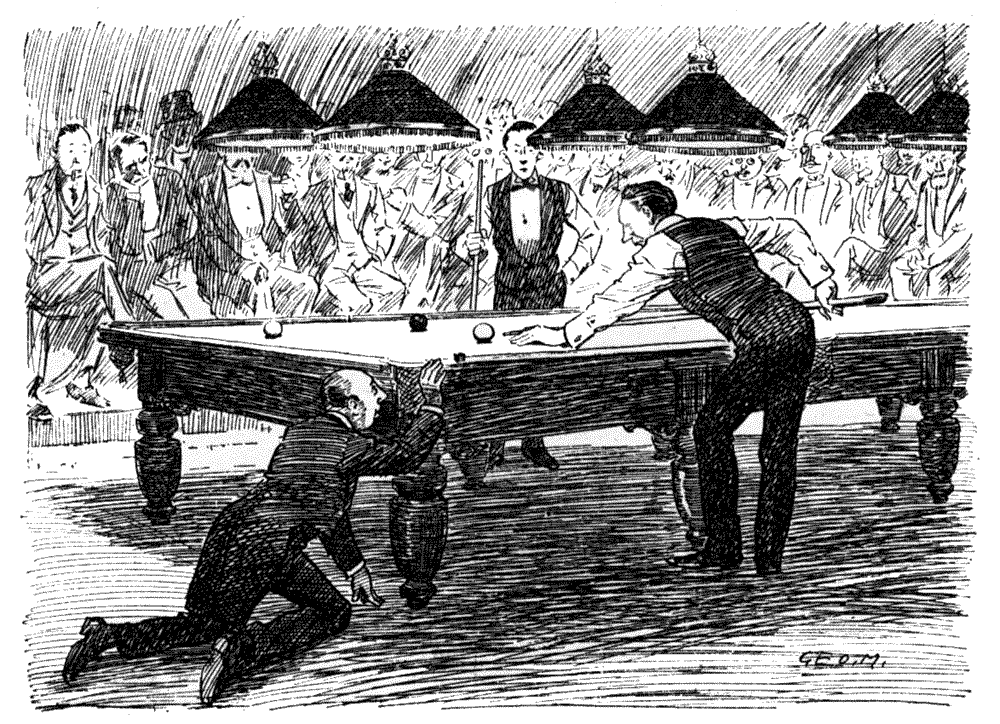
OUR CURIO CRANKS.
The man who collects the chalk used by famous billiard-players.
I have often wondered why so few novelists select the English Lake District as a fictional setting. I wonder still more after reading Barbara Lynn (Arnold), in which it is used with fine and telling effect. Miss Emily Jenkinson's previous story showed that she had a rare sympathy with nature, and a still rarer gift of expressing it. Barbara Lynn does much to strengthen that impression. It is a mountain tale, the scene of which is laid in an upland farm, girt about by the mighty hills and the solitude of the fells. Here, in the dour old house of Graystones, is played the drama of Barbara and her sister Lucy; of Peter, who loved one and married the other; of the feckless Joel, and the old bed-ridden great-grandmother, who is a kind of chorus to it all. Practically these five are the only characters. Of them it is, of course, Barbara herself who stands out most prominently, a figure of an austere yet wistful dignity, of whom any novelist might be proud. I should hazard a guess that Miss Jenkinson writes slowly; one feels this in her choice of words and her avoidance (even in the final tragic catastrophe) of anything approaching sensationalism or melodrama. When all, is said, however, it is for its descriptions that I shall remember the book. The hot summer, with the flocks calling in the night for water; the storm on the slopes of Thundergray; and the end of all things (which, pardon me, I do not mean to tell)—these are what live in the reader's mind. Barbara Lynn, in short, is an unusually imaginative novel, which has confirmed me in two previous impressions—first, that Miss Emily Jenkinson is a writer upon whom to keep the appreciative eye; secondly, that Westmorland must be a perfectly beastly country to live in all the year round. Both of which conclusions are sincere tributes.
I was at school, some years ago, with two brilliant twins called Duff, who between them captured, amongst other trifles, the Porson, two Trinity scholarships, a Fellowship, and first place in the examination for the Indian Civil Service. I mention them here as an example of the minute care with which Alistair and Henrietta Tayler have compiled The Book of the Duffs (Constable). For I find their names and achievements duly recorded in the list of (I should think) every male Duff born of the stock of Adam of Clunybeg, temp. 1590, from, whom the present Duchess of Fife is ninth or tenth in descent. And that is only one branch of the clan, only one of the numerous family-trees that make these two bulky volumes a perfect forest of Duffs. I know now exactly how Macbeth felt when he saw Birnam Wood descending on Dunsinane. No wonder he exclaimed, "The cry is still, They come." When I looked at all these genealogies and lifelike portraits I had an appalling vision of this great army of Duffs of Clunybeg and Hatton and Fetteresso and the rest advancing towards me solemnly waving their family-trees. In the van, with his Dunsinane honours thick upon him, marched Macduff—Macduff, you know, who was also "Thane of Fife, created first Earl, 1057, m. Beatrice Banquo." Then followed a long train of other warriors—General Sir Alexander, who fought in Flanders; Captain George, who was killed at Trafalgar; Admiral Norwich and Admiral Robert, also contemporaries of Nelson; General Patrick, who slew a tiger in single combat with a bayonet; General Commander-in-Chief Sir Beauchamp of our own day—and I was afraid. Not, you understand, of their swords, but of their trees. And then suddenly the spirit of Macbeth came upon me again. With him I shouted, "Lay on, Macduff; and damn'd be he that first cries, Hold, enough." But, luckier than he, I have lived to tell the tale, or rather to tell about it, and to recommend it to all those who have arborivorous tastes. I can promise them that they will heartily enjoy a good browse in the Forest of Duff.
When a book is called The Sea Captain (Methuen) I do not think that the hero ought to be the driest of dry-bobs for nearly a quarter of it. If, however, Mr. H. C. Bailey is a slow starter he knows how to make the pace when he once gets going; indeed, he travels so fast and so far that merely to follow him in fancy is a breathless business. When I have told you that Diccon belonged to the spacious times of Elizabeth, I need hardly add that his methods of winning fame and fortune on the sea were as rough as they were ready. Mercifully he had a steady head and a very strong back, or something must have given way under the strain that his creator puts upon him. No hero in modern fiction has jumped so frequently from the frying-pan into the fire with so little injury to himself. But if I cannot altogether believe in Diccon I admit an affection for him. He was as loyal a lover and friend as could be found in the Elizabethan or any other age, and although he treated troublesome men without mercy his behaviour to women was marked by the extreme of propriety; so, though you may insist that he was merely a pirate, I shall still go on calling him a gentleman-adventurer, and leave him at that.
The Barbados Standard on an approaching Royal visit:—
"The visit it is understood is fixed to begin on April 29 and to last until April 25. The visit is probably unprecedented."
It is.