Volume 146 — ORANGES AND LEMONS.
Reading edition
VI.—The Record of it.
"I shall be glad to see Peter again," said Dahlia, as she folded up her letter from home.
Peter's previous letter, dictated to his nurse-secretary, had, according to Archie, been full of good things. Cross-examination of the proud father, however, had failed to reveal anything more stirring than "'I love mummy,' and—er—so on."
We were sitting in the loggia after what I don't call breakfast—all of us except Simpson, who was busy with a mysterious package. We had not many days left; and I was beginning to feel that, personally, I should not be sorry to see things like porridge again. Each to his taste.
"The time has passed absurdly quickly," said Myra. "We don't seem to have done anything—except enjoy ourselves. I mean anything specially Rivierish.' But it's been heavenly."
"We've done lots of Rivierish things," I protested. "If you'll be quiet a moment I'll tell you some."
These were some of the things;
(1) We had been to the Riviera. (Nothing could take away from that. We had the labels on our luggage.)
(2) We had lost heavily (thirty francs) at the Tables. (This alone justified the journey.)
(3) Myra had sat next to a Prince at lunch. (Of course she might have done this in London, but so far there has been no great rush of Princes to our little flat. Dukes, Mayors, Companions of St. Michael and St. George, certainly; but, somehow, not Princes.)
(4) Simpson had done the short third hole at Mt. Agel in three. (His first had cleverly dislodged the ball from the piled-up tee; his second, a sudden nick, had set it rolling down the hill to the green; and the third, an accidental putt, had sunk it.)
(5) Myra and I had seen Corsica. (Question.)
(6) And finally, and best of all, we had sat in the sun, under a blue sky, above a blue sea, and watched the oranges and lemons grow.
So, though we had been to but few of the famous beauty spots around, we had had a delightfully lazy time; and as proof that we had not really been at Brighton there were, as I have said, the luggage labels. But we were to be able to show further proof. At this moment Simpson came out of the house, his face beaming with excitement, his hands carefully concealing something behind his back.
"Guess what I've got," he said eagerly.
"The sack," said Thomas.
"Your new vests," said Archie.
"Something that will interest us all," helped Simpson.
"I withdraw my suggestion," said Archie.
"Something we ought to have brought with us all along."
"More money," said Myra.
The tension was extreme. It was obvious that our consuming anxiety would have to be relieved very speedily. To avoid a riot, Thomas went behind Simpson's back and took his surprise away from him.
"A camera," he said. "Good idea."
Simpson was all over himself with bon-hommy.
"I suddenly thought of it the other night," he said, smiling round at all of us in his happiness, "and I was just going to wake Thomas up to tell him, when I thought, I'd keep it a secret. So I wrote to a friend of mine and asked him to send me out one, and some films and things, just as a surprise for you."
"Samuel, you are a dear," said Myra, looking at him lovingly.
"You see, I thought, Myra, you'd like to have some records of the place, because they're so jolly to look back on, and—er, I'm not quite sure how you work it, but I expect some of you know, and—er——"
"Come on," said Myra, "I'll show you." She retired with Simpson to a secluded part of the loggia and helped him put the films in.
"Nothing can save us," said Archie. "We are going to be taken together in a group. Simpson will send it to one of the picture papers, and we shall appear as 'Another Merry Little Party of well-known Sun-seekers. Names from left to right: Blank, blank, Mr. Archibald Mannering, blank, blank.' I'd better go and brush my hair."
Simpson returned to us, nervous and fully charged with advice.
"Right, Myra, I see. That'll be all right. Oh, look here, do you—oh yes, I see. Right. Now then—wait a bit—oh yes, I've got it. Now then, what shall we have first? A group?"
"Take the house and the garden and the village," said Thomas. "You'll see plenty of us afterwards."
"The first one is bound to be a failure," I pointed out. "Rather let him fail at us, who are known to be beautiful, than, at the garden, which has its reputation yet to make. Afterwards, when he has got the knack, he will be able to do justice to the scenery."
Archie joined us again, followed by the bull-dog. We grouped ourselves picturesquely.
"That looks ripping," said Simpson. "Oh, look here, Myra, do you—— No, don't come; you'll spoil the picture. I suppose you have to—oh, it's all right, I think I've got it."
"I shan't try to look handsome this time," said Archie; "it's not worth it. I shall just put an ordinary blurred expression on."
"Now, are you ready? Don't move. Quite still, please; quite——"
"It's instantaneous, you know," said Myra gently.
This so unnerved Simpson that he let the thing off without any further warning, before we had time to get our expressions natural.
"That was all right, Myra, wasn't it?" he said proudly.
"I'm—I'm afraid you had your hand over the lens, Samuel dear."
"Our new photographic series: 'Palms of the Great.' No. 1, Mr. S. Simpson's," murmured Archie.
"It wouldn't have been a very good one anyhow," I said encouragingly. "It wasn't typical. Dahlia should have had an orange in her hand, and Myra might have been resting her cheek against a cactus. Try it again, Simpson, and get a little more colour into it."
He tried again and got a lot more colour into it.
"Strictly speaking," said Myra sadly, "you ought to have got it on to a new film."
Simpson looked in horror at the back of his camera, found that he had forgotten to turn the handle, apologised profusely, and wound up very gingerly till the number "2" approached. "Now then," he said, looking up ... and found himself alone.
As I write this in London I have Simpson's album in front of me. Should you ever do us the honour of dining with us (as I hope you will), and (which seems impossible) should there ever come a moment when the conversation runs low, and you are revolving in your mind whether it is worth while asking us if we have been to any theatres lately, then I shall produce the album, and you will be left in no doubt that we are just back from the Riviera. You will see oranges and lemons and olives and cactuses and palms; blue sky (if you have enough imagination) and still bluer sea; picturesque villas, curious effects of rocks, distant backgrounds of mountain ... and on the last page the clever kindly face of Simpson.
The whole affair will probably bore you to tears.
But with Myra and me the case of course is different. We find these things, as Simpson said, very jolly to look back on.
A. A. M.
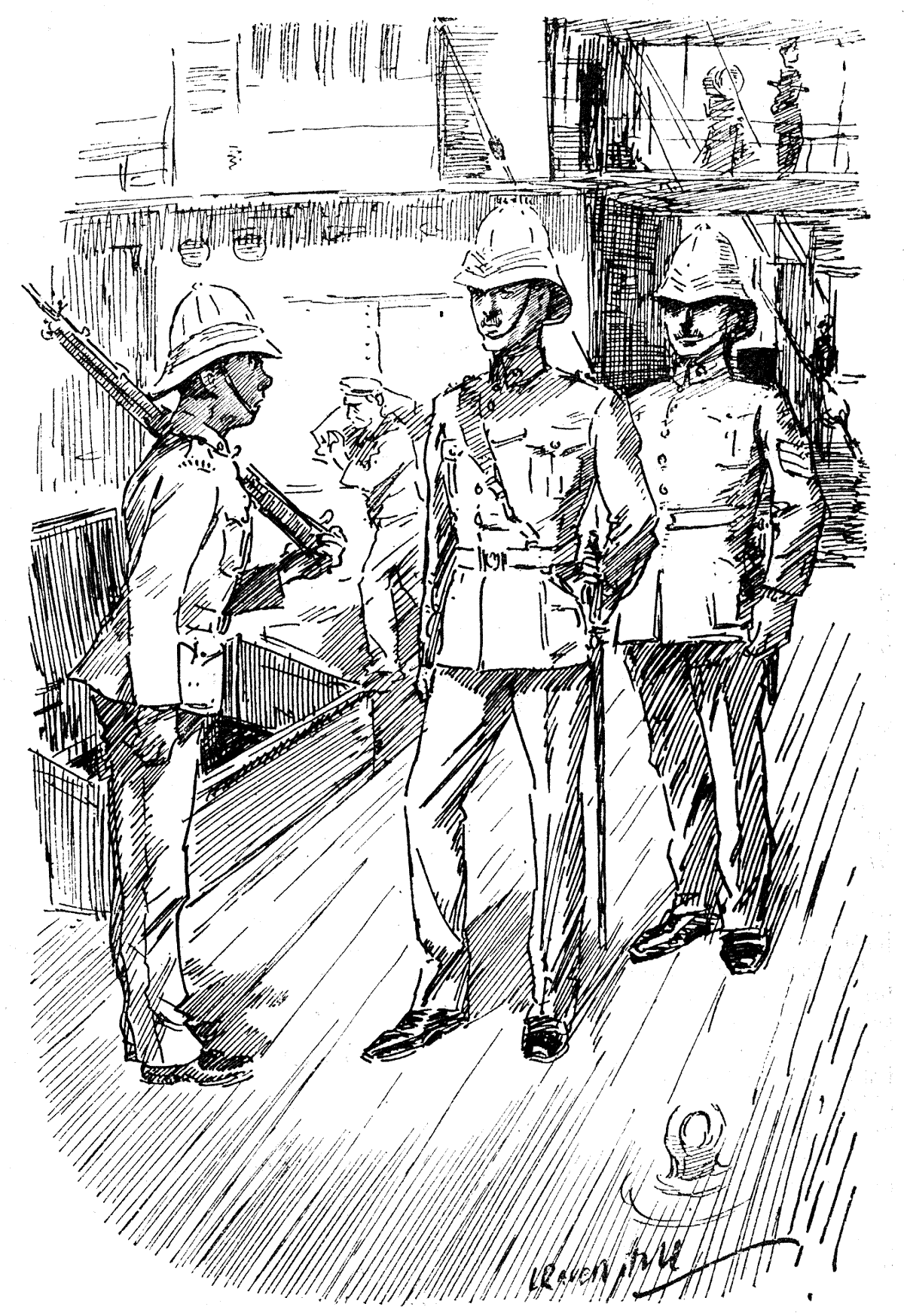
Extract from Sentries' Orders: "In case of man overboard, will throw the ship's life-buoy overboard, and report to the ship's officer on the bridge. In case of fire will at once report it quietly to the ship's officer on the bridge."
Officer of the Watch (on transport). "What do you do in case of fire?"
Nervous Sentry. "Throw meself overboard an' report at once to the bloke on the balcony."
IN SEARCH OF PETER.
Martell is one of those men that you might live next door to for half-a-century and never know any better. It is entirely owing to his wife and her love for Peter that Martell and I have discovered each other to be quite companionable fellows with many tastes in common, and I am smoking one of his cigars at the present moment.
Peter is the most precious and the most coveted of my possessions. He is coveted, or was, chiefly by Mrs. Martell, who fell in love with his name and his deep romantic eyes. Apart from these I can see nothing remarkable in him. He is certainly the most irresponsible hound that ever sat down in front of a motor-car to attend to his personal cleanliness, but still I should not like to part with him. "We must have a Peter," was the text of Mrs. Martell's domestic monologues, and of late, before the great disillusionment—that is, after hinting delicately to me that she would like best of all to have the Peter—she took to sallying forth, armed with the name, into the purlieus of dog-fanciers to find a criminal that would fit the punishment.
I was not altogether surprised, therefore, one afternoon when a note was brought in asking me to step round and have a cup of tea. Martell was monosyllabic as usual, and we sat and gazed into the fire.
"I don't suppose you would like to part with Peter," he said suddenly.
"I certainly should not," I answered.
Then, after a pause, "Could you tell a good lie?" he asked.
I looked up in astonishment, but just then Mrs. Martell entered and plunged in medias res. She had just returned from the last of those fruitless expeditions, and the slow realization that there can be only one Peter in the world had brought her nearly to tears.
"And I've bought such a sweet little collar for him," she said, "with 'Peter' printed in big letters."
I remembered then that the original dog was in daily danger of being arrested, his very aged collar having been chewed to pulp after his last castigation therewith.
"And a dear little pair of soft slippers, one for him to play with, and the other to smack him with if he's ever naughty, although I don't think he could be—your Peter, I mean. Have you slippers for him?"
"Well, not a pair," I said, "and not exactly slippers. One's a golf-ball, the other's more in the nature of a boot."
"Oh, but he 's such a sweet-tempered little creature, isn't he?"
I felt Martell's eye upon, me.
"Very," I said; "his early upbringing gave him a healthy body and a mellow heart. He was born in a brewery, you know, and never tasted water until I flung him into the canal the first day I had him. Since then, as often as he has time, he goes to bathe in the scummiest parts, and then comes and tells me all about it with any amount of circumstantial evidence. Most enthusiastic little swimmer he is."
"What a funny dog! But I should never allow him to go out alone—if he were mine, I mean. And what sort of food do you give him?"
"Well, he tried to swallow one of my white ties last night."
"Oh, but I should give him proper food," she said. "He doesn't hate cats, does he? I couldn't bear a dog that did."
My eyes met Martell's for one moment, then I cleared my throat. Slowly and sadly I opened the history of Peter militant, with unacknowledged borrowings from the lives of other Peters with other names. Beginning with cats I had seen in my garden looking as if they felt rather blurred and indistinct, I passed on through cats speechless and perforated, to cats that were. I told sad stories of the deaths of cats. I talked of nights of agonising shrieks, and mornings of guilty eyes and blood-stained lips. My store of reminiscences lasted five minutes, and before Mrs. Martell had recovered from their recitation I pleaded a pressing engagement and took my departure.
You will now understand why I count Martell among my friends and am at this moment, as I said before, smoking one of his cigars. It came in a box of a hundred, with the laconic note, "One for each."
As I write, my dog and my black kitten are barging in perfect accord all round my legs in pursuit of a brand-new collar with "Peter" printed in big letters.
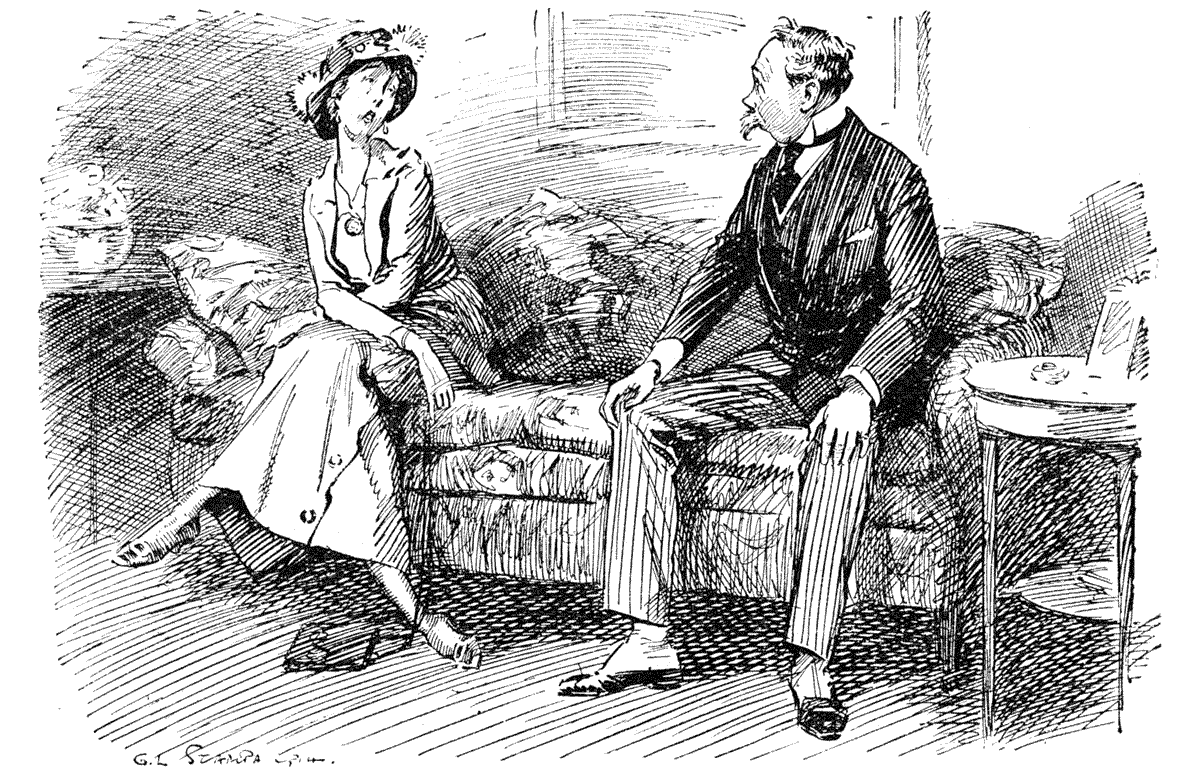
A NEW CRAZE.
"What a tragic face you have, Miss Pootle."
"Yes, You See, I adore misery."
Notice outside a station of the Wirral Railway Co.:—
"Loiterers on the Company's premises or annoying passengers will be prosecuted."
The passenger who annoys us most and seems worthiest of prosecution is the fifth on our side of the carriage.