Volume 146 — APRIL FOR THE EPICURE.
Reading edition
(An effort to emulate the gustatory enthusiasm of "The P.M.G.")
April, though regarded as somewhat suspect by meteorologists, appeals with a peculiar force to gastronomic experts, owing to the number of delicacies associated with the month.
Fish.
Oysters, like the poor, are still with us, but only till the end of the month; hence, ostreophils should make the most of their opportunities. But, besides the "king of crustaceans," as Colonel Newnham-Davis happily termed the oyster, the sea provides us with a quantity of other succulent denizens of the deep. Foremost among these is the turbot; a fish held in high honour since the time of the Roman emperors. Nor must we omit honourable mention of lobster, whitebait, mullet and eels. It is true that some people have an insuperable aversion from eels, but it is the mark of the enlightened feeder to conquer these prejudices. Besides, no one is asked to eat conger-eel at the best houses.
Meat.
Beef, mutton and pork are in good condition, or, if they are not, they ought to be. But the ways of the animal world are inscrutable, especially pigs. Lambs, again, show a strange want of consideration for the consumer, for, though April 12th is called "Lamb and Gooseberry-Pie Day," lamb, like veal, is dear just now and shows no signs of becoming less expensive. This is one of the things which independent back-bench Members should ask a question about in the House of Commons, or, failing that, they might write to The Times.
Verdant Stuff.
Lovers of salads should now be conscious of a pleasing titillation, for this is the green season par excellence. Watercress is at its cressiest; and lettuce springs from the earth for no other reason than to invite the attentions of those two culinary modistes, oil and vinegar—the Paquins of the kitchen—and so be "dressed", with highest elegance.
Les Petits Oiseaux.
Pheasants and partridges are, alas! not now obtainable except from cold storage. But let us not grumble over-much. Let us rather remember that the more they are neglected by the diner during the mating season the more of them there will be to eat when the horrid period of restriction is over. Among the rarer birds which are now on the market to compensate us may be mentioned the bobolink, the dwarf cassowary, the Bombay duckling and the skewbald fintail. The last-named bird, which comes to us from Algeria, is renowned for its savoury quality and is cooked in butter and madeira, with a soupçon of cayenne. The effect of the cayenne is to merge the too prominent black and white of the flesh into an appetising grey. The Rhodesian sparrow is another highly esteemed delicacy, which does itself most justice when seethed in a casserole with antimony, garlic and a few drops of eau-de-Cologne.
Rhubarb.
This is an extremely painful subject. Let us hurriedly pass to something more congenial.
Exotic Fruit.
An agreeable seasonal feature is the widening of the horizon to the fruit lover. All sorts of delightful foreign species and sub-species may now be bad for cash or (if one is lucky) credit—such as bomboudiac, angelica, piperazine, zakuska, shalloofs and pampooties. A delicious pampootie fool can be made quite cheaply as follows: 3 lb. of pampooties, 8 oz. of angelica paregoric, 1 imperial pint of sloe gin, 1 gill of ammoniated quinine, 9 oz. of rock salt. Boil the sloe gin and quinine to a frazzle, put in the pampooties, cut in thin slices, and take out an insurance policy.
Plovers' Eggs.
These eggs by a strange freak of nature are more easily obtainable in April and May than in any other month. In fact in December they are worth their weight in gold, and are then to be found on the tables only of Mr. Mallaby-Deeley, Mr. Rockefeller, Mr. Harry Lauder and Mr. John Burns. To-day they are anything from ninepence to a shilling each, and in a fortnight's time they will be sixpence each, with the added pleasure to the consumer of now and then finding a young plover inside.
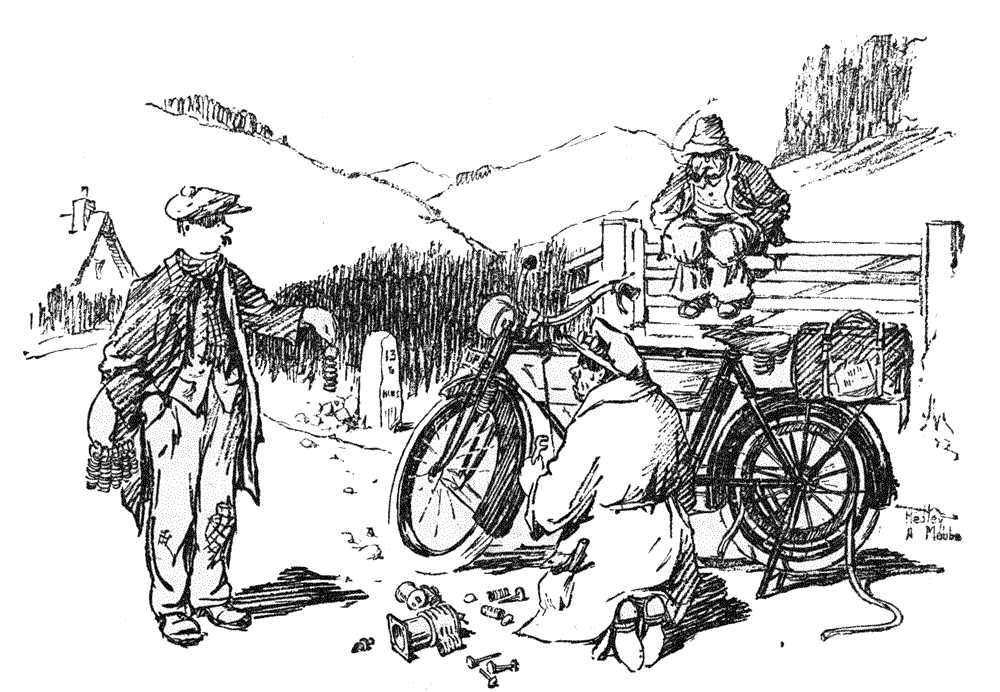
"Buy a puzzle, Sir?"
"On Wednesday of last week an express train dashed into a flock of sheep being driven over a level crossing at Northallerton to-day."
Meat Trades' Journal.
Only an express train could arrive a week early; the other ones are always late.
From a calendar:—
"April 6th. Dividends due. 'We needs must love the highest when we see it.'"
Unfortunately we don't often see it.