THE PROBLEM PLAYWRIGHT'S VADE MECUM.
Reading edition
Question. Has the Problem Play a solution?
Answer. Certainly; it answers the purposes of the author and the manager.
Q. From this I take it that it is invariably successful?
A. Well, it is never a failure; or, rather, hardly ever.
Q. Can you make your meaning a little plainer?
A. If it is not invariably a triumph of coin, it is a success of esteem. The house is crowded for a couple of months.
Q. And after?
A. The Problem Play is not expected to have an after.
Q. What is the essence of such a creation?
A. The unconventional treatment of the conventional.
Q. Give an example?
A. Two men tossing up for a lady. In Box and Cox the transaction was conducted with the assistance of a sixpence in the politest fashion imaginable; in a later version the affair could not be arranged without a pack of cards and much forcible language.
Q. Was the scene the same in both, like the situation?
A. No, in Box and Cox the spot was a second-floor back; in the other, the interior of an observatory on the summit of a mountain.
Q. Can you mention any other characteristic of the Problem Play?
A. The dramatist should be daring. People should say of his work that it would have surprised their parents and startled their grandmothers into fits.
Q. How can this desirable end be attained?
A. By the playwright causing his heroine to throw a pocket-bible into the fire, or perform some other act of parallel eccentricity.
Q. Should the heroine have any peculiarity?
A. As a rule she should be a woman with a past.
Q. But has not this type been worked to death?
A. It has certainly seen much service, to that the newest kind of heroine is to be preferred.
Q. What is the newest kind of heroine?
A. The woman who, without having a past, has, under the influence of drink, seriously damaged the possibility of enjoying a future.
Q. When does the leading situation arrive?
A. At the end of the second act. What goes before and comes after that climax is, to a large extent, immaterial.
Q. What is the customary fate of the heroine after the leading situation?
A. On rare occasions, suicide "off." But the usual exit is a retreat in rear of the clergy.
Q. What is the customary effect of the Problem Play?
A. That for a considerably longer time than nine days it is a wonder. Every one talks about it, and many see it during that period. When the wonder is exhausted according to precedent the cause of the amazement is forgotten.
Q. And, when this last season arrives, what does the author do?
A. A dramatist, having written one Problem Play, usually writes another.
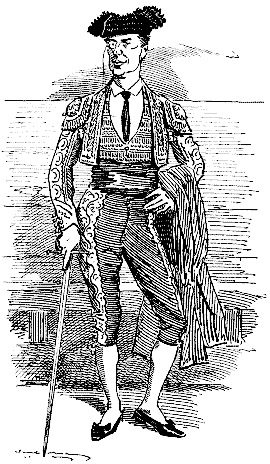
"DON JOSÉ."
J-e Ch-mb-rl-n, in Spain, as "The Tory-ador."
Professional and Journalistic.—The Editor of an illustrated paper says that his only difficulty with his artists is "the Initial Difficulty." He now has on hand an illustrated alphabet ready for all emergencies.
THAT TUNE!
(Sad Story of a Victim of "D——d Iteration.")
Tum-tum-tum-tiddle-um-tum-tum! 'Tis ground out twelve times over!! My nerves all twitch, my brain seems numb, Faith! I'm a music-lover; But that infernal organ-grind, With hideous iteration, Is driving me out of my mind, Into sheer desperation. Tum-tum-tum-tiddle-um-tum-tum! Tum-tum—O this is maddening! It may be in some gloomy slum, The organ-grinder's gladdening. But to a poor suburban scribe, Intent on scribbling copy, 'Tis torture! Shall I try a bribe? Or seek oblivion's poppy? Tum-tum-tum-tiddle-um-tum-tum! Tum-tum-tum-tiddle——Gracious! Those "tums" will split my tympanium, Eternally sequacious. Free country? Bah! When an organ-strain May blast, and blight and bore you, Till you get "tum-tum" on the brain? Ah! There's a picture for you! Tum-tum-tum-tiddle-um-tum-tum!— (The writer, once thought clever, Is now at Hanwell, doomed to hum That hideous tune for ever!)
A Story Anent the North.—According to the Dundee Advertiser, Colonel North has paid cash to the King of the Belgians, not for concessions of land near Ostend, but for similar advantages on the Congo. It has been rumoured that the purchase-money was ostensibly (or should it be Ostendsibly?) handed over for the possession of the former, and not the latter. But the rumour must be taken with reserve. Perhaps the report may have arisen from the fact that the Belgian watering-place is situated on the North Sea—a locality naturally associated with the name of the King of the Nitrates. Be this as it may, the gallant Colonel is certain to command the confidence of volunteers in the future as in the past. So far as he is concerned, shares (plough and other varieties) will be as popular as bayonets.
Stones in Sermons.
"Sermons in stones," the poet says; and when Smelfungus scolds, and rails, and girds, and groans at us, We feel that worst of sermonising men Is—throwing stones at us.
Mrs. R. observes of a respectable young man among her acquaintances, that she was sorry to hear he was incremated in a recent swindling case.
BIKE v. BICYCLE.
Some Tennysonian Bouts-rimés.
[Mr. Ernest Shipton, Secretary of the Cyclists' Touring Club, protests against the term "bike" as being unmitigated slang.]
Bike, bike, bike, By your leave, oh C. T. C. Quite too long for my tongue to utter Is "bicycle"—bike for me! O well for the slang-loving boy, That he "bikes" with his sister at play! O well for the lass or lad Who don't Mr. Shipton obey! For, in spite of him, "bikes" go on, Thus called, over dale and hill; And "bicycles" soon will be vanished, and The voice of the pedant still. Bike, bike, bike, Mr. Punch says, oh C. T. C. And the tender grace of a term that is dead Will never come back to me!
To Squire Punch.—Sir,—I don't quite know how to spell the gentleman's names, whether its "Tycho" or "Tykeo Brahe," but, anyhow, he was a sharp chap, and all I want to learn for certain is, was he one of the good old genuine "Tykes," and a Yorkshireman?
Yours,
John Browdie's Grandnephew.
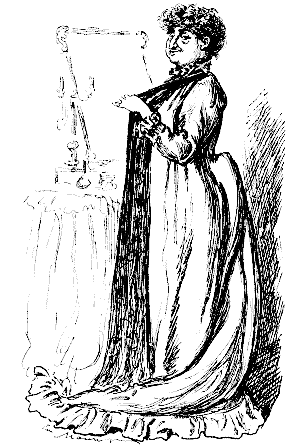
THE LATEST LITERARY SUCCESS.
"The Woman who wanted to."