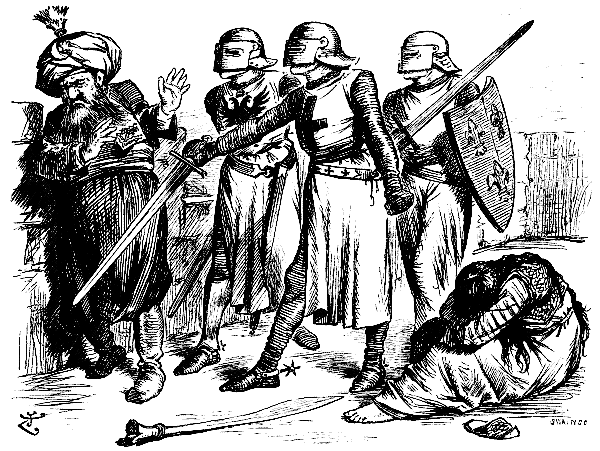
"COLLAR WORK"; OR, THE UNAPPRECIATED ENTERTAINER.
Reading edition
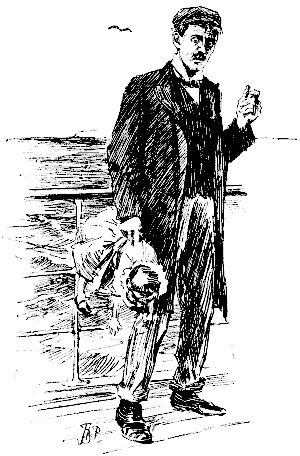
Scene—The after-deck of an excursion-steamer, which is on its return to Scarborough from Bridlington, where the excursionists have employed a shining hour in laying in copious luncheons at various restaurants and eating-houses. Owing to the tide, they have had to land and re-embark in small boats through a rather choppy bit of sea, the consequence being that the majority of the party—though not indisposed—are inclined to prefer meditation to moving about, probably on the principle of "letting sleeping dogs lie." After Flamborough Head has been rounded, a young man in a frock coat and a cloth cap, who has hitherto been regarded as perfectly inoffensive, suddenly brings out a pair of plush-covered tables from behind the funnel, and reveals himself in the unwelcome character of a professional conjuror.
The Young Man (clearing his throat and pointedly addressing a group of torpid tourists on the centre seats). Ladies and gentlemen, with your very kind permission, I will now endeavour to amuse you by exhibiting a few simple feats of ledger de mang to which I invite your closest attention (the persons addressed instantly assume an air of uneasy abstraction), as I find that the more carefully my audience watches my proceedings the less able they are to detect the manner in which the trick is performed.... I 'ave 'ere, ladies and gentlemen, a gingerbeer bottle, just a plain stone gingerbeer bottle of a pattern no doubt familiar to you all. (He produces it, and it appears to be generally unpopular, as if it called up reminiscences of revelry which some would willingly forget.) I will now pass it around in order that you may satisfy yourselves that it is what it appears to be. (To a Somnolent Excursionist in a corner.) Will you oblige me, Sir, by kindly taking it in your 'and?
The Somnolent Excursionist (who seems to be under the impression that he is being offered refreshment). Eh? gingerbeer? No, thanky, never take it.
[He closes his eyes again.
The Y. M. (to a Grumpy Excursionist on a campstool). Perhaps, Sir, you will oblige me by examining this bottle.
The Grumpy Excursionist (wrathfully). Hang it all, Sir, do you suppose I'm any judge of gingerbeer bottles; take the beastly thing away!
The Y. M. (cast down, but undeterred). Well, you are all satisfied that it is an ordinary earthenware bottle. Now I take this tin case—made, as you perceive, in two parts to fit closely round the bottle. I will just give you an opportunity of 'andling the case so that you may convince yourselves of its being perfectly empty. (He proffers it for inspection, but everybody seems willing to take it on trust.) I enclose the bottle in the case—so—I make one or two passes—hey, presto—and, on opening the case, the bottle will be found to have vanished. (It has—but nobody appears to regret its disappearance.) I close the case, which you all saw to be empty, once more, and what do I find it contain! (He pulls out yard after yard of coloured ribbon, which falls absolutely flat, but if the tin case had emitted a column of smoke and a genuine Arabian djinn, it would probably fail just now to produce any deep impression.) I shall next produce a pack of ordinary playing cards, from which I will ask you, Sir, to be good enough to select a card, without letting me see it or mentioning which it is (to the Grumpy Excursionist, who brushes him away irritably as he would a bluebottle). Madam, will you kindly——? (to the Stout Lady, who turns a shawled shoulder and feebly requests him "Not to come bothering her"). Perhaps you, Sir——? (to a Cadaverous Tourist, who intimates that he "never encourages cardplaying under any form"). Thank you very much (to a Rubicund Tourist, who accepts a card out of sheer good-nature). Now I shuffle the cards again, cut them, and (exhibiting a court-card with mild triumph) unless I am mistaken, Sir, this was the card you chose!
The Rubicund Tourist. Was it? I dessay, I dessay. I didn't notice particularly myself.
[Upon this the Young Man recognises that his conjuring fails to charm, and retires to the funnel in apparent discomfiture.
Excursionists (to one another). Card-tricks are all very well in their proper place; but, when you come out for a blow like this, why.... If it had been a little music, now, or a song, or soomat o' that soart, it would ha' been nahce enoof.... (With dismay.) Why, danged if he isn't going to give us anoother turn of it!
[The Young Man reappears, carrying two dismal old dummies with battered papier-maché heads, and preternaturally mobile jaws.
The Y. M. (after planting these effigies in such a position as to depress as many as possible). I now 'ave the pleasure of introducing to your notice two very old friends of mine, Mr. and Mrs. Jeremiah Jordles. (The audience, not having energy enough to escape, submit in sombre resignation to these fresh tormentors, which goggle at them with cheerful imbecility.) Well, Mrs. Jordles, Ma'am, and how do you find yourself this afternoon? I 'ope you're enjoying this most delightful trip.
[He bends his head deferentially for the answer, with a sympathetic movement of his own lips.
The Female Figure (with a waggling jaw, and in an impossible falsetto). No, I ain't enj'yin' this most delightful trip, so there. I believe I'm going to be ill in a minute. I feel that queer, I do.
The Male Figure (in a voice scarcely distinguishable from his introducer's own). Queer? And no wonder, after taking all them pickled wornuts with yer sooet pudden!
[The Stout Lady's ample cheeks are contorted by a transitory spasm, and the Cadaverous Tourist passes his hand across his mouth, which the Ventriloquist construes as reluctant tributes to his facetious powers.
Female F. Well, you needn't talk, after all them jam puffs and the prawns you swollered, 'eds and all!
Male F. Ah, I 'ad a appetite. And I 'ate waste, I do. But lor, when I see her a swallerin' down that sorcer o' cockles just after clearing out the 'okypoky barrer, I knew she'd live to be sorry for it!
The Stout Lady (to the Cadaverous Man). They didn't ought to be allowed to go on like this. Downright vulgarity I call it!
The Cadaverous Man. You are right, Mum It's quite enough to upset anybody. If he's going to make either of them images purtend to be unwell, I shall call the Captin and put a stop to it.
The Y. M. (with a tardy perception that he might have chosen a more generally agreeable topic, and meanly throwing the blame upon the innocent dummies). There, Mr. Jordles, Sir, that'll do. We don't care to hear what you and your good lady took by way of a relish; tell us about something else.
Male F. All right. There was a quart o' winkles, as wasn't over——
The Y. M. (shaking Mr. Jordles up, and stopping his mouth). 'Ush, Sir, 'ush! Beyave, now, and see if you can set quiet while Mrs. Jordles sings us a little song.
Male F. What? 'Er sing! 'Ere, chuck me overboard, will yer? I've 'eard her.
The Grumpy Exc. (in a savage undertone). For heaven's sake chuck 'em both overboard, and follow them!
Female F. Oh, dear, me sing? I'm all of a flutter like. Well, what shall I sing? Oh, I know. (Quavering.) "Where are the friends of Child'ood now?"
Male F. Why, in gaol, doing time!
[Mr. Jordles is reproved and corrected as before, but his senile flippancy only excites general disgust, and when he proceeds to boast that a beautiful young lady he met in Bridlington has fallen violently in love with him, the audience clearly resent the statement as an outrage to their intelligence. The Ventriloquist perseveres a little longer, though even his own belief in the dummies seems to be shaken, and at length he gives them up as hopeless, and carries them off ignominiously, one under each arm. Whereupon the party breathe freely once more, only to gasp in impotent horror the next moment, as the irrepressible Young Man returns with a smaller figure, modelled and dressed to represent an almost inconceivably repulsive infant. He perches himself on the bulwark, and placing this doll on his knee, affects to converse with it, until its precocity and repeated demands for a cheesecake render it an object of universal loathing and detestation. However, its pertness suddenly begins to flag, as beads gather upon the Ventriloquist's pallid brow, and allowing the figure to collapse in a limp heap, he rises unsteadily to his feet.
The Y. M. (in faltering tones). Ladies and gentlemen, such a thing has reelly never 'appened to me before in the 'ole course of my professional career; but I feel compelled to ask you kindly to excuse me if I break off for a few minutes, 'oping to resume—and with your kind indulg——
[Here he staggers feebly away and is seen no more, while a faint smile may be observed for the first time to irradiate the faces of the company, as they realise that their sufferings are more than avenged.
"I feel compelled to ask you kindly to excuse me."
CABBY; OR, REMINISCENCES OF THE RANK AND THE ROAD.
(By "Hansom Jack.")
No. IX.—PECKERS-UP!—ANTI-PRIG PHILOSOPHY—"TOMMY THE THUMPER"'S TALES—THE HAUNTED CAB.
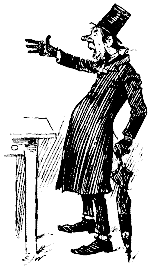
"Sort o' parson one time, if all stories is true."
A Cabby may be this or that; 'e's a chap as the world is much given to slang or to chaff; But there's one blessed boon as is usually 'is, 'e can do—what your prigs seldom can—a fair laugh. I 'ave known a good few of all sorts in my time; some scarce fit for to tool a old Sawbones's gig, Some as smart as they're made; but I never yet met a true Cabby as answered percisely to "prig." You look at a rank at a time fares is off, and the nosebags is on, and you find the chaps all A 'anging around with their 'ands in their pockets, 'ard by their pet pub, or close under a wall. They're looking about 'em, and passing the patter, and doubling sharp up at a wheeze or a joke; They may look on the lollop, but not on the sulk, nor they don't 'ang their 'eads like a ill-tempered moke. But life's not all laugh with 'em give you my word; summer's not all a beano, while winter is worse, And many a chap must drive 'ard through a sleet-storm when fur better fitted for blankets and nurse. Your fare snugged inside may be grumpy and growly, a crack in the winder will give 'im the 'ump; But you mustn't cuss, though you're soaked to your socks, and the rheumatiz racks your poor back at each bump. Stillsomever to take the lot smilin' 's our motter, though sometimes the smile sets a mossel askew. Old "Tommy the Thumper"'s just left me. Queer egg! Sort o' parson one time, if all stories is true. But rum 'ot and religion don't mix none too well, as tomater-nosed Tommy 'as reason to know. Still 'e 'as got the gift o' the gab, and no error, 'is yarns when 'e's on, make yer creepy and low. Tommy is one o' that mildewy sort as are gen'rally gloomy and down on their luck. 'E will tip you 'is graveyardy tales of old times, till you stand 'im a nobbler, or give 'im the chuck. Remembers the old body-snatchers, Tom does, and the Burke and Hare yarns make you cold as a dab; But what 'e reeled out o'er 'is rum-'ot to-night was a gospel-true tale of a old Haunted Cab. "Gospel-true, on my davy," is Tommy's pet clincher. "Ah, Jack," 'e grumped out, as 'e stoppered 'is bowl With a forefinger brown as a rusty old spike; "you young chirpers ain't go neither fancy nor soul. Hagnostical lot, you smart 'Ansoms, as think you are Huxleys on wheels, I 'ave not the least doubt, But why ain't a cab just as like as a castle to 'ave its own ghost? Tell me that, 'Ginger Grout'!" "Ginger" shook 'is red 'ead and said nothink. Says Tommy, "Old 'Barney the Bunch' was the sulkiest sort, 'E 'adn't no heart for a pal in distress, and 'e never liked 'parting' for friendship or sport. But what 'e most shirked was all haccident cases. Well, Cabbies don't cotton to them, as a rule, But 'Barney the Bunch' was a bit extry-brutal; a reg'lar old flint-hearted, foxy-eyed fool. "Bunched up on 'is box all alone one cold evening, when not a four-wheeler, 'cept 'is, was in sight, Old Barney was 'ailed by a poor shrieking creetur as 'eld a small girl in 'er arms, taller-white, With a small crimson cut on 'er poor little temple, arf hid by 'er goldian ringlets shook loose: 'The orspital—quick—for 'ev'n's sake!' pants the mother; 'Oh! don't lose a hinstant.' Lor, 'twasn't no use! "Barney whips up 'is 'orse, and trots off, most deliberate, grunting as 'ow that 'is cab worn't a 'earse. Most superstitious old griffin the 'Bunch' wos. Well there, the child died. But if ever a curse 'Ung over a cabby and cab it wos 'isn. Oh yes, you may grin o'er your corfee and toast In this 'ere cosy shelter. But strange fares, at night-time, do not like to ride number two—with a ghost! "All fancy? Then wy did all talk of a kiddy with goldian curls, and of wild-woman cries? And wy did fares pull Barney up on the suddent, and scuttle with shuddersome looks and skeart eyes? And wy did old 'Barney the Bunch' take to boozing, and wy wos 'e found stony-stark in 'is cab With eyes fixed on—nothink? Yus, nothink, of course! 'Tommy Thumper''s a fool to you young 'uns to blab." "She is a fare as I'd not loose for somethink." Shut up like a rat-trap, and trotted off twist-ways, the "Thumper" did, huffed in 'is boozy old style. A ghost-seer's dignitude does stand on end if 'e twigs that 'is cackle is met with a smile. But I didn't grin—not contemphuously, leastways; I've seen fur too much to be big on the boast, And this I do know, that your 'ard-'earted hunks will one day git 'is gruel—if not from a ghost. Conscience, I tell you, can build spooks like Guy Foxes, or as the jim-jams makes green rats or snakes. Real? Wot's "real"? Who's goin' to be cocksure wot's actual facks and wot's fancy's queer fakes? Only your ignerant, stuck-uppish shaller-pate. I never shirk no true orspital case; And if any ghost should make free with my Forder—I 'ope I could look the spook fair in the face. I' ave saved lives by a hopportune hurry-up; so I imagine 'ave most of my mates. 'Ansoms are everywhere, like London sparrers, and five minutes' start sometimes dodges the fates. Gratitude don't grow on every gooseberry bush, and to 'ave just saved a life or a leg Mayn't mean a fiver, or even a fare, but wot flaviour it gives your next corfee and hegg! I 'ave one "regular," crippled but rich, as I saved—so 'e says—from a fur worser fate. Only a fluke, as I tell 'im each Christmas, but somehow 'e won't wipe that job off the slate. Many a nice little extry it lands me; and as for 'is daughter, a brown-eyed young dove, Well, she is a fare as I'd not lose for somethink, though bob-less; I'd much sooner drive 'er for love!
At the Aquarium the highly trained and well-educated horse, Alpha, finishes a wonderful performance by being dressed up as a nurse, and wheeling a pony, Little Beta, about in a perambulator. Clever Alpha shouldn't be allowed to end by making such a donkey of himself. One of these days he'll be beaten by little Beta.
Mrs. R.'s nephew writes from Harrow that his aunt on returning from Homburg, observed cheerfully, "My dear, I feel as jolly as a sandbag."
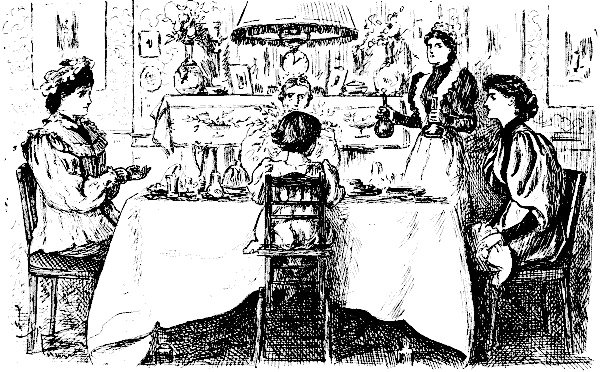
SMALL SOCIAL AGONIES.
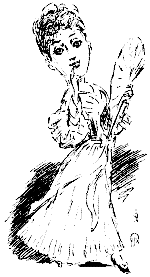
Hostess. "It's but a poor Lunch I can give you! But my Cook has got Influenza!"
Enfant terrible. "Oh, Mummy, you always say that!"
NOW AND THEN.
A Morality (after Morris) in Hyde Park.
"O, give me the sweet shady side of Pall Mall!" Sang Captain Charles Morris. But he was a swell, Filled with cockney, no doubt anti-democrat, spleen, At "an ass on a common, a goose on a green." But what had he said had he lived in our days Of the scenes that Hyde Park in the season displays? Where the "goose on the green" is a Socialist scamp, And the "pig on the dunghill" a somnolent tramp. O sweet rus in urbe, our London delight! A Ghetto by day, a Gehenna by night! Who cares for the meaningless trill of a lark, When the shriek of the spouter is heard in Hyde Park? "In London the spirits are cheerful and light," O Morris, your lyre is not up-to-date—quite. You knew not how coarse Boanerges can bawl, Saw not on the turf filthy vagrants asprawl. In Liberty's name what strange license is shown To the scoundrels who swear, and the zealots who groan; On turf that is tender, 'midst leaves that are green, The sights are repulsive, the sounds are obscene. Yes, Morris, that's what we now make of our Park; And as to the deeds that go on after dark, They would be far too gross for your liberal Muse, And to sing them e'en satirists now must refuse. You fancied each object in town a fresh treat; Had you seen a tramp huddled upon a park seat, You might not have felt so "revived by that whim," And you certainly had not sat down after him! Full many a trait of the times of gross George Makes humanity shrink, raises Liberty's gorge; But certain things now that to Park and Pall Mall come, In Freedom's name, truly are more free than welcome. In a Park that is spacious, umbrageous, and green, Seats, sprawlers, and speeches, at least, should be clean. And oh what avail that 'tis fragrant and floral, If loungers are frowsy and manners immoral? "In London, thank heaven! our peace is secure" You sang; and your London you knew, to be sure. But whether by daylight, or whether by dark, Our peace is by no means secure—in Hyde Park! Ah, Morris, we're freer, more human, more kind, Since you found your London so much to your mind. But, though to your days we've no wish to return, In the art of park-keeping we've something to learn.
The Poet-Laureate Stakes (by "Our Special Commissioner").—There is not much to choose between the competitors for the above unimportant fixture. Ever since the publication of the weights Sir Edwin Arnold has held the position of first favourite. He appears to have derived no harm from his recent journey to "India"; indeed, on visiting him at his new quarters in "the Tenth Mews" we found him in the pink of condition. Although Mr. Austin has, owing to a strained cæsura, and consequent restriction to walking exercise, gone back in the betting, he is, nevertheless, looked upon in some quarters as a likely candidate; while Sir Lewis Morris is very much fancied—by himself. A somewhat sensational wager of £3000 to £10 was booked against Sir Lewis and Mr. Henley "coupled."
Caution in Right Direction.—Dear Mr. Punch,—The direction, written by a correspondent, on an envelope I found on returning from a short trip, suggested to me exactly the description of a sly puss (which I am not) of a young lady (which I am) who would be a perfect model of propriety ("that's me") in her own domestic circle, but
"Forward if away from home!"
There's a nice description! So misleading! I mention this as something to be avoided by any one writing to a nice girl of his, or her, acquaintance, and placing special posting directions on the envelope.
Yours ever,
Lalage.
Cowardly Action on the part of a Soldier.—To "strike a tent."