CRAZY TALES.
Reading edition
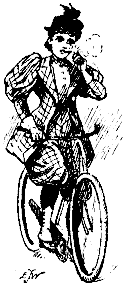
The Duchess of Pomposet was writhing, poor thing, on the horns of a dilemma. Painful position, very. She was the greatest of great ladies, full of fire and fashion, and with a purple blush (she was born that colour) flung bangly arms round the neck of her lord and master. The unfortunate man was a shocking sufferer, having a bad unearned increment, and enduring constant pain on account of his back being broader than his views.
"Pomposet," she cried, resolutely. "Duky darling!"
(When first married she had ventured to apostrophise him as "ducky," but His Grace thought it infra dig., and they compromised by omitting the vulgar "c.")
"Duky," she said, raising pale distinguished eyes to a Chippendale mirror, "I have made up my mind."
"Don't," expostulated the trembling peer. "You are so rash!"
"What is more, I have made up yours."
"To make up the mind of an English duke," he remarked, with dignity, "requires no ordinary intellect; yet I believe with your feminine hydraulics you are capable of anything, Jane."
(That this aristocratic rib of His rib should have been named plain Jane was a chronic sorrow.)
"Don't keep me in suspense," he continued; "in fact, to descend to a colloquialism, I insist on Your Grace letting the cat out of the bag with the least possible delay."
"As you will," she replied. "Your blood be on your own coronet. Prepare for a shock—a revelation. I have fallen! Not once—but many times."
"Wretched woman!—I beg pardon!—wretched Grande Dame! call upon Debrett to cover you!"
"I am madly in love with——"
"By my taffeta and ermine, I swear——"
"Peace, peace!" said Jane. "Compose yourself, ducky—that is Plantagenet. Forgive the slip. I am agitated. My mind runs on slips."
The Duke groaned.
"Horrid, awful slips!"
With a countenance of alabaster he tore at his sandy top-knot.
"I have deceived you. I admit it. Stooped to folly."
A supercilious cry rent the air as the Duke staggered on his patrician limbs.
With womanly impulse—flinging caste to the winds—Jane caught the majestic form to her palpitating alpaca, and, watering his beloved features with Duchessy drops, cried in passionate accents, "My King! My Sensitive Plant! Heavens! It's his unlucky back! Be calm, Plantagenet. I have—been—learning—to—bike! There! On the sly!"
The Duke flapped a reviving toe, and squeezed the august fingers.
"I am madly enamoured of—my machine."
The peer smoothed a ruffled top-knot with ineffable grace.
"Likewise am determined you shall take lessons. Now it is no use, duky. I mean to be tender but firm with you."
The Potentate gave a stertorous chortle, and, stretching out his arms, fell in a strawberry-leaf swoon on the parquet floor, his ducal head on the lap of his adored Jane.
"Happy Thought."—Mem. (from note-book of careless man). When nothing else to do, wind up my watch. It saves time.
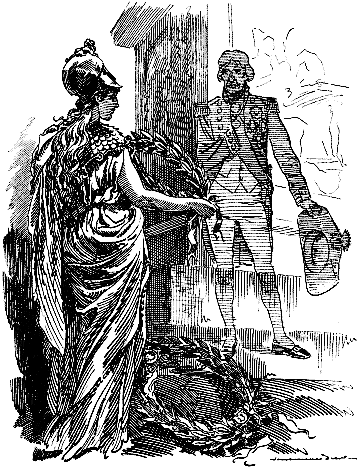
TRAFALGAR'S TEACHING.
Nelson (receiving the wreath, October 21, nineteenth anniversary of Battle of Trafalgar). "Thanks! But your Duty to-day is to see you have plenty of Ships and lots of Men to fight them!"
SCRAPS FROM CHAPS.
Mount the Butter-tub!—Irish butter is on its trial, it seems. It has managed to get a bad name, because some of the makers or dealers become so attached to it they won't part with it for a month or so after it is churned—and when they do part with it they pretend it's new. So the trustees of the Cork butter market suggest a "date-brand" as a means of restoring the damaged reputation of the Hibernian cow. It is quite obvious that if butter is to keep, it mustn't be kept—which sounds like a bull, but it's true. Now is the time for Irish patriots to come to the rescue of their firkins—to form a "Brand League" if necessary—and prevent the produce of Irish dairies being evicted from the markets of England.
Why should Glasgow Wait?—The average time taken by a telegram to get from Glasgow to London, or vice versâ, is twenty-nine minutes, and the cry of the Glasgow Chamber of Commerce, in consequence, is "More wires!" The Chamber does not mind if they are overhead wires; all it objects to is, overdue wires. There has been a railway race to the north; but a telegraph race seems still more wanted just now. And the worst of it is that the lordly Stock-Exchange folk are specially provided with a wire that sends their telegrams in five minutes. Punch's advice to the Chamber of Commerce is—"wire in!"
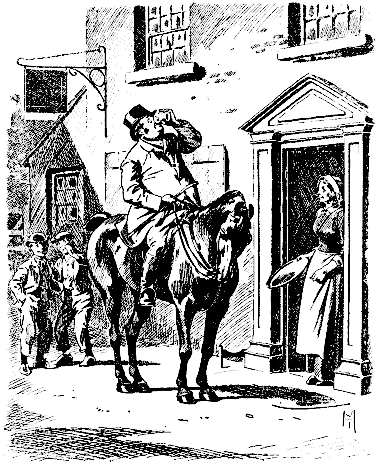
JUMPING POWDER.
(Mr. Twentystun having a Nip on his way to Covert.)
Small Boy. "Oh my, Billy, 'ere's a Heighty-ton Gun a chargin' of 'isself afore goin' into Haction!"
Bumbledom and Bristles.—A strike of barbers has occurred at the Cork workhouse; no inmate cares to undertake the duty at the pay of one shilling a week; and the guardians are thinking of getting in outdoor relief for the chins of their paupers. Why not an "Irish Melody," to this effect?—
The barbers have struck, farewell to the shave, And the rate-supplied soap on the cheek of the brave.
A Magnificent Opportunity.—The enormous hotel, the neighbour and, it may be, the friendly rival of the Savoy Hotel à la Carte,—for friendship in opposition is possible though improbable,—is almost completed, but apparently it is still "a deed without a name." What is it to be called? The board, not of directors, but of advertisement outside, says, "This Magnificent Hotel," &c., &c. Well, gentlemen proprietors, why not take this description as the title? It does not look bad in French, "L'Hôtel Magnifique." And in plain English "The Magnificent" is a striking title, which can become popular as "The Mag." Mr. Punch, as General Hotel Inspector and Universal Board Adviser, offers the above suggestion.
"FINIS."
(By an Old-fashioned Novel-reader.)
Oh! when we finished a tale of old, The thing was through, and the story told. But when we shut up a tale that's "New," There's little told, and there's nothing "through." With neither beginning, middle, nor end, We do not part with the book as a friend. Finis! The word seems ironical sport, It is not finished, but snapt off short, Like the poor maid's nose by the blackbird's beak In the "Song of Sixpence." That tale was weak, Ending in nought, like an alley blind. But our story-spinners appear to find Their moral there. Their tales don't close, But break off short—like the poor maid's nose! Ah me! for a few of the fine old chaps Who gave us meals, not mere dishes of scraps!
"Post Obit."—The Sheffield Daily Telegraph announces that the first piece of patronage in the district which has fallen to the new Postmaster-General is now being competed for. It is that of medical officer to the local post-office. Our contemporary announces that the applications, which are said to be very numerous, have all gone in. It is generally understood that the gentleman ultimately selected to undertake the duties of the post will not necessarily be connected with the Dead Letter Department.
A CLERICAL MISTAKE.
(Fragment of a Romance found shortly after the holding of the recent Clerical Meetings.)
"You are most kind," said the guest, getting down from the dogcart and assisting the retainer to carry his portmanteau into the house.
"Not at all," was the reply. "If you are so good as to wait a moment, I will take the vehicle round to the stables and then show you your room."
The guest bowed his head gratefully, and yet with some embarrassment. Who was this retainer? He seemed to be a man of education, and yet—— He had no time for further thought, as the subject of his meditations returned to him.
"I was as speedy as possible," said he; "as I knew you would like to dress. The rector dines rather early, and is sure to be punctual to-night. This way."
And then the two young men marched up the staircase, and entered together the spare room.
"There!" exclaimed the retainer, as he finished laying out the contents of the guest's portmanteau. "Now all you have to do is to look sharp and get down into the drawing-room, before the arrival of the bishop. I shall try and snatch a few moments' doze, as I have been busy from the early morning."
"I really cannot sufficiently thank you," said the guest, hunting in his waistcoat pocket for a shilling. "But if you will allow me——"
"Oh, no thank you," interrupted the retainer, with a slight blush. "I really do not require a tip."
"But surely, from your multitudinous duties, you must be the butler?"
Then came the solution to the mystery.
"Oh dear no! I am not the butler! I am only the curate!"
A NEW SWAN SONG.
[Miss Annie Swan says—"What appears to be required is, that the wife should have something of her own, given to her freely by her husband for her own use and benefit, absolutely apart from other moneys, that she should spend it as she chooses."]
Oh! give me something of my own, In which Man has no part; Which I may hoard, or spend, or loan, And it shall ease my heart. And if you ask me whence 'twill come, And what will be my plan, I answer that that private sum Should come—of course—from Man! I'll grab it quick, I'll hold it tight, That welcome L. S. D., Concerning which Man's only right Is—just to give it Me!
Probable.—New edition of "Cornelius Nepos," with notes by Lord Halsbury, assisted by Mr. Hardinge Frank Giffard, Sec. Comm. Lun.
Proverbial Conservative Philosophy.— Sow Local Government in Ireland and it will come up Home Rule.