THAMES TALK.—A Forecast for 1896.
Reading edition
How greatly improved are the steamboats. They seem to be as good as any at home and abroad.
Quite so. They are simply floating palaces. You could find nothing to equal them in America.
So convenient to have a better class for those who can afford a few extra pence. Without this, we should have never seen that duchess chatting away with the countess in her own right.
Yes; and so pleasant to be able to get five o'clock tea nicely served by trim waitresses in a saloon upholstered with satins and ormolu.
And the duke and the viscount seem quite comfortable in the luxuriously furnished smoke-room.
Well, the sight is not surprising considering that the designer went to the Junior United Service Club for his model.
And yet the artisans are contented with their part of the vessel. It certainly was a happy thought to supply their cabins with bagatelle boards, dominoes, and a five guinea compendium of games.
In spite of the size of the vessels the boats travel at a rapid rate. No doubt this is attributable to the magnificent engines.
Of course. And really it is very pleasant to travel from Chelsea to Kew to the sounds of a first-rate Hungarian Band.
The commissariat, too, has not been neglected. The luncheon on board is worthy of the best traditions of the buffet at Calais. And as cheap. Only fancy, half-a-crown for three courses and dessert!
Yes; and that meal seems equally popular with the sixpenny tea (with cakes and crumpets) prepared for the patrons of the fore-part.
The fares are also very low. Even in these hard times it would be unreasonable to complain of overcharge when the ticket between the Temple and Hampton Court is only fourpence.
It is marvellous that no one tried the plan before of starting boats from half the piers for all the rest at five minutes interval.
And yet they are crowded with travellers. Really the Thames seems to be a very popular highway.
Naturally, when the passengers are sheltered from the weather—too much sun or a plethora of rain—at all times.
And I suppose London may thank the County Council for establishing comfort with economy, and luxury with rapidity?
Oh dear, no! If the metropolis had trusted to that dilatory body, it would have had to wait indeed!
Then to whom are the five million inhabitants of the chief city of the universe indebted for these sweet boons?
To an ordinary man of business who knows how to cater for the multitude, and has the courage to rely upon increased income as a means of meeting additional outlay.—He merits a statue.—He deserves more—hearty praise by the Press when he discards his incognito.
ROBING-ROOM RUMOURS.
In consequence of the great success of the "Smoking at Home" at the Inner Temple, it is proposed to start a circus at the Middle.
The suggested "Musical Dinner" at Lincoln's Inn is now under consideration, and will probably see the gas-light before the end of the term.
The numerous professional engagements of Sir Fr-nk L-ckw-d will not prevent him from appearing as The "Lightning Cartoonist" at the coming Gray's Inn Matinée.
Should the anticipated "Free-and-easy" come off at the Middle, the Lord Chancellor is not unlikely to give an exhibition of swordsmanship. The distinguished Peer is said to be the finest living exponent of the sword and dagger fight.
The Lord Chief Justice is expected before Christmas to repeat his recent interesting address, with the assistance of a piano and dissolving views. A troupe of first-rate banjoists from the Three-in-a-Bar Musical Society may possibly be found among the incidentals.
There is no truth in the report that at the next "Five o'clock tea with pipes" at Lincoln's Inn Sir 'Arry 'Awkins will warble "Down Newmarket Way."
In spite of the social entertainments in contemplation, the Examiners of the Council of Legal Education will perform their duties. At present there is no intention of adding another subject to the pass for admission to the Bar. In the future it may happen that all students will have to take up "the duties and responsibilities of proprietors of music halls."
From "The Pottery," Haymarket.—The "Tree-ilby Tree-o," G. D. M.-cum-P. P.-et-B. T., beg to state that they are all delighted with "the reception" of the piece, and still more with "the receipts."
"Ex Pede."—Miss Baird appears as the model Trilby without shoes or stockings. Such realism is a novelty which unfortunately prevents this young actress from ever losing her identity, as, though the upper portion of her figure is "very Trilby," her feet are most decidedly Baird.
Another Theatrical Benefit.—"The Benefit of the Doubt."
TRUE HUMILITY.
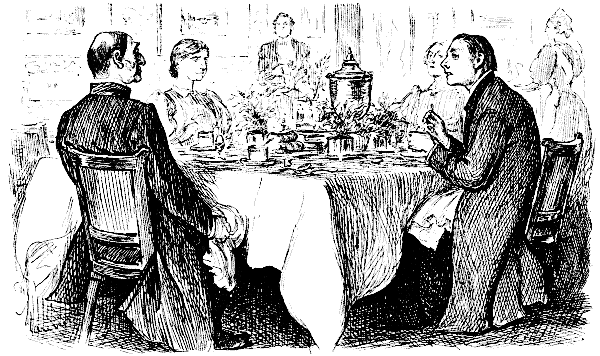
Right Reverend Host. "I'm afraid you've got a bad Egg, Mr. Jones!"
The Curate. "Oh no, my Lord, I assure you! Parts of it are excellent!"
IN PITY FOR SPRAGUE.
[A fund is being raised in aid of the widow of the fireman Sprague, who met his death gallantly in the late explosion in the Strand. "Sprague was a young man, under 30 years of age, of good character and promise. His widow has one child, and is soon again to become a mother."—Times. Any subscriptions forwarded to Mr. W. O. Reader, Vestry Clerk, 151, Strand, towards the relief fund, will be thankfully received and acknowledged.]
Air—Prowse's "City of Prague."
We dwell in a city fear-haunted, And danger from fire is our lot; Great pluck in our firemen is wanted, And that they have certainly got. We've stalwart young heroes in plenty To fight with the fiery-tongued flame. But to die when scarce past five-and-twenty, Seems sad, though like Sprague, you die game. Our duty to-day seems quite certain The aim, of the fund, is not vague; Punch hopes human pity will stir the whole city To honour the memory of Sprague. In he dashed, though the hugh wall was frowning, The wall which fell, crushing on him; Friends toiled, as to rescue the drowning. Mates dug, though with hope growing dim. They found him, death's flood bravely breasting,* Ten hours of lone anguish he bore. Now, alas! the brave fireman is resting, To fight London's fire-fiend no more. Though honour o'er him drops the curtain, Our duty to his is not vague. Subscribe, London city, in pride, and proud pity, And love of your brave fireman, Sprague!
* "Covered with dirt, haggard, and hardly recognisable for the vigorous man who had dashed into the court ten hours before; he smiled faintly, and whispered words of gratitude and hope. 'I am so glad you have come,' he said. 'I shall be all right again soon.'"—Daily News.
"I PROMESSI SPOSI."
Princess Maud and the Danish Prince Charley.
(With Apologies to the Memory of the great Author of "Maud.")
["Her Royal Highness Princess Maud of Wales, youngest daughter of the Prince and Princess of Wales, is engaged to be married to His Royal Highness Prince Charles, second son of the Crown Prince and Crown Princess of Denmark. The Queen has received the news of the betrothal of her dear granddaughter with much pleasure, and given her ready consent."—From "Court Circular."]
I.
Words that brighten the season, As winter's gloom is falling, "Maud, Maud, Maud, Maud!" Loyal Britons are calling.
II.
Well loved Maud, of a well-loved brood! And brave Prince Charles is with her. 'Tis good, indeed, to see once more, Briton and Dane together!
III.
Sea-king's son from over the sea, Successfully you have sought her! England cries "Welcome!" this day to you, As once to the "Sea-king's daughter."
IV.
Our Queen is well content. "I Promessi Sposi." May the future stint its shadows, And leave their pathway rosy.
V.
Heard she the well-loved voices, Crying and calling to her:— Where is Maud, Maud, Maud? A Prince has come to woo her.
VI.
Hark! a sound at the door! "Little King Charley snarling"?— Nay. A Danish Prince from a distant shore; And—this Charley is her darling!
A PLEA FOR OUR TREES.
["The frost has told heavily on the London trees."—Westminster Budget.]
"Frost has told heavily on the London trees." What matter; whilst the seasons wane and wax? But what makes London-lovers ill at ease Is the fierce ruin of the Vandal axe. "Frosty but kindly" is chill Winter's touch Upon our trees, as on old Adam's head; But when the Jerry Builder lays his clutch On trees, he leaves them but deformed—or dead! Ruined by jobbing gardeners' ruthless ravages, Hideous as Doré's cripples, trolls or gnomes. Will no one save from these tree-slaughtering savages The bowery charms of our suburban homes?
Happily Named.—"M. Jaures spoke in the Assembly for four consecutive hours."—Telegram from Paris.