OUR BOOKING-OFFICE.
Reading edition
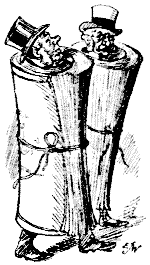
"I like it muchly," quoth the Baron, finishing Baring Gould's Noëmi:—
"This scribe for publishers ne'er writes in vain; His pen prolific, Baring Goulden grain."
And Noëmi, if a trifle less Gouldish than Weymanish, is a tale of stirring times, when to plunder, hack, stab, and string up a few unfriendly fellow-creatures, who would have done the same by you if the turn of luck had been theirs, came in the day's work; while to roast an offender whole "all alive O," just for once and away, was, so to speak, "quite a little 'oliday," as a special and exceptional treat. And all these jocular barbarities were occasioned, not by any religious fervour, or by intolerant persecuting zeal, excusing itself on the score of anxiety for future spiritual welfare of victim, but simply out of pure cussedness, and for the humour of the thing, much as, now-a-days, the bowie-knife and the cord are used "down West." Personally, the Baron gives not full credit to all these tales of mediæval cruelty, but the "scenes and properties" serve an excellent artistic purpose, and so he loves them as he loves such romances as those of She who must be obeyed, and Treasure Island. Therefore here's to the lass Noëmi, and, as she herself would of course say, in response to the toast, "You'll like me the more you Know-o'-me."
Another capital story by Frank Barrett, entitled A Set of Rogues, is strongly recommended by the faculty; the faculty in question being that of deciding upon what sort of book is certain to suit the tastes of the majority of romance-readers, who, aweary of the plodding every-day business in this "so-called nineteenth century," like to get away from it occasionally and live, just for a change, in the seventeenth. Stirring tale this of A Set of Rogues, without a dull chapter in it: and just enough human sentiment in it to soften down the roguery. In fact, so skilfully is the tale told that the reader will find himself siding with "their knavish tricks"; for the hearts of these rogues are in the right place, though their bodies very seldom were, and their heads never, in the noose. But "no noose is good noose," and so let the honest reader procure the book from Innes & Co. of Bedford Street; he will come to love the scoundrels, and will ask, with the Baron, "What on earth became of that captivating Don Sanchez?" and another query, "Was the villainous old Steward really killed?" Perhaps the author is reserving the Don and the Steward for another romance. If so, "What will he do with 'em?" asks the
Interested Baron de B.-W.
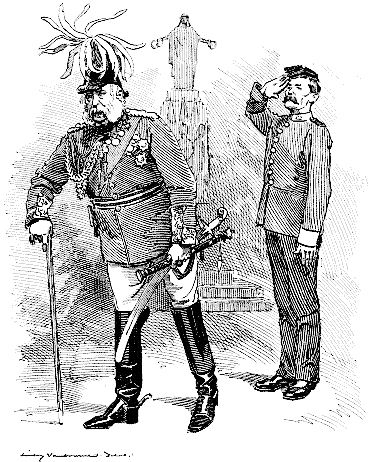
THE LAST SALUTE!
Tommy Atkins (to Commander-in-Chief H.R.H. The Dook of C-mbr-dge) "Sorry to lose you, Sir! You have always been a very good Friend to us!"
"In this, his first Army Order, Lord Wolseley wishes, in the name of the Army, to assure His Royal Highness of the affectionate regard of all who have served under him during his long period of office."—London Gazette, November 1, 1895.]
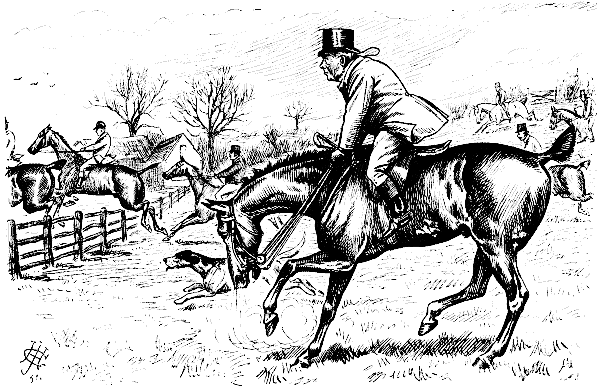
HOPE DEFERRED.
Old Gent (pulling up, not fancying the timber). "Confound it all! Surely One of 'em 'll manage to Break the Top Rail."
THE TWO SOLDIERS' TEARS.
(Some way after Thomas Haynes Bayly's "Soldier's Tear.")
When at the porch he turned, To take a last fond look. (Human emotion will have way In Tommy or in Duke.) He listened to the tramp, So familiar to his ear; And the soldier gripped his good old sword, And wiped away a tear. Not far from that same porch A Tommy stood at ease, But, as he saw, his head braced up, And he stiffened at the knees. "Sorry to lose you, Sir! You've been our friend, and dear!" That Tommy cried, and with his cuff, He wiped away a tear. Both turned, and left the spot, Oh! do not deem them weak, For dauntless was each soldier's heart, Though a tear bedewed each cheek. As Punch gives hearty thanks, At the close of a long career, To the gallant Duke, he also turns, And—wipes away a tear!
Seasonable Dialogue.
First Dissatisfied Sportsman. What do you think of the present season, so far?
Second Dis. Sport. (with a terrific "cold id 'is dose"). Der preselt seasult? You mead der cubbig season.
First Dis. Sport. (correcting him). Well, the present season is the "cubbing season."
A YELL FROM THE YELLOW.
The "Yellow Dwarf" (in the Yellow Book), in an almost incoherent scream against the literary ladies and gentlemen of the day, wails as follows:—
"The bagman and the stockbroker's clerk (and their lady wives and daughters) 'ave usurped his (the 'gentleman and scholar''s) plyce, and his influence on readers; and the pressman has picked up his fallen pen—the pressman, Sir, or the press-woman!... With an illiterate reading mob howling at our doors, and a tribe of pressmen scribbling at our tables, what, in the name of the universe, can we expect? What we get; not so?"
Well, "what we get" is (among other things) the above shriek of the "Yellow Dwarf," who seems to do his full share of the "howling" he attributes to the "reading mob," and who, indeed, might be better described as the "Yeller Dwarf."
On a Sympathetic Actress.
Air—"The Widow Malone."
To the Garrick Theayter you'll roam, You'll roam, Where Marion Terry's at home, At home. She melts all the hearts Of the swains in such parts As she plays in a play by Jerome, Jerome. Not much of a play by Jerome.
Why should "All Souls," Oxford, be always a distinguished college? Because it could not be "all souls" without "somebodies" in it.
BENN AND JIM.
A Pathetic (L. C. C.) Ballad.
[See recent controversy between Mr. Benn and Lord James in the Times.]
Benn, an L. C. C. fighter bold, Was used to war's alarms; And when Jim knocked him off his legs, He wouldn't lay down his arms. He cried. "I will not quit the field, Though Hereford Jim may shoot; And though to stand on I've no leg, I will not budge a foot!" Now Hereford Jim, a gunner smart, Riddled Benn fore and aft. Cried Benn, "Although my decks he's swept, He has not sunk my craft." Says Jim, "Those shanks are not live limbs, They're only party pegs! You have as wooden members quite, As represent your legs!" "Alive—and kicking, still am I!" Says Benn, with huge elation; "But if you think my legs are dead, Let's have—an arbitration!" Says Jim, "They are mere timber-toes, Though as live limbs you sport 'em, Though arbitrators have their use, They do not sit post-mortem! "A coroner sits on a corpse, To find out how he died." The Times then "sat on" Benn, and found A mistake in his inside.
The "Rubber Industry."—Evidently whist.