ROUNDABOUT READINGS.
Reading edition
It is a great thing to know—and one must believe it if one believes, as I do, in what the newspapers say—that every single male member of the upper or fashionable ranks of society is at this moment engaged in slaughtering grouse. It is of course well known that every member of Parliament is, on his election, presented by a grateful country with a large and well-stocked grouse-moor, situated in one of the most picturesque and romantic parts of Scotland, and no one (not even a brewer) is ever raised to the peerage unless he can prove that at least three generations of his family have shot grouse regularly on the 12th of August on a moor of their own. Thus is the connection of both branches of our legislature with sport safeguarded.
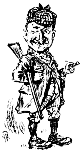
Whenever the 12th of August, or, for the matter of that, the 1st of September or the 1st of October, comes round with the revolving year, we are informed in every newspaper that "Sportsmen were early astir." There is about these words a halo of tradition so ancient and venerable as to have become almost sacred. Imagination conjures up the picture of happy bands of shooters all duly booted, gaitered, gunned, cartridged and cigarred, sallying forth with dogs and keepers at 5 A.M., no doubt after eating, as condemned men do, a hearty breakfast. Of course this may be so. I have read it so often that I hardly dare to doubt it. My own experience, however, is that sportsmen are not specially early even on the 12th, although keepers and other professional guns who cater for the London market are often so early as to anticipate by more than a few hours the recurring anniversary.
Now with black London's close and torrid street Stern Caledonia's heathered moors compete. Lo, well equipped with cartridge-bag and gun, Concurrent streams of rank and fashion run Where, though the birds be strong upon the wing, Not unrewarded sounds the frequent ping; Where dealing fate to feather (and to fur) The early sportsman is perceived astir, And in the lengthy language of the chase, A bird's no bird, but merely half a brace. Some skilful, some not fit to shoot for nuts, Walk for their game or take their stand in butts; And, wondrous fact, as all the scribes proclaim, Each from a separate butt destroys his game. At least it was so when the Emperor shot, so With non-Imperials it perhaps is not so.
I am never irritable myself; I am sometimes justifiably annoyed by the unreasonable conduct of a friend. But I have often noticed the most melancholy irritability in others, and have wondered why they gave way to it, and what it portended. Now I know. I have been reading the Medical Press and Courier, and I learn from it that "this hyperæsthesia of the temper is the direct outcome of overwork and want of sleep; in fact, it is a morbid sensitiveness of the cells of the cerebral cortex due to exhaustion or under-nutrition. Irritability is, therefore a clinical sign of some importance, the more so because it is often the premonitory indication of impending breakdown. Under these circumstances, the condition is usually most marked during the forenoon, and is associated with a distaste for food at breakfast time. Later on, even the humanising effect of a good lunch fails to raise circulatory activity to the standard required for adequate cerebral nutrition, and the irritability becomes chronic, yielding only to the influence of repeated doses of a diffusible stimulant, such as brandy and soda. The remedy naturally only aggravates the symptom, which is sooner or later followed by other manifestations of cerebral exhaustion."
When you're lost in the whirl of a medical vortex, You gasp and you grasp, and you'll struggle in vain; For it seems you have cells in your cerebral cortex, Which is somehow connected, I fancy, with brain. Exhausted and panting with under-nutrition, You dare not presume to declare yourself well, And you rapidly tend to complete inanition, Produced by a morbidly sensitive cell. The result is a wound to the temper, a something Not as deep as a well, but, no matter, it serves, Perplexing your friends, who pronounce it a rum thing That Dick—that's yourself—should have gone in the nerves. You toy with your breakfast; the kidney, the kipper, The egg that is buttered, the egg that is fried, The tea that once found you a regular sipper, Unsipped and untasted you push them aside. Your lunch of cold beef with the gaff and the shandy, You simply can't face it, your head is one ache: A "diffusible stimulant" (alias brandy) Is all that you wish for and all that you take. A day or two back all your manners were courtly, Alas, what a change is apparent to-day, For you jump on your friends, and you take them up shortly, With a quarrel a minute whatever they say. Then, in spite of the canon that's set 'gainst self-slaughter (In the language of verdicts it's felo de se,) Some day you'll be found with your head in the water, Six inches will do, or attached to a tree.
There have been some difficulties at Brierly Hill. At a recent meeting of the Urban Council a letter was read from the Local Government Board asking for information with regard to a communication which Dr. Ellis, the medical officer of health, had addressed to them. This referred to the fact that Dr. Ellis had ordered a "dumb" well at the Town Hall to be cleared out. What is the use of a dumb well? Even if it contains the truth it cannot speak it. Personally, I prefer a babbling brook.
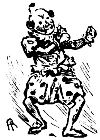
What is this? Is it a revolution or merely a mistake? Do I sleep, do I dream, or is visions about? These questions occur to me on reading that at Ironbridge the other day a clown, a member of a circus, was brought up on remand charged with stealing £1 10s. and several articles, the property of his landlady. And he was actually sentenced to fourteen days' hard labour. All I can say is that I have rarely allowed a year to pass without seeing at least one clown steal a string of sausages, a lady's bonnet, two plump babies, half a dozen fowls, the greater part of a general dealer's property, and the upper half of a policeman. Nobody bothered him about it. In fact, everybody expected him to do it, and there would have been great dissatisfaction if he had observed the laws against larceny. And yet when a clown at Ironbridge acts as clowns are intended to act, an unfeeling bench visits him with a fortnight of hard labour. This is preposterous. There ought to be an Amalgamated Union of Clowns to protect its members from such an outrage.
Those who study the reports of meetings of Town Councils learn many things. For instance, at Bristol the other day, during a discussion of passenger tolls at the docks, Mr. Gore complained that they had been hocussed by the chairman of the sub-committee that day. Mr. Baker objected to the word "hocussed" being applied to him, but added that they had been hocussed out of a good deal of time to-day, and Mr. Gore retorted that they were going to be hocussed out of another quarter-of-an-hour yet. Mr. Baker asked Mr. Gore to withdraw the word, and Mr. Gore refused. Matters had apparently come to a desperate pass, when it occurred to the Mayor to inquire what the word "hocussed" meant. Mr. Baker thought it was something akin to cheating, whereupon Mr. Gore, in the handsomest manner, said that knowing the meaning of the word he would now withdraw it. The only thing that was not explained was why Mr. Gore had used a word of the meaning of which he was ignorant. There is a fatal attraction about the sound of certain words which forces speakers to use them entirely without regard to their actual meaning.
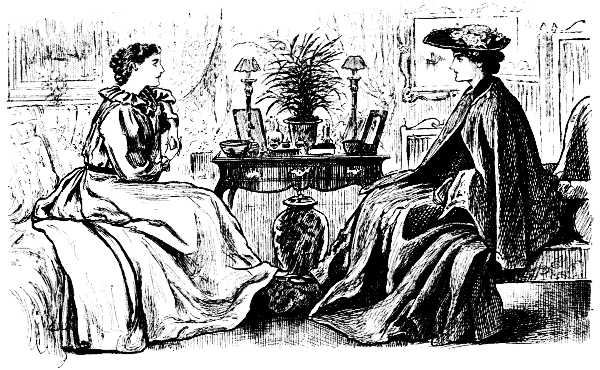
A LESSON IN DOMESTIC ECONOMY.
Laura (to her rich Sister, who has been extravagant as usual). "I do think it's a mistake to buy an Ugly Thing one doesn't want, merely because it's dear!"
'ARRY ON HARRY.
(A Rejoinder to "Harry on 'Arry.")
Dear Charlie,—My eye and a bandbox! Wot next, and wot next, and WOT next?
'E bangs Boernerges to bittocks, this lar-de-dar bagman—in silk—
And 'e's going to do me a fair knock-out as sure as a whale ain't a whilk.
I larf, I do, Charlie, tremenjus! Wot's needled my nabs, it appears, Is 'is being mistooken for Me!!! Well, 'e needn't 'ave no blooming fears! The public ain't all of 'em mugginses, some of 'em can twig a joke. Confound 'im with me? Yus, they will—when they can't tell Bend Or from a moke.
'E calls me,—yus, me,—"the cad-cockney well known to the 'Eath and the 'Arp." Well, that's a fair challenge, old man, and I mean being on to 'im—sharp! I'll take 'im—with 'is aitches chucked in—with one 'and whensomever 'e likes; And "Cads" do the road in smart dog-carts as well as afoot or on bikes.
"'Arry the Cad!" Great Jemimer! Jest fancy our Harry's disgust At the thought of their knocking 'is aitch out! 'E's fair on the bile and the bust. Way oh, Harry! Do keep yer 'air on, old pal, if you've got any thatch,— For it's wonderful 'ow these swell Harries go in for the shiny pink patch!
It's their brines working through—or their bumptiousness. I've got no hend of a crop, As looks, when I've 'ad a close clip, like a fuzz-bush a sprouting up top; But lor! these 'ere munchy-mouthed mashers—with aitches—as gives theirselves hairs, Carn't grow any, not arter thirty, the bladder-o'-lardy-dar scares!
'Owsomever, that ain't to the pint, Charlie. Wot is a Gent? That's the nip! Well, it's partly a matter of "snap"-like, and partly a matter of "snip." If I've got the grit and the gumption, and know 'ow to tog like a toff, I've got the true gent in my nyture, and them as ain't got it—they're hoff!
But "aitches" won't do it, my pippin! Yer grammar may be quite O K, All yer parts o' speech proper as pie, and yer spellin' fust chop in its way, But if you can't rattle and patter, and 'old up your end like a man, All yer mincey-wince mealy-mouthed has-p'rates is nothink but slop and cold-scran.
You may garsp out yer aitches in spassums, until you 'ave got a sore throat, And it won't give you "clarss" arf as much as cool cheek and the cut o' your coat. Wot the mivvies call hinsolent hotoor, wot cocktails dub cocksure conceit, With snideness and "suitings" to match,—that, dear boy, is wot makes the eleet.
There, Harry, you've got it in once! And, now, dear boy, 'ow about you? Well, I guess, as the Yankees observe, you 'ave bit hoff a chunk you can't chew. Bit vulgar? Well, never mind that, mate, for, spite of your finnickle fuss, It's jest wot you guffins calls "vulgar" as swells love to borrer from hus.
There's chick in it, Harry, and that's wot you chalk-witted chowders ain't got. Not one snappy snide phrase in your sermon, except that old gag "tommy rot," Which you didn't invent, nor your sort; it's hus aitchless ones start all the fun, And our yesterday's wheeze you freeze on to to-morrer, as sure as a gun.
And the same with your sentiments, Harry. Your loud "Rule, Britannyer" sall right; But we gave you the patriot tip, years ago, in "We don't want to fight." You water it down, and then wave it as if 'twos your own privit flag, And then, arter nicking our principerles, slang us—and with our own gag!
I'm one with you as to the furriner, leastways you seem one with me, And when you rile up at the rot about "'Arries Abroad," I agree. I shan't discumfuddle myself if they don't like my tystes or my togs. Let the Germans go 'ome and eat coke, Frenchies stick to their snyles and stewed frogs.
But when you suggest as the "aitch" makes a 'a'porth o' difference—Bosh! You call me a "aitch-droppin' howler," whilst you are "a gent"! It won't wash. Me a Rad,—arter all I 'ave written? 'Taint much on it you can 'ave seen. And to ask Punch to give me the chuck!—yah! it's mean, Mister Harry, it's mean!