"CALM AND PEACE."
Reading edition
Lord S-l-sb-ry (Skipper). "WELL, ARTHUR, WE'VE WON OUR RACES—AND NOW WE CAN TAKE IT EASY!"
["I hope we shall have a period of calm and peace."—Mr. Balfour's Speech, August 12.]
"A Battersea bounder," too! Rats!!! Do you think I'm a pal o' Jack Burns? Mix me with "the masses"? Great Scott! It's a thought as the soul o' me spurns. You jumped-up, cheap, Coventry bagman, silk-sampling, no doubt, is your biz, But sampling "the classes and masses" is not, blow me tight if it is! Yah! Pack up your ribbings, and aitches, and don't aggranoy me no more, But jest mind your own interference! A bounder you are—and a bore. You've borrered my patriot sperrit, you've borrered a slang phrase or so, But there's one thing, my boy, you carn't borrer, and that is my rattle and go! There, Charlie, I've given 'im beans, this 'ere Harry, as carn't abear Cads, And wants to put up a aitch-fence like to keep out us row-de-dow lads. Let 'im call 'isself 'Enery at once, that's the badge for sech bounders to carry, And then 'e may bet 'is larst bob as 'e won't be confounded with 'Arry.
THE SONG OF THE SHRIMPER.
[A correspondent, writing (to the Daily Chronicle) from Harwich, describes the deplorable condition of work prevailing among the shrimp catchers. "These poor fellows," he says, "are at sea twelve hours a day catching, and have to devote four hours more to boiling and packing for London. And yet all the middlemen send them down is from fourpence to fivepence a gallon."]
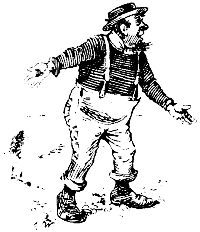
Toiling sixteen hours a day, and for precious little pay, Seems a blend of prison labour and starvation, Yet I do hear some suggestion that the "burning Labour Question" Is the one that mainly agitates the nation! No Trades Unions have we, and I do not rightly see How "Co-operative Wholesales" help our like, Who must slave in sun or shine, cramped and chilled in the salt brine, With the choice of sheer starvation if we "strike." Labour Questions? Well, here's one. When the I. L. P.'s have done A-wrangling and a-jangling o' th' Election; When Mister Chamberlain has done counting o' the slain, And Keir Hardie a-explaining his rejection; When Tillett and John Burns have both taken of their turns At wildly lamming into one another, It might help to "cool their parritch" if they cast a glance at Harwich, And the state o' their poor shrimping "man and brother." Ah! above our nets to stoop, and to scrape, and scratch, and scoop, In loneliness laborious and risky, Is not a task, in truth, to encourage sturdy youth, Or make work-worn old age alert and frisky, Then with sore and aching back we have got to boil and pack; And then the hungry middleman's remittance, When it comes, is precious small, what a docker-lad would call A paltry and a belly-pinching pittance. Yet the Fish-Rings, they do say, are quite prosperous and gay, And Billingsgate is wealthy; and the skimpers Who so cut our profits down, live like fighting-cocks in town, On the ill-paid toil of fishermen and shrimpers! Ah! That "Harvest of the Sea" is a sounding phrase, but we Find such "poetry" for us has little meaning. The "Fish-Farmers" may do well, as their profits plump and swell, But, alas! for those who have to do the gleaning!
A TRIP "PER SEA."
Projected Re-visitation—Ilfracombe—Torrs Walks—En route—Start—In Dock—Out—Tender Thoughts—On Board—Reception—Greetings—Exciting Search—Parting—Off!
Happy Thought.—Revisit Ilfracombe. Hire highest possible house at the lowest possible price close to celebrated "Torrs Walks." Why called "Torrs Walks"? Probably original Torrs who discovered Ilfracombe used to walk here; one stormy night Torrs lost his head and legs; then fell from sheer height of several hundred feet into boiling sea; boiling sea made it hot for the unhappy Torrs; Torrs only walking, not swimming. Therefore end of Torrs. Family name perpetuated in Walks. Years ago, price to ascend Torrs was one penny per head, body included. Tariff gone up since then. To Torrs Torr-tuous Turnings admission Twopence. Extra penny might have improved paths. Here there is as much "winding up" as in bankruptcy. "Excelsior" is motto of visitor; likewise of proprietor who put on the extra penny. No matter; not another spot in England where pedestrian can get better air, better exercise, and finer views, all for twopence!
Friendly Advice—gratis.—Always carry waterproof. If practicable get someone to carry it for you. Never know when you may want it, or when you mayn't. Stop for five o'clock tea on Torrs top. Whistle merrily "Torr-eador contento" as you descend, and you will be giving one of the best airs in Carmen in return for about the finest air in Devonshire.
How to get to Ilfracombe.—Per rail, London and South-Western. Picturesque line of country. Another, and a longer route, per mare et terram, and therefore more varied and health-refreshing, which are important points to score if your holiday be circumscribed, is to take passage on board steamer, Pacific Orient Line for choice, which stops at Plymouth en route to give a last glance at Old England before proceeding across the Bay of Biscay to Naples, and, ultimately, Australia. Only drawback to this is the start from Fenchurch Street. Fenchurch Street Station enough to make anyone start. Wanted here a spacious, light and airy place where passengers carrying "hand properties" can move about rapidly without loss of that equanimity of temper which every traveller should cultivate under circumstances that would try even the joviality of that utterly impossible creation Mark Tapley. Still Mark Tapley is an ideal to be lived up to as near as may be; and the passenger who, with bag in hand, while struggling with mixed crowd in Fenchurch Street Station on the departure of any important Tilbury Dock train, can be jovial or even ordinarily polite, is already in a fair way towards earning the Ideal Tapley Medal.
Tilbury Wharf. "And at this wharf of Tilbury" why not more porters? Why not a covering to the landing-stage, where at present, the traveller, like the sky parlour in ancient song, "exposed to the wind and the rain," will be thoroughly drenched while awaiting the advent of the tender. Happy Thought.—To-day, fortunately, fine.
These queries occur to me as I stand on this floating quay, and witness in the distance the "tender parting." There will be many "a tender parting" beside this one to be seen when the Orotava gets her steam up, and quits Tilbury for Melbourne.
We board the Orotava, which is to board and lodge so many of them (with another contingent going overland, and joining the ship later on) for the next month or so.
I am personally introduced to the captain by some kindly friends who come to see me off, and whom, as I lose sight of them in the crowd, it is soon my turn to "see off"; as subsequently I can only catch a glimpse of them in the crowd, on the tender, as they depart for shore, when we wave hands to one another implying thereby all sorts of good wishes. After making the captain's acquaintance, I am introduced by some light-hearted companion—everyone on board is either boisterously gay or in the deepest grief—to a good-humoured-looking portly gentleman, whom, there being nothing whatever nautical in his appearance, I should have taken for a landed proprietor, "one of the olden time," had I not very soon discovered him to be something uncommonly superior in the Nautical Pacific Service, and the friend in need, without whom no passenger's happiness is complete, that is, speaking from practical experience, if the destination of that passenger is only Plymouth, as was mine.
Farewell! The tender is about to depart. It seems to me to be as full as when it arrived. "Cheers, tears and laughter:" only the laughter is a bit forced, while the tears are natural, and the cheers most hearty. The tender hesitates. Tug evidently tender-hearted; can't bear to part with the good ship Orotava. No; this is not the cause of the delay. Some one is waited for. Tender crew impatient. Where is he? Who is he? Find him. Some one, in ordinary frock coat and top hat but clearly an official on board tender, puts both hands to his month and shouts out what sounds to me like "Wait for Mister Tubbs!" Evidently tender cannot go ashore without Tubbs; equally evident that Tubbs is not to sail with the Orotava. Puzzle, to find Tubbs. Stewards, chief officers, mates, men rush in all directions to rout out Tubbs. Look-out man aloft in sort of suspended clothes basket cannot get a sight of Tubbs either in the offing or out of it. Nothing like Tubbs to be seen anywhere. Somebody reports at top of voice "He's with the captain." Captain up above somewhere, invisible, denies soft impeachment as to being cognisant of the whereabouts of Tubbs. What is Tubbs doing? Playing hide and seek? Search light turned on into darkest and deepest depths of Orotava. No Tubbs. Suddenly first gangway withdrawn, and grasp of tender partially relaxed. Exciting moment. Crew of tender rattle second gangway threateningly: their patience is almost exhausted. The cry goes up once more for Tubbs ahoy! Even the weeping wives and sorrowing friends, lovers and children forget their dear ones for a moment and strain their eyes in every direction, gasping for a glimpse of invisible Tubbs. At last a small, stoutish figure appears on the gangway. Is he hatless? breathless? Not a bit of it. He walks the gangway as if he yet had hours of leisure before him, and was quite unconscious of having kept anyone waiting. It is Tubbs himself. The self-possession of Tubbs is remarkable, nay admirable. He notices nobody. Speaks to nobody. Suddenly he disappears; the gangway is withdrawn; more cheers, more waving of pocket-handkerchiefs, and the tender, with the impassive Tubbs to boot, drifts out of sight, and the Orotava is fairly under weigh.
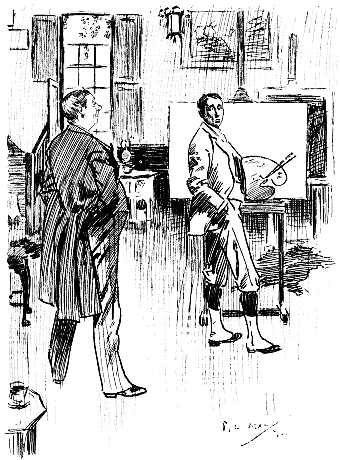
WITHOUT PREJUDICE.
Ugly Man (who thinks he's a privileged wag, to Artist). "Now, Mr. Daubigny, draw me."
Artist (who doesn't like being called Daubigny, and whose real name is Smith). "Certainly. But you won't be offended if it's like you. Eh?"
THAT POOR IRISH HARP!
Moore hymned the "Irish Melodies," And as he harped all heeded his chords. But heaven help the bard who tries To harmonise the "Irish Discords" The Paddies quarrel, gird, and carp, Blend petty squeak with mad mock-thunder. No Minstrel Boy may tune that Harp Since faction "tore its chords asunder."
A wedding of great interest to Welsh society, which took place lately in the Rhondda Valley, was that between Mr. Smith and Miss Margaret Abraham, daughter of "Mabon," M.P. Of course "Ma bon-nie bride." The presents, though numerous and handsome enough, did not somehow include one that, having in view the nationality of the interesting pair, would have been singularly appropriate. There was no gift of Taff-eta.