A LITTLE CHANGE.
Reading edition
Hang it all! They have blocked the street and are laying it with asphalte; just in May, as usual. From early morning the quiet of my rooms is disturbed by the noise of the work, when I go out I scramble over heaps of rubbish, past smoking cauldrons of pitch, and when I come home at night my cab drops me nearly a quarter of a mile away. Moreover, one neighbouring house is being painted, and the other is being rebuilt. I fly from falling dust and brickbats, only to run against ladders and paint-pots. It is awful. And now my Aunt Jane is coming up from Bath, and has invited herself to tea at my chambers. Her rheumatism prevents her from walking more than a yard or two, she cannot bear any noise, and the smell of paint makes her ill. She is very rich, and could leave all she has to the poor. Accurately speaking, that class includes me, but in my aunt's opinion it does not. She is very suspicious, and, if I made excuses and invited her to tea anywhere else, she would feel convinced that I was hiding some guilty secret in my dull, quiet, respectable rooms. She is very prim, and the mere suggestion of such a thing would alienate her from me for ever. Why on earth can't she stop in Bath? And I shall have to go with her to May meetings! It is impossible; I must fly. But where? She has a horror and suspicion of all foreign nations, except perhaps the steady, industrious Swiss. Good idea—Switzerland. But what reason can I give for rushing off just now? Someone must send me. I have it. She knows I try to write a little, so I will say my editor requires me to go at once to Geneva to write a series of articles in the Jardin Alpin d'Acclimatation on Alpine botany. Botany, how respectable! Geneva, how sedate! Makes one think at once of Calvin and Geneva bands. These sound rather frivolous, something like German bands, but they are not really so, only, I believe, a sort of clerical cravat. Then I will start off to Paris, the direct way to Geneva.
Perhaps I shall never reach Geneva. Paris will do well enough. No streets there taken up in the Spring. No painting on the clean stone houses. No rebuilding on the Boulevards. No aunt of mine anywhere near. I shall escape all my troubles. I shall be able to smoke my cigarette lazily in the pleasant courtyard of the Grand Hôtel, and try to imagine that I see some of the people in Trilby—Little Billee, or Taffy, or the Laird—amongst the animated, cosmopolitan crowd. And the stately giant in the gilt chain will solemnly arrange the newspapers in all languages, and will supply me with note-paper. I must be careful not to write to my aunt a long description of the Jardin Alpin d'Acclimatation de Geneve on paper stamped "Grand Hôtel, Paris." And the attentive Joseph, with those long grey whiskers, sacred to the elderly French waiter and the elderly French lawyer, will exclaim, "V'là, M'sieu!" in all those varied tones which make the two syllables mean "Yessir!" "Coming, Sir!" "Here is your coffee, Sir!" "In a minute, Sir!" and so many things besides. And I shall be able to watch, assembled from all parts of the world, some younger and prettier faces than my Aunt Jane's. That settles it. A regretful letter to my aunt. And to-morrow en route!
Change of Spelling?—Our dramatic friend known to the public through Mr. Punch as Enry Hauthor Jones appears to have recently altered the spelling of his name. He has left the Jones and the Henry alone, but in the Times of Friday he appears as "Henry Arther Jones," "U" out of it; and what was "E" doing there?
Presentation to the Rev. Guinness Rogers.—Last week this worthy minister was presented by his Congregationalists with an address and a cheque for a thousand guineas, Mr. Gladstone, ex-minister, being among the subscribers. In future the bénéficiaire will be remembered as the "Reverend Thousand Guinness Rogers."
Music Note (after hearing Mr. J. M. Coward's performance on the Orchestral Harmonium).—It would be high praise to say of any organist that "he attacks his instrument in a Cowardly manner."
"Very Appropriate."—Last Wednesday the Right Hon. A. W. Peel became a "Skinner."
A COMING CHARGE.
(Prematurely Communicated by our Prophetic Reporter.)
Gentlemen of the Jury, for the last couple of years or so you have no doubt read any number of denunciations of the conduct of the man whose actions you are now about to investigate. You have heard him abused right and left. You have seen pictures of him, in which he has been held up to scorn and public ridicule. You have heard it announced in all quarters that he is a scoundrel and a thief. And as this has been the case, Gentlemen of the Jury, it is my duty to tell you that you must put aside the recollection of these attacks. You must treat the prisoner before you as if he were immaculate. In fact you must lay aside all prejudice, and give the man a fair trial; and, Gentlemen, it is my duty (sanctioned by precedent) to have the pleasure of informing you that I am sure you will! Yes, Gentlemen of the Jury, having regard to all the circumstances of the case, I repeat, I am sure you will!
At the National Liberal Club, on Wednesday, Lord Rosebery told the company they were not dancing on a volcano. That may be true, but it is equally true that the Government, in proposing to remit the sixpenny duty on whisky, are riding for a fall in (or, shall we say, a drop of) the "crater."
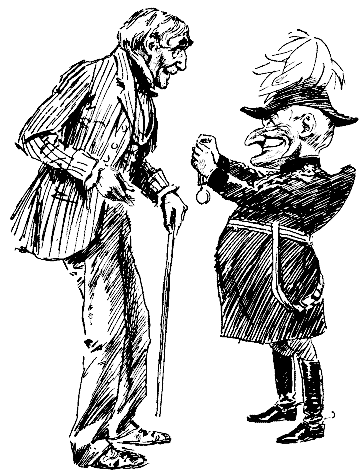
A WELLINGTON (STREET) MEMORIAL.
General Opinion (Mr. Punch) presents the Medal of the Highest Order of Histrionic Merit to Henry Irving in recognition of distinguished service as Corporal Gregory Brewster in the action of Conan Doyle's "Story of Waterloo."
ON THE NEW STATUE.
["Her Majesty's Government are about to entrust to one of our first sculptors a great historical statue, which has too long been wanting to the series of those who have governed England."—Lord Rosebery at the Royal Academy Banquet.]
Our "Uncrowned King" at last to stand 'Midst the legitimate Lord's Anointed? How will they shrink, that sacred band, Dismayed, disgusted, disappointed! The parvenu Protector thrust Amidst the true Porphyrogeniti? How will it stir right royal dust! The mutton-eating king's amenity Were hardly proof against this slur. William the thief, Rufus the bully, The traitor John, and James the cur,— Their royal purple how 'twill sully To rub against the brewer's buff! Harry, old Mother Church's glory Meet this Conventicler?—Enough! The Butcher dimmed not England's story But rather brightened her renown. In camp and court it must be said, And if he did not win a crown, At least he never lost his head!
Among Mr. Le Gallienne's new poems there is one entitled Tree Worship. It is not dedicated to the lessee of the Haymarket Theatre by "an Admirer."
A MAY MEETING.
They met in a cake-shop hard by the Strand, He in black broadcloth, and she in silk. She had a glass of "fizz" in her hand, He had a bun and a cup of milk. She had a sunshade of burnished crimson, He had a brolly imperfectly furled, And a pair of pince-nez with tortoiseshell rims on. He looked the Church, and she seemed the World. They sat on each side of a marble table, His legs were curled round the legs of his chair. Around them babbled a miniature Babel; The sunlight gleamed on her coppery hair. She held a crumpled Academy Guide, Scored with crosses in bold blacklead; A pile of leaflets lay at his side, And he grasped a Report, which he gravely read. His shaven lip was pendulous, long, Her mouth was a cherry-hued moue mutine, His complacent, uncomely, strong, Hers soft appetence sharpened with spleen. Her eyes scale-glitter, his oyster-dim, His huge mouth hardened, her small lips curled As he gazed at her and she glanced at him; He looked the Church, and she seemed the World. "A holy spouter from Exeter Hall!" (So she mused as she sipped her wine.) "A butterfly in the Belial thrall Of Vanity Fair, all tinkle and shine!" So thought he as he crumbled his bun With clumsy fingers in loose black cloth; And the impish spirit of genial fun Hovered about them and mocked them both. Mutual ignorance, mutual scorn, Revealed in glances aflame though fleeting; Such, in the glow of this glad May morn, The inhuman spirit of mortal meeting. The worm must disparage the butterfly, The butterfly must despise the worm; And Scorn, the purblind, will ne'er descry A common bond, or a middle term. Modish folly, factitious Art? True, grave homilist, sadly true! But Boanerges truculent, tart, What of the part that is played by you? You denouncing the "Snare of Beauty," She affecting to feel its spell,— Which falls shortest of human duty? Shallow censor, can you quite tell? Meanwhile the lilac is blithely budding, And sweetly breatheth the nutty May, The golden sunshine the earth is flooding, And you—you echo the old, old bray Of Boanerges. A broader greeting Of brotherhood full, warm hearts, wide eyes Might lend a meaning to your "May Meeting" To gladden the gentle and win the wise.
"What's in a Name? A Rossa, &c."—Before being ejected from the House of Commons on Wednesday last, O'Donovan Rossa shouted out that "A stain had been put upon his name." Where is the ingenious craftsman who did it? He might try his hand next time at gilding refined gold.
Query.—Can a champagne wine from the vintage of "Ay" be invariably and fairly described as "Ay 1"?
MODES AND METALS.
["Neckties made of aluminium have just been invented in Germany."—Evening Paper.]
Visited my tailor's puddling works to-day. He has some really neat new pig-iron fabrics for the season. I am thinking of trying his Bessemer steel indestructible evening-dress suits.
Really this new plan of mineral clothing comes in very usefully when one is attacked by roughs on a dark night. Floored an assailant most satisfactorily with a touch of my lead handkerchief.
The only objection I can find to my aluminium summer suiting is its tendency to get red hot if I stand in the sun for five minutes.
I think I can now safely defy my laundress to injure my patent safety ironclad steel shirts.
I find, however, that there is no need of a laundress at all. When one's linen is soiled, sand-paper and a mop will clean it in no time.
My frock-coat has got a nasty kink in it; must send it to be repaired at the smelting furnace.
Once Cut don't Come Again!—It was said by The Figaro last week that Japan would demand "an extra payment of one hundred millions of taels by China." But surely a hundred million Chinamen would evince a pig-headed obstinacy in parting with, or being parted from, their "tails" on any consideration.
"A Lightship Sunk."—Impossible! couldn't have been a lightship, it must have been a very heavy ship.
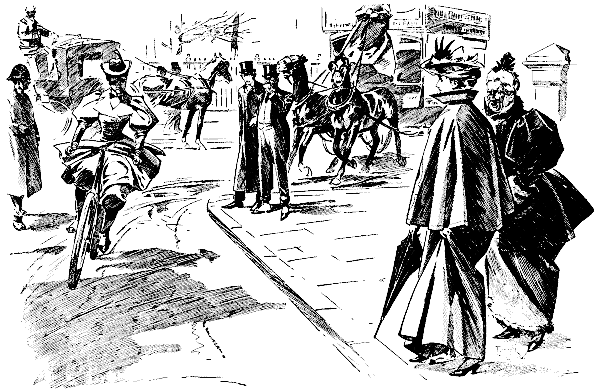
Daughter (enthusiastically). "Oh, Mamma! I must Learn Bicycling! So delightful to go at such a pace!"
Mamma (severely). "No thank you, my dear; you are quite 'fast' enough already!"