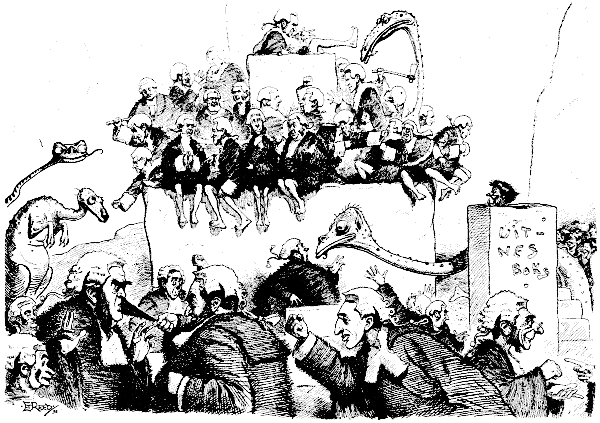
OUR BOOKING-OFFICE.
Reading edition
Marco Polo Ulysses Henry Norman, having returned from a comprehensive tour in foreign parts, has set forth his experience in a handsome volume published by Fisher Unwin. The Far Fast is its alluring and well-sustained title. But why drag in Ulysses and Marco Polo? Their journeyings were on the scale of a jaunt to Switzerland as compared with Mr. Norman's. He has travelled through British, French, Spanish and Portuguese Colonies; has visited Siberia, China, Japan, Corea, Siam and Malaya. Whether in his study of political problems, his pictures of people, or his sketches of scenery, he is equally keen and habile. Anything that relates to China is peculiarly interesting just now, and Mr. Norman throws a flood of light on the state of the unwieldly empire. The description of the examination halls is instructive. The Government of China, Mr. Norman testifies, is a vast system of competitive examination tempered by bribery. Those who come out successfully in examinations—the subject-matter of which is knowledge of the works of Confucius, the history of China, and the art of writing as practised by the old masters—have berths found them under the Government. They are sent all over the country to be magistrates, generals, ship captains, engineers, without having the slightest acquaintance with details or systems over which they are put in a position of command. This fully accounts for what has taken place in recent campaigns by land and sea in the Far East. We can't all undertake Mr. Norman's monumental journey. But, adapting Sheridan's advice to his son on a certain occasion, my Baronite counsels the public to read The Far East and say they've been there.
The immortal Flaccus (writes one of the Baron's assistants) has, it appears, been sojourning in Cambridge, having gone into residence there some time before he stayed at Hawarden, either for translation or perversion. I make this statement after reading a delightful little book of light verse entitled Horace at Cambridge, by Owen Seaman (London, A. D. Innes & Co.). To every University man, and particularly, of course, to Cambridge men, this book will be a rare treat. But in virtue of its humour, its extreme and felicitous dexterity of workmanship both in rhyme and metre, and the aptness of its allusions, it will appeal to a far wider public. I pledge Mr. Seaman in a bumper of College Audit! and beg him to give us more of his work.
The Baron de Book-Worms.
The Olympians threaten.—A real ice rink, "said to be the largest in the world," is in course of construction at Olympia. Does "Niagara" realise, or, as in this conjunction it might be written, "real-ice," the fact that its own nice invention may, by its rival, be beaten all to shivers?
From "Love's Labour."—What our Sir Frederic, P.R.A. (quoting the Divine Williams), will soon be saying to the accepted artist, "Bid him go hang!"
A COCK AND BULL STORY.
Air—"Casabianca."
["European navies were like fighting-cocks, armed to the teeth; a single spark might cause an explosion."
Dr. MacGregor on the Navy Estimates.]
The fighting-cock stood on the deck, His eye was rolling red, His feathers whiffled round his neck, His crest was on his head. He wore his spur above his heel, His claws were underneath, He also had a mass of steel Plate-armour on his teeth. Meanwhile the House was haggling on In one of those debates When Little England jumps upon The Navy Estimates. There Cleophas, of many wiles, Brought up his little lot, And Mr. Byles, with wreathèd smiles, Was deadly on the spot. And Labby said the bootless pay Of navies should be stamped on; "There is no boot!" as strikers say In Labby's own Northampton. "Then came a burst of thunder-sound" That shook the very street, And lo! Macgregor's form was found To be upon its feet. He called the rates a great expense, He was a peaceful Scot, And said the talk about "defense" Was simply Tommy-rot. Far better for his country's good, So long allowed to bleed, If only half the money could Be spent across the Tweed. Then with a petrifying shout, Like some clamantis vox, He fetched a trumpet-note about The teeth of fighting-cocks. A simile of crew and crew All ripe for any ruction; (Refer to verses one and two, Or else the introduction). A spark might fall from out the sea, Completely unforeboded, And then the birds—where would they be? Why, they would be exploded. He looked around for some applause From front or side or rear; They never said a word, because They hadn't strength to cheer. With many an accidental jest The hearts of men were full, But O! the thing they liked the best Was bold Macgregor's bull!
"SUR LE TAPIS" DE BRUXELLES.
However clever as a dramatic author he, M. Maurice Maeterlinck of Brussels, may be, it is rather handicapping him to be dubbed by enthusiastic but injudicious admirers "The Belgian Shakspeare," though, of course, "Belgian" does qualify the Shakspeare, just as Brussels prefixed to sprout decides the character of that favourite and useful vegetable. M. Maeterlinck may be the "coming on," or sprouting, dramatist of the future. Up to the present time there has not been much in any way to connect Belgian and English drama, so Maeterlinck may be the missing link destined to electrically illuminate "all the world," which "is," as the Divine Williams remarks, "a stage."