APRIL FOOLOSOPHY.
Reading edition
(By One of Them.)
Fools rush in where angels fear to tread. Well, this only shows our valiant disregard of danger, our readiness of initiative, our championship of forlorn hopes. We are the heaven-sent leaders of all "New" enterprises, whether literary, theatrical, or artistic. It is we who penetrate the mysteries of Bodleyosophy, Beardsleyotechny, and Yellow Astrology. We are the real and only Mahatmaniacs, Sexomaniacs, Miasmaniacs. Among our ranks you will find the Women who Did, the anticonjuGallias, the shedonKeynotes, and all their attendant and Discordant tribe of Jack-asses. We are the elect and proper bell-wethers of mankind. Come to us, then, for guidance.
Where ignorance is bliss, 'tis folly to be wise. Folly is therefore the true wisdom. However, this is an Oscarian paradox, which the Divine Williams has previously plagiarised, and enlarged on at some length, so we will pass on.
Fools build houses, but wise men live in them. Exactly so; we are the architects of this generation. The wise man depends on us for his roof and lodging; and without us he would be homeless. We have built "Snookson's Folly" and "Babel Mansions"—half of London, in fact. The jerry-builders have done the rest.
A fool and his money are soon parted. A compliment to our open-handed and indiscriminate generosity. It is we who swell the subscription list for the last new gold mine or building society; who subsidise insolvent South American Republics; who support the mendicant tramp and the deserving blackmailer.
There is no fool like an old fool. That is, the quality of folly improves with keeping, like that of wine. The seniors of our class are thoroughly reliable old fools, and Past Grand Masters in the art of ineptitude. We, fools as we are, know how to pay the proper respect that is due to senility and second-childishness.
A fool at forty is a fool indeed. This is a corollary of the preceding aphorism, for it is only at the age of two-score that we attain to years of full indiscretion. We develop later than the rest of humanity; we undergo a severe probation before our claim to the title of complete nincompoop is recognised. Before forty there is yet a chance that the budding ninny may desert, and degenerate into a prig, a Philistine, or a physician. After that age he is safe, and can be depended on for unwisdom, whereas your ordinary wiseacre cuts his back teeth and graduates in common-sense at twenty-one.
Lastly, Fools stand in slippery places—where wise men tumble down; but this needs no further illustration than that provided years ago by C. K., in Mr. Punch's pages.
Not for their "Ben."—Judging from some of the evidence at the recent trial of Tillett v. "The Morning" (Limited), it probably occurred to the unemployed dockers that they might have been well employed in "docking" B. T.'s salary.
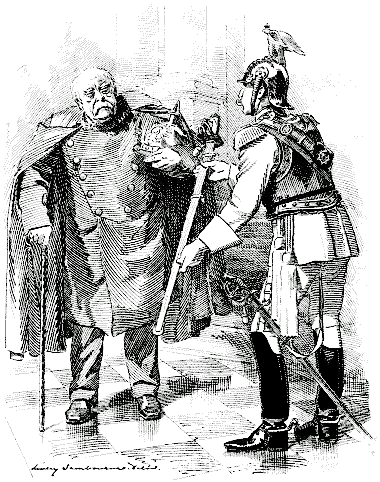
BISMARCK'S EIGHTIETH BIRTHDAY: A TARDY TRIBUTE.
[Last week the Emperor of Germany presented Prince Bismarck with a sword sheathed in gold as a birthday present.—Vide Daily Papers.
A Historical Parallel.—"The notice you have been pleased to take of my labours, had it been early, had been kind; but it has been delayed till I am indifferent, and cannot enjoy it."—Extract from Dr. Johnson's Letter to Lord Chesterfield, February 1755.
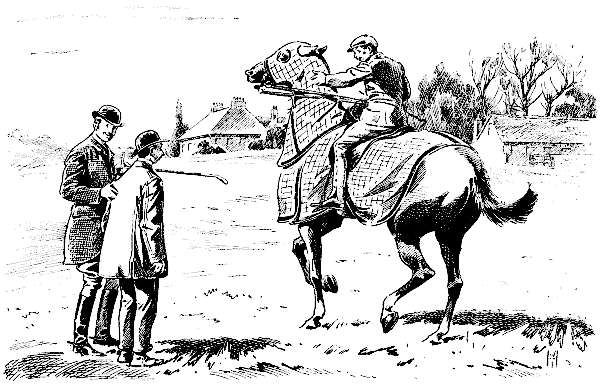
AN INNOCENT.
Sportsman (who has been training a "Dark 'Un" of his own for the "Grand National"). "There, my Boy, there's a Fifty to One chance for you! Now, just you take my advice, and get on at once!"
Little Greensmith. "Get on, eh? Thanky! Prefer to see the Lad on him, thanky!"
BISMARCK'S BIRTHDAY;
Or, a Tardy Tribute.
["In the presence of this band I now come to hand my gift to your Serene Highness. I could find no better present than a sword, the noblest weapon of the Germans, a symbol of that weapon which your Highness, with my blessed grandfather, helped to forge, to sharpen, and also to wield—a symbol of that great building-time during which the mortar was blood and iron, a remedy which never fails."—The German Emperor, in presenting a Sword of Honour to Prince Bismarck, in celebration of his eightieth birthday.]
["The notice which you have been pleased to take of my labours, had it been early, had been kind; but it has been delayed till I am indifferent, and cannot enjoy it; till I am solitary, and cannot impart it; till I am known, and do not want it."—Doctor Johnson to the Earl of Chesterfield.]
Bring their revenges, and to-day he stands,
Age-bowed but firm, amidst the ringing cheers
Of the young Monarch's mailed Germanic bands;
And with proud patience takes, from lesser hands,
The proffered Symbol-sword!
Grim face, with years and labours scarred and scored,
What marvel should those lines relax awhile
To a Saturnian smile?
Splendid old Sword-smith, Wieland of our day, Bestwielder of the matchless steel you made, This "Sword of Honour" is but baby play Compared with that tremendous Balsung-blade Forged by the mightiest master of his trade Since the great Norseman wrought, For the fierce battle-field where Titans fought. What may the shouting young Amilias know Of its great swashing blow?
He prates of Brandenburg, Iron and Blood, In swelling royal rhetoric, but you hear The clash of squadrons in war's sternest mood In that "great building-time"; and the boy-cheer Of him who, eager the State-bark to steer, Snatched from your hands the helm, Impetuous Palinurus of the realm,— That cheer seems bitter and belated now, Hollow, all sound and show!
You forged the blade he flourishes with pride, That new Excalibur, "Unity"; you gave That mighty weapon to Germania's side, You and the iron comrades, silent, brave, Who fought beneath the flag he loves to wave. The man of scanty speech, Who smote and shouted not, in war's dread breach, The valiant Emperor, and his noble son,— By these the work was done.
And he, the inheritor of fulfilled renown, Set the survivor of the Splendid Four Coldly aside; wearing the iron crown, Won for his wearing 'midst red battle's roar, Jauntily, and the blade you sharpened bore With cool complacent pride As though his own hands bound it to his side. And now he comes like Mars amidst his ranks, And brings—belated thanks!
What thinks the ancient Sword-smith in his soul?
Like the old scholar, sick with long neglect,
And help delayed till he had reached the goal,
Fame-crowned but solitary, self-respect
The tardy tribute. Raise
"Hochs," Emperor-fugled! Shout hurrahs of praise!
Render such honour as it may afford;
That glittering Symbol-sword!
All well-deserved, all worthily received! But think they cold ingratitude's slug-trail Dims not that blade? All generous spirits grieved That grudging party malice so should fail Of patriot magnanimity, and rail At the great chief who gave The sword they turned against him. Let the brave Join in one voice in shouting loud, "Well done!" To one who made them One!
Mrs. R.'s Abstinence.—The good lady says, "My dear, I always like to strictly observe our Church's audiences, and so every Friday morning during Lent I invariably have a broiled skipper for breakfast."
Concentration.—Mightn't the verdicts of separation or divorce be reported in the papers under the ordinary business heading of "Partnerships Dissolved"?