PARLIAMENTARY "LIBERTY MEN" COMING ABOARD AFTER TEN DAYS' LEAVE.
Reading edition
A SONG OF SPRING.
Oh, painters, you who always "come Before the swallow dares, and take The winds of March"—till May—with some Atrocious smell of paint, and make The streets in such a shocking state, you Are quite a nuisance—how I hate you! How can I wear in peace a neat, Silk hat, and coat of decent black, When, passing you in any street, Your paint may tumble on my back, Or I may smash, which might be sadder, My hat against your sloping ladder? How can the spring delight my mind, How can I like the budding trees, The butterflies of any kind? A Painted Lady could not please In any way the mental man, Were I a painted gentleman. How can I like the balmy air, How dream of violets in bloom, When paint-pots swing aloft and scare With visions of impending doom? I'm mad and hot—quite crimson madder— With dodging each successive ladder.
TO A BANTLING.
(Lines written to a Lady who "Banted.")
Some rhymes to make you laugh? I can't Drop, Wegg-like, into rhyme instanter. It's easiness itself to bant, Comparatively hard to banter. The many pretty things I'd say, The pleasant thoughts I'd like to utter, I may not do, it seems to-day— You scorn the bare idea of butter! "Sweets to the sweet." Not long ago, Why chocolates—you'd gladly greet them. Now you've abandoned them, and so You never (hardly ever) eat them. To see you drink hot water—that The very stoniest heart would soften, You evidently think it flat, You're in it—aren't you—much too often? Yet whether 9st. 12, as when You weighed that day at Margate Station, Or 10st. 7, or 7st. 10, I can't pretend to indignation. To bant from early morn till late May be, of course, supremely right of you; But if you feel oppressed by weight, Would it not do if we made light of you? Though that I swear I will not do, Let others, if they like, make bold to— I merely write these rhymes for you, I always do just what I'm told to! But if you cease to peak and pine (For Time the Banting Conscience hardens), You will not fail to drop a line— My chambers are in Temple Gardens.
SEXOMANIA.
By an Angry Old Buffer.
"When Adam delved and Eve span," No one need ask which was the man. Bicycling, footballing, scarce human, All wonder now "Which is the woman?" But a new fear my bosom vexes; To-morrow there may be no sexes! Unless, as end to all the pother, Each one in fact becomes the other. E'en then perhaps they'll start amain A-trying to change back again! Woman was woman, man was man, When Adam delved and Eve span. Now he can't dig and she won't spin, Unless 'tis tales all slang and sin!
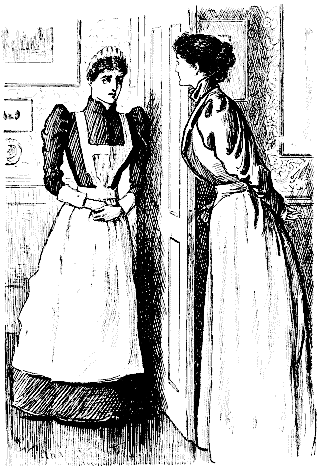
DOMESTIC TROUBLES.
"What is it, Nurse?"
"If you please, Ma'am, the Children will make Slides on the Floor with Tapioca Pudding!"
OSTRICH FEATHERS.
["The magnificent ostrich at the Zoological Gardens, presented by the Queen, has recently died from lung-disease."—Daily Paper.]
My eyes are wet with dewy tears, That will not cease to flow. Like Mary's little lamb, my grief Somehow is sure to go Wherever I do. It all comes From something that I've read, The ostrich that I loved so well Fell ill, and now is dead. "Magnificent" indeed, it was. I never ceased to take A pride in its magnificence For its own special sake. But added unto this there was An extra joy. I mean That loyalty asks ardour for A present from the Queen. Oh! ostrich. I have often thought Your smile childlike and bland, And speculated if it's true That right down in the sand You really do conceal your head. But even though that's wrong, It seems without a lung for life You could not live for long. My wife and I delight to hear Our wee girl's merry laugh, As she's astride the elephant Or feeding the giraffe. But ostrich—regal, lung-gone, dead! When we are at the Zoo, My wife's best hat will always serve To turn my thoughts to you.
CARMENCITA.
(An Impression.)
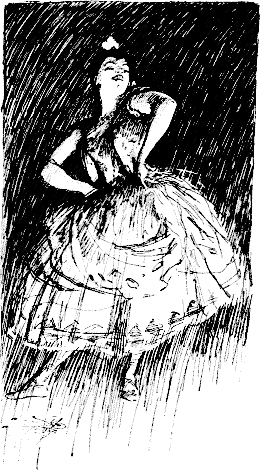
"O east is east, and west is west And never the twain shall meet." And the dance of Spain is one of the twain To the English Man in the Street. We love the trick of the lofty kick And the muscular display Of the nymph who has leapt at a muslin hoop And stopp'd in her flight half-way. A plain, blunt girl in the stormy swirl Of accordion pleats and laces, Tho' she cannot dance, if she spin and prance, Is numbered among the Graces. For heel and toe our hearts can glow And the feats of the rhythmic clog, And a poem of motion wells forth in the notion Of a Serpentine Dancing Dog. But the dancer's art, of her life a part, A song of the wordless soul With a tale to tell, like the music's swell, Too large for the word's control, That goes not down in London town Where dogg'd conventions stick, And dancers still must charm with frill, Or "make shymnastic drick." As the jungle king with his wrathful spring, To the lamb that aptly bleats, As the trumpet's blare to the palsied air Of that which plays in pleats, So is east to west, with its sun-born zest, With fire at the quick heart's core, And passions bold as the ardent gold Of the sun on a southern shore.
THE BALLAD OF THE KAISER'S MERCY.
(In brief.)
"The sovereign'st thing on earth Was parmaceti, for an inward bruise." Henry the Fourth, Part I., Act i., Sc. 3.
A quarrel, anything but pretty, Cannot be healed by parmaceti. But honour, bruisèd in the leg, Finds sovereign solace in an egg.