BLIND ALLEY-GORIES.
Reading edition
By Dunno Währiar.
(Translated from the original Lappish by Mr. Punch's own Hyperborean Enthusiast.)
No. II.—The Illustrious Stranger.
The sky was darkened by swart birds, with tufted tails, and a look in their clay-coloured eyes as of millions of stifled croaks; the rain fell in grizzled sheets like the streaming hair and beard of some Titanic lunatic, and the thunder boomed over the town as if it had just discovered another epoch-making novel.
Night fell; I lit my lamp and closed the shutters, drew my curtains, so as to shut out any gleaming cats' eyes that might be peering at me through the chinks, and mixed myself a tumbler of hot punch.
As I finished it, a wild piercing shriek rose from the universe, as though someone had run a pin into the Great Unknown, and a shining blue-white ball came down the chimney and burnt a hole in the yellow-green gloom of my hearthrug.
I looked up; a strange man was sitting right in front of me. His crested hair had a blue-white gleam, like the electric light in a mountain hotel when the storm is nearly ended; it stuck out in a spiral fringe round his cheeks and chin; his mouth was prim like a purse; but his spectacles twinkled with laughter like the new ferrule on a gingham umbrella.
"I am the Shaker of Society's Pillars, I have discovered that the Tree of Knowledge of Good and Evil bears nothing but rotten apples. There are milestones on the Bergen road—but I can see through most of them. I am the New Generation knocking at the old stage-door. I am also the Dramatiser of Social Conundrums to which there will never be any answer."
Time passed—a second or an hour. I began to wish he would go.
"I am the great Wizard that has ennobled and purified Humanity by showing that they are all the morbid victims of a diseased heredity. The great fire at Christiania was not the fire in which Mrs. Solness's nine dolls were burnt. I am he who has emancipated Woman by convincing her that she has the right to be hysterical."
Again time passed—an hour or a second. I fancy I must have dropped off to sleep.
"I fancy I must have dropped off to sleep."
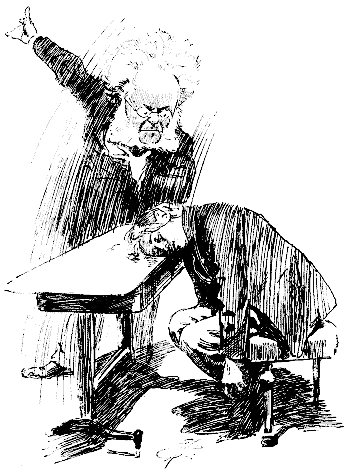
"I am he who has broken through the conventions of the well-constructed drama. When we lived at Drontheim, Bernick's gander was stolen by tinkers. I am the original eld, and also the child who instructs the grandmotherly critic in the art of sucking problematic eggs; but I, too, am a master-builder of magnificent bathos."
And again time passed—a second or an hour. I wondered whether he had come to stay the night.
"Read, I am called 'dramatic'; acted, I am called 'impossible.'"
With that the cock crew. The stranger had flown before I had an opportunity of asking him his name or asking him to look in again some evening.
I was rather sorry, for he seemed to have a flow of agreeable small talk, though it was perhaps a little egotistic.
THE WOULD-BE SOLDIER'S VADE MECUM.
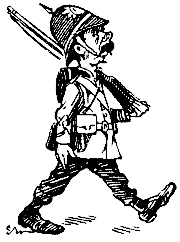
Question. Why did you become a member of a Volunteer corps?
Answer. With the intention of strengthening our national defences.
Q. Then you think such a proceeding patriotic?
A. Not only patriotic, but necessary.
Q. You probably have some recollection of the French collapse in 1870-71?
A. Yes; but I have been chiefly influenced by considerations of a mathematical character.
Q. Make your meaning plainer.
A. I mean that it stands to reason that as only a small percentage of our people are trained to arms, and ninety-six per cent of our neighbours are converted into soldiers, the latter, in the case of a quarrel with us, would have the upper hand.
Q. And you think a quarrel entailing the arbitration of the sword might be sprung upon us at any moment?
A. Precisely; that is entirely my opinion.
Q. And, consequently, you take a serious view of Volunteering?
A. Assuredly, or I would not give up most of my leisure time to master drill in all its branches.
Q. Do you obtain any social advantages by wearing the uniform of a Volunteer?
A. No; on the contrary, the grade of a private in the long run causes considerable expense; and the commission of an officer is inseparable from large expenditure and a loss of self-respect.
Q. Why is the holding of a commission of a Volunteer officer "inseparable from a loss of self-respect"?
A. Because, in the general estimation, the holder of a commission in the Volunteers is worthy of ridicule, pity, or contempt.
Q. Can you give the reason for this impression?
A. It is probable that it has been created by the consideration that a Volunteer officer is chaffed by his friends, sneered at by his enemies, and mulcted of much money by his comrades.
Q. Then a Volunteer officer or private usually joins the force from the most patriotic of motives?
A. Certainly. Nine-tenths of the rank and file and their commanding officers wish to qualify as soldiers capable of repelling a foreign invasion.
Q. And this being so, they do not wish to spend three or four days of training in practising "marches past" and other manœuvres of a more or less ornamental character?
A. Quite so; not even when the practice terminates with a review in a royal park, and a salute performed to the strains of the National Anthem.
Q. Nor do the Volunteers desire to be made into a raree show?
A. Not even to make a cockney Bank Holiday.
Q. And if you are told that this is the sort of thing that the Volunteers want, what do you reply?
A. Nonsense.
Q. And if it were added that more serious work would be unpopular, what would be your suggestion?
A. Try and see.
Mem. for Vetoists.—It is the question of "tied" houses which makes the compensation question so knotty.
RAILWAY BALLADS.
I.—THE EXPRESS TRAIN.
A gruesome tale I tell of the West-Eastern Railway Companee. "Its virtues few, its faults a score"— (I quote the view held heretofore). The chief among its faults, you see, Is sad unpunctualitee. Now, gentles all, list what befel Augustus Hall, of Camberwell. The Fates were stern, the world unkind; And this, I learn, unhinged his mind. Che sarà, sarà! Think how sad! His evil star it drove him mad! "If life has no more joy to give," Quoth he, "I'll go and cease to live. Nor yet delay an hour to dine, But straightway lay me on the line. "The train now due will end distress— So haste thee, Two o'clock Express!" With that he'd gone, nor stayed to snack; But climbed upon the railway-track. He waited now two hours—not less; And yet, I vow, came no express! And he had nought his pangs to ease. He wished he'd brought some bread and cheese. He had to fast. He fain would sup. The hours flew past. He sate him up. "'Tis strangely late. I should not mind— I'd gladly wait—if I had dined. "If I'd a joint that I could carve, I'd strain a point; but here to starve!! May I be hung if e'er I see Such gross unpunctualitee! "No gentleman can now depend On any plan to plan his end." Twelve hours or more he waited thus. "A train?" he swore; "an omnibus! "It tarries yet all through the night, And helps to whet my appetite!" His hunger grew inside his chest; With nought to chew, he was—non est. Two days pass by, and then we find The train draw nigh, three days behind! Directors sigh, deplore, and frown; And fine the driver half-a-crown. "But had I been on time," Jack said, "Hall's death, I ween, were on my head." "Quite true, good Jack! Our conscience pricks. We hand you back your two-and-six!" Envoi. Now that is all I have to tell Of Mr. Hall, of Camberwell.
THESE DULL TIMES.
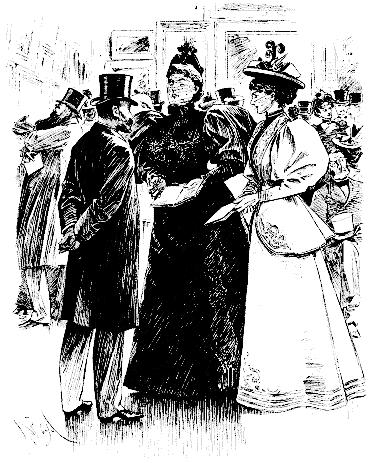
Lady Gushton (always so agreeable). "And the magnificent Pictures you had here last year,—have you got them all still?"
Mr. Flake Whyte (sadly). "Yes; I have them all."
Lady Gushton. "How very nice! It is so hard to part with one's own Pictures, is it not?"
Mr. Flake Whyte (with much feeling). "Awfully, awfully hard! Sometimes impossible!"
ROBERT AND THE COUNTY COUNSELLS.
Brown and me has been a having sum rare good fun lately. We has managed to see and hear a good deal about the County Counsellers, and werry emusing we finds em to be. They suttenly does manage to quarrell among each other more than I shood have thort posserbel. There's a depperty Counseller among em who will tork whenever he gets a hoppertunity, yes and keeps the pot a biling, as Brown says, for nearly arf a nour at a time, and then finds hisself beaten into a cocked at, and so has to sit down, while the others has a jolly larf.
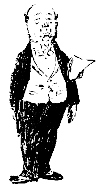
Ever so many on em belongs to the Tems Conserwancy, and so we are offen hearing of their going up the River, when there's two much water there, and hoffering to show the poor natives how to get a lot of it away, but from what I hears they don't seem for to be werry sucksessful.
Too or three on em went to the Boat Race the other day and took ever so many Ladies with em, and jolly nice dinners they had on bord after the Race was over and there wasn't no more fear of no more rane, which had rayther spylt the morning.
It's reel good fun to hear the Counsellors tork about the Copperation nowadays! such a difference to what it was about a year ago! Then it was all bragging and boasting, now it's all begging your pardon, and arsking your grace, and it shant occur again! I never thort to see such a change, and it's really werry emusing. The two places where they speshally seems not at all at their ease are the Court of Common Counsel and the Manshun House; and in both of these honnerd places the few as wenters in do look uncumferal indeed! and the reel natives don't show them no pitty! not a bit of it, but takes a quiet larf whenever they gits a good chance.
I've herd as one of the Counsellors has been herd to say as there are no less than three on em in the House of Commons, each of em quite equal to the late Speaker, if not shuperior to him, and that it was only beggarly jealousy as prewented them giving them a fare chance!
The same honorable Gent has been herd to say that the County Counsellors was much shuperior to the City Copperation, for it was only last Toosday as they agreed, without a word of remonsterance, to raise no less than two millions of money from next year's rates!
I wunder if it's all trew!
Robert.
The Newest Nuisance.—The woman with a past before her.
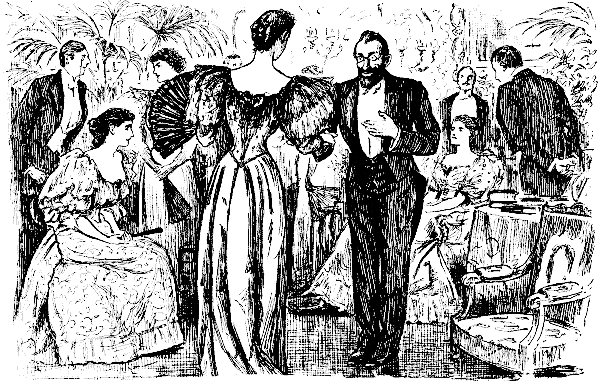
PRACTICE MAKES PERFECT.
"Coot-night, Mrs. Prown. I haf to sank you for de most bleasant Efening I haf effer schbent in my life!"
"Oh, don't say that, Herr Schmidt!"
"Ach! bot I do say dat! I alvays say dat!"