UNDER THE ROSE.
Reading edition
(A Story in Scenes.)
Scene IV.—An Up-platform at Clapham Junction. Time—Monday afternoon.
Curphew (to himself, as he paces up and down with a pre-occupied air). I ought to have been up at the Hilarity rehearsing hours ago. Considering all that depends on that play of mine—but there'll be time enough to pull Flattery together before Saturday. And this is the only chance I have of seeing Althea for days. Her mother hinted last night that she was obliged to let her travel up to Waterloo alone, and if I did happen to be going up about this time—and of course I do happen to be. I must tell Althea; I can't go on playing a part any longer. I felt such a humbug last night over that confounded Eldorado business. But if I'd revealed myself then as "Walter Wildfire, Comedian and Vocalist," those puritanical parents of hers would probably have both had a fit on the floor, and have kicked me out of the house as soon as they were sufficiently recovered! That's the worst of becoming intimate with a serious Evangelical family in the character of a hard-working journalist. I ought to have undeceived them, I suppose, but it was such a blessing to sink the shop—and besides, I'd seen Althea. It would have been folly to speak until—but she must know now, I'll have no more false pretences. After all, there's no disgrace in being a music-hall singer. I've no reason to be ashamed of the means by which I've got my reputation. Ah! but she won't understand that—the name will be enough for her! And I can't blame her if she fails to see the glory of bringing whisky and water nightly to the eyes of an enraptured audience by singing serio-comic sentiment under limelight through clouds of tobacco-smoke. Heaven knows I'm sick enough of it, and if Flattery only makes a hit, I'd cut the profession at once. If I could only hear her say she—there she is—at last—and alone, thank goodness! I wish I didn't feel so nervous—I'm not likely to get a better opportunity. (Aloud, as he meets Althea.) Mrs. Toovey said I might—can I get your ticket, or see after your luggage, or anything?
Althea. Oh, thank you, Mr. Curphew, but Phœbe is doing all that.
Curph. (to himself, his face falling). That's the maid; then she's not alone! I must get this over now, or not at all. (Aloud.) Miss Toovey, I—I've something I particularly want to say to you; shall we walk up to the other end of the platform?
Alth. (to herself). It looks more serious than ever! Is he going to give me good advice? It's kind of him to care, but still——(Aloud.) Oh, but we shan't have time. See, there's our train coming up now. Couldn't you say it in the railway carriage?
[The train runs in.
Curph. (to himself). For Phœbe's edification! No, I don't quite——(Aloud, desperately.) It—it's something that concerns—something I can't very well say before anyone else—there'll be another train directly—would you mind waiting for it?
Alth. (to herself). It's very mysterious. I should like to know what it can be! (Aloud.) I—I hardly know. I think we ought, perhaps, to—but this doesn't look a very nice train, does it?
Curph. (with conviction). It's a beastly train! One of the very worst they run, and full of the most objectionable people. It—it's quite noted for it.
Alth. (to Phœbe, who hurries up with her hand-bag). No, never mind; I'm not going by this train, Phœbe; we'll wait for a more comfortable one.
Phœbe. Very good, Miss. (To herself, as she retires.) Well, if that isn't downright barefaced—I don't know what it is! I hope they'll find a train to suit 'em before long, and not stay here picking and choosing all day, or I shan't get back in time to lay the cloth for dinner. But it's the way with all these quiet ones!
Alth. Did you want to speak to me about last night, Mr. Curphew? Has my cousin Charles been getting into any mischief? I only came in afterwards; but you were looking so shocked about something. Was it because he had been to a theatre, and do you think that very wicked of him?
Curph. (to himself). I ought to manage to lead up to it now. (Aloud.) It was not a theatre exactly—it was—well, it was a music-hall.
Alth. Oh! but is there any difference?
Curph. Not much—between a music-hall and some theatres. At theatres, you see, they perform a regular play, with a connected plot—at least, some of the pieces have a connected plot. At a music-hall the entertainment is—er—varied. Songs, conjuring-tricks, ventriloquism, and—and that kind of thing.
Alth. Why, that's just like the Penny Readings at our Athenæum!
Curph. Well, I should hardly have—but I'm not in a position to say. (To himself.) I'm further off than ever!
Alth. It couldn't be that, then; for Papa has presided at Penny Readings himself. But Charles must have told him something that upset him, for he came down to breakfast looking perfectly haggard this morning. Charles had a long talk in the library with him last night after you left, and then Papa went to bed.
Curph. (to himself). I felt sure that fellow spotted me. So he's let the cat out to old Toovey! If I don't tell her now. (Aloud.) Did Mr. Toovey seem—er—annoyed?
Alth. He looked worried, and I believe he wanted to consult you.
Curph. (to himself). The deuce he did! (Aloud.) He mentioned me?
Alth. He talked of going round to see you, but Mamma insisted on his staying quietly indoors.
Curph. (to himself). Sensible woman, Mrs. Toovey! But I've no time to lose. (Aloud.) I think I can explain why he wished to see me. He has discovered my—my secret.
Alth. Have you a secret, Mr. Curphew? (To herself.) He can't mean that, and yet—oh, what am I to say to him?
Curph. I have. I always intended to tell him—but—but I wanted you to know it first. And it was rather difficult to tell. I—I risk losing everything by speaking.
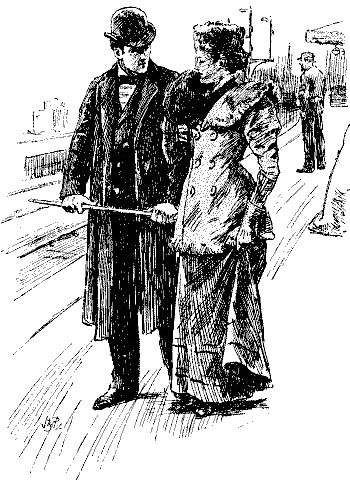
"He does mean that!"
Alth. (to herself). He does mean that! But I won't be proposed to like this on a railway platform; I don't believe it's proper; and I haven't even made up my mind! (Aloud.) If it was difficult before, it will be harder than ever now—just when another train is coming in, Mr. Curphew.
Curph. (angrily, as the train passes). Another—already! The way they crowd the traffic on this line is simply dis——But it's an express. It isn't going to stop, I assure you it isn't!
Alth. It has stopped. And we had better get in.
Phœbe. I don't know if you fancy the look of this train, Miss, but there's an empty first-class in front.
Curph. This train stops everywhere. We shall get in just as soon by the next—sooner in fact.
Alth. If you think so, Mr. Curphew, wait for it, but we really must go. Come, Phœbe.
Phœbe. I only took a second for myself, Miss, not knowing you'd require——
Curph. (to himself). There's a chance still, if I can get a carriage to ourselves. (Aloud.) No, Miss Toovey, you must let me come with you. Your mother put you under my care, you know. (To Phœbe.) Here, give me Miss Toovey's bag. Now, Miss Toovey, this way—we must look sharp. (He opens the door of an empty compartment, puts Althea in, hands her the bag, and is about to follow when he is seized by the arm, and turns to find himself in the grasp of Mr. Toovey.) How do you do, Mr. Toovey? We—we are just off, you see.
Mr. Toovey (breathlessly). I—I consider I am very fortunate in catching you, Mr. Curphew. I accidentally learnt from my wife that you were going up about this time—so I hurried down, on the bare chance of——
Curph. (impatiently). Yes, yes, but I'm afraid I can't wait now, Sir. I—Mrs. Toovey asked me to take care of your daughter——
Mr. Toov. Althea will be perfectly safe. And I must have a few words with you at once on a matter which is pressing, Sir, very pressing indeed. Althea will excuse you.
Alth. (from the window). Of course. You mustn't think of coming, Mr. Curphew. Phœbe will look after me.
Curph. But—but I have an important engagement in Town myself!
Alth. (unkindly). You will get up quite as soon by the next train, Mr. Curphew, or even sooner—you said so yourself, you know! (In an under-tone.) Stay. I'd rather you did—you can tell me your—your secret when I come back.
The Guard. Vauxhall and Waterloo only, this train. Stand back there, please!
[He slams the door; the train moves on, leaving Curphew on the platform with Mr. Toovey.
Curph. (to himself, bitterly). What luck I have! She's gone now—and I haven't told her, after all. And I'm left behind, to have it out with this old pump! (Aloud.) Well, Sir, you've something to say to me?
Mr. Toov. (nervously). I have—yes, certainly—only it—it's of rather a private nature, and—and perhaps we should be freer from interruption in the waiting-room here.
Curph. (to himself). I wish I'd thought of that myself—earlier. Well, he doesn't seem very formidable; it strikes me I shan't find it difficult to manage him. (Aloud.) The waiting-room, by all means.
[He follows Mr. Toovey into the General Waiting-room, and awaits developments.
End of Scene IV.
"DUE SOUTH!"
Note.—When I am travelling due South, as I am now, per L. & S. W. R., to join my party, all I require may be summed up in the accompanying "Mem.," which is to this effect:—
Mem.—Give me a Pullman car, my favourite beverage, a good cigar, or an old pipe charged with well-conditioned bird's-eye, an amiable companion possessed of sufficient ready money in small change, give me likewise a pack of playing cards, let the gods grant me more than average luck at écarté or spoof, and never can I regret the two hours and forty minutes occupied by the journey from "W't'r'o" to "P'm'th."
To start with, the line to Pinemouth is one of those "lines" that have "fallen," in the pleasantest of "pleasant places." On a broiling summer's day you pass through a wide expanse of landscape, refreshingly painted in Nature's brightest water colours—plenty of colour, plenty of water. All over the sandy plains of Aldershot, boxes of toy soldiers, with white toy tents and the smartest little flags, have been emptied out; and everywhere about the tiny figures may be seen marching, lounging, digging, riding, firing, surveying, performing evolutions to the sound of the warlike trumpet, and generally employed in a sort of undressed rehearsal of such martial business as is incidental to a Great Campaign Drama. Then, lest the spirits of the travelling tourist should rise so high that he might run the chance of "getting a bit above hisself," as horse-dealers graphically express it, he is whirled away from the war-like scene, and is taken through the peaceful grounds of Wokingham. Here to the unwonted military ardour so recently aroused in the bosom of the travelling civilian will be administered a succession of dampers in the shape of attractively-placed and most legibly printed reminders to the effect that "eligible plots" for burial are "still to be let," and that the terms for intending residents in the thriving country town of Necropolis can be obtained on application to Messrs. Somebody and Sons at Suchandsucher Place, London; the tone of these notices suggesting, in a generally festive spirit, that the good old maxim "first come first served" will be strictly observed in all matters of Necropolitan business.
Then we come to fair Southampton Water, with its marine kind of flymen waiting to take you to the boats, and the boats waiting to take you from the flymen to the yachts. On we speed through the New Forest, where those historically inclined remember William Rufus, and others, with a modern political bias, think of William Harcourt; while the grateful novel-devourer remembers that away in the forest resides the authoress of Lady Audley's Secret, and many other plots. Here, within ten minutes of our appointed time, is Terminus Number One, East Pinemouth, and, finally, West Pinemouth, which, speaking for myself individually and collectively, I prefer to East Pinemouth; at all events, at this particular time of year. Moreover, it appears that a rapidly increasing number are of my opinion, seeing how house-building, and very good house-building, too, is extending westward, and, alas and alack-a-day, threatening immediate destruction to heather, pine, fir, and forest generally. I sing:—
"How happy could I be with heather If builder were only away!"
No sooner is a house (most of them excellently-planned houses) set up, with garden and lovely view of sea, than down in front of him squats another squatter, up goes another house, the situation is robbed of the charm of privacy, and unless the owner of the first house sits on his own roof or has a special tower built, which erection would probably involve him in difficulties with his neighbours, his view of the sea is reduced to a mere peep, and in course of time will, it is probable, be altogether blocked out. However, as Boys will be Boys, so Builders will be Builders.
One of the chief advantages offered by Pinemouth as a place where a summer holiday may be happily spent, is the facility afforded for getting away from it, in every possible direction; by sea, river, rail, and road. À propos of "road," the fly-drivers, shopkeepers, and livery-stable keepers of P'm'th, are, for the most part, like the fly-drivers, livery-stablers, and shopkeepers at any place which boasts a recognised season. The eccentric visitor, who chooses to come out of the regulation time, must take his chance, and be content with out-of-season manners to suit his out-of-season custom; still, in the words of the immortal bard, "They're all right when you know 'em, but you've got to know 'em fust!"
As to the hiring of flys and midgets, there is a board of rules and regulations stuck up in the railway station and elsewhere, the interpretation whereof may possibly be mastered by those able and willing to devote a few days to the study of its dark sayings.
"What's the meaning of this rule?" I inadvertently ask a ruddy-faced policeman, on whose broad shoulders time unoccupied seems to be weighing somewhat heavily, at the same time pointing to one of the regulations on the board in question.
"Well, Sir," replies the civil constable, in a carefully measured tone, "it is this way"—and then he commences.
I breathe again; it is half an hour since I addressed that ruddy-faced official, from whom, thank goodness, I have at last contrived to escape. He has kept me there, giving me, as it were, a lecture on the black board, telling me what this rule might mean if it were read one way, and what that rule might mean if it were read another way, and what both rules might mean if they were each of them read in totally different ways; and how one was labelled "a" (which I saw for myself), and how another was distinguished by being lettered "b"; and how he (my constabulary instructor) "wasn't quite sure himself whether his reading of 'em was quite right;" then going over all the paragraphs again in detail, indicating each syllable with his finger, as though he were teaching an infant spelling-class, and finally coming to the conclusion whereat Bottom the Weaver arrived when he surmised that it was all "past the wit of man to understand," and advising me that, on the whole, if any particular case of attempted extortion should happen to arise, I should do well not to appeal to these rules and regulations, but to summon the extortionist before the nearest police magistrate. "But," said he, as if struck by a new light, "it may be that this rule 'a'"——And here he faced round, in order more closely to inspect the mysterious cryptogram. Taking advantage of his eye being off me for one second, which it had never once been during the previous thirty minutes, I stepped as lightly and rapidly away as my thirteen stone will permit, and fled. I fancied I heard him calling after me that he had discovered something or other; but not even if he had shouted "Stop thief!" should I have paused in my Mazeppa-like career. "Once aboard the lugger," I exclaim to myself, quoting the melodramatic pirate, "and I am free!" So saying, I entered the hospitable gates of my present tenancy, and sank exhausted on the sofa.
Mem.—Never again ask a policeman to explain strange cab-rules and regulations.
NOT A QUESTION AT ISSUE.
["Mr. Gosse holds a middle station between the older and the younger schools of criticism. He is neither a distinguished and respectable fossil nor a wild and whirling catherine-wheel."—Athenæum.]
Oh, luckiest of Critics! What A joy unquestioning to feel On such authority he's not "A wild and whirling catherine-wheel." And is it such a wild idea To think that clever Mr. Gosse'll Rejoice he's reckoned not to be a "Respectable, distinguished fossil?"
THINGS ONE WOULD RATHER HAVE EXPRESSED OTHERWISE.
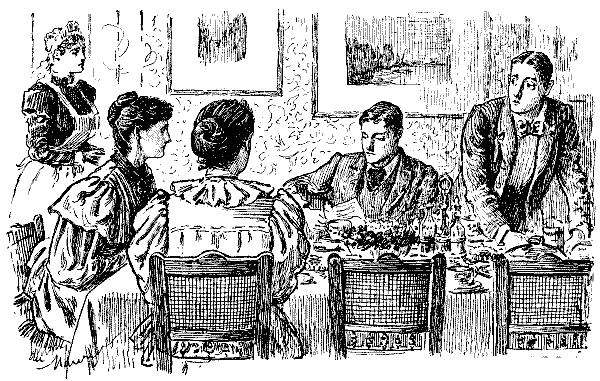
Would-be Considerate Hostess (to Son of the House). "How inattentive you are, John! You really must look after Mr. Brown. He's helping himself to Everything!"
[Discomfiture of Brown, who, if somewhat shy, is conscious of a very healthy appetite.
A LESSON FOR "LABOUR."
["The overwhelming vote of the Yorkshire, Derbyshire, and Lancashire miners against accepting any reduction, or even submitting the wages question to arbitration, does not encourage any very sanguine hopes of the Nottingham Conference."—Westminster Gazette.]
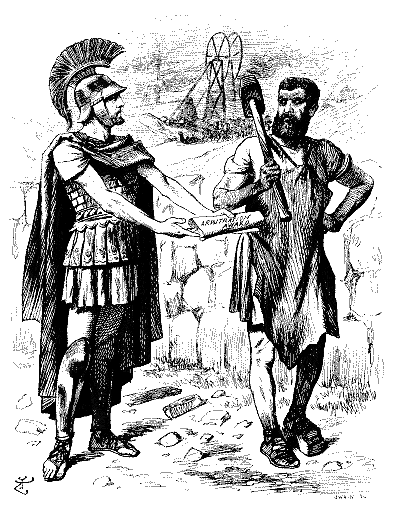
"My sentence is for open war!" Thus spake Fierce Moloch, when within the marly lake "The Stygian Council" in dark conference met! "The scepter'd king's" advice prevaileth yet, And Mammon's self, who in his pristine might Stooped to the avowal that "all things invite To peaceful counsels," now in stubborn mood Urges resistance—at the cost of blood! Yes, Mammon, musing on "the settled state Of order," at that dim chaotic date, Speaks, in the mighty-voiced Miltonic way, "Of Peace," and "how in safety best we may Compose our present evils, with regard Of what we are and were." Mammon's award Is now more martial: Mammon, swoln and proud With domination o'er the moiling crowd, Lifts a most arrogant head, and coldly curls An insolent lip against the clod-soul'd churls Whose destiny and duty 'tis to slave 'Twixt cradle comfortless and cheerless grave, To glut his maw insatiate! Proud is Pelf; But might not Legend lesson Labour's self? "Thus sitting, thus consulting, thus in arms!" Comes not the echo loud of wild alarms To Labour's Conference? Violence and wreck, Incendiary hate that sense should check, Mad mob-intimidation, brutal wrath,— These are strange warders for the pleasant path Of human progress! While they crowd and clash In headlong stubbornness and anger rash, Whilst factories burn, and workmen fall in blood, And women mourn, and children moan for food, Unnumbered multitudes the misery feel Who share not in its making! Mars' red steel Is sheathed to-day at Arbitration's nod; Hath this no lesson for the milder god? Vulcan, the smithy-toiler, and his crowd Of sooty Cyclops, raging fierce and loud, Impetuous, implacable, whilst Mars, That savage god of sanguinary wars, Awaits the award of Arbiters of Peace! Strange contrast! "Cease, great hammer-wielder, cease!" Says the Sword-bearer. "Cease this frenzied fray. Try Arbitration—'tis the gentler way, And wiser. I have tried it—shall not you? Call back your Cyclops, let not them imbrue Swart hands in Battle's sanguinary hue. Shall War, now partly driven from the field, Find refuge in the factory, nor there yield To the sage suasion of mild Equity, At whose just Arbitration even I Suspend or drop the sword?" So Mars, and so All friends of Labour. Raise no stubborn "No!" At Arbitration's offering, seeing that there Lies fairest hope of an adjustment fair 'Twixt clashing claims, which if they "fight it out" In war's wild way may put to utter rout Humanity's fairest hopes. Oh, time enough When Arbitration fails to essay the rough And ruddy road of Mars. Stay, Vulcan stay! Or blameless hosts long-menaced by your fray May have a stern effective word to say! And you, as once of old, though stout and tall, Kicked out of heaven may have a maiming fall!
SURGEON-MAJOR PARKE.
(Doctor to Stanley's Emin Pasha Relief Expedition. Died September 10, aged 35.)
"Rarest doctor in the world!" Tribute rare from sturdy Stanley! Skilful, tender, modest, manly! England's flag may well be furled Over the young hero's bier, Whose memory is to England dear. Africa has cost us much. Fortune send us many such!
Mrs. R. says she understands that disaffecting (disinfecting) fluid was discovered by the great Condy, a celebrated Frenchman.