LOVE AND LAW.
Reading edition
(A Fragment from a Modern Romance.)
["It would be distinctly an advantage to girls to serve as clerks in a lawyer's office before they launched forth on the world."—Weekly Paper.
Edwin was sad indeed, for all had gone against him. He had lost everything. Even the furniture in the house he occupied was scarcely his—for all he knew, at any moment it might be seized in execution.
"What shall I do?" he asked again, wringing his hands and tearing his hair.
"Cheer up," was the reply, spoken in a soft voice and by a sweet-faced girl. It was Angelina.
"And you have come to me in my distress—after I have treated you so badly?" he said, with a flush of shame colouring his hitherto pale face.
"No, darling," returned the golden-haired maiden, looking into his brown eyes with optics of an azure hue. "Do not say that you have behaved badly to me. You wrong yourself; you do, indeed."
"Have I not deserted you?" he asked in a tone of bitter sorrow.
"But only after you had written me letters upon which I could base an action for breach of promise," murmured the forgiving girl.
"But do you propose to proceed upon them?" he asked earnestly.
"Yes, my own. To quote that touching song you so frequently sang to me in the gilded days of the golden past, 'it will be the best for you and best for me.' I shall certainly ask for substantial damages."
"And is there no way to avoid this crushing, this final disaster?" asked the young man, in deep distress.
"Dearest, you know that I have studied the law. Well, I would propose that you should carry out your contract. I have here the form which requires but the registrar's signature to make us man and wife. What do you say to the matter being settled to-morrow?"
"If it must be so, it must," returned Edwin, in a tone of resignation. "And now, as we are to be married to-morrow, let us dine together. I have an invitation from my aunt at Putney to stay with her until my goods have been seized and sold. I am off. She will extend to you her hospitality."
"Oh, my betrothed, I cannot come." she sobbed. "I am kept here by duty."
"Well, as you will," he replied, carelessly. "But I suppose we meet at noon at the registrar's to-morrow?"
"Yes, for by that time all will be over. The goods will be removed, and I shall be free—free to become your wife."
"But what have you got to do with my property?"
Then came the sorrowful admission.
"Oh, Edwin, my own. You know I am in a lawyer's office. For the moment I am their guardian. Yes, darling, I am the woman in possession!"
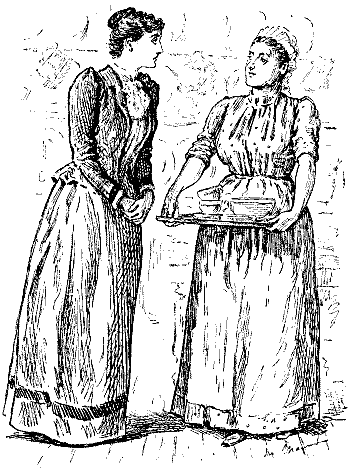
DOMESTIC ECONOMY.
Cook (to Vicar's Wife). "And what's to be done with the Sole that was saved yesterday, Ma'am?"
BALLADE OF LOST REPARTEES.
When mirthful humours reign supreme, And heated revellers are prone To make sound wisdom kick the beam, While vain wine-bubble wit alone Has weight, we, mostly, can depone To feeling joy to blankness fade On finding, now our chance has flown, The repartee we might have made.
One prating fool is apt to deem
No jesting pretty save his own;
Another strives, whate'er the theme,
To make all comers, passive grown,
For sharpening his witty blade;—
Too late below our breath we moan
The repartee we might have made.
Of course, it now contrives to seem So patent to the dullest drone; And, if we wake or if we dream, It weighs upon us like a stone, But, unlike, cannot now be thrown; And thus we languish in the shade, Because the world has never known The repartee we might have made.
Envoi.
My friends, a certain sage has shown What paving-stones below are laid; Now learn that on each blast is blown The repartee we might have made!
"Fungar vice cotis, acutum Reddere quæ ferrum valet, exsors ipsa secandi." Horace. De Arte Poetica.
THE BURDEN OF BURDON SANDERSON.
["Every organism must have sprung from a unicellular ancestor."—Dr. Burdon Sanderson's Presidential Address to the British Association.
That life is a sell we most of us know, But Doctor Burdon Sanderson tells It began in a cell oh! æons ago! And Progress is merely the growth of cells. And is that what you were fashioned for Our "unicellular ancestor"? "The specific energy of cells" Is a taking phrase, but what does it mean? Is it merely the Life that in most things dwells, Or must we go reading the lines between, To find what you really were fashioned for, Our "unicellular ancestor"? Words, words, words! What matter if They're scientific and pseudo-oracular. Or, scouting a terminology stiff, Couched in sciolist's plain vernacular! Do they tell us what you were fashioned for, Our "unicellular ancestor"? Burdon's burden, like Villon's of old Leaves us a prey to doubt and fear. Your meaning and purpose when shall we be told Oh cells—or snows—of yester-year? Or what you truly were fashioned for Our "unicellular ancestor"?
The Modern "Tender" Passion.—Bimetallism.