THE WERE-WOLF.
Reading edition
[Anglo-Saxon wer, a man, and wolf—a man in the form of a wolf.
"The garments are changed into hair, his arms into legs; he becomes a wolf, and he still retains vestiges of his ancient form. His hoariness is still the same, the same violence appears in his features; his eyes are bright as before; he is still the same image of ferocity."—Ovid, on the metamorphosis of King Lycaon into a wolf.]
Wolf! Wolf! The cry that wakes The slumbering shepherds, shakes The faint-hearts of the fold with shuddering fear. The flock's ferocious foe Compassion doth not know, His breathing's heard, his furtive foot-fall's near. It is no season for slack guard, But watchful care and unrelaxing ward. This is the Man-Wolf, theme Of ancient classic dream, And mediæval myth, at last made fact. Worse than the lupine pest Upon whose hoary crest Old monarchs laid a price! 'Gainst him a pact Of all the peoples must be made; Rapine's his life, red ruin his dread trade. The old grey wolf who prowled Around the fold, and howled Impotent rage to the black wintry skies, Was no such foe as this, Our Were-Wolf, whom the abyss Of yawning chaos looses, whose red eyes, Half human and half bestial, glare Malignant menace from his secret lair. Such subter-human guise, Such fiercely fiendlike eyes, Arcadian Lycaon. Jove-changed, bore When mortal hate took on, At the Olympian frown, Its fitting shape. The lessons of old lore, Magic-divested, myth-stripped, still Commend themselves to human wit and will. Humanity must urge Against this lupine scourge Civilisation's forces banded close. The watch-dogs, as of old, Must guard the human fold Against this last and worst of order's foes; And the world's sleuthhounds led by Law Must hunt this Were-Wolf of the insatiate maw. Hunt him from every lair, Till, outlaw everywhere, This friend of carnage and sheer chaos finds A foe at every turn. A foot to crush or spurn, The warning cry of "Wolf!" on all the winds, And wheresoe'r the ravener stray Civilisation's light must search—and slay!
"Très Bang!"—To T-m Sm-th, of the Wholesale Crackery Warehouse, with Mr. Punch's compliments. Certainly, at Christmas-time. T. S.'s crackers "get the pull!" At least, so says his Lordship the pop-ular Bishop of Go-Bangor.
Dr. R-bs-n R-se
(In the "Fortnightly" this month).
To be in perfect health live well and wisely: This just sums up my article concisely.
Quite on the Cards.—In last Saturday's Daily Graphic there was an interesting picture on a pretty subject, to which was subscribed the legend: "The New Governor of the Isle of Man being Sworn in at Castle Rushen." Suppose by some printer's-devil's error the "at" had been placed before the "in"! "O what a difference in the morning," when it would have read: "being Sworn at in Castle Rushen."
DUCAL DOINGS.
"Lord A. B. C. will return to town to-morrow."— [Any "Fashionable Intelligence" column.]
I'm but a plebeian, I know, But feelings as ardent as mine May feel a legitimate glow On reading this eloquent line; Though Fate has denied me as yet A fame or a fortune renowned, By items like these I can feel when I please An aristocrat down to the ground! The fact that I never have seen The gentleman mentioned—as soon I'd fly as distinguish between Himself and the Man in the Moon— Has little to do with the case; My knowledge, I frankly confess, Of the doings of those who our "classes" compose Is wholly derived from the Press. But eagerly over my tea My eyes on this volume I cast, I read of engagements to be, Of dances and fêtes of the past, I learn with the deepest regret That the Duke of X. Y. is unwell, And with pleasure I glow that the Marquis of O. Has dined with the Duchess of L.! In fact, as I muse in a dream, The charm that this column extends Makes all the nobility seem My intimate personal friends; Political leaders are bosh, And Foreign Intelligence stuff, Just print up to date the deeds of the great, And I shall be happy enough!
Mr. Lecky and the Scotch.
—Dear Mr. Punch,—If Mr. Lecky is deserving of censure, surely some public notice should be taken of the insult offered to the Scotch, Welsh, Irish, and Manx nations by Lord Nelson in his celebrated signal. That signal should surely have run:—"England, Scotland, Wales, Ireland, the Channel Islands, and the Isle of Man, expect that every man this day will do his duty."
—Yours truly, An Indignant Manxman.
Motto for Hairdressers.—
"Cut and comb again!"
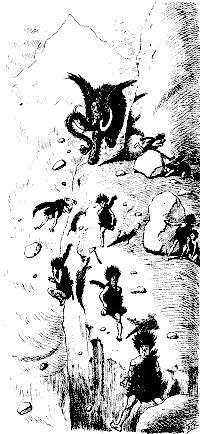
PREHISTORIC PEEPS.
Owing to his notorious eccentricity their relations with the local Mammoth were somewhat strained.
BANK HOLIDAY BEAUTY.
(Protest by a Pretty Girl at the Crystal Palace.)
That "Beauty's decaying among us!" By certain old fogies we're told. Many poets have ceaselessly sung us! But then even poets grow old. Smelfungus has "been to the Palace," And Beauty, he thinks "going out." Now can it be folly or malice? Is he blind, or bald-headed and stout? I think 'tis most likely the latter. He's fifty, no doubt, if a day. Yes, that I suspect's "what's the matter"; And then, who cares what he may say? When he went to the Palace of Crystal, He puffed, I've no doubt, and swigged port, And what wonder then if he missed all The Vision of Beauty at sport? At Kiss in the Ring we were playing, He envied us, that's where it is, Because if near us he came straying He knew we'd refuse him a kiss. And so (as Tot puts it) he "telled a lie," To cover his nasty mean spite. No, pessimist purblind and elderly, Our looks weren't in fault, 'twas your sight! What with Tennis, and one thing and t'other, We're prettier than ever all round; I'm nearly as strong as my brother, Tall, straight, nimble, healthy, and sound. And as to my teeth!—you don't know them, Or else you have told what's not true; You'd retract, were I only to show them, And I feel I could show them—at you!
Evident.—In drinking the health of the Italian Parliament, the Toast of the evening ought to be,—as indeed every Toast when well done ought to be,—"Crispi."
AN ODE OF ODOURS.
(A Poem of Recognition.)
Oh, what is this faint perfume that I smell, And smelling seem, somehow, to know so well? What recollections should it start again, What memories of the past bring in its train? Is it a whiff of country come to-day, Of mangel-wurzels, or of new-mown hay? Or was it when She witched me with a glance The subtle odour reached me—at the dance? Where'er it was, I'm certain that I know it, As certain as I am I'm not a poet, But stay, was it when influenza gripped us? It was! Eureka! Yes, it's Eucalyptus!
On Certain Philistine Pedagogues.
Greek and Philosophy but tire and twist 'em. Duncedom they praise, and dub it "democratic," And their abuse of the great Attic system Is systematic!
Mem. from Accrington.—Liberal party in a fix here. Naturally anxious to keep a Leese-hold on the constituency, it looks a little awkward to pose as the labourer's friend, and at the same time to keep (Hermon) Hodge out of Parliament!
Mem. by a Horse-buyer who has been "Had."—"Novice" does not always mean no vice.