Volume 2 — CHAPTER VIII. SAMUEL EVANS (“YOUNG DUTCH SAM”)—1825–1834.
Reading edition
Among the town celebrities of the second quarter of the nineteenth century the subject of this memoir held a prominent place. His immediate and personal intimacy as boon companion or “pal” of a certain notorious marquis, and an earl whose career, while “sowing their wild oats,” savoured rather of the early days of the Regency than those of Queen Victoria, brought him too often before the public. Indeed, the nature of the associations into which he was thus unfortunately thrown, acting upon a volatile and reckless disposition, led him into excesses which destroyed a fine constitution, prevented his availing himself of more than one opportunity of achieving competence and a fair social position, and finally consigned him to a premature grave. In the ensuing pages, however, we shall chiefly deal with Young Dutch Sam as a public demonstrator of the art of self-defence, and as one whose biography furnishes an illustrative chapter in the history of the Ring.
Samuel Evans, deservedly distinguished as “the Phenomenon,” was born in Wells Street, Ratcliff Highway, on the 30th of January, 1808. He was descended from a sire whose fame as a professional boxer the son did no discredit. The battles of Samuel Elias, in his day also dubbed “the Phenomenon,” will be found in our first volume. Sam’s earlier years, from all that we have gathered from his own lips and his intimates, were spent in the same “university” which another famous “Samuel” (not Johnson, but Weller) declares to be the “best for sharpening the intellect” of the youth who may chance to be subjected to its rough discipline. The traditions of Rosemary Lane, now itself swept into what Thomas Carlyle calls “the dustbin of the past,” were once rife with reminiscences of the intuitive fistic skill and the marvellous mastery of milling manœuvres 354displayed by “Young Sam,” in many an encounter with the pugnacious progeny of the “peoplesh,” who once populated that inodorous but sweetly named thoroughfare, renowned for the “ancient and (fried) fish-like smell” of its edibles, and the yet more fusty emanations of its clobbered and thrice-renovated garments.
Thus Sam fought his way upwards in the rude “battle of life” until his sire “shuffled off this mortal coil” in the month of July, 1816, when Sam appears to have been thrown upon his own resources. Sam was evidently a precocious youth, for in his fifteenth year, if we take Pierce Egan’s account, he was following the employment of a baker, when his associate in dough, one Bill Dean, a chap with some milling pretensions, threatened to serve out Young Sam for some trifling fault. This brought forth the father’s blood in his veins, and in emulation of his warlike sire, he challenged Dean out to fight early the next morning; but old Burntcrust, his master, locked Sam up in his bedroom to prevent the mill. Sam, however, in defiance of bolts and bars, got out of the garret window, scrambled over the tiles of several houses, found his way into a strange house, ran down the stairs, ultimately into the street, and met Bill Dean at the appointed place, Kennington Common, when the battle commenced without delay. In the course of four rounds Young Sam played his part so well that Dean would not fight any longer, gammoning it, as was supposed, that his thumb was out of joint.
Dean was not exactly satisfied with this first battle, and, after several quarrels, a second match was agreed upon, Sam fighting Dean for three half-crowns to two. This mill was also decided upon Kennington Common, Tom Cooper and Spencer acting as seconds for Young Sam, a fact which shows that “the Young Dutchman” was already an associate, if not a member, of the P.R. Dean “screwed his courage to the sticking-place,” and fought well for three-quarters of an hour; but finding the chance was against him, he declared his knee was injured, and he would fight no more. Sam was loudly applauded by the spectators for the pluck and science he had displayed throughout the battle.
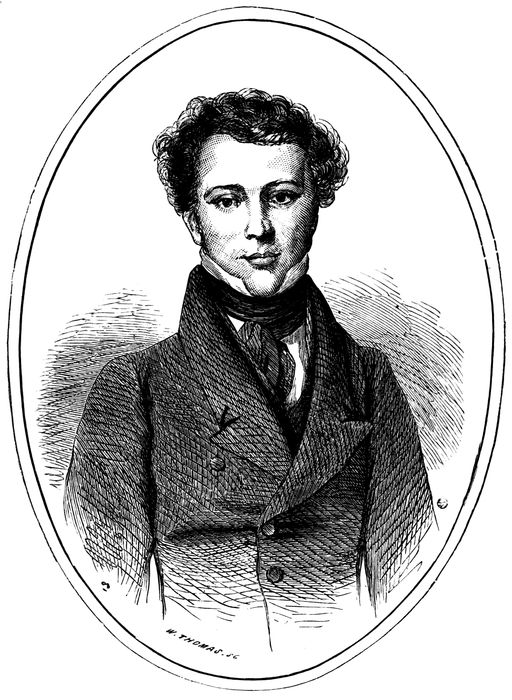
SAMUEL EVANS (“Young Dutch Sam”).
355Soon after this affair our hero migrated westward, leaving the “dead men” of the east, and becoming an apprentice at case in the office of Mr. Charles Baldwin, in the Crescent, Blackfriars, on the very spot now occupied by the Ludgate Terminus of the London, Chatham, and Dover Railway. Sam had scarcely taken his initiatory lessons in the mystery of a typo when he got into a fracas with the peripatetic potman of the neighbouring public, which supplied the printing-office with beer and other alcoholic stimulants. The purveyor of heavy wet had with him a pair of gloves, and he and the youthful Sam (we had this from his own lips) at first began to spar “in fun,” for the entertainment of such of the compositors as were taking their midday meal beneath their “frames” and on the “stone” from pressure of business. The publican and sinner was short-tempered as well as conceited, and Sam having “pinked him” more than once on his prominent proboscis, the gin-spinner’s deputy threw off the mufflers, let go right and left viciously, and “went in” in earnest. He was a strong fellow, a stone, or perhaps two, heavier than the youthful Sam, but the Young ’Un retreated milling, and popping in “teazers” all along the passage and out into the short street, when, after half an hour’s fighting, from Apothecaries Hall to Bridewell, Mr. Gin-and-Bitters cried, “Hold, enough!” In the opinion of Mr. Charles Baldwin’s overseer, however, Sam’s skill in “setting-to” did not seem to compensate for his deficiencies in skill in “setting up,” and our hero was soon after a “gentleman at large.”
Released from the confinement of a printing-office, Sam turned his attention to selling newspapers instead of setting them up. In this vocation he became known to Pierce Egan, and with his natural predilection for sporting, Sam took up the supply of his sporting paper to sporting houses. It must be remembered that newspapers were then costly articles—the Dispatch, Bell’s Life, and Pierce Egan’s Life in London being 7d. to 8½d. per copy, and the trade profit proportionate.
About this time, also, Young Sam obtained an introduction to Mr. John Jackson, Captain Dudley, and other amateurs of distinction, whose judgment of the pretensions of the young aspirant for fistic fame was decidedly favourable. London then teemed with “professors” of the noble art, and among them one known as Jack Poulton, of the Mint, opened a school in that classic locality “to teach the young idea how to shoot” straight from the shoulder. Sam was “planted” on the-rough-and-ready Southwark bruiser as a lad who wanted improving. The result was comical to all but the “professor.” Sam stopped him, got away, nobbed him as he came in, and so completely bothered the soi-disant “professor” that he threw down the gloves, and never again showed as the principal of an academy. At this period, Pierce Egan says of him: “On comparing likenesses, it is the general opinion that the Young ’Un’s countenance does not possess the fine-spirited animation of the late renowned Dutch Sam’s face, yet the resemblance was admitted to be genuine, allowing for 356the difference between youth and age, and the want of large whiskers. The sparklers of the Young ’Un, if not partaking (? possessing) the penetrating look of the once Phenomenon of the P.R., nevertheless gave Young Sam’s nob a lively appearance throughout the battle. Our hero is in height five feet eight inches and three-quarters, weighing ten stone and a half, and generally considered a fine-grown young man.”
Soon after Sam’s introduction to the sporting world, his friends were so satisfied with his abilities as a sparrer that they matched him, as a trial, against Jack Lenney (the Cowboy), a boxer who had won three ring fights, but had surrendered to the “Pet of the Fancy,” Dick Curtis. Monday, the 28th of March, 1825, was named as the day, and the Old Barge House, opposite Woolwich, as the battle-field. Young Sam showed at the scratch, his “soul in arms, and eager for the fray,” but no Cowboy came in sight. It was reported he was locked up in town, so the Young ’Un claimed and pocketed the stakes (£25), without a struggle for the prize. About this time Sam, while in training at Tom Shelton’s house at Walton, in Surrey, made the acquaintance of the scientific Dick Curtis, an acquaintance that soon ripened into a warm friendship. Dick’s report to Hughes Ball, Esq. of Sam’s capabilities led to a glove exhibition before that gentleman and his friends at Combe Park (when Dick gave his opinion that the “novice” must beat Lenney), and the subsequent patronage of “The Golden Ball,” one of the notabilities of the Fourth George’s reign.
Sam declared himself much disappointed, and possessing the utmost confidence in his powers, he soon found an opening for a public début.
On Tuesday, July 5th, 1825, after White-headed Bob (see Life of Baldwin, ante, p. 342) had defeated the game George Cooper at Knowle Hill, Berks, Young Sam made his first bow in the Prize Ring, as the opponent of Ned Stockman, for a purse of twenty pounds. Stockman was well known to the Fancy as “the Lively Kid,” and, in addition to several victories, had beaten Harry Jones (the Sailor Boy, 10st.) three times, and lately defeated Raines. The general idea was that Sam was too much of a novice and too boyish to defeat so experienced and crafty a boxer as Stockman, who was therefore backed freely at six to four, and at setting-to at two to one. On this occasion Sam was waited upon by two East-End friends, Dick Curtis and Josh Hudson, the John Bull Fighter. Stockman had the attentions of Harry Holt and Dick Acton. The colours, a canary-yellow for Sam and a blue bird’s-eye for Stockman, being tied to the stakes, the men shook hands and stood up for
357THE FIGHT
Round 1.—Sam was not only in excellent condition, but appeared the better man of the two, as he had length and weight over his opponent. Stockman soon perceived he had reach against him, and did all he could to get between the guard of Sam, but in vain. Stockman, determined on mischief, let fly, but Sam stopped him with perfect ease, and returned with advantage. In a sharp rally Sam hit his opponent so neatly as to call forth the admiration of the ring; be also adopted Cribb’s favourite mode of milling on the retreat, and jobbed Stockman’s nose repeatedly, till he went down. (Immense applause. “This,” said Josh, patting Sam on his back, “is not a chip of the old block, it’s Old Sam himself. He’ll win, for £100.”)
2.—Stockman, full of gaiety, came to the scratch, and in a resolute manner tried to find out a soft place on Sam’s head, but it was “no go.” Sam sent down his opponent by a rattling hit with the left in the neck. (Thunders of approbation; and “Here’s a Shiloh for Duke’s Place! Here’s the pink of Petticoat Lane!”)
3.—This round, at this early stage of the battle, decided victory in favour of Young Sam. He jobbed Stockman all over the ring; in fact, the nob of Stockman was a mere drum to the hands of Sam. The latter finally floored his opponent. The Sheenies, who always claimed the Dutchman, were uproarious in the praise of Sam. (“Vat a nishe boy! Vat a shweet hitter! Isn’t he like ish fader!”)
4.—Stockman positively had not a shadow of chance, and if he planted one blow he got five in return. The jobbing system was resorted to by Sam, and in closing at the ropes he held Stockman in his left arm, and with his right hand he nobbed him in the Randall style, ditto, ditto, ditto, ditto, and ditto, till Stockman went down quite bothered, amidst the loudest applause ever heard in the Prize Ring.
5.—The length of Sam, his steady guard, and his confidence, prevented Stockman from placing any hits with effect. Stockman, after the receipt of several blows, went down on his knees; but Sam held up his hands, smiled, and walked away. “That’s right Sam; he only wants a foul blow.”
6.—We never saw Stockman so much at a loss before; he was nobbed with the utmost ease by his opponent, and fibbed tremendously till he went down.
7.—Sam stopped the rush of Stockman, hit him as he liked, till Stockman dropped. Two to one, but no takers.
8.—Stockman might have resigned the contest—every round was against him. The left hand of Sam was continually in his face, when with a heavy blow Stockman was floored. Three to one.
9.—Stockman countered well, but Sam got out of the way of punishment with the skill of an old general. Stockman received a staggering hit, and a repeated blow sent him down.
10.—This was a good round. Fine science was exhibited on both sides, till Sam sent Stockman down on his knees. Sam raised his hand. (“Be careful,” said Josh, “we won’t have it that way at all, Sam; mind, don’t be caught for a foul blow!”)
11.—“Move your feet in and out,” said Curtis; “but it is all your own.” Stockman made a good stop, and also put in a heavy blow on Sam’s throat. In closing both down. Any odds against Stockman, but shy of taking.
12.—Stockman went down on his knees from a hit, but Sam held up his hands, and walked away. Applause.
13.—Stockman put down his hands, and appeared to wish the battle was at an end. Sam planted a tremendous blow bang in the middle of his opponent’s head; Stockman’s eyes flashed fire, he was quite abroad, and went down completely exhausted. Ten to one laid and taken.
14.—The battle nearly over; by way of a finish, Sam caught hold of Stockman and fibbed him down. The Jews in rapture on beholding the talents of Dutch Sam the second.
15.—It was all U P.; Stockman, groggy as a Jack Tar three sheets in the wind, was sent down before he was scarcely at the scratch.
16.—Stockman still showed fight, but he was met by Sam on going in, when he fell on his knees, but he instantly got up, and with much fury rushed in to mill Sam. The latter, however, floored him like a shot.
17. and last.—Sam had it completely his own way, till Stockman went down. While sitting on his second’s knee he hinted that he had enough—if not too much. Sam was hailed the winner in thirty-six minutes and a half.
Remarks.—The “Downy Ones” were completely thrown out, as the non-favourite proved victorious. Stockman did all he knew to win; but he could not get at his opponent. Sam was completely his master in every point of view; in fact, he felt so surprised on being declared the conqueror that he exclaimed: “Is it all over? Why, I’m not hurt in the least; I could fight an hour longer.” Stockman, on being taken out of the ring, was quite exhausted, and insensible for a short period. Young Sam was positively without a visible scratch.
Young Sam was now welcomed as the true son of the Phenomenon of 358the Prize Ring, entering eagerly on a life of gaiety which must impair the stamina of an athlete. Dick Curtis, too, selected him as his partner in public sparring exhibitions. At this period it was the fashion to illustrate the art of self-defence at the theatres, and more especially upon the stages of the transpontine houses. Dick Curtis and Young Dutch Sam figure frequently in the playbills of this period, and he showed off his graceful and effective style with much éclat behind the footlights of the Surrey, Coburg (now Victoria), and Royalty Theatres, and at the Sanspareil, in Catherine Street, Strand.
Sam was not long allowed to be idle. Harry Jones, the Sailor Boy, offered himself to his notice, and a match was made for £25 a-side.
This battle was decided at Shere Mere, on the borders of Bedfordshire, on Tuesday, the 18th of October, 1825. Jones was backed for this event in consequence of his being said to have had the best of Sam in a sparring match at the Jacob’s Well, Barbican. The odds, nevertheless, were against Jones, six to four, and in several instances two to one, and some persons even ventured to lay three to one on the ground. Sam was attended by Dick and George Curtis, and Jones by Goodman and Reid. The Young One had the length of his opponent, but Jones showed most muscle and strength, and also the best condition. Two to one on setting-to in favour of Sam.
THE FIGHT.
Round 1.—Caution was the order of the day on both sides—Sam on the look-out, and the Sailor Boy equally leary to guard against squalls. Sam tried all the manœuvres he was master of to do summat, but Jones, who had a good knowledge of milling, was not to be had. Some minutes elapsed and nothing was done, until the Sailor Boy rushed in to work. He made a hit with his left hand on Sam’s cheek, and closed. The weaving system was now adopted; Sam was thrown; and the Sailor Boy fell on the young Israelite. (“Well done, Jones!”)
2.—Jones cleverly stopped Sam’s left hand; sparring for advantages; and Sam hit short. The Sailor Boy, eager for work, went boldly up to his adversary, and planted a right-handed hit on Sam’s nob. A sharp rally of give and take occurred. In closing, the Young One received a cross-buttock, and Jones fell heavily on his opponent.—(“Bravo, Jones! that’s the way to win.”)
3.—Jones hit short, being too eager to make play; however, he soon made up for it, by planting a heavy blow on Sam’s cheek. In closing, the pepper-box was handed from one to the other, the Sailor Boy fighting at the nob, while his opponent was hammering at the body. The round was finished by Jones getting down as well as he could, Sam keeping on his pins.
4.—The Young One did not show anything like the superiority he exhibited in the fight with Stockman. The claret was running down from Sam’s mouth, while, on the contrary, the Sailor Boy looked none the worse for his engagement. Sam’s mouth was open, rather piping. Jones, with excellent skill, stopped a heavy left-handed blow of Sam’s. In fact, considerable science was displayed by both combatants, till Jones rushed in to mill; sharp counter-hitting; in closing, the pepper-box was in full use until they separated. Another sharp rally took place, when the Sailor Boy went down.
5.—This was a prime round; and the fighting was excellent on both sides. Sam’s peeper napped a rum one from Jones—the Sailor Boy repeated the dose. (Great applause; and “He’ll win it!”) Sam was also bored down at one corner of the ring.
6.—The Sailor Boy appeared as fresh as when he commenced the battle. Sam’s condition was not satisfactory. He sparred, and looked anxious. The Sailor Boy appeared quite up to the movements of Sam, 359and would not be decoyed from his mode of fighting by the stratagems of the young Israelite. Severe counter-hits, which told on both sides. Jones, however, received a heavy one on his listener as he was going down.
7.—A long fighting round, and Harry as good as Sam. A sharp rally, and mischief in it. The Sailor Boy broke ground, but soon returned to his adversary, laid hold of him by the body, and sent him down in an ugly manner. (“Well done, Jones—you can’t lose it!”)
8.—Sam’s left hand was stopped by Jones; still the former persevered till he made a good hit. Sharp counter-hitting; rather too hot for Jones, so he retreated; nevertheless he returned to the charge in a passion, and planted a flush hit on the young Israelite’s face. Jones ultimately went down.
9.—The upper works of Sam napped a little one; and Jones got away laughing. A severe rally; give and take without flinching. Sam tried milling on the retreat, was successful, and the Sailor Boy slipped down.
10.—This round was decidedly in favour of the Sailor Boy. The latter began his work without delay; and Sam slipped down by accident, receiving a heavy hit on his conk; but, like a trump, he jumped up and slashed away without ceremony. The Sailor Boy drove him to the ropes. Sam adopted the weaving system, but not with effect; the Sailor Boy hung upon his neck, till both went down.
11.—The Sailor Boy was a dangerous customer. He planted a heavy blow with his left hand—then boldly went up to his opponent, and caught him round his neck—it was then blow for hit, till Sam was thrown. (Lots of applause for the Sailor Boy.)
12.—The chaffing-box of Sam received rather an ugly thump from Jones; but Sam was determined to be with him, cutting the skin of his eyebrow like a knife, the claret following. Good milling, till Jones seemed a little abroad, and pulled Sam down.
13.—Jones parried well; and in a sharp rally the Sailor Boy was extremely active. Sam was cautious, but kept milling with his opponent. Ultimately Jones went down.
14.—The young Israelite appeared distressed, and also exhibited marks of punishment. The blows of Sam, at this period, seemed to have but little effect on Jones. The Sailor Boy again parried the hitting of his opponent with much skill; but he bored in, and caught hold of his adversary round his neck. Sam, in order to extricate himself, fibbed his opponent, and at length got away. Jones went down.
15.—Severe counter-hitting, after which, Jones bored Sam to the ropes. It was expected the Sailor Boy would have done some mischief, but after a little struggling he went down.
16.—Jones planted a sharp facer with his left, but the young Israelite, in return, jobbed him with his right. A rally, of no long duration; and in closing Sam was thrown.
17.—The Sailor Boy planted several hits, after which he bored in with his head down, in order to escape milling. A struggle for the throw, when Jones got down anyhow. (“I don’t like that,” observed an Old Ringgoer; “he’s going to cut it.”)
18, and last.—Sam came up to the scratch quite gay; and the Sailor Boy was lively to all appearance. After some sparring, Sam planted a blow on the right side of his opponent’s nob, and he fell on his back. It did not appear by any means a finishing blow, and the amateurs did not like it. When time was called, the Sailor Boy was deaf to it; and Young Sam was declared the conqueror. The battle was over in fifty-three minutes.
Remarks.—There is nothing new in the Sailor Boy’s cutting it: in several of his battles he has done the same thing, when the amateurs have been perfectly satisfied that he had the best of it. It was exactly the same sort of thing in his last battle with Stockman. He showed himself decidedly the best fighter, and was also the strongest man. In truth, when he had got his clothes on, he was very little the worse for milling! The blows of Sam were more showy than effective, and his hits were trifling on the nob of Jones, compared to the style with which he finished off Stockman. To sum up the matter, it was the opinion of the majority of persons present that Jones, although a good fighter, a strong chap, and capable of doing severe execution, by the manner of his giving in, showed the “white feather” most unmistakably.
Sam’s defeat of Harry Jones did not add much to his reputation; but he was soon matched with Tom Cooper, the Gipsy, for £30 a-side. This battle was decided on Tuesday, the 25th of April, 1826, at Grays, in Essex, nearly opposite Gravesend, twenty miles from London by road.
It would be wrong to state that the road was covered with amateurs on the appointed Tuesday; nevertheless, the “Old Ring-goers” were in motion at an early hour, and a good muster of the Fancy, in gigs and other vehicles, 360were trotting over the ground, to arrive in time at the scene of action. Tom Cooper, by his manly behaviour in a turn-up with Bishop Sharpe, which continued for twenty minutes and upwards, was viewed as an opponent likely to test the “staying capabilities” of the Young ’Un. Nevertheless, the betting was decidedly in favour of Sam, six and seven to four. The ring was formed in a field near the Thames, in a most delightful spot; the ships in the river added to the picturesque effect. The ride from London was truly charming. At one o’clock the combatants entered the ring, Dutch Sam attended by Dick Curtis and Harry Holt, and Cooper waited upon by Jem Ward and his brother Jack Cooper. After the hands were crossed together in friendship, the men made their toilets, and in a few minutes set to.
THE FIGHT.
Round 1.—Sam looked well, and the advantages of careful training were perceived in the improvement of his frame. The “Hero of the Bush” was also in good trim; in fact, Cooper is naturally a hardy, wiry sort of chap. Both on the alert, but cautious; and a short time occurred in manœuvring to obtain an opening. At length the Gipsy let fly, and touched Sam’s canister slightly, but the son of the Phenomenon returned a sounder on the body of his opponent with his right. In a rally, counter-hits took place. Sam, however, got away in style; but the Gipsy, anxious to do mischief, again made use of his right hand, when Young Dutchy, with great celerity, planted a second body blow. Sam also, by his skill, bored the Gipsy into a corner, and exhibited his superiority, to the delight of his backers, by using his left and right hands on the index of Cooper, producing the claret, until he went down. (Uproarious shouts of applause for Sam, and two to one offered without the slightest hesitation. “Sam will win in a canter.”)
2.—The blows of the Gipsy were seen on the frame of Sam, but did not appear mischievous. Caution again on both sides; but the Gipsy, always fond of slashing, used his left hand with success on Sam’s head. Dutchy, like a good one, and master of his art, took the lead, went in, and punished the nob of his opponent like fun. The Gipsy did not like it, but kept fighting as he was retreating from danger. A sharp rally, and milling on both sides. Sam, perceiving that he could go in without much danger, again drove his antagonist to the ropes, where the Gipsy, rather tired, went down. (“It’s as right as the day!” said the Pet of the Fancy; “we shall win without any trouble.” “Sam for a hundred.”)
3.—The mug of the “Hero of the Bush” was now the worse for fighting, but his pluck was as good as ever, and mischief seemed his object, by his slashing away at his adversary. Random shots seldom tell, and so it turned out for the Gipsy. Sam took advantage of this sort of wildness, and put in a conker so sharp that Cooper was quite mad, rushed in to work, helter-skelter, and planted a severe blow under Sam’s right ogle, which produced the claret. (“Capital!” from the friends of Cooper; “another like that, and summat will soon be the matter!”) Young Dutchy, as gay as a lark, returned the compliment by two severe hits, and as a sort of tie-up to the round, sent his opponent headlong on the turf. (“Dat’s de vay!” from the Sheenies; “Vat a peautiful hitter! Dat’s vat he ish, my dears! He’s an article not to be shold for his vally!”)
4.—The coolness displayed by Sam, as well as his superiority as a boxer, satisfied the judges he must win it, although he had napped a severe one under his left eye, which bled rather copiously. His left mauly was also a tiny bit damaged, and the friends of the Gipsy announced the circumstance with delight and hopes that it was a good chance for their man, who, they said, could last a long time. Sam got away cleverly from a desperate blow, but went in to his opponent, and by a flush hit on his mouth set Cooper’s ivories dancing. The Gipsy, not dismayed, returned on the body. A sharp rally followed, in which Cooper was floored; and Sam, rather weak, reeled against the stake. (Five-and-twenty pounds to ten, but the backers of the Gipsy did not fancy it.)
5.—This was a prime round; and the friends of the Gipsy observed, if he had but commenced the battle as he now fought, the chance might have been in his favour. The 361Gipsy wildly fought at the body, while Sam (adopting the traits of his master, Curtis, who was at his elbow) kept milling at the head, and doing considerable execution at every hit. Sam also got away from numerous blows; and such was the fine science he exhibited, uniting tremendous punishment, that he nobbed the Gipsy five times, one after the other, and then, by way of a quietus, floored him. (The Sheenies were now roaring in ecstasy, offering any odds on their “peautiful Young Dutch Sam!”)
6.—The courage and resolution of the Gipsy were admired by every one present, but his mode of fighting was wildness instead of science. He trusted much to desperation, and slashed out without looking at his opponent; in a word, he was no marksman. In the hands of a scientific boxer like Young Dutchy he stood no chance. When once kept out with a few nobbers such a fighter becomes an easy prey, and is licked off-hand at the leisure of the cool miller. Thus was the Gipsy disposed of in this round. He napped “divers blows in sundry places,” and was ultimately floored. (Five to one, but no takers.)
7.—The appearance of the Gipsy was considerably altered, but his friends insisted he was now fighting better, and thought they perceived a small turn in his favour. Anxiety and friendship for a man, in addition to backing, too often punishes the pocket of the amateur—he does not view the contest in a proper light. The Gipsy was still mischievous, and a chance blow might win the battle. (“Be on your guard,” said the Pet. “Give nothing away. Be ready for him; he’s coming, wild as an ox.”) Sam waited for his adversary, met him in the head, and in the struggle for the throw both went down.
8.—In this early stage of the battle it was a guinea to a dump as to the best fighter. Sam did as he pleased, as a superior tactician, and finished this round in great style by a flooring hit. Any odds.
9.—The Gipsy was piping, all abroad, and of little use, with his index out of shape. He was also fatigued, yet he went to work desperately, in order to obtain something like a chance in his favour. It, however, was “no go.” The wildness of the Gipsy was fast leaving him; and the jobbers he received at every turn rendered him nearly stupid. He was hit down distressed.
10.—It was “bellows to mend” with Cooper—in addition to which, Sam’s fists were never out of his face until he was floored. (Thirty to ten. “Take him away; he can’t win it.”)
11.—The Gipsy in this round endeavoured to hit up, which, if it had told upon Sam’s nose, might have been dangerous. But he was punished severely, and in endeavouring to make a return Cooper fell exhausted.
12.—The Gipsy was nearly done over, but he was gay, fought like a man, and contended till he went down. (“Take him away.”)
13.—Wildness and mischief was still the tactics of Cooper, but it was all up with him as to victory. Sam planted his hits as safely as if he had been attacking a dead mark. The Gipsy down.
14.—Cooper was now so distressed that all the champagne in Charley Wright’s extensive cellars—successful as it is in most cases towards recruiting drooping spirits—would have proved of no use towards renovating the strength of the defeated Gipsy. He was severely punished till he went down like a log of wood. (“Pray take the brave fellow away!”)
15, and last.—All things have an end, and the Gipsy was compelled to submit to defeat. Like a drowning man that catches at a straw, Cooper made a desperate rush as his last effort. But Sam finished his opponent by a tremendous blow on the nose as he was falling forward, which deprived him of his senses. When time was called the Gipsy was deaf to it, and Sam was declared the winner. The Young ’Un left the ring little the worse for the combat, excepting his hands, which were much swelled. The Gipsy did not open his eyes for several minutes, when he was not only carried out of the ring, but also to the nearest public-house. In fact, Cooper could not stand. The battle was over in thirty-eight minutes.
Remarks.—Sam not only proved himself worthy the confidence of his backers, but he raised himself a step higher in the sporting world by his victory over Tom Cooper. He won the battle like a master of his art. His coolness was admirable. He was perfectly prepared at all points, and he met his man with all the skill of an experienced warrior. Cooper did not disgrace himself by this defeat, but he ought to have paid more attention to science. His mode of fighting may suddenly dispose of ugly commoners in a street row, but with a skilful pugilist, when desperation is stopped, the chance is gone, and it is a heart-broken attempt to retrieve the day.
At Ascot Races, on Thursday, June 8th, 1826, after His Majesty (Geo. IV.) had left the ground, a subscription purse of £50 was subscribed for a fight. Sam, determined not to let a chance pass him, entered the lists.
This mill was patronised by some swells of the first order, £50 being 362collected in the Royal Stand with little difficulty, and great interest was manifested by the spectators when Young Sam was announced as prepared to contend for the prize-money. It will be observed that only six weeks had elapsed since his last fight, and Sam’s hands were said to be somewhat damaged. His opponent, Bill Carroll, was a good man. He was seconded by M’Kenzie and Lenney; and Sam was handled by Dick Curtis and Barney Aaron. Sam took the lead, at two to one, till the tenth round, when he received a severe cross-buttock. This circumstance rather alarmed his friends; but he soon recovered from its effects, and finished off his man in a canter, in sixteen rounds, occupying thirty minutes. The Duke of Wellington was present during the fight, and subscribed £30 towards the stakes, and to a purse for the losing man.
From the great improvement exhibited by Sam, not only in his person, but his knowledge of milling, he was matched, without hesitation, against Jack Cooper, known as the Slashing Gipsy, for £50. This contest was decided upon a stage, on Tuesday, February 27th, 1827, at Andover, after Dick Curtis had defeated Barney Aaron. The Gipsy, attended by Jem Ward and Mr. Nathan, ascended the stage, and Dutch Sam was waited upon by his faithful friends Josh Hudson and Dick Curtis. The appearance of the latter hero as Sam’s second excited general surprise. Curtis said, “Gentlemen, a bet was laid me, ten pounds to one, that I did not win the fight and second Young Dutch Sam. I believe,” said he, laughing, “I shall win both events.” The combatants appeared in excellent condition; Sam seemed lively as a dancing-master, and full of confidence. The Gipsy’s mahogany mug bore a smile of triumph as, after shaking hands, the men set to.
THE FIGHT.
Round 1.—Sam did not exhibit the determined character of his late sire, who was considered the hardest hitter of his time. Young Sam stepped in and out exactly after the lively manner of Curtis, and he also held up his hands like that great master of the art of self-defence. The Pet is a model for all boxers; and Uncle Ben (Burn) publicly expressed his regret that his Nevvy Jem was not at Andover, to have taken a lesson from the battle between Curtis and Aaron. Sam endeavoured to make a hit, after long sparring; but the Gipsy got away from mischief. A precious long pause, and both upon the watching system; at length the Gipsy went in hand over head, and planted a heavy blow on the left arm of Sam, which left its mark. (“I say, governor,” observed an old ring-goer, “if that there hit had knocked at the door of Sam’s victualling office, summat would have been the matter.”) Sam, on the alert, got away from another random shot. The Gipsy followed Sam all over the stage, but gained nothing by his bustling system. The Young One planted a facer; an exchange of blows was made, but Sam had the best of it. In closing, the strength of the Gipsy prevailed, and Sam went down upon his knees.
2.—This was a long round, Sam taking his time to punish his opponent. After several pauses, feints, and other manœuvres, Sam gave a facer which produced “first blood.” The Gipsy, rather wild, rushed in and planted a body blow; but it was a chance hit. Sam, upon the whole, was too leary for his opponent, and having Curtis at his elbow might be considered three points 363in his favour. He nobbed the Gipsy frequently, without any return. The long space of twenty-five minutes elapsed before this round was finished. In struggling for the throw, both down, the Gipsy undermost. Sam for £100.
3.—The Gipsy, at times, stopped well; but in general he had little discretion about his hitting; he, however, planted a body blow. Sam kept out of mischief with considerable skill, every now and then planting facers, which put the Gipsy out of temper—nay, made him so wild that he rushed in like a bull, and by a sort of scrambling pull, he got the Young One down; five and six to four on Sam.
4.—Had Sam been a punishing hitter, the numerous blows which the Gipsy had received upon his mug must have reduced the fight at this period to a complete certainty, and also short in its duration. Cooper is always a dangerous customer, and his scrambling hits may win a fight. Sam, aware of this feature belonging to the Gipsy, kept out of harm’s way with considerable talent, nobbing the Bush Cove at his leisure. The Gipsy’s mug was bleeding profusely, and in rushing in to do mischief, he ran himself down weak.
5.—This was a long round, but the Gipsy, although desperate at times, could not turn the fight in his favour. The face of Sam did not exhibit punishment. It is but right to observe that Cooper stopped several well-meant blows; but he fought open-handed, and missed numerous hits. If he had measured his distance properly, another account might, perhaps, have been given of the battle. The face of the Gipsy was bleeding in every direction, and he did his utmost to win. In struggling for the throw Sam undermost.
6.—“You need not be in a hurry, Sam,” said Dick, “you are sure to win it; he’s about cutting it now. It is £100 to a kick of the rump.” Sam planted a facer that sent the Gipsy staggering, but he returned to the charge, and fought desperately. In closing Sam fibbed Cooper down. Six to one upon Sam, and “Take him away! He’s of no use!”
7.—The Gipsy, quite abroad, ran at his opponent like a madman, receiving facers at every step; nevertheless, he bustled Sam about, who appeared a little distressed. In closing the Gipsy again napped it severely, and went down, covered with claret. (“Take him away!”)
8.—Strange to say, the Gipsy answered the call of time with alacrity. He also made two good stops. (“Bravo, Gipsy! you behave like a brave fellow!”) Sam now had nothing to do but wait for the rush of his opponent and nob him with ease and certainty. The Gipsy was again punished severely till he went down. (“It is all up now! ten pounds to a crown he does not toe the scratch again! Take him away!”)
9, and last.—The Gipsy, however, showed fight, and proved himself a much gamer man than his friends had anticipated. But he only stood up to receive. Sam milled him down without ceremony. The Gipsy would again have answered the call of time. He was game enough to have had another round, but his backer humanely interfered, and said “he should fight no more.” The battle continued for one hour three minutes and a half. It is impossible to describe the joy felt by Sam; he performed some regular dancing steps in the ring on being declared the winner.
Remarks.—Sam is an improving fighter; and if he can but add force to his blows, bids fairly for the highest honours of the P.R. He left the ring without a mark upon his face, and no casual observer could have told that he had been engaged in a battle. The face of the Gipsy exhibited severe punishment. Jack Cooper never took anything like such a licking before. He did his best to win, and the bravest could not have done more. Sam is anxious to get higher on the pugilistic list; and if he can find friends to back him, expresses no hesitation to fight Bishop Sharpe. We should say, upon this point, to him, “Be bold, but not too bold!” But the Young One, perhaps, knows best what he is about. He asserts that he fancies “the Bishop” as a customer in preference to any other boxer in the Ring.
In the days of old “the road to the fight” was one of the features of sporting life, nor was the “return from the fight” made without its vicissitudes. On this occasion the sudden alteration in the weather, and the overwhelming showers of rain, rendered the roads almost impassable between Andover and Basingstoke, and the men and horses were beaten to a stand-still. But “it is an ill wind that blows no one any good,” and the “Wheatsheaf Inn,” at Virginia Water, was not neglected either in the journey from or return to London. A good larder, excellent tipple, prime beds, and moderate charges are sure recommendations to the sporting world; and here many of the 364London division rested for the night. Curtis and Sam arrived in town on Wednesday night, with full pockets, and amidst hearty greetings. Before he left Andover for London, Sam called upon the Gipsy, and made him a present of two sovereigns.
On Thursday, March 1st, 1827, Young Dutch Sam took his benefit at the Tennis Court, and was well supported. The sets-to generally went good, the wind-up by Young Sam and Ned Stockman. Sam was as gay as a lark, fresh as a four-year-old, and quite ready for another mill. Stockman stood up well against his clever adversary; but Sam had decidedly the best of the bout. Curtis also appeared at the Court, and was congratulated by his numerous friends upon his recent conquest over Aaron. His face was considerably swollen, and the handiwork of Barney evident. The Star of the East also showed himself. Barney’s peepers were completely in mourning; his mouth also damaged, and he complained of soreness of his throat. He was quite cheerful, consoling himself that he had done his duty like a brave and honest man.
The Gipsy did not exhibit much punishment—his head was rather out of shape—a proof that Sam was not so hard a hitter as the Pet. Sam himself had no visible signs of recent fighting about his nob; his face was entirely free from marks. He returned thanks for the support he had received, and hoped he had given his friends satisfaction.
Dick Davis, the “Pet of Manchester,” stood so high in the provincial Fancy, from his repeated conquests, that the patrons of boxing in Manchester were determined Davis should have a shy in the London Ring. He was accordingly matched with Young Sam for £100 a-side. This battle was decided on Tuesday, June 19th, 1827, near Stony Stratford. The journey was rather too long for the cockneys, being nearly sixty miles from the sound of Bow bells; as it is also one hundred and twenty-nine miles from Manchester, it was also above a joke for the Manchester lads to leave their homes. Therefore the muster of the Fancy was but thin at Stony Stratford, although the battle between Sam and Davis excited considerable interest among the lovers of boxing, both in town and country. Davis was a native of Lancashire, and twenty-eight years of age. He was employed in Mr. Peel’s iron foundry, at Manchester, as a moulder—in height about five feet six inches and a quarter, weighing ten stone twelve pounds. Davis, by his numerous victories, stood high as a milling cove; and his friends at Manchester flattered themselves that he was invincible, as with his country opponents he was never particular as to weight and size. Davis 365defeated twice Jack Wilson, also Witman twice; with Tom Reynolds he made a capital battle, which was brought to a wrangle; and he likewise defeated Fidler Hall. Davis entertained an opinion that he could conquer any pugilist of his own weight with the greatest certainty. Sam had now proved victorious in five battles; Ned Stockman, Jack and Tom Cooper (Gipsy), Carroll, and Harry Jones (the Sailor Boy), all in succession had surrendered to his conquering arm.
Davis, with two of his backers, and Phil. Sampson, arrived at Stony Stratford on Saturday, making the “Cross Keys” their headquarters. Davis wore his working dress, consisting of a fustian jacket and wide thick trousers; he also wore a check shirt, and he looked as rough a customer as might be met with in a day’s walk, offering in these respects a striking contrast to the smart and natty London boxer, who was a decided swell in dress and deportment.
Sam arrived with Curtis during Monday, and made his headquarters at the “George.” In walking through the streets of Stratford, the men met each other for the first time, and shook hands like brave fellows. After this rencontre, Davis appeared yet more confident he should prove the winner, the opinion of the countryman being that “such a fine gentleman couldn’t stand to be spoilt.”
On Tuesday morning the knowing ones laid their nobs together as to a spot of ground, and a field at Haversham, about five miles from Stony Stratford, was named as the scene of action. Thither the travellers repaired, and a few minutes past twelve o’clock Sam, attended by Curtis and Oliver, threw in his tile. Sam sported silk stockings. Davis appeared immediately afterwards, followed by Sampson, and Johnny Cheetham, of Manchester. The colours, yellow for each of the combatants, were tied to the stakes. Sam was the favourite for choice; but his friends were not inclined to give above five to four. Sam won the toss.
THE FIGHT.
Round 1.—Davis reminded us of Bishop Sharpe, but was even more formidable in appearance. He had been well trained; in fact, he was up to the mark, and his heart also in the right place. To win, and nothing else but to win, he said, he left Manchester. Sam was gay as a lark, but his friends did not think him so well as he might have been, and one of his knuckles on the left hand was tender and swelled. Sam had the advantage in height and length, but the superiority in weight was with Davis. The latter hero looked every inch a milling cove. On appearing at the scratch Davis was still cautious, and watching the movements of Sam from his eyes down to his toe. Sam also measured his opponent at all points, and felt assured that he had a rum customer before him. Offers on both sides, but no blows; at length Davis rushed in, and slightly planted a hit on Sam’s arm. Sam, with great skill, crept, as it were, by degrees, up to his adversary, and let fly on Davis’s sensitive plant. Davis’s ogles winked again, 366(“Sam for £100!”) A trifling exchange occurred, when Sam cried, out, “First blood!” the claret slightly appearing on the mouth of Davis. Sam was not long before he planted another snouter, but Davis received it very coolly. Davis put in a body hit. Exchange of blows; when they separated, Sam waiting for another turn. A long pause. Davis would not make play. Sam planted another successful noser. Several minutes had elapsed; so much caution was observed on both sides that it was certain that a long fight would be the result. Sam retreated from some heavy work to a corner of the ring, where he received a bodier; but he returned a heavy nobber, which sent Davis staggering until he went down. This was considered a knock-down blow; and the two events had been obtained upon the part of Sam, as to first blood and the first knock-down blow. (The Samites opened their mouths like good ones, saying, it was as right as the day, and offering any money on the son of the Phenomenon.)
2.—Davis hit Sam on the ribs. Sam returned right and left. Davis missed two heavy blows. A long pause. Sam again felt for the nose of his opponent. Davis gave two body hits, but they were short, and not effective. Counter-hits; but the length of Sam gave him the “best of it.” Another tedious pause. Sam walked round his opponent to get an opening. (“As you are a fine fighter,” said Sampson, “why don’t you go to work?” Curtis observed to Sampson, “Do you recollect Ned Neale?”) Davis stopped a left-handed blow cleverly; he also got away from another. The men now went to work, and several blows were exchanged. In closing Sam endeavoured to fib his adversary; but the strength of Davis was too much for him, and in struggling for the throw Sam got down well. “Well done, Sam!” from the London boys.
3.—The claret was now visible upon the mug of Davis, and the nose-enders he had received put him on the winking system. This round was a truly tedious one—five minutes at a time and no blows passed. Sam was determined, like a skilful general, not to lose an inch of ground, and only to hit when it was a certainty to get home. Sam let fly, and the face of his adversary napped it. Some sharp fighting occurred, Davis endeavouring to do mischief, and he ultimately succeeded in planting a desperate left-handed hit on the side of Sam’s head, which floored the Young One. The Lancashire lads began to open their mouths—“That’s right, Dick!”—while the Samites not only looked blue, but were silent as fish.
4.—Sam looked rather stupid; he was labouring under the effects of the last blow. Davis did not follow up his success, but waited for Sam to make play. The latter with great ease put in a rum one, and Davis put up his hand to feel if his nose was in the right place. Sam stopped a well-meant body blow. A short rally, but Sam broke away. In closing some expressions of disapprobation saluted Davis for his mode of throwing. But as it did not appear to be done intentionally, the umpires did not notice it, and Sam was under.
5.—This was a short round, but the milling in it was better than in any of the preceding rounds. The exchanges were at par. Davis thrown.
6.—Several of the London Fancy began rather to be alarmed, and got their money off by backing Davis. Excepting his nob he was none the worse for the battle, although one hour and more had passed away. The science displayed by Sam was the delight of the amateurs; he jobbed Davis repeatedly; but the game of the latter was not to be reduced by the left-handed blows of Sam. The right eye of Davis was cut in the corner, and the claret was streaming from his nose. He made some counter-hits, but had the worst of the round until he went down.
7–9.—The fighting of Davis in all these rounds was the same; he would not go in; and stood out to be nosed at the will of Sam. The latter was thrown heavily in the last round.
10.—This was a long round. Sam was more than cautious; and under the circumstance of his bad hand his fighting was entitled to praise. The lip of Davis was cut severely. He received lots of smashers in the face, and the claret running down his throat annoyed the Lancashire man much. In closing Davis was under.
11–16.—The superiority of the style of Sam’s fighting in all these rounds gave him the lead; yet the goodness and game of Davis rendered him a troublesome customer. The latter could not get at Sam with anything like certainty, and therefore his favourite hits were at the body. Sam was thrown, and also received some heavy blows. In the last round he received a severe cross-buttock.
17–21.—(“Pray take him away,” said Tom Oliver to his backer; “he is one of the gamest fellows I ever saw, but he cannot win; you will get yourself into trouble—nay, all of us. It is a shame to let such a brave fellow fight any longer.” “Well done, Tommy,” replied a Manchester covey; “he is not half licked yet; Davis will soon begin; he can’t lose it. Sam has not strength to lick a baby.”) The head of Davis, by the repeated jobbers he had received, was quite out of shape; both his peepers were damaged, his cheeks puffed up, and his nose cut and bleeding. But his backers relied upon his gameness, and several of them calculated upon his winning. The last round was well fought, and rather in favour of Davis, who went in to fight. Sam was down.
22, 23, 24.—Nose and mouth. Although it might be termed quite safe to Sam, and three to one offered upon him, yet the son of the Phenomenon treated Davis as a dangerous 367rival, and kept out of mischief. He jobbed Davis at his leisure, reducing his strength every round. (“Take him away!” from all parts of the ring.)
25–27.—Davis would not listen to anything like “giving in,” and although his nose was hit two or three times in every round, he fought in the most manly style. He was down in every round. (“Take him away!”)
28.—The gameness of Davis never deserted him and it did appear to the spectators that he would sooner part with his life than lose the battle. (Ten pounds to a crown—any odds—but no takers.) Davis sent down.
29, 30, and last.—Davis again appeared at the scratch and showed fight. Sam now did as he liked with his brave opponent, punishing him in all directions, until he hit him down in the corner of the ring. His backers said Davis should not fight any more. In fact, Davis could not have appeared again at the scratch. The fight occupied three hours and thirty-five minutes.
Remarks.—Against a fine fighter like Dutch Sam something more than gameness is required. Davis may defeat a mob of yokels, but it is quite a different thing to tackle London prize-fighters. Davis is a good man, a scientific hard hitter, and stands up like a chopping-block; but the above requisites, although essential to a boxer, will not ensure victory unless he can fight more than a little. He must learn to give as well as to take; a receiver-general is but a foolish character. Davis was severely punished about the head. Had he gone in according to the direction of Sampson a different account might have been given of the fight; yet it is but common justice to say of Davis that he exerted himself all in his power to win the battle. Sam, notwithstanding it took him upwards of three hours to defeat his opponent, won the fight like a first-rate tactician. If the left hand of Sam had not been injured he would probably have won the battle in half the time. He left the ring quite fresh, and could have fought another hour without difficulty.
The backers of Sam, without hesitation, now pitted him against the “all-conquering Bishop Sharpe” for £100 a-side. This match excited an unusual degree of interest. Sharpe had the majority in his favour, particularly the old ring-goers; nevertheless, Young Sam stood well with the Corinthians and the lovers of fine fighting. The following remarks as to the different capabilities of the combatants were published a few days previous to the day appointed for the battle to take place: “First on the list stands Bishop Sharpe, the Bold Smuggler, who has proved himself successful in upwards of twenty battles, both in and out of the Prize Ring. The Smuggler never picked his customers, but took them as they came, and always got through the piece with victory. As a fighter, Bishop Sharpe is not generally admired; but as a hitter he is tremendous, and one blow well planted has often rendered it ‘no go’ to his opponents. The Sage of the East pronounces him to be ‘prodigious;’ and the John Bull Fighter asserts, ‘He hits them as I like, and so hard as his opponents do not like!’ But Sharpe will be opposed by a ‘leary’ fighter in Sam, cautious in a high degree, and who has a very great aversion to be hit at all. This renders Sam a very difficult cove to be ‘got at.’ He is also a very dangerous adversary for those customers who like to ‘go in,’ as he nobs and gets away, frequently without any return; his blows are considered light, and of the sparring school; but the Manchester Pet tells another tale. We are inclined to think—nay, almost certain—that Young Sam cannot punish anything like his late papa, nor hit as hard; but he has a knack of hitting a man twice in a place which nearly amounts to the same 368thing. Sam is confidence personified, and the Bishop thinks victory is as safe to him as if the battle were at an end. Sharpe is at present the favourite, five to four.”
Tuesday, October 23rd, 1827, was the day set apart for the battle to take place, and great anxiety was manifested upon the event. Many of the Londoners started overnight for the scene of action; and in consequence the Bonifaces on the road to No Man’s Land came in for a turn, more especially at St. Albans, the “Blue Boar” being the grand rallying point.
Before peep of day on Tuesday morning, the North London road was covered with vehicles of every description, filled with the lads of the Fancy, picturing to themselves a prime day’s play between Sam and the Bishop, and the complete fill up of the scene by Barney Aaron and Redmond. The “Crown,” at Holloway, kept by Joe Emms, was attractive; Young on Highgate Hill was not forgotten; Pepper, at the “King’s Arms” at Barnet, came in for a good slice, and “Little Tim’s Crib,” near to the twelfth milestone, was overflowing with company.
Sharpe, on the Monday evening, made his quarters at St. Albans, and Sam took up his residence for the night at “Little Tim’s.”
As the day wore on, it was ascertained that a screw was loose, and five to one offered that no fight would take place. Such was the state of things for two or three hours at St. Albans; at length it was announced that Sam was upon the road, and he shortly afterwards made his appearance in a post-chaise.
Time was on the wing; and Sharpe and his seconds, Peter Crawley and Ward, made the best of their way to No Man’s Land, where the ring had been previously made by Joe Fishwick. At one o’clock Bishop Sharpe threw his hat into the ring, according to custom, in order to claim the stakes should Sam not make his appearance, but Sam, attended by Curtis and Harry Holt, showed himself within the ropes. All was happiness amongst the crowd for a few minutes, and nothing but a scientific battle expected to take place; but the mishap was soon developed; Sam took off his fogle, but the remainder of his toggery remained untouched. The traps now appeared, and said they had a warrant against Sam; but on no occasion whatever did officers ever conduct themselves more gently, or act “according to their instructions” to behave in a gentlemanly manner to the offender against the law, than these did. This compliment is most certainly due to them. The warrant was demanded, and was soon brought to light. 369It purported to be from Marylebone Office, signed by Mr. Rawlinson, directing all constables, &c., “to apprehend Samuel Evans and bring him before the said magistrate of the county of Middlesex, on suspicion of his being about to commit a breach of the peace with one Bishop Sharpe.” During the conference with the traps, the Bishop addressed himself to several gentlemen in the ring, observing, “It is too bad—it is rascally conduct to rob me of the battle-money,” and taking off his clothes, went up to his opponent, and said to him, “Sam, do you mean to fight? I am ready for you.” Sam replied, “What am I to do?—I can’t fight in the face of the officers.” His seconds, Holt and Curtis, declared they would not give a chance away by seconding Sam in defiance of the law. The traps, to prevent any further misunderstanding on the subject, and to make “their visit pleasant,” in the most gentle manner gave Sam a hint that his services in the ring would be dispensed with, so, like “a good boy,” he retired from within the ropes without giving them any further trouble. Bishop Sharpe put on his clothes; but before he left the ring he said he had no doubt the lovers of fair play would not let him be deprived of the stakes, and thus the affair ended.
On Thursday, October 25th, 1827, the Pet of the Fancy took his benefit at the Tennis Court; and, considering the unfavourable state of the weather, it was a good one. Several bouts proved attractive; but the great feature of the day was the set-to between Harry Holt and Young Dutch Sam. This gave the amateurs an opportunity of judging of Sam’s condition; and, in the general opinion of the audience, he appeared nothing wanting; on the contrary, he was considered up to the mark. Young Sam was pitted against one of the best sparrers on the list, and one who has had great experience, not only in fighting with Jack Randall, but continually setting-to with the Nonpareil in his best days. Holt has been opposed to all the first-rate men on the list, and always proved himself a distinguished scientific artist. The attack and defence were a masterpiece on both sides. Harry was perfectly aware that he had a troublesome customer before him, and Sam had not to learn that the eyes of all the Court were on him. We do not know a better opponent than Holt for Sam to produce a trial scene for the Fancy in order that they may draw their own conclusions. Harry was capital, and Sam proved himself excellent. The “best of it” was of a doubtful nature, and a feather in the scales of candour and justice might have been the award on either side; but it should be recollected that Sam was in condition, and Harry quite out of it. This, however, was not the 370point in view; but the most remarkable and valuable feature in the above set-to was this—Sam, it was seen, could change his mode of fighting as circumstances presented themselves—no hopping about, no standing still, but stopping and hitting his opponent with the utmost ease, rallying like the most determined boxer, and getting out of trouble with ease, style, and decision. Indeed, such was the display of Sam and Harry Holt that the greatest admirers of Bishop Sharpe on witnessing the set-to, must have pronounced the “Young One” a formidable and dangerous customer to the Bold Smuggler. Tumultuous applause crowned their exertions and exits from the stage. It was pronounced by the whole of the visitors one of the best sets-to ever witnessed at the Tennis Court.
Several persons of rank who were present wished that Sam would give some explanation on the subject of his not fighting with Sharpe. He replied “that he had no explanation to give; he had been used very ill, and it was not his fault!”
Decision of the Stakeholder.—The “Castle Tavern” was overflowing on Wednesday, October 24th, 1827; Bishop Sharpe and his backers were present. The stakes of £200 were demanded by the Bishop, on the score that he was in the ring, and ready to fight, according to the articles of agreement. He said that Sam had declined to fight through the collusion of parties, under the idea they would lose their blunt if he fought, and not on account of any fair magisterial interruption. One of the backers of the “Young One” resisted the stakes being given up until the whole of Sam’s backers were present, as they had nothing to do with the matter in dispute. The stakeholder, Tom Belcher, considered, in point of right and fairness, the Bishop was entitled to the battle-money, and accordingly gave Sharpe one hundred pounds, holding the other hundred as an indemnity against any legal proceedings which might be instituted against the stakeholder.
Sam, full of pluck, and anxious to obtain a job, offered to fight Peace Inglis, but no match was made.
In April, 1827, Dan M’Kenzie was matched against Young Sam for £50 a-side, but the backers of M’Kenzie ultimately preferred a forfeiture to running the risk of a battle.
In a set-to with “the Young Gas” at the Tennis Court, Sam distinguished himself, proving a most troublesome customer. Jonathan had “all his work to do” to prevent his being placed in the background by the superior tactics of Young Sam.
371The set-to between Young Sam and Harry Holt had given so much satisfaction to the amateurs that a second bout was called for by the admirers of the art of self-defence. At the benefit of Jem Burn at the Tennis Court on Tuesday, December 11th, 1827, the above pugilists again met. Sam, as a rising performer, appeared anxious to obtain the superiority, and Holt was equally on the alert to prevent losing his laurels obtained as an accomplished sparrer. The latter defended himself with considerable skill; but the length and activity of Sam ultimately gave him the advantage. Upon quitting the stage they received thunders of applause from a delighted audience.
The following statement, addressed to the sporting world, appeared in the newspapers in vindication of Young Sam’s character:—
“November 1st, 1827.
“Gentlemen,—I have been much surprised to perceive that almost all the blame of the disappointment experienced by the fancy owing to the fight not taking place between Bishop Sharpe and myself has been laid upon my shoulders, and yet I have been unquestionably the greatest sufferer; for I am confident that had no interruption taken place the battle-money would be now in my possession. An inference is drawn to my prejudice that as the warrant from the Mary-la-bonne Office was granted on the information of my mother, I had employed her to give such information, or, at least, that she acted with my knowledge and consent; but I declare most solemnly that this was not the case. I had no previous knowledge whatever that any one intended to adopt such a course, nor did I know that such a warrant was issued, till informed of it on the morning of fighting. Whether or not this warrant was obtained at the instance of persons who had taken a strange alarm and were afraid to risk their money on me, I shall not pretend to say; but of this the Fancy may be assured, that I meant to do my best to win, and felt fully confident of success. With respect to the assertion that the officers had no authority to take me, as their warrant was issued from Middlesex, and was not backed by a Hertfordshire magistrate, I can safely plead that they told me they certainly had full powers to act, and I did not feel sufficiently acquainted with legal niceties to resist their authority. I could not venture to fight in defiance of a couple of experienced officers, who I reasonably concluded must be much better judges of the extent of their powers than I could be. As to the alleged error of a misnomer in the warrant, my real name is Samuel Evans, so that the document was correctly drawn in that respect at least. The whole affair has ended most unfortunately for me; I am bound over to ‘keep the peace towards all his Majesty’s liege subjects for twelve months,’ and am thus prevented from exercising my profession in the Ring during that period—a consequence of most serious import to a young man who, vanity apart, was rising into notice, and had been hitherto invariably successful. Of course, it is useless for me to talk of making any match at present; but, when the above period has expired, I shall be prepared to fight any man in England, of my weight, for from £100 to £500. And now a word or two to Bishop Sharpe: If he has one spark of English feeling belonging to him, he will not fail to give me the preference as soon as I am free from the fetters of the law and able to meet him. I have a prior claim upon his notice, and shall never rest satisfied till I have a fair opportunity of proving which is the best man. Good luck, and the unfair precipitation of the stakeholder, have placed the battle-money for our late match in the Bishop’s possession (to which, under all the circumstances, he was not entitled); let him add to the windfall as much more as he pleases up to £500, and, at the end of one year from the date of this letter, I will fight him for the whole.
“Yours, &c.,
SAMUEL EVANS
“(Commonly called Young Dutch Sam).”
During the twelve months of enforced exclusion from the ring as a principal, Sam figured in a turn-up in February, 1828, with a big carman who insulted his friend, Dick Curtis, near London Bridge, polishing off the 372wagon-driving Hercules in five rounds. The affair will be found in the memoir of Dick Curtis, post.
In the autumn of 1828, in consequence of some personal unpleasantness, the veteran Jack Martin (the once-renowned conqueror of Scroggins, Josh Hudson, Phil. Sampson, and Ned Turner) challenged Young Sam to the battle-field, and a match was made for £100 a-side. For some months this affair was the talk of sporting circles; Sam’s conduct being the subject of much censure. At length, all preliminaries being arranged, the men met on the 4th of November, 1828, at Knowle Hill, Berks, thirty-four miles from London, a spot celebrated from its having been the scene of similar exhibitions on a former occasion—we allude to the fights between George Cooper and Baldwin, Young Dutch Sam and Ned Stockman, and Goodman and Reidie, all of which were decided on the same excellent arena without interruption. In fact, a more suitable spot could not have been selected; first, from its being at a distance from any populous neighbourhood; and next, from one side of the grounds being bounded by a gradual elevation, from which the spectators could look down upon the sports as from a sort of amphitheatre. The distance from London, too, four-and-thirty miles, brought the journey within the scope of a day, and enabled the amateurs to go and return without any serious sacrifice of time or labour.
Both men had been attentive to their training; Martin at Milford, in Surrey, and Sam first at Hartley Row, and then at the “New Inn,” Staines. In the early part of his training, Martin, from having but just recovered from a severe fit of illness, as well as from the deep wound which his feelings had sustained, was in anything but promising condition. At last he came out with every appearance of renovated health. At his benefit, on the previous Tuesday, he seemed to have reached his pristine vigour, and, as he said himself, was quite as well as an “old ’un” could expect to be. Of the result of the battle he always spoke with perfect confidence, and led his friends to believe that victory was certain. So persuaded was he himself of this issue that he advised all whom he knew to back him without hesitation, and actually gave them money to lay out on his account. In the end this confidence proved to be misplaced, and the milling maxim that “old stale ones are of no use to young fresh ones,” was fully exemplified; Martin, who had been for some years a licensed victualler, being in his thirty-third year, while Sam’s summers numbered but twenty-one. It was stipulated in the articles that Martin should not 373weigh more than 11st. 7lbs. on the morning of fighting—a superfluous condition, seeing that his weight, in his prime, was under 11st., and his recent illness had reduced him some pounds. Sam stated his weight at 10st. 12lbs.; to us he looked more than half a stone heavier. The toss for choice of place was won by Sam, and he very naturally named the scene of his former good fortune. On Monday afternoon Martin reached the “Castle Inn,” on the further side of Maidenhead; and Sam, accompanied by Dick Curtis and other friends, shifted his quarters from Old Shirley’s at Staines, to the same neighbourhood. It was soon ascertained that the magistracy would not interfere, and the anticipation of the approaching contest was thus unalloyed by those fears which were but too common even in those days in meetings of a like character.
The road from London during Monday afternoon was crowded by drags of every description. A great number pushed on to Maidenhead, while others pulled up at Cranford Bridge, Colnbrook, or Slough.
The dawn of day produced a new cavalcade from all quarters. Carriages, post-chaises, and gigs kept pouring through the town all the morning in an almost uninterrupted line, reminding men of the days when Crawley Downs was the favourite resort of the Fancy. Many persons of distinction were among the motley assemblage, whose patronage, under the encouragement afforded by the Fair Play Club, was hourly increasing. The weather was as propitious as the most fastidious could desire; the sun shone with brilliancy, and every countenance seemed gladdened by the cheering prospect of a good day’s sport.
The Commissary was early on the ground, and formed the ring with his usual judgment. The whole was surrounded by wagons and other vehicles, which were drawn up three and four deep, and the most perfect regularity was preserved. As the hour of combat approached the throng came rattling in from every point of the compass, and the “yellowman” of Sam and the “blue bird’s-eye fogle” of Martin were everywhere sported. Tom Cribb and most of the old members of the P.R. were present, and we were glad to recognise in the circle many of those old Fancy mugs whose countenance in former days lent life to the scene.
At half-past twelve there were not less than ten thousand persons assembled. At this time the F.P.C. whips were put into the hands of twelve of the “Order of Regulators,” and the ring was immediately cleared of interlopers, all of whom, with a few exceptions, retired behind an outer ring of ropes, in which situation they remained throughout the contest.
374At a quarter before one o’clock it was announced that both men were on the ground, and in a few minutes afterwards Sam entered the ring, attended by Dick Curtis and Jem Ward. He looked serious, and was a little pale, but still appeared well and confident.
In a few minutes afterwards Martin entered from the opposite side of the circle, attended by Tom Spring and Peter Crawley. He was received with loud cheers, and appeared in high spirits. He came forward with a smile on his countenance, as if, to use the words of an old toast, “the present moment was the most happy of his life.”
Martin paid but little attention to his antagonist, while Sam eyed him with a searching look, and, turning towards his friends, said, “It will be seen to-day whether fear forms any part of my composition.” On peeling, Martin showed a fine muscular pair of understandings, and had some good points upwards; but it was obvious that his frame was not in its prime. His breast showed marks of recent blisters as well as the bites of leeches, and the flesh about his collar-bone and ribs wanted that fulness and freshness which betoken good health. Sam was “all over right,” and was evidently in slap-up condition. Though not so well pinned as Martin, his upper works were symmetry itself, and the fine muscle of his shoulders and arms was visible at every move. At length, both men being ready, the toss for choice of position took place, and was won by Curtis. The men then went to the scratch, and shook hands slightly, and immediately threw themselves into position. Breathless silence prevailed, and the seconds retired to their corners. At this time the betting was twenty-five to twenty on Martin.
THE FIGHT.
Round 1.—The men set to across the sun, with their sides to it, and each got close to the side of the ring. Sam had the higher ground, and made one or two dips or half plunges with his left, as if going to let fly; but Martin was steady, and held his arms well up to guard his nob. In this way they stood opposite each other for some seconds, when Sam again made a feint with his left. Martin immediately broke away, and veering round, got the upper ground, so that they, in fact, changed positions. Three minutes had now elapsed, when Sam hit out slightly with his right, but was stopped. He tried it again, and popped in his left and right with great force on Martin’s right eye and left cheek. Martin then rushed in to a rally, but was cleverly met by Sam with his left, and both hit away, Sam well in, and quick with his right and left. Martin slipped on his knees from the moist state of the ground, or from a hit in the neck, but was up in a moment. Sam, ready at all points, instantly plunged in to a close in the corner of the ring, and a desperate struggle ensued, each trying for the advantage, Sam hitting right and left at the body and head, while Martin grasped him round the neck. Sam cleverly disentangled his left hand, and delivered a slashing hit on his right eye; he then hit him with the right, and both still continued to struggle with all their force, Martin receiving some severe hits, but making no return; at last Sam threw out his leg, and catching Martin on his thigh, flung him over, and fell heavily on him. The ring was in an uproar, and all Martin’s friends in dismay. It was a fearful but decisive struggle in favour of Sam, for on Martin rising to his second’s knee his right eye was closed and dreadfully swollen, while his face exhibited other marks of Sam’s handiwork. Sam himself had not a mark. “It’s all 375over,” was the general cry—“Sam must win;” and, indeed, it was evident that Martin was quite abroad, as well as obviously distressed. The round lasted five minutes, and six and seven to four were freely offered on Sam, but no takers, for all were too much astonished to think of hedging.
2.—Both men came to the scratch with deliberation, and each seemed desirous of recruiting his wind, which was in full play from the violence of the previous struggle. Sam again poised himself on his left leg, keeping his head well up, and his fists ready for delivery. At length Martin, as if he considered something desperate was necessary, hit out with his right, but the blow fell short; he then rushed in, but was met cleverly by Sam with his left. Martin, quite wild, bored him to the ropes, but Sam, cool and steady, broke away and jobbed him with his right. Martin, rather abroad, now tried at the body, and rushed in with his head down—Sam again met him with his right, and closed, when he caught poor Jack’s nob under his right arm, and hit up with his left ultimately flooring him, and falling on his head. Three to one on Sam, and no takers.
3.—Sam cautious, and in no hurry to begin. Martin stood with his back close to the ropes, and many thought Sam ought to have gone in to finish. He seemed to think, however, he had the game in his own hands, and was evidently collecting his wind. At last he put in a fearful job with his right on Martin’s left eye, and again with his left on the nose, drawing claret in abundance. Martin broke away and took up fresh ground (Approbation). Both got to the corner of the ring, and again waited for Captain Wind-’em. Martin hit out with his left, but was neatly stopped, and Sam smiled; Martin then tried his right, but was short, and this was followed by another desperate rally, in which Sam’s deliveries, right and left, were precise and severe. His hitting was admirable, and style of attack beautiful. Quick as lightning Martin had it in the chops, without being able to make a successful return, and again in the throat. At last Martin closed for the fall, running in with his head down, and succeeded in getting Sam down, and falling upon him. (Ten minutes had now expired, and it was pretty evident the first round had taken the fight out of Martin).
4.—Martin all abroad; but still kept his hands well up. At length he rushed in with his head down, and attempted to deliver a body hit, which fell on Sam’s breast. Sam stepped back and met him as he came in, and then closing hit up with great force, and delivered a tremendous body blow with his right. In the struggle for the fall both went down, Martin under.
5.—Spring now called for a lancet, if possible, to let the blood from Martin’s right eye, but could not obtain one; he endeavoured to scarify the skin with a penknife, but without effect, and poor Jack was again brought to the scratch, when Sam lost little time in jobbing left and right on the sore spots. This dose he repeated and broke away. Martin rushed in wild, hitting right and left, but short and without effect. Sam again closed, fibbed, and threw him. (Fourteen minutes had elapsed.)
6.—Martin came up quite abroad, when Sam, after a feint, threw in a tremendous smack with his right on the left jaw, and dropped him, thus winning the first knock-down blow as well as the first blood.
7th, and last.—It was now Bushey Park to a lark sod. On Martin being brought to the scratch Sam jobbed him right and left on the head and ear, and repeated this discipline till his man went down completely abroad and woefully punished. He tried to make a rally, but it was all in vain, and on being lifted up by Spring, he said it was no use, he was too stale, and had not a chance. Spring tried to persuade him to get up for a few more rounds, but he would not “have it,” and on his rising on his legs Spring gave in for him. He then walked a few paces, and Spring gave him his knee when he complained of his being sick at stomach. Sam was declared the victor in sixteen minutes.
Remarks.—In the history of Martin’s pugilistic feats—with the exception, perhaps, of his quick despatch by Jack Randall in his second fight, upon which so much was said at the time—we never witnessed greater disappointment or astonishment than was manifested on the present occasion. Hundreds of individuals, many of the highest respectability, who had long since abandoned the sports of the Ring, were induced to come from distant parts of the country in full confidence that they would be gratified by seeing something worth looking at, but what was their surprise to find that their anticipations were groundless, and that the man on whose talent and game they had relied proved to be below mediocrity, indeed, we have never seen even the most unpretending commoner so easily and so quickly disposed of. After the first round, in fact, he had not the ghost of a chance. It is said that he was taken by surprise by the quick assault of Sam, who from being a cautious out-fighter suddenly changed his style and became the assailant. This may have been the case; and we know that Sam, under the advice of Dick Curtis, adopted this mode as the most likely to puzzle a man of Martin’s bustling manner. Sam’s first feints were evidently dictated by a desire to try what Martin meant, and whether he would stand to be jobbed if an opening offered. The experiment told. Curtis saw the advantage, and exclaiming to Sam, “Go it!” the latter at once made play. This quickness immediately drew Martin to a rally, in which he clearly lost his presence of mind, and left himself open to the severe punishment, which he received without making anything like a 376return. Feeling the sting of Sam’s hits he had recourse rather to hugging and endeavouring to get his man down than to the more prudent course of dropping or breaking away. This effort in his state of constitution was decidedly the worst he could have made, as it could only lead to exhaustion on his part much more easily than with his more vigorous and youthful assailant. It also gave Sam an opportunity of hanging upon him, and fibbing him in a way which, of all things ought to have been evaded. Sam was alive to all his advantages and availed himself of them in the most decisive manner, and in so short a time we have seldom witnessed more decided execution. If anything were wanting to prove the “patched up” state of Martin’s frame, it was the rapidity with which his eye puffed up from the effect of Sam’s left-handed hit, and the distress which he exhibited when he was placed on his second’s knee. It has been observed that after this he lost his temper, but to this we do not subscribe, as he came up with great coolness and courage. He had, however, sufficient reason to lose his confidence, which combined with the punishment he had received, led him to the wild efforts he subsequently made, and exposed him to the excellent generalship which Sam displayed—not only in averting his antagonist’s injudicious rushes, but in making the best of the openings which were offered. It is true that after the first round Sam’s work might be considered as done, but still he preserved his caution, did not throw his chance away, and finished his man in a very masterly manner. After the first round Martin was sick at stomach, and when all was over this was his principal complaint, for, though severely hit, we have seen him take five times the hitting with not one tithe of the effect. A good deal of regret was expressed that Martin should have had so signal a defeat added to his other mortification. We have only to look to the character of the men in the ring; and, in this view, to give Sam every credit for his milling talent, which we unhesitatingly pronounce of the first order. From the ring Martin was led to an adjoining cottage, where he was put to bed, and received every necessary attention. Previous to Martin quitting the ring Sam went up to him and begged him to shake hands. This Martin for a long time refused, but at last put up his hand coldly, and Sam promised to give him £10 of the battle-money. Sam dressed on the ground, and appeared as if nothing had happened. He returned to dinner at Shirley’s, and arrived in town the same night. Martin, on recovering went to the “Castle Inn,” and set off the same evening for Godalming, where he arrived alone at twelve o’clock at night and remained there. He was much depressed, and refused to see any person who called.
The battle-money was given up to Young Dutch Sam on the following Thursday evening at Tom Cribb’s, in Panton Street, in the presence of a full muster of the Fancy, and all bets were of course paid.
In the September following the defeat of Ned Neale by Baldwin (White-headed Bob), Neale fought and defeated Nicholls, who had defeated Acton, an opponent of Jem Ward. This match was for £100 a-side, and was won by Neale in eighteen rounds and seventy-eight minutes. On the 2nd of December, 1828, he beat Roche for £100 a-side, in thirty rounds, occupying exactly half an hour, and was now without a competitor. At this time Young Dutch Sam, who was in the zenith of his fame, was naturally anxious still further to increase his reputation, and, although he knew that Neale was a much heavier man than himself, he, with a different feeling to that which is now but too prevalent, issued a challenge to fight Ned, provided he would confine himself to 11st. 10lbs., he (Sam) undertaking not to exceed 11st. His fighting-weight was declared to be under 10st. 10lbs., so that, in fact, he gave away at least a stone. Neale, although his milling-weight was 12st. 4lbs., agreed to reduce himself to the stipulated 11st. 10lbs., the match was made, and everything went forward satisfactorily, the battle exciting intense interest.
377First Fight between Young Dutch Sam and Neale, for £100 a Side.
The battle took place on the 7th of April, 1829, at Ludlow, in Shropshire, but, owing to the distance from the Metropolis, and the difficulty of getting thence to the scene of action, did not attract that crowd of London Particulars which the known capabilities of the men would have undoubtedly attracted had it come off nearer home. The inducement to the men to go so far afield seems to have been a sum of £100 subscribed for them by the inhabitants of Ludlow.
Neale, it may be remembered, had but once found his master, and that in the never-flinching Baldwin (White-headed Bob); and Sam, although not quite so old a member of the pugilistic corps, had at this time never been beaten.
Strong apprehensions were entertained that Neale, by reducing himself so much below his fighting-weight, would weaken his frame, and give his more youthful antagonist an advantage over him (apprehensions which were fully justified by the result). Neale, however, did not participate in this feeling, and, after a sparring tour, he set out for his training quarters, at Milford, where, by constant labour, he gradually got off his superfluous flesh, and, a few days before fighting, was five pounds under the stipulated weight. This was certainly carrying the point too far, and although Ned himself said he never was in better health, he was forced to confess he did not feel so strong as when his weight was greater. In point of spirits and confidence, it was impossible that he could have been in better form, and he booked winning as a certainty. He left Milford on Saturday, and proceeded direct by mail to Ludlow, where he arrived on Sunday afternoon, under the convoy of a gallant Captain, and the Portsmouth Dragsman, the well-known Will Scarlett. It is needless to observe that such a journey so near upon the approaching struggle was not consistent with strict prudence, but such was Neale’s estimate of his opponent, and such his reliance on his own physical powers, that he treated the remarks on this subject with levity, and fancied the laurels of victory already entwining his brow. Young Sam, who trained first at Staines, was not less attentive to his duties. He was known to be in tip-top condition, and as sleek and active as a deer; showing at the same time a confidence in his carriage not less obvious than that of Neale. He said his game had been doubted, but the approaching combat would show whether these doubts were well or ill 378founded. He, more wisely than Neale, left London with his backers and friends on Friday, slept at Worcester, and reached Bromfield, near Ludlow, on Saturday, and there remained till the morning of fighting. He was attended by Dick Curtis and some of his favourite pals, who lost no opportunity of reminding him of those qualifications which he had so often shown to advantage, and which, in fact, had obtained for him the character of one of the prettiest fighters of the day. In point of age there was but little difference, Sam being twenty-two, and Neale twenty-five. In the course of Monday the town of Ludlow was all bustle and gaiety, and the certainty that no apprehensions were to be entertained from the officiousness of the beaks gave universal satisfaction.
The ground chosen for the lists was admirably suited for the purpose, and was situated upon the top of a hill, in Ludford Park, within a hundred yards of the adjoining county of Hereford. The ring was formed under the direction of Tom Oliver and his secretary, Frosty-faced Fogo, in their very best style, and was encompassed by an extensive circle of wagons, which were liberally contributed by the farmers in the neighbourhood, who behaved like trumps on this occasion, and were heart and hand in favour of the game.
On Tuesday morning the men were “up with the lark,” and having taken their customary walks, laid in a few strata of mutton chops, and other belly furniture, after which they submitted to the titivation of their respective barbers, who turned them out as blooming as a couple of primroses, and looking as well as the most sanguine hopes of their friends could have desired. As the day advanced, the crowd thickened, and all betook themselves to the ring-side. By twelve o’clock upwards of 5,000 persons were assembled. The weather partook of the varied character of April—alternate showers and sunshine—but, on the whole, was favourable.
At half-past eleven o’clock the men went to scale, and were both found within their weight, Sam about 2lbs., and Neale full 4lbs., but neither was weighed to a nicety. Neale, when stripped, looked extremely thin, and excited the surprise of many who had seen him in the same town a few weeks before in the full proportion of thirteen stone, and it was evident that his admirers became less sweet upon his chances, for the odds of two to one, which had been freely offered on the night before, received a sudden check, and few were found to offer them.