Volume 2 — CHAPTER I. TOM SPRING (CHAMPION)—1814–1824. (continued 2)
Reading edition
27THE FIGHT.
Round 1.—On stripping, the bust of Langan was much admired for its anatomical beauty; his arms also were peculiarly fine and athletic; and his nob looked like a fighting one. His legs were thin; his knees very small, and his loins deficient as to strength. It was evident he had been reduced too much in training. Langan did not exceed twelve stone four pounds, and was nearly two inches shorter than his opponent. Spring was in fine condition; cool and confident, and a stone heavier than his adversary. On placing themselves in attitude, the advantages were manifest on the side of the English Champion. The combatants kept at a respectful distance from each other; both on the look-out for an opening. Spring at length made a hit, which Langan stopped with skill. The Champion slowly advanced, and Langan kept retreating, till he was near the stake at the corner of the ring. At this instant the position of Langan was not only fine but formidable, and Spring did not view it with contempt. The latter let fly right and left, and Langan’s left ogle received a slight touch. Spring got away from a heavy body blow. A pause. An exchange of blows, but no mischief done; Langan broke ground well. Another pause. Langan again in the corner, smiling, in a position armed at all points; Spring’s eye measuring his opponent, but hesitating to go in. Langan endeavoured to plant a body blow with his left hand, when Spring jumped away as light as a cork. Here Langan put his thumb to his nose, by way of derision. The latter stopped Langan’s left hand. “Fight away, Jack,” said Josh. Hudson, “he can’t hurt nobody.” Some blows were exchanged sharply, when the John Bull fighter, and Tom Reynolds, exclaimed, “First blood!” “No,” replied Spring. “Yes,” urged Hudson, “it is on your lip.” A long pause. Langan made a good stop with his right hand. Some hits passed between the combatants, when they closed, and a severe struggle ensued to obtain the throw; both down, but Langan uppermost. This round occupied nine minutes. “This battle will not be over in half an hour,” said a good judge.
2.—It was seen, in this early stage of the battle, that Langan would require heavy work to take the fight out of him. Spring was very cautious, and appeared as if determined not to receive any of Paddy’s clumsy thumps. A long pause. Langan hit Spring with his left hand on the body. The latter planted a tremendous facer on the top of Langan’s nose, that produced the claret; but the Irishman shook it off. Science displayed on both sides. After a long pause Spring put down his hands. The English Champion appeared to have made up his mind not to be hit, but to be liberal in the extreme—to give and not to take. Langan again displayed skill in stopping. (At this juncture the left wing of the temporary scaffold erected for the accommodation of the spectators, gave way with a tremendous crash, and upwards of one thousand persons, from the height of thirty feet, were precipitated one upon the other in one confused mass. The countenance of Spring, whose face was towards the accident, underwent that sort of sensation which did honour to his feelings and to his heart—he appeared sick with affliction at the circumstance, put up his hands, indicating that his mind was perplexed whether he should quit the ring or proceed with the battle.) Langan received a heavy blow on his left eye; and both went down in a close.
3.—Both cautious. Spring put down his hands. Langan tried his left hand twice; but Spring jumped away. “Take care of your plum-pudding, boy!” said Josh., “he’s coming.” In closing Langan went down.
4.—The slightest offer on the part of Langan to make a hit never escaped the wary eye of Spring, and the latter got away with the utmost dexterity and ease; Langan followed his opponent to the ropes; but Spring stopped a heavy hit. In closing, at the corner of the ropes, both went down, but Langan uppermost.
5.—This was a short round. The Irish Champion ran in, hit Spring, and also bored him down. “You have got the great man down, at all events,” said Josh.
6.—Langan’s left peeper was nearly closed; but, in struggling for the throw, Spring went down heavily on his head.
7.—Twenty-five minutes had elapsed, and nothing like mischief to either combatant had yet taken place. A long pause. Langan made two good stops, when he run in, and by dint of strength got Spring on the ropes; a severe struggle took place till both down. The spectators were now getting close to the ropes; and the whips were hard at work, to keep the space allotted to the boxers.
8.—Langan received a nobber without giving any return. Another tedious pause. Spring, as lively as an eel, jumped backwards from a hit. Pause the second. The attitudes of the men were considered peculiarly fine at this instant. Langan appeared formidable. The English Champion put in two facers left and right. Langan could not reach the body of Spring effectually: the left hand of the latter could not get home. In struggling for the throw Langan was undermost.
9.—The science and patience displayed by Spring rendered him a truly troublesome, nay, a very tiresome customer to Langan. The Irish Champion threw Spring in good style.
10.—Spring waiting at his leisure for Langan to commence hitting. Langan, however, was not to be gammoned to go in, without 28something like a chance offering itself. Spring put in a slight nobber, which produced an exchange of blows. A very long pause. Langan’s left hand touched the body of his opponent. This was a tedious round. In struggling at the ropes, both down, but Spring uppermost.
11.—Without the Irish Champion ran in he could not make a hit to a certainty. Both down, Langan undermost.
12.—Spring got away from almost every blow aimed at him. In closing, Spring was thrown heavily.
13.—Langan came to the scratch smiling, and said, “You see I am always ready.” Spring jumped two yards back from a body blow. An exchange of hits but no mischief. Spring was again thrown.
14.—In all the preceding rounds, though Langan had received several nobbers, he was not in the slightest degree reduced as to courage. On the contrary, he was as gay as a lark. Langan observed to Spring, “My boy, I can fight for a week.” “Yes,” said Josh., “for a month, if you get no heavier blows than you have received already. I’m sure it is not safe to the Champion; his honours are shaking, if not upon the go.” Langan was thrown.
15.—Langan’s nose was pinked a little, and his left eye swelled up. In closing, both down.
16.—The length of Spring enabled him to make a hit without any return. The caution manifested by the English Champion perfectly satisfied the spectators that he meant to give, but not to take. Langan, by strength alone, got his opponent down.
17.—After looking at each other for some time, Langan bored in. At the ropes both were down, Spring undermost.
18.—This was a tedious round. Nothing done. Both down.
19.—“Go to work, Spring,” from several spectators. “All in good time,” replied Tom. “Never fear,” said Langan, “I am ready for anything,” An exchange of blows; but the combatants were out of distance. Both down.
20.—Langan could not reach Spring effectively at the scratch; he therefore bored in. At the ropes Spring tried the weaving system till both were upon the ground.
21.—Langan threw Spring out of the ropes; and, with much jocularity and good nature, observed, laying hold of Spring’s arm, “If I sent you down, I have a right to pick you up!” (“Bravo! What a strange fellow!”)
22.—Both down, Spring uppermost.
23.—Langan stopped several blows skilfully; but he was not tall enough for his opponent. In closing, Spring went down heavily, and Langan upon him.
24.—Spring put in a body hit. In closing, both down.
25.—Spring was undermost in the fall.
26.—This was a good round, in comparison with several of the preceding sets-to. Langan again put out his strength, and Spring was undermost on the ground.
27.—The Irish Champion ran his opponent completely down.
28.—One hour and fourteen minutes had elapsed, and the Irish Champion still as good as gold. Langan took the lead rather in this round. He planted a couple of hits, and also threw Spring.
29.—Langan, it was thought, had decidedly the best of this round also. He hit Spring; and, in closing, a severe struggle took place; but ultimately Langan threw Spring over the ropes. (“Bravo, Langan.”)
30.—Of no consequence. Both down.
31.—In this round, Spring was thrown upon his head. (“How well the Irishman throws,” was the remark.)
32.—In several of the preceding rounds Spring planted some facers; but they were not heavy enough to take the pluck out of Langan. (“How bad Spring fights to-day,” was the observation of an old backer of the English Champion. This was not the fact; Spring appeared to fight with more caution than usual; the blows of Langan were to be avoided at all events, if the battle was to be made perfectly safe to Spring. The truth was, that Langan’s right hand was dangerous, and a well-directed blow, at a proper distance, on the mark, or on the nob, might have reduced the science of Spring.) Langan napped a facer; but Spring was undermost in the fall.
33.—The left hand of the Irish Champion told on his opponent’s body. Several blows passed, and Langan put in a hit on the side of Spring’s head. Both down, Langan undermost.
34.—Langan went sharply up to Spring, but he received a nobber and went down.
35.—The Irish Champion, as fresh as a daisy, appeared at the scratch. In closing at the ropes Spring endeavoured to fib his opponent till both went down. The ring was in much confusion, and the P. C. men had their work to do to keep it clear.
36.—If Spring did not please the multitude by his smashing qualities, his backers expressed themselves well pleased with the caution he displayed. Lots of blunt, as to long odds, had been sported upon the English Champion; but his friends began to be somewhat apprehensive that the strength and throwing of Langan, might tire out Spring. Some exchanges, but both down.
37.—Langan hit Spring slightly. On the whole this might be termed a fighting round. In closing, a desperate struggle took place; Spring undermost.
38.—This was also an excellent fighting round. Langan laughed at Spring, saying, “You have done nothing yet!” “All in good time,” replied Spring, “I shall do it at last.” Langan planted two blows on the side of Spring’s head; but the Irishman wanted length to do severe mischief. Both fell, and Cribb, in the bustle, was also on the ground.
2939.—Spring gave his opponent a noser, when a few hits passed till both went down.
40.—Langan received another nobber. Both down.
41.—This was a tedious round; neither combatant would go to work for some time. In closing, Spring obtained the fall, and was uppermost.
42.—Langan kept trying his left hand, in order to punish Spring’s body; but the latter got away so cleverly, that the blows of the Irish Champion were not effective. Spring undermost in the throw.
43.—A desperate trial of strength on the part of Langan to obtain the fall, which the Irish Champion ultimately accomplished, Spring being undermost.
44.—Langan planted two body blows with his left hand. Langan was thrown; and Spring fell upon his knees.
45.—Spring cautious; Langan full of spirits. (Most of the fighting men exclaimed, “He is the best Irishman ever seen in the ring. He is the gamest man alive!” Here Martin observed to a Corinthian, “What a pity it is that the backers of Langan had no more judgment than to place him in opposition to Spring.”) Spring had the best of this round, and Langan was fibbed down at the ropes.
46.—Langan made a hit. An exchange of blows, but the Irish Champion slipped and went down.
47.—The ring was getting worse every round. In closing, both down.
48.—The men had not room for their exertions. The spectators were close upon the combatants, and the utmost disorder prevailed. In closing, Langan threw Spring.
49.—Some severe struggling; the English Champion fibbing Langan till he went down.
50.—The face of Spring did not exhibit any marks of punishment, but the left hand of Langan had told now and then upon his body. The English Champion appeared getting weak from the struggles, and from several heavy falls. Both down.
51.—The rounds were now short—the crowd pressing upon the men at every step they took. Spring received a heavy hit on the side of his head. In closing, both went down.
52.—Close quarters. An exchange of blows; both again down.
53.—Langan hit Spring, and also got him down.
54.—The English Champion had no room now to jump away from his antagonist. Spring, in closing, fibbed Langan down.
55.—Struggling for the throw, but Langan undermost.
56.—The outer roped ring had been for the last hour in the greatest disorder. The constables’ long poles were useless; the whips of the fighting men were of no avail; and the mob was now close up to the ring. Spring put in the most hits on the nob of his opponent; but the strength of Langan in getting Spring down surprised every one present. Both down.
57.—Spring received a fall, and Langan upon him.
58.—So much disorder now prevailed, that it was difficult for those persons who were placed only at a few yards’ distance from the ring to see the fight. Langan on the ground, and undermost.
59.—Spring had not room to display his science, but he endeavoured to hit Langan as the latter rushed in. Spring had the worst of the throw.
60.—Cribb, at this instant, was so pressed upon by the crowd, that, in a violent rage, he declared he would give a floorer to any person who stood in his way. “Here’s a pretty go!” said Tom, “a set of fellows with books and pencils in their hands, pretending to be reporters. A parcel of impostors! I don’t care; I’ll hit anybody.” One of the umpires, a noble lord, was hit with a shillelah by a rough Patlander, who was attempting to get a little space for Langan, and when informed that he was behaving rude to a nobleman, “Devil may care,” says Pat; “all I want is fair play for Jack Langan. There’s no difference here: lords are no better than commoners. Faith! I can’t distinguish them one from another, at all, at all!” Langan ran in and gave Spring a blow on the head: but, in struggling for the throw, the Irish Champion was undermost.
61.—When time was called, “Here we are,” said Langan. Spring had only time to make a hit, when Langan bored in; but Spring again had the best of the throw, Langan being undermost.
62.—Nothing. Langan bored Spring down.
63.—Spring had decidedly the best of this round. He made several hits; and Langan received an ugly throw.
64.—“Go to work, Erin-go-bragh! Spring has no hits left in him. You must win it,” said Josh. Langan followed this advice, and some sharp work was the result. Spring could not retreat. Fighting till both down.
65.—(“Go in, Jack,” said Josh., “as you did the last time, and you will soon spoil his fine science.” Langan rushed in, but Spring avoided his blow. In closing, the struggle to obtain the throw was violent in the extreme, but Langan got it; Spring came down on his back, and Langan on him, and the breath of the Champion was nearly shaken out of his body. Spring was picked up by Cribb in a weak state, and looked extremely pale. Here two or three persons hallooed out six to four on Langan, but the confusion was so great that no bets could be made.)
66.—In this round the English Champion put in a tremendous nobber, and also fibbed Langan down. (“That’s a settler,” said a bystander. “Indeed it is not,” replied a Paddy, “Spring will not settle his account this time.” (Laughing.) “Where’s Jack Randall?” says Josh.; “here’s a countryman for you! Spring’s tired of it. He can’t hit 30a dent in a pound of butter.” “Well done, Josh.,” said Spring, smiling, “chaff away. I’ll give you all you can do, except winning.” “We can’t lose it,” replied the John Bull fighter.)
67.—Spring was still cautious: he would not give a chance away. Both down.
68.—Langan’s left hand told on Spring’s body; but the Irish Champion received a nobber for it. Langan seemed determined to have Spring down, at all events. The struggle for the throw was severely contested; Langan got Spring undermost.
69.—Short; a hit or two passed, when both were down.
70.—Langan’s face looked the worse for the battle, but his eye retained all its fire and animation; the other peeper had been nearly darkened for an hour and a half. “I am sure,” said Josh., “that Langan has made a contract with Spring for seven years; this is a fine specimen of one of his fighting days.” Both men were getting weak, but Langan always got up when time was called, saying, “I am ready!” In the throw, Langan was undermost.
71.—The ring was now in confusion; yet some of the sharpest rounds were fought. Spring received another fall, and was undermost.
72.—The general opinion in the twenty-four foot ring (which was nothing else but a crowd), appeared to be, that Spring would win; nevertheless the countenances of Spring’s backers indicated it was not quite safe. Spring had no room to get away. Colonel Berkeley, the referee, said, “I am so disgusted with the treatment I have experienced, that I will give up the watch. Here is no ring. It is impossible to stand still a second, without being assailed with a cut from a whip, or a blow from a stick, and no good done either.” In no fight whatever was there such a scene of confusion in the space allotted for the men to fight. In closing, both down. During the time Spring was on Painter’s knee, Sampson, Oliver and Israel Belasco, were giving advice. “Hallo!” said Josh., “do you call this fair play? How many seconds is Spring to have?” and, snatching a whip out of a bystander’s hand, endeavoured to whip out the ring, followed by Oliver. “Only give us a chance,” cried Josh., “and we can’t lose it.” Nothing foul appeared to be attempted on the part of Spring or on the side of Langan. The constables were mixed in the mob, struggling for breath; the fighting men hoarse with calling out, “Clear the ring,” and dead beat from the exertions they had made. Nothing less than a company of Horse Guards could have made out a ring at this period, so closely jammed were the spectators.
73.—The courage, confidence, and good spirits displayed by Langan, excited the admiration of every beholder. He was too short in the arm for Spring: he could not reach his head without rushing in to mill. Langan left his second’s knee rather weak; in closing, he was fibbed severely by Spring, who was well assured he had not a minute to lose. The English Champion was cool, felt his situation, and his knowledge and experience in the prize ring gave him the advantage when the nicety of the thing was required.
74.—On Langan placing himself in attitude, “Go and fight,” said Cribb to Spring; when the Champion went to work without delay, and Langan received a heavy blow in the middle of his head, and went down. (“Twenty to one,” said a swell, “he’ll not come again.”)
75.—The Irish Champion appeared the worse for the last round, and, on his appearing at the scratch, Spring commenced the attack, when Langan returned with great spirit; but Spring had decidedly the best, and Langan was fibbed down, his face covered with claret. (“Take the brave fellow away.” “I will not be taken away—who dare say so?” exclaimed Langan.)
76.—Spring was now determined to lose no time, and again went to work; but Langan showed fight, and struggled to obtain the throw: both down. (“Take him away!” Langan’s head rested on his second’s shoulder till time was called. The Springites roared out—“It’s as right as the day. Ten pounds to a crown the battle is over in five minutes.”)
77th and last.—Langan came up quite groggy, but full of pluck. Spring now administered heavy punishment with both hands and Langan fell quite exhausted. Reynolds had great difficulty in getting him from the ground; he was in a state of stupor, and his eye closed. Several gentlemen said, “Do not let the brave fellow fight any more; Reynolds, take him away; it is impossible he can meet Spring any more.” When time was called, Langan was insensible—and Josh. Hudson gave in for him. Half a minute after, Langan opened his eyes, still sitting on the knee of his second. When he was told that the fight was over, he said, “His second had no right to give in for him. He could fight forty more rounds.” “Don’t leave the ring, Spring,” several persons cried out. Cribb told Langan, “The battle was over;” and Painter observed, “Don’t let so good a man be killed; he does not know what he is talking about!” The umpire was asked for his decision, and he said, “Langan did not come when time was called; therefore he had lost the battle, according to the rules of pugilism.” Upon this answer, and decision of the umpire, Spring left the ring, amidst the shouts of the populace, Langan roaring out, “I am not beaten—clear out the ring—I can fight for four hours.” In the course of a few minutes, he left the ring, and, as he approached the Grand Stand, he was received with applause, and jumped over some ropes in his way with agility. The battle lasted two hours and twenty-nine minutes.
31Remarks.[3]—In consequence of the breaking in of the ring, the struggles, and repeated falls of the men, it is impossible for any reporter to be strictly accurate as to the precise rounds fought. The battle would have terminated much sooner could Spring have used his left hand effectively, but after the eighth round he could only use it defensively, having injured his knuckles by bringing them in violent contact with Langan’s nut. He has, however, proved himself one of the safest boxers over known, and as Dusty Bob observes, “never gives a chance avay. Another circumstance that retarded the final issue was the destruction of the inner ring; the combatants were so closely surrounded that they had no room for action, which was greatly to the disadvantage of Spring, whose fine science was set at nought in such close quarters. Langan has proved himself a perfect glutton, and the best big Irishman that ever appeared in the P.R. He has hitherto been unknown to the London Ring, and the wonder is, how such a novice could make so long a stand against the best man in it, and his superior in weight by nearly half a stone.” The remarks conclude with some observations upon the persons who had erected stands for the spectators, which, although the charges were exorbitant, were so insecure as to cause serious injuries to many of their customers. Not less than twenty persons were seriously injured, many having broken bones, while an equal number were more or less bruised. After deducting sufficient to pay the ring-keepers, out of the money collected for admission to the ring, there remained £200, which was divided equally between Spring and Langan. At the conclusion of the fight, Cribb said to Langan, “You are a brave man indeed.” “I never saw a better,” replied Painter. Even betting occurred several times in the fight for small sums; and six to four was offered on Langan in light bets, after the fight had lasted two hours.
A voluminous paper war followed this fight, stimulated by “the historian,” who at this period edited a weekly, called Pierce Egan’s Life in London. The “milling correspondence,” as it was termed, became as verbose and inconsequential as diplomatic circular notes or the “protocols” on the Schleswig-Holstein question. Langan, Spring, Tom Reynolds, Josh. Hudson, and Cribb, by their amanuenses, or self-appointed secretaries, figured in print in what they would have called in their vernacular, the “’fending and proving” line; but the great gun was Tom Reynolds, primed and charged by Pierce himself. The very reading of his letters, and weary reading they are, reminds us of the Bastard Falconbridge’s description of the magniloquent citizen of Angiers:—
“He speaks plain cannon, fire, and smoke, and bounce;
He gives the bastinado with his tongue;
Our ears are cudgelled; not a word of his
But buffets better than a fist of France.
Zounds! I was never so bethump’d with words
Since I first called my brother’s father ‘dad.’”
Reynolds proved too much in these letters (several of which serve to “pad” out the bulk of “Boxiana”) by charging conduct upon men whose whole life gave the lie to such imputations.
On the 19th of February, 1824, Langan had a bumper benefit at the Tennis Court, and, at its close, thus addressed the audience:—“Gentlemen, I thank you for the honour you have conferred upon me, and I beg to assure you, on the honour of an Irishman (placing his hand on his breast), if I have 32the good fortune again to enter the ring, that no effort shall be wanting on my part to make it a more pleasant and agreeable ‘mill’ than the last in which I was engaged. Gentlemen, I am ready to fight any man who calls himself Champion of England, for any sum, from three hundred to a thousand, upon a boarded stage, like this, in the same way as Cribb fought Molineaux.”
This challenge produced the following epistle from Spring to the Editor of Pierce Egan’s Life in London:—
“Sir,
“Your paper, and others of the public journals, have of late teemed with idle correspondence on the subject of my fight with Langan. Of Langan I have nothing to say, but that I consider him a brave fellow in the ring, and a good fellow out of it; but in order to put an end to all further chaffing, and to bring our matters to a clear understanding, I have only this to observe: Langan, at his own benefit, publicly stated that “he was ready to fight any man who called himself Champion of England, on a stage, for from £300 to £1,000.” Now, I have been pronounced the character he describes, and I am ready to fight Langan, or any other man, for £500, in a roped ring on the turf, or for £1,000 in any way that himself or his friends may think proper to suggest—on an iron pavement if they choose. This is my final answer to all challenges; and I shall be at the Fives’ Court to-morrow, at Turner’s benefit, and come to the scratch if called.
“I am, sir, yours most respectfully,
“THOMAS W. SPRING.
“February 24, 1824.”
This was followed by a letter (bearing internal marks of proceeding from the pen of Tom Reynolds) magniloquently entitled—
“THE IRISH CHAMPION’S DECLARATION TO THE SPORTING WORLD.
“Gentlemen,
“Mr. Spring, in his letter, speaks of his wish to avoid ‘chaffing, and bring matters to a right understanding’ between him and me. To show you, therefore, the chaffing is not on my side, and that I am really anxious to have matters clearly understood, I beg leave to submit the following facts to your judgment:—
“When I challenged him in Manchester, for £100 a-side, he pretended to treat my offer with contempt (though he had never, but in one instance, fought for more), and named £500 as the least stake, a sum three times greater than any for which he had contended. But though he was afterwards shamed into agreeing for £300 a-side, yet he calculated on my inability to raise so much; and, to prevent my doing so, he and his friends, besides throwing other obstacles in my way, contrived to induce the gentleman who agreed to put down the whole sum for me to withdraw his patronage, so that it was with the utmost difficulty I raised the battle-money.
“As to the battle, it is needless to repeat that I have good reasons to complain of the treatment I experienced. Every unprejudiced witness will bear me out in this, and my friends are so satisfied with my conduct, that they are ready to back me against Spring for £500, on a stage, which they think the only way of guarding against a repetition of unfair treatment. But when Spring finds me thus supported, he raises his demand to £1,000, on the ground that I challenged him to fight for any sum from £300 to £1,000. My words were, that I would fight him for from £300 to £500, or for £1,000, if I were backed, and I do not deny them; for if I had £100,000 I would confidently stake it. But £500 is a sum between £300 and £1,000; and if I could get backed for £1,000, I should rejoice at it, as it would at once do away with this excuse of Spring. I think, however, that it will not tell much for his credit, if he continues to reject the £500, which I can command, and £50 of which I am ready to lay down at Belcher’s, to make the match, any time he thinks proper. I believe nine out of ten in the sporting world will agree that Spring cannot honourably refuse this proposal, were it only to meet the complaint of foul play, which I am justified in making with regard to the former battle.
33“But he also pledged himself, when he received the championship, to imitate the donor’s conduct. Then why not redeem his pledge, or resign the gift?
“He says that he does not wish to enter the ring again. This is mere shuffling. He ought not to hold a situation for which he has no taste: he cannot, in justice, have the honour without the danger. If he will not fight, then let him resign the championship to one that will—to a man who will not want to make a sinecure of the title, and will always be ready to fight for a stake of £500.
“Permit me again to repeat that I am ready to make a match to fight Spring for £500 a-side, within a hundred miles of London, on a stage[4] similar to the one on which Cribb and Molineaux fought. Sparring exhibitions I cannot attend till I set-to for my friend Reynolds, on the 17th of March.
“I am, gentlemen, your very obedient servant,
“JOHN LANGAN.
“Castle Tavern, Holborn, February 26.”
This letter produced its desired effect, for next week Spring thus addressed the several sporting editors:—
“Sir,
“I can bear the bullying of this Langan no longer, but will, by the consent of my friends, meet him upon the terms demanded in his last letter. I will be at Cribb’s on Tuesday evening next, at eight o’clock, to stake £100, and settle the business at once.
“I am, sir, yours, etc.,
“T. W. SPRING.
“84, High Street, Marylebone.”
Langan accepted Spring’s invitation, and honest Tom Cribb’s crib, on Tuesday, February 24, 1824, at a very early period of the evening was crowded, not a seat to be had for begging or praying, for love or money. The house was not one-third big enough, and hundreds of persons went away angry and disappointed. Tom Belcher first made his appearance, followed by Langan, in a military cloak; the rear was brought up by the president of the Daffy Club. The street door was immediately closed, to prevent an improper rush, and a sentinel was placed at the door of the stairs. The Irish Champion seated himself in the first floor, and drank Spring’s health in 34a glass of wine, the company, in return, drinking the health of Langan. Spring, on being informed Langan had arrived, sent word to the Irish Champion that he was ready. Cribb, who was very lame, hobbled up stairs to meet his old opponent, and to “argufy the topic” in a parliamentary style, across the table. Belcher then produced a draft of the articles which, he said, Langan was prepared to sign. These articles were as follows:—
“Memorandum, of an Agreement entered into between Thomas Winter Spring and John Langan at Thomas Cribb’s, Panton Street, on the 2nd of March, 1824.
“It is hereby agreed between Thomas Winter Spring and John Langan to fight, on a twenty-four feet stage, on Tuesday, the 8th of June, 1824, for £500 a-side, to be a fair stand-up fight, half-minute time; umpires to be chosen by each party, and a referee to be chosen on the ground by the umpires. The fight to take place within one hundred miles of London, and the place to be named by Mr. Jackson. The men to be in the ring between twelve and one o’clock, unless prevented by magisterial interference. Fifty pounds of the money are now deposited in the hands of the stakeholder, Mr. ——; £50 more to be deposited, on the 17th of March, at Mr. John Randall’s, Hole-in-the-Wall, Chancery Lane; £200 to be deposited at Mr. Thomas Cribb’s, on the 1st of May; and the remainder of the £500 to be made good at Mr. Thomas Belcher’s, at the Castle Tavern, Holborn, on the 1st of June; and in case of failure on either side, the money deposited to be forfeited.
“The stage to be boarded with deal planks, at least three inches thick, and to be six feet from the ground, without turf. The bottle-holders and seconds to retire to the corners of the ring when the men shall have set-to, and not to approach the combatants till one or both of them shall be down.
“The expenses of the stage to be equally borne by each of the men.”
To these conditions Spring took exceptions; first, expressing his desire that the present deposit should be £100 instead of £50; this objection, after a few remarks, he waived. He then objected to the day named for the fight to take place, proposing the 25th of May instead of the 8th of June; and, lastly, he insisted that the second £50 should be deposited on the 13th of March, instead of the 17th, upon the ground that the 17th had been appointed for Reynold’s benefit, and he did not wish to lend himself to this additional attraction to the public. A good deal of discussion followed, but, finally, there was mutual concession, Spring agreeing to fight on the 8th of June, and Langan agreeing to make his second deposit on the 13th instead of the 17th of March. All difficulties thus cleared away, there were one or two verbal alterations made in the articles; and a paragraph was added, by which it was agreed, “that when the whole of the money was made good, it should be deposited in the hands of Mr. Jackson.”
Spring, in alluding to the expense of erecting the stage, said he thought it but fair, as this was Langan’s fancy, that he should bear the whole expense. To which Langan replied, “See, now, Tom; say nothing about that, for if I win, and I think I will, I’ll bear the whole expense of the stage myself. (Loud cheers.) But that’s neither here nor there; I hope the best man will win; and though we are going to fight, it’s myself that would go a hundred miles to serve you, for I have no antipathy or ill-blood towards you whatever.”
35The president of the Daffy Club was then appointed stakeholder. The articles having been signed and witnessed, and everything relative to the pugilistic tourney having been settled comfortably on both sides, Langan and his friends made their bows, and returned to finish the evening at Belcher’s (the Castle).
Spring and Langan, according to the articles, met on Saturday evening, the 13th of March, at Randall’s, and made £100 a-side good towards the completion of the stakes of 1,000 sovereigns. They met like good fellows, brave men, and personal friends. In the course of the evening Langan proposed the health of Spring. He also rebuked several of his partisans, who frequently shouted out, “Well done, Langan!” “Bravo, Jack!” etc. “I hate these sort of remarks,” said the Irish Champion; “they are calculated to make ill-blood and provoke animosity, which it is my most sincere wish to prevent, if possible. All I want is, that we may meet as friends, and have a comfortable, pleasant mill on the 8th of June!” Sixty to forty was offered by a gentleman from Yorkshire upon Spring. “I will bet £70 to £40,” said the latter. “I’ll take it, Tom,” replied Langan; and before they separated, Spring betted with Langan £580 to £168, that he should win the battle. The evening was spent with the utmost good humour by all parties.
Spring’s benefit at the Fives Court on Tuesday, June 1, 1824, not only produced a bumper, but the body of the Court was crowded, the gallery overloaded even to danger; the little room, “the swells’ retreat,” once secure from the vulgar eye and intrusion of commoners, was now full of all sorts, and Earls, Right Honourables, Honourables, and M.P.’s, were squeezed together, without complaint, quite satisfied with obtaining only now and then a glimpse of the stage. In fact, numbers of persons could not be admitted, and the doors were closed to prevent accidents from the pressure of the multitude. Spring addressed the populace in the street from one of the windows in the Fives Court.
In the evening a dinner was held at the Castle Tavern, Holborn, at which fifty-two gentlemen were present. The chair was taken by Mr. Rayner (well known for his excellent performances of Tyke, Giles, Fixture, etc.), and the deputy-chair ably filled by the President of the Daffy Club. When “time” was called, Spring, supported by his backer and Cribb, appeared and posted the money. Loud approbation was expressed when it was announced that £1,000 were deposited in the hands of the stakeholder. Langan was present for a short time. The dinner was excellent, and the wines pronounced of the first quality. Four to one was betted on Spring!
36The second great match was fixed for Tuesday, June 8, 1824, and Warwick, in the first instance, was the place decided upon, but Chichester was the “latest intelligence.” Some hundreds were “thrown out” by the change. Nevertheless, the capital of Sussex was overflowing with company so soon as it was known to be the right scent. Spring arrived at the Swan Hotel in the course of Monday, in company with his backer, Mr. Sant; they were received with loud cheers. Colonel O’Neil, Langan, Tom Belcher, and company, arrived nearly at the same time at the Dolphin Hotel, and were equally well received.
The cause of the change was, Mr. Hewlings, of the Swan Inn, Chichester, having undertaken to give the men £200, and having intimated that there would be no interruption. The spot chosen for the trial of strength was admirably adapted for the purpose; it was a field about three miles from the city, one side of which was bordered by the Canal, and it was only approachable by means of a drawbridge, over which all must necessarily pass to the ring side, and at which a toll was imposed on all comers. The bridge was called Birdham Bridge. The moment the farmers in the neighbourhood were informed of the gratification which awaited them, they volunteered their wagons to form the outer ring, an offer which was at once accepted by Mr. Hewlings, who appears to have taken the whole management on himself, and in the course of Monday, the day prior to the fight, no less than fifty-three large wagons were arranged in a circle round the spot on which, in the course of the day, the stage was erected. This stage was six feet from the ground, and was planked with three-inch deal. Round it were fixed strong posts, to which three rows of stout rails were fastened; these and the posts were rounded, so as to diminish as much as possible any injury to the combatants. During Monday afternoon Chichester presented an extraordinary appearance, and was as crowded as one is accustomed to see it during the Goodwood meeting, and all day the windows were filled with anxious spectators on the look-out for a peep at the combatants.
In London, as soon as it was generally known that Chichester was the centre of attraction, there was a simultaneous move to secure places in the coaches going either to that city, or to Brighton or Portsmouth. Many persons, unable to obtain places, and equally unable to afford posters, had to betake themselves to their ten toes, so determined were they not to miss the treat. As the evening advanced, the curiosity of the Chichester folks was more or less gratified by the arrival of Cribb, Oliver, Jack Martin, Dick Curtis, Ben Burn, Randall, Painter, Jack Scroggins, and a long list of pugilists of note. Post-chaises and carriages and four poured rapidly into 37the town: every inn was soon crowded to an overflow, and soon every corner was filled. Spring and his friends arrived at the Swan Inn about half past seven o’clock, and were received with loud cheers. He was in excellent health and spirits, and seemed delighted at his cordial reception. Langan was not long after him, and took up his quarters at the Dolphin. He, like Spring, was warmly cheered. He was in high spirits, laughed heartily, and appeared to be in excellent condition. Some doubts having been expressed by the friends of Langan as to the good faith of Mr. Hewlings, who had promised the men £200 to fight near Chichester, that gentleman at once posted half the money in responsible hands, to be paid to the loser, and it was agreed that the winner should receive his £100 as soon as the contest was over. In the course of the evening a little money was invested at three to one on Spring.
On the morning of fighting the bustle was redoubled in Chichester, and the excitement appeared to extend to Bognor, Portsmouth, and other places in the neighbourhood. Both men rose in excellent spirits, and thoroughly up to the mark. Spring’s weight was about thirteen stone four pounds, while Langan was at least a stone under that amount, and by many it was considered he had drawn it too fine. About eleven o’clock a move commenced towards the ground, and on the arrival of the public at the before-named bridge, it was found that some of the milling gentry had planted themselves at the entrance, where they extorted sums varying from 2s. 6d. to 5s. from every one who passed, thus forestalling Mr. Hewlings, who had hired the field and erected the stage at his own expense, depending on the toll at the bridge for his reimbursement. Of course much indignation was excited by this conduct, but on the arrival of Mr. Jackson everything was set right, and a settlement made with Mr. Hewlings.
At length, everything being arranged, Mr. Jackson, who acted as Commander-in-Chief, directed that the men should be brought forward.
A few minutes before one o’clock, Spring, arm-in-arm with his backer and a baronet, made his way through the crowd towards the stage, and was received with loud huzzas, Cribb and Painter close behind him. Spring threw up his hat, which alighted upon the stage, then ascended the ladder and jumped over the rails.
While Spring was taking off his boots, Cribb and Ned Painter put on knee-caps, made of chamois leather and stuffed with wool. It having been circulated in Ireland that Painter used his knee against Langan when he was on the ground, in the fight at Worcester, a sergeant-major in a marching regiment, quartered at Norwich, and occasionally visiting the house of 38Painter, observed, “By J——s, Mr. Painter, I’ll take care you do not hurt Langan this time with your knees: I’ll have a couple of knee-caps made for you both, and if you mean to give Jack fair play, I insist that you wear them during the battle.” The sergeant had them made according to his own order, and as Painter and Cribb always were lovers of fair play, both these pugilists, with the utmost good humour, placed the caps, tied with a narrow blue ribbon, round their knees.
Langan shortly followed, under the patronage of Colonel O’Neil. Belcher, Harmer, and O’Neil (not “Ned,” of Streatham), his bottle-holder, were in attendance. The Irish champion ascended the stage, and in a modest manner dropped his hat within the rails. He was prepared for action; but the Champion not being ready, he walked up and down the boards with the utmost composure.
A black silk handkerchief was placed loosely round Langan’s neck, which, we understand, was tied by the delicate hands of the lady of a gallant Irish Colonel O’B——, before he left the inn, at which the lady stopped in her journey to the Isle of Wight. Mrs. O’B—— offered him a green handkerchief, as a token of his country; but Langan politely refused, saying, “I am not of importance enough to make it a national affair: I do not wish it, indeed, madam; it is merely to decide which is the best man; therefore, if you please, I prefer a black one, having fought under that colour.” Mrs. O’B——, on tying it round his neck, romantically exclaimed, “You are Irish: colour is immaterial to a brave man: glory is your only object. Go, then, and conquer!” Langan returned thanks very politely for the attention paid to him, and the good wishes of the lady. Everything being ready, the colours, dark blue with bird’s eye for Spring, black for Langan, were tied to the stage, and Mr. Jackson arranged the spectators round the ring in an orderly and comfortable manner. Betting two to one, and five to two, at the beginning of
THE FIGHT.
Round 1.—Spring never looked so big, nor so well, in any of his previous contests; he appeared perfectly at his ease: coolness sat upon his brow, and his deportment altogether was a fine personification of confidence; indeed, it was observed by a noble lord, “There is something about the person of the Champion, if not truly noble, yet manly and elegant.” Langan also looked well; his face exhibited a tinge of the sun, and his frame was robust and hardy; his loins appeared smaller than in his former contest. His countenance was as pleasant as his opponent’s, and his eyes sparkled with fire and animation. Previous to setting-to, Langan went up to Spring, opening his drawers, and observed, “See, Tom, I have no belt about me,” the Champion immediately followed his example, and said (also opening his drawers), “Nor I neither, Jack!” This circumstance elicited great applause from all parts of the ring. “Well done, Langan; bravo, Spring!” Spring now shook his brave opponent by the hand. Cribb laid hold of Tom Belcher’s fist, and Ned Painter shook the bunch of fives of big Paddy O’Neil (shortly afterwards 39beaten by “my nevvy,” Jem Burn.[5]) The men placed themselves in attitude. The glorious moment had arrived, and the seconds, in compliance with the articles, retired to the corners of the stage. This time Langan stood up within the reach of his adversary, and it was pleasing to witness the activity displayed by the combatants moving over the stage to obtain the first hit. A stand still, steadfastly looking at the eyes of each other; at length Langan made an offer, which Spring stopped well. The Champion made a hit, which told slightly on Langan’s nob; the latter fought his way into a close, in which Spring endeavoured to fib his antagonist. Here the struggle began for the throw—it was desperate; the art of wrestling was not resorted to by either of the boxers, and main strength was the trial. Langan broke from the arms of Spring, and a stand still was the result. Langan observed, “First blood, Tom;” which slightly appeared at the corner of Spring’s mouth. The Irish Champion made a good stop, but was blowing a little. Spring planted another facer, when Langan fought his way into a close: a desperate struggle ensued: fibbing was again attempted, when Langan went down on his knees. Spring patted the Irish Champion on the back with the utmost good humour, as much as to say, “You are a brave fellow,” (A thundering report of approbation, and “Well done, Spring!”) Four minutes and a few seconds. The referee, on being asked who drew the first blood, replied, “He did not see any on Spring; but he saw a little on the left cheek of Langan, just under his eye.”
2.—Langan made play; but Spring, with the nimbleness of a harlequin showed the utility of a quick step. The Irish Champion made a rush, when they were again entangled for a short time, until Langan broke away. A pause: breath wanted: and consideration necessary. Langan gave Spring a facer with his right hand, and tried to repeat the dose; another quick movement prevented it, Spring smiling. A little bit of in-fighting: a desperate struggle for the throw: downright strength, when Spring went down, Langan falling heavily upon him. (“Bravo, Langan!”)
3.—The attitudes of the combatants were interesting, and both extremely cautious. Spring got away from one intended for his nob. The science displayed on both sides was so excellent in stopping, that in the ecstasy of the moment the Commander-in-Chief[6] loudly exclaimed, “Beautiful.” Another skilful stop by Spring; and one by Langan, “Well done: good on both sides,” observed Mr. Jackson. Langan planted a hit. A pause. (“Fight, Langan,” from Belcher, “you have all the best of it.”) Spring drove Langan to the corner, but the hero of the black fogle got out of danger in style. He made also an excellent stop while on the retreat: Langan made himself up to do mischief, and Spring received loud applause for stopping a tremendous hit. The Champion also bobbed his nob aside, in the Dutch Sam style, from what might have been a floorer. The Champion again broke ground, and bobbed cleverly away from the coming blow. Spring now took the lead famously. He planted a facer without any return; repeated the dose, and administered a third pill. Langan again got out of the corner, by fighting up like a trump. A short stand still. Heavy counter hits. A pause: Spring made another facer; a stand still. The Champion stopped well, and also drove Langan into the corner, but the hero of the black wipe would not be detained; he fought his way out manfully, and, in closing, though the struggle was terrible, Spring obtained the throw. (Loud applause.) This round occupied nearly seven minutes. The left hand of Spring was already going, if not gone.
4.—The “good bit of stuff from ould Ireland” endeavoured to take the lead, and had the best of this round; he fought first. He planted one or two hits, and not light ones either, and would have kept it up, but Spring said “it wouldn’t do,” and stopped him. In fact, this was a well-contested round on both sides; and Langan, after a terrible try for it, got Spring down. (Applause.)
5.—The left ear of Langan was much swelled; he was also piping. The superior science of String enabled him to get away from a number of heavy blows. Langan followed his opponent, trying to do something. Two counter-hits, which reminded both the men they were milling; the claret ran from Spring’s nose. Spring planted a facer; and after a determined struggle on both sides, as Langan was going down, the Champion cleverly caught him a hard blow on the nose. (“That’s the way, Spring; you’ll soon win it.”)
6.—A stand-still for a short time—Spring always taking his time to do his work. Counter-hits that were a little too much for the combatants. Langan began to shift: indeed, Spring had drawn his claret liberally. Both down, Spring uppermost.
7.—This was a bustling round. Langan stopped well. Counter-hits, and good ones. The stopping on both sides was excellent, and obtained loud applause, “Be ready, my boy,” said Belcher, “fight first; he can’t hurt you!”—“Walker,” replied Tom Cribb; “gammon him to that if you can.” Langan followed the advice of his able second, put a tremendous hit under Spring’s left ogle, and tried to repeat it, but it was “no go.” A pause. Spring planted a facer; Langan got away from another intended for him. The left hand of Spring told well on his opponent’s body: he also planted three facers without 40any return. Counter-hits, of no consequence to any but the receivers; the hero of the black fogle touched Spring’s body with his left hand. A stand still. “Keep up your head, Langan.” Spring followed his opponent, administering pepper, and Langan’s face clareted. Langan endeavoured to put in a heavy blow, but the harlequin step of Spring prevented it. Langan napped two or three hits in succession; in fact, he was quite groggy; nevertheless he fought like a man, was mischievous, and gave Spring a nobber. In closing, Spring could not throw him, when they separated; in closing again, after another struggle, Langan received a topper as he was staggering and going down.—(Great applause. It won’t last long—five to two, and three to one, Spring will win it in a few rounds the backers of the Champion were smiling, and said, “It is all right.”)
8.—Belcher got his man up very heavily, but on his being placed at the scratch, he showed fight and got away from a hit. However, Spring had decidedly the best of the round, and Langan was thrown. Twenty-six minutes.
9.—This was also a short round, but against the Irish Champion. Spring planted two or three nobbers, and also got his opponent down.
10.—It was evident to every one that Langan up to this time had had the worst of it, and the general opinion was, that he must lose the battle. Spring planted two successive blows, without any return. Langan was getting better, and made an exchange of blows with some effect. Belcher again cried out, “Fight, Jack.” In struggling for the throw, Paddy O’Neil sung out, “Give him a back fall, Jack, but don’t hurt him;” and, sure enough, Mr. Spring did receive a back fall.
11.—Langan was now fast recovering his second wind and went to work. An exchange of blows; a pause. Langan planted a slight body hit with his left hand. Counter-hits. Langan down, Spring on him.
12.—In the struggle for the throw, Spring was undermost. (“Bravo, Langan!”) The head of the Champion had an ugly knock against the lower rail of the stage.
13.—Spring proved himself a most difficult boxer to get at; however, Langan got in a body blow. In closing, both down, Spring uppermost.
14.—Spring getting weak, Langan improving: so said the most experienced judge of boxing belonging to the P. C. Indeed, it is accounted for without difficulty; as a superior fighter Spring ought not to have wrestled so much with his opponent. The strongest man in the world must have felt weakness had he been engaged in such violent pulling, hauling, grappling, and catching hold of each other’s hands. This round was little more than a struggle for the throw; Langan undermost.
15.—It was now known to all the ring that the left hand of Spring was gone; indeed; it was swelled and puffed like a blister. Langan planted a left-handed blow, but Spring stopped his right. In closing, the struggle was great, and, as Langan was going down, Spring hit his nob. (“Foul, foul!” It was unintentional on the part of Spring; he was in the act of hitting, and therefore, it could not be decided wrong.)[7]
16.—Under all circumstances, Langan was a troublesome customer. The remarks made by some persons were, that he did not fight well, though they were compelled to allow that he was an extraordinary game man. The counter-hits in this round were again well placed; but it was regretted, by several sporting men, to see such numerous struggles. Yet, to their credit be it spoken, neither of the men wished to go down unhandsomely, which accounts for so much wrestling. Both went down together; Langan patted the back of Spring with the utmost good humour, both smiling.
17.—The fine science of Spring was again exhibited in skilfully stopping his opponent; but, in closing, he received a dangerous cross-buttock, which shook him terribly, and his legs rebounded from the ground. (A cheering burst of applause for Langan.)
18.—The manner with which Langan had got round did not look very promising for the backers of Spring. The Irish Champion went resolutely in, and planted two hits. In closing, Spring tried the fibbing system, when Langan broke away. Both combatants in turn retreated from the blows of each other. Both down.
19.—The Champion showed weakness: it would have been singular if he had not. He bobbed his head aside from a tremendous right-handed blow of Langan’s, which might have settled the account in favour of the hero of the black fogle; however, he closed the round by throwing Langan cleverly.
20.—Spring stopped several blows, and the Irish Champion was thrown violently on his head; Spring also fell heavily on him. Forty-five minutes had elapsed. (“That fall is a settler: he can’t fight above another round or two.”)
21.—Spring nobbed his opponent. A severe struggle took place at the corner of the stage, and some fears were expressed that the men might fall through the rails upon the ground. Langan received another heavy fall.
22.—Langan, according to the advice of Belcher, fought first, but his efforts were stopped, and he again went down, Spring uppermost. During the time the Champion was sitting on the knee of his second, he 41nodded, and gave a smile to his friends, intimating “It was all right.”
23.—This was a short round, and Spring fibbed Langan down severely, to all appearance, yet, on being picked up and placed on his second’s knee, when asked to have some brandy and water by Belcher, who told Harmer, who was below the stage, to hand it up, Langan said, “Stop a bit, Harry; only keep it cool.” The president of the Daffy Club, who was standing close by at the time, observed, “What a strange fellow!”
24.—After three heavy falls in succession, and severe fibbing, Langan came to the scratch as if nothing serious had happened; he contrived to put in a body blow, but was thrown.
25.—Spring, although he had got the lead by his superior science and length, was determined not to give a chance away, and was as cautious as when he first commenced the battle. He retreated from Langan’s blows, planted some returns with success, and ultimately Langan was down.
26.—Langan made play, but Spring was too wary. Both down, Spring uppermost.
27.—The Champion was evidently distressed, and his right hand also getting bad. Some exchanges took place; but, in a trifling struggle at the corner of the stage, it appeared to Spring’s umpire that Langan went down without a blow, when he observed to Belcher, “Tell your man not to go down without a blow, or I shall notice it.” “I assure you, gentlemen,” replied Tom, “blows had passed in the round, and it could not be termed going down without a blow, according to the rules of fighting.” Blows certainly had passed between the combatants.
28.—Langan walked up to the umpire, and said, “Sir, I did not go down.” Time had been called, when Cribb sung out, “Why don’t you come to the scratch? what manœuvres are you about, Mr. Belcher?” “I want nothing but fair play,” replied Tom; “lick us fairly, and I shall be satisfied.” Langan again made play, but was thrown.
29.—Spring planted a heavy facer. (“That’s a little one for us, I believe,” said Cribb; “our hands are gone, are they?” Laughter.) Langan was thrown heavily.
30.—It was quite clear that Langan could not get the lead, yet he was not to be viewed with indifference; he was still dangerous, as a throw might win the battle. Both down, Spring undermost.
31.—This round, more particularly at this stage of the fight, exalted the character of Langan as one of the gamest of men. Langan planted a body blow, but napped three facers in succession. A pause. Langan received a heavy body blow, seemed exhausted, and fell on his latter end.
32.—This round it was thought would have proved the quietus of Langan. He was thrown heavily, and his head touched the lower rail. (“That’s a finisher!” “He’ll not come again,” were the remarks of the spectators.)
33.—Spring’s conduct towards Langan was generous and manly, and deservedly applauded. Langan rushed in and made a blow at his opponent, which Spring parried, then, laying hold of Langan, let him down without punishment.
34.—Langan’s determination not only astonished the amateurs, but a little alarmed the backers of Spring. Without an accident it was booked almost to a certainty that Spring must win; still an accident might happen. Langan could not persuade himself that anything alive could master him. His backers were aware of his opinion, and therefore would not oppose his resolution. The Irish Champion had again the worst of it, and went down very much distressed. One hour and seven minutes had elapsed, therefore all the bets that Spring proved the conqueror in an hour were lost.
35.—This was a milling round. Langan would not go away, although hit staggering: he went down as if he would not have been able to come again. (Four to one on Spring.)
36.—This was ditto, with repeated, if not increased, punishment; yet Langan returned, and Spring, with a caution that all his backers must give him credit for, got away when anything like a heavy blow was levelled at him. Langan fell exhausted. (“Take the brave fellow away. Where are his backers?” “Very good, indeed,” replied Belcher; “you are not hurt yet, Jack; and Spring’s hands are too far gone to hurt you now.” “I will not give in,” said Langan; “I shall win it.”)
37.—Langan fought this round better than any of the spectators could anticipate. He planted a couple of hits; it is true they were not effective, but it showed the fight was not out of him. The Irish Champion fought under the black flag, “death or victory,” and went down, out-fought at all points.
38.—Belcher brought his man to the scratch, nay, almost carried him,[8] when, singular to relate, gamecock like, all his energies appeared to return, and he commenced milling like a hero. Spring planted four blows without any return, and Langan went down.
39.—Langan was again down.
40.—The hero of the black fogle showed fight till he went down quite exhausted.
41.—A short round, but it was surprising to witness the strength exhibited by Langan in the struggle for the throw. Both down, when Spring patted him on the back.
42.—Langan was undermost in this round, 42but Spring really had his work to do to place his opponent in that situation.
43.—Langan again undermost, and Spring fell heavily upon him.
44.—Spring planted a facer, but met with a return. In struggling for the throw, Langan took hold of the drawers of Spring, when Cribb and Painter called out “Let go his drawers.” Langan immediately relinquished his hold. The Irish Champion was thrown.
45.—Langan hit Spring on the side of his head, and fought well in an exchange of blows. Spring, however, obtained the throw.
46.—It was astonishing, after getting the worst of it in the previous rounds, to witness the resolute manner in which Langan contested this round. He was still dangerous in the exchanges, and, in struggling, both fell upon the stage. Langan undermost.
47.—Langan, on being placed at the scratch, was ready for the attack. In a short time, after struggling, both went down. (The John Bull fighter roared out—“I’m sorry for you, Tom Belcher; you will certainly be ‘lagged’ if you don’t take your man away.” “Well done, Josh,” replied Belcher, “that comes well from you; but we shall win it; Spring can’t hurt a mouse now.”) Langan took a little brandy and water.
48.—Spring exhibited weakness, but threw Langan.
49.—Langan still made a fight of it, to the surprise of all. In an exchange of blows, however exhausted the brave boy from Paddy’s land appeared to be, Spring used his harlequin step to prevent accidents. In struggling for the throw, both down.
50.—Langan again showed himself ready at the scratch. “My dear boy,” said Belcher, “it’s all your own if you will but fight first.” Langan put in a body blow, and also countered with his opponent, but had the worst of it, and went down.
51.—Seeing is believing; but to the reader who has perused the whole of the above rounds, it must almost appear like romance to state, that Langan held Spring for a short time against the rails to get the throw, till they both went down, and Spring fell on him.
52.—Spring stopped a blow, and also got away from another; ultimately Langan was hit down.
53.—Langan went to work and hit Spring on the nose; but the Champion returned the favour, with interest, by nobbing his brave adversary down. (“Is there anything the matter with that hand, I should like to know? Lord! how Spring did hit him in the middle of the head!” exclaimed Cribb.)
54.—“’Pon my soul, it’s no lie!” Langan threw Spring cleverly. Great applause followed this momentary turn. (“He’s an extraordinary fellow,” said Mr. Jackson; “he is really a very good man.”)
55.—Spring again had all the best of this round; but Langan kept fighting till he went down.
56.—This round, it was thought, had settled the business. Langan exchanged several blows, but, in closing, Spring hit up terrifically on the face of his opponent, who went down like a log of wood.
57.—Langan commenced milling, and planted a blow on the side of Spring’s head! “Do that again,” said Belcher. Langan endeavoured to follow the directions of his master, but the Champion got away. Spring now hit him staggering, repeated the dose, and Langan went down.
58.—This was a good round, considering the protracted period of the battle. Langan returned some blows till he went down.—(“Take him away,”—“he has no chance.”)
59.—Langan appeared so exhausted that every round was expected to be the last. He went down from a slight hit, little more than a push.
60.—“Wonders will never cease!” said a cove who had lost a trifle that Langan was licked in forty minutes—“why he has got Spring down again; it’s not so safe to the Champion as his friends may think.”
61.—Langan was now as groggy as a sailor three sheets in the wind, and a slight blow sent him down. “I never saw such a fellow,” said Jack Randall; “he’ll fight for a week! He don’t know when to leave off.”
62.—The distress exhibited by Langan was so great that every time he went down it was thought he could not again toe the scratch. If the spectators did not think Langan dangerous, Spring got away from all his hits, to prevent anything being the matter. Langan was once more sent down.
63.—Langan, still determined to have a shy for the £500, made a hit at Spring, but was shoved, rather than hit, down.
64.—For the last fifteen minutes it was next to an impossibility Spring could lose, yet, contrary to all calculations on the subject, Langan still contested the fight. The hands of Spring were in such an inefficient, not to say painful, state, that he could not hit. Here was the danger, as it was possible that he might be worn out, but his caution and generalship did everything for him. Langan was so distressed that a slight touch on his arm sent him down. A good blow must have put an end to the fight, but Spring could not hit effectively.
65.—Langan, when at the scratch, not only showed fight, but hit Spring on the head; the latter, however, had the best of the round, though Langan got the throw, Spring undermost. (“Where’s the brandy?” said Belcher. “Here it is,” replied Tom Cribb; “a brave fellow shall not want for anything in my possession.” “Bravo!” cried Belcher; “that’s friendly, and I won’t forget it.”)
66.—The chance was decidedly against the Irish Champion; nevertheless, he attempted to be troublesome to his opponent. Spring put in a nobber, and also threw him.
67.—Exchange of blows. A pause. Langan 43on the totter, but he planted two slight hits on the Champion’s face. Spring followed him up, and gave Langan two blows, one in the body and one in the head, which dropped the hero of the black fogle.
68.—The bravery of Langan was equal to anything ever witnessed in the prize ring. The hands of Spring were in such a swollen state that he could scarcely close them, and most of his blows appeared to be open-handed. Langan was hit down. (“Take him away!” “Do you hear what they say, Jack?” said Belcher. “Yes,” replied Langan: “I will not be taken away; I can win it yet.”)
69.—In struggling for the throw, Langan’s head fell against the rails. Both down.
70.—Langan again napped on the nobbing system, and was sent down. One hour and forty-two minutes had elapsed. (Loud cries of “Take him away!”)
71.—The backers of Spring were anxious to have it over; and the spectators in general cried out, on the score of humanity, that Langan ought not to be suffered to fight any more. Colonel O’Neil, the friend and backer of the Irish Champion, assured the umpire that he did not want for humanity; and he was well satisfied in his own mind that, from the tumefied state of Spring’s hands, no danger could arise. Langan was fighting for £200 of his own money, therefore he had no right to interfere; he had, previous to the fight, left it in the hands of his skilful second, Belcher, who, he was certain, would not suffer the fight to last longer than was safe to all parties. Langan, after a short round, was sent down.
72.—Langan was brought to the scratch by Belcher, who said, “Fight, my dear boy; Spring can’t hurt you.” Langan, with undaunted resolution, plunged in to hit his opponent; but, after receiving more punishment, was sent down. (Repeated cries of “Take him away!”)
73.—It was now evident to all persons that Langan, while he retained the slightest knowledge of what he was about, would not give in. Spring fibbed Langan as severely as he was able, to put an end to the fight, till he went down. (Here Jack Randall came close to the stage, and said, “Tom Belcher, take him away; he cannot win it now.” “He says he will not, Jack, and that he can fight longer,” replied Tom Belcher.)
74.—This round was a fine picture of resolution under the most distressing circumstances. Langan, without the slightest shadow of a chance, seemed angry that his limbs would not do their duty; he came again to the scratch, and, with true courage, fought till he was sent down. While sitting on the knee of his second, Cribb thus addressed him: “You are a brave man, Langan!” “A better was never seen in the prize ring,” rejoined Painter; “but you can’t win, Langan; it is no use for you to fight, and it may prove dangerous.” “I will fight,” said Langan; “no one shall take me away.”
75.—When time was called, Langan was brought to the scratch, and placed himself in attitude. He attempted to hit, when Spring caught hold of him and again fibbed him. (“Give no chance away now,” said Cribb; “you must finish the battle.”) Langan went down quite stupid. (“Take him away!” from all parts of the ring.)
76 and last.—Strange to relate, Langan again showed at the scratch; it might be asserted that he fought from instinct. It did not require much punishment, at this period, to send the brave Langan off his legs; and, to the credit of Spring be it recorded, he did his duty towards his backers as a fighting man, and acted so humanely towards an opponent, that, to the end of life, Langan had the highest respect for him as a man. Langan put up his arms in attitude, but they were soon rendered useless, Spring driving him down without giving punishment. When time was called, Langan was insensible to the call, and thus, after a contest of one hour and forty-nine minutes, the hat was thrown up, and Spring was declared the conqueror, amidst the loudest shouts of approbation. Mr. Jackson and Mr. Sant immediately ascended the stage. Mr. Sant congratulated Spring on his victory, but concluded, “If you ever fight again, I will never speak to you any more, Tom; I never saw such bad hands in any battle.” Spring replied, “Sir, I never will.” He then left the knee of his second, and went up to Langan, and laid hold of his hand. The Irish Champion had not yet recovered, but on opening his eyes, he asked in a faint tone, “Is the battle over?” “Yes,” replied Belcher. “Oh dear!” articulated Langan. Spring immediately shook his hand again, and said, “Jack, you and I must be friends to the end of our lives; and anything that is within my power, I will do to serve you. When I see you in town I will give you £10.”
Remarks.—This contest was one of the fairest battles ever witnessed. The principals had twenty-four square feet for their exertions, without the slightest interruption throughout the mill. The seconds and bottle-holders did their duty like men; they remained as fixtures during the whole of the fight, except when the rounds were at an end, and their assistance became necessary.[9] The umpires were gentlemen—an Englishman for Spring, and an Irishman for Langan—and they both did their duty. They watched every movement of the men, that nothing like foul play should be attempted on either side, and had the satisfaction of feeling there was no difference of opinion 44between them in any instance whatever, and therefore no necessity to call on the referee. Langan was beaten against his will; and the conduct of Belcher deserves the highest praise as a second: he stuck to his man; and we must here observe that his humanity ought not to be called in question. He was anxious that no reports should reach Ireland, or be scattered over England, that he had given in for his man. Langan, previous to the battle, requested, nay, insisted, that neither his bottle-holder nor second should take upon themselves that decision, which, he declared, only rested in his own bosom. They complied with it. After thirty minutes had elapsed, it appeared to be the general opinion of the ring, by the advantages Spring had gained, that the battle would be decided in forty minutes; but at that period Langan recovered, and Spring became weaker, and the best judges declared they did not know what to make of it. The strength of Langan, certainly for several rounds, did not make it decidedly safe for Spring. The superior science of Spring won him the battle; and this confirmed a celebrated tactician in the memorable observation that he “always viewed Tom as an artificial fighter—he meant that he had no ‘natural’ hits belonging to him; and hence always placed him in the highest place on the boxing list.” So Tom Spring overcame the defects of nature, and, without what are vulgarly called great “natural” capabilities for fighting, has become the Champion of England. He is the greatest master of the art of self-defence, and, if he could not hit hard himself, almost prevented others from hitting him at all. His stopping in this battle was admirable, and he continually got out of danger by the goodness of his legs. Always cool and collected, he proved himself one of the safest men in the P.R. to back, because he could not be gammoned out of his own mode of milling. Before the company quitted the ground £50 were collected for Langan, which was afterwards increased three-fold. Spring was much bruised by his falls on the stage, and complained of them as his principal inconvenience. He now announced, a second time, his retirement from the ring.
Spring beat all the men he ever fought with in the prize ring; and in the whole of his contests lost but one battle. It is a curious coincidence, that on Whit-Tuesday, 1823, he defeated the formidable Neat, near Andover, and on Whit-Tuesday, 1824, he overcame the brave Langan. Spring, therefore, won three great battles in one twelvemonth, and one thousand pounds into the bargain; for instance—
With Neat £200
With Langan 300
Ditto 500
£1,000
On Spring’s return to the Swan Hotel, Chichester, he was received by the shouts of the populace all along the road; the ladies waving their handkerchiefs at the windows as he passed along. Langan, so soon as he had recovered a little from the effects of the battle, left the stage amidst loudly expressed approbation: “You are an extraordinary fellow, Langan,” “A brave man,” etc. The Irish Champion, accompanied by Belcher and his backer, also received great applause on his return to the Dolphin, in Chichester. Spring was immediately put to bed, and bled, and a warm bath prepared for him. His hands were in a bad state, and his face exhibited more punishment than appeared upon the stage, yet he was cheerful, and quite collected. The same kind attention was paid to Langan; and on being asked how he felt himself? he replied, “Very well; I have lost the battle, but it owing to my want of condition; I am not quite twelve stone; I have been 45harassed all over the country; I have travelled two hundred and sixty miles within the last two days; I was feverish, and on the road instead of my bed on Saturday night; I wanted rest.” After making his man comfortable, Belcher, accompanied by his bottle-holder, and also Colonel O’Neil, in the true spirit of chivalry, all rivalry now being at an end, paid a visit to the bedside of Spring. Here all was friendly, as it should be, and all parties were only anxious for the recovery of both the pugilists. “How is Langan?” said Spring to Belcher. “He is doing well,” replied Tom. “I am glad of it,” said Spring. “We have had a fair fight, we have been licked, and I am satisfied,” observed Belcher. All parties shook hands over the bed of the conqueror. On leaving Spring, Mr. Sant, followed by Tom Cribb and Ned Painter, immediately returned with Colonel O’Neil to the bedside of Langan. Mr. Sant observed, “Well Langan, how do you do—do you know me? You can’t see me.” “Yes, sir,” replied the fallen hero. “I am Spring’s backer,” said Mr. Sant, “but, nevertheless, your friend.” “I am obliged to you, sir,” answered Langan; “if it was not for such gentlemen as you in the sporting world, we should have no fights. Indeed, Spring is a smart, clever fellow, and I wish him well.” “That is liberal,” said Painter; “I am happy to hear one brave man speak well of another.” The visitors now retired, and left Langan to repose.
Spring left his bed early in the evening; and his first visit he paid to Langan, at the Dolphin; they met like brave men, and on taking his departure he shook Langan by the hand, leaving ten pounds in it.
The Champion left Chichester at eight o’clock on Wednesday morning, in an open barouche, accompanied by Mr. Sant. He was cheered out of the town by the populace; and, on his entrance into the metropolis, he was also greeted with loud marks of approbation.
We here close the unstained and untarnished career of Tom Spring, as a pugilist; if we wished to point a moral to his brother professors, a better proof that “honesty is the best policy,” than the esteem which Spring earned and held throughout his long career, could not be desired. This respect has exhibited itself in several public testimonials, to say nothing of innumerable private marks of respect. Spring, who had been keeping a house, the Booth Hall, in the city of Hereford, on the retirement of Tom Belcher became landlord of the Castle, in Holborn; and, as the present seems the most fitting opportunity for a brief sketch of this headquarters of sporting, we shall make no apology for here introducing a brief history of this once noted sporting resort.
The Castle Tavern was first opened as a sporting house about seventy 46years ago, by the well-known Bob Gregson; and designated, at that period, “Bob’s Chop House.” (See Gregson, ante.)
The Castle Tavern was viewed as a “finger-post” by his countrymen, as the “Lancashire House;” and considered by them a most eligible situation to give their Champion a call on their visits to the metropolis. It is rather singular that Bob Gregson rose, in the estimation of the sporting world, from defeat; he fought only four battles in the P.R., and lost them all. Indeed, Bob’s character as a boxer reminds us of the simile used in the House of Commons, by Charles James Fox, who observed of the fighting Austrian General, Clairfait, who had been engaged in one-and-twenty battles in the cause of his country, that he might be compared to a drum, for he was never heard of but when he was beaten. Just so with Gregson. Nevertheless, the Castle Tavern rose rapidly into note, soon after Bob showed himself the landlord of it.
In mine host’s parlour, or little snuggery, behind the bar—considered a sort of sanctum sanctorum, a house of lords to the fancy, where commoners never attempted to intrude upon the company—Gregson carried on a roaring trade. “Heavy wet,” or anything in the shape of it, except at meal-times, was entirely excluded from this “Repository of Choice Spirits,” where Champagne of the best quality was tossed off like ale, Madeira, Claret, Hock, and other choice wines, handed about, while Port and Sherry were the common drink of the snuggery. It might be invidious, if not improper, to mention the names of the visitors who spent an hour or two, on different occasions, in this little spot, famed for sporting, mirth, harmony, and good fellowship; let it suffice, and with truth, to observe, that persons of some consequence in the state were to be seen in it, independent of officers, noblemen, actors, artists, and other men of ability, connected with the “upper ten thousand.” John Emery, distinguished as a comedian on the boards of Covent Garden, and a man of immense talent in every point of view, spent many of his leisure hours in “the snuggery.” George Kent, the ring reporter, was also eminent here for keeping the game alive. He was of a gay disposition, fond of life in any shape; when perfectly sober one of the most peaceable men in the kingdom, and an excellent companion, but, when he got a little liquor in his noddle, a word and a blow were too often his failings, and which came first doubtful. The late Captain D——, connected with one of the most noble families in the kingdom, and one of the highest fanciers in the sporting world, in consequence of being six feet four inches and a half in height, was likewise a great frequenter of the “Repository of Choice Spirits.” Numerous others might be noted, but these three will be sufficient as a sample of 47the company to be met with in Bob Gregson’s snuggery—where there was wit at will, the parties sought out each other to please and be pleased, “Dull Care” could never obtain a seat, and fun to be had at all times. Sporting was the general theme, but not to the exclusion of the topics of the day. Heavy matches were made here; and certainly the period alluded to may be marked as the “Corinthian age of the Fancy.”
The sun, for a time, shone brilliantly over this Temple of the Fancy; but poor Bob, like too many of his class, did not make hay while it was in his power. The scene changed, the clouds of misfortune overwhelmed him, and, in 1818, the Lancashire hero was compelled to take a voyage on board his Majesty’s “Fleet,” not only for the recovery of his health, but to obtain a certificate against future attacks of the enemy. Thus ended the reign of Bob Gregson, at the Castle Tavern, Holborn.
For a few months a sort of stoppage occurred at the Castle; the sporting world was missing, and comparative silence reigned throughout the house, when the sprightly, stylish, well-conducted Tom Belcher, in the summer of 1814 (under the auspices of his sincere friend, and almost father, Mr. John Shelton), appeared in the character of landlord. The house had undergone repairs; the rooms were retouched by the painter; elegance and cleanliness, backed by civility, became the order of the day, and a prime stock of liquors and wines was laid in. Tom’s opening dinner was completely successful, and the Fancy immediately rallied round a hero who had nobly contended for victory in thirteen prize battles. Tom was considered the most accomplished boxer and sparrer of the day; and the remembrance, likewise, that he was the brother of the renowned Jem Belcher, were points in themselves of great attraction in the sporting world. The Castle again became one of the most favourite resorts of the Fancy in general.
During the time Tom Belcher was the landlord of the Castle Tavern the famous Daffy Club was started by Mr. James Soares.
During the principal time of Tom’s residence at the Castle, the members of the sporting world were in “high feather.” Patrons “came out” to give it support. No man knew better how to get up a purse, make a match, or back a man, than Tom Belcher. He was always smart, and exemplarily well dressed, whenever he made his appearance in the ring, upon a race-course, or indeed in any situation before the public. Belcher was a keen observer of society: he measured his way through life, and every step he took turned to good account. He had lots of sporting dinners, numerous gay little suppers, and plenty of matches on the board to excite the attention of 48the fancy. “The Daffy Club” became very popular in the sporting world, and for a long time was crowded to excess; indeed,
“Fortune seem’d buckled to his back!”
Everything went right; Tom stuck to the Castle—he was always to be found at his post; and the Castle in turn fortified him at all points; and although Tom was prompt at times to lay a heavy bet, prudence was generally at his elbow to prevent him from getting out of his depth. Tom was far from a gambler; the hazard table had no charms for him, and he scarcely ever sported a shilling, except upon a horse-race or a fight. His principal style of betting was, to use his own words, “Blow my dicky, I’ll bet a guinea and a goose!” and if he did not like to make a bet, he would observe, “I’ll leave it all to the cook!”
Tom Belcher, after fourteen years’ residence at the Castle Tavern, was enabled, by his civil conduct, attention to business, and good luck, to retire from the busy world. If Tom did not retire in a “shower of gold,” he, nevertheless, put by a good quantity of the “sweeteners of life,” to render his retreat to the country safe and pleasant.
At this juncture Tom Spring, who had not only been losing his time amongst his countrymen at the Booth Hall, in the city of Hereford, but, what was worse, his hard-earned money, was determined, when the opportunity offered, to have another “shy” in London: therefore, after several sets-to had taken place between the “two Toms,” the match was made, the money posted, and Tom Spring appeared in the character of “mine host,” at the Castle Tavern, Holborn.
The subject of this memoir did not enter upon his new capacity without possessing the highest claims to the notice of the patrons of boxing, from his victorious career; and no man, from his general conduct and deportment, was considered by the sporting world so eligible in every point of view to succeed Tom Belcher.
With the close of Spring’s life the glories of the Castle were extinguished; but ere we chronicle this event we will pause to notice the testimonials with which his many admiring friends at various times presented him.
The first was a vase in silver, entitled “The Hereford Cup,” of the weight of fifty ounces. The inscription on this local mark of esteem from the inhabitants of his native place sufficiently explains the motive of its donors. Its presentation and inscription will be found at page 23.
In the following year (1824), after his first battle with Langan, some Manchester sporting men, out of respect to his honour, integrity, and noble 49maintenance of the English championship against all comers, decided upon their testimonial in the form of a silver vase, of elegant proportions and massive weight. This, called “The Manchester Cup,” also decorated Tom’s buffet on public and festive occasions. It was thus inscribed:—
“This Cup was presented to
THOMAS WINTER SPRING
By a Party of his Friends in Manchester,
Not only for the Upright and Manly Conduct uniformly displayed by him in the Prize Ring,
But also as a Man,
And as a Sincere Token of the Esteem
In which they hold his Private Character.
Manchester, 12th of April, 1824.”
The third and most valuable public testimonial (for Tom had many gifts of snuff-boxes, canes, pencil-cases, etc., from private friends), was known as “The Champion Testimonial,” and consisted of a noble tankard in silver, of the capacity of one gallon, or six bottles of wine, with a lining of 450 sovereigns, the balance of a subscription of over £500 raised by the ex-Champion’s friends. The tankard, which was executed by Messrs. Hunt and Roskell, is a beautiful work of art, ornamented with chased bands of leaves of the British oak and English rose. The cover was surmounted by a bold acorn, the outer edge having, in raised letters, “The Spring Testimonial.” On the shield it bears the inscription:—
“Presented
By Public Subscription to
THOMAS WINTER SPRING,
EX-CHAMPION OF ENGLAND,
In Testimony of the Sincere Respect in which he is held
For his Pure and Honourable Conduct
During his Long and Unblemished Career
In Public and Private Life.
1846.”
After an excellent dinner (on Tuesday, May 19, 1846), presided over by the editor of Bell’s Life in London (Vincent George Dowling, Esq.), the Chairman took occasion thus to allude to the letters of various distant subscribers: “Every letter he had seen bore testimony to the public and private worth of Spring, and spoke of him as a man whose unblemished integrity, benevolence of heart, urbanity of disposition, and unquestionable courage, entitled him to the highest praise. In all and every of these sentiments he concurred. From the first hour he had known him he had watched his conduct, and he could conscientiously say that in his opinion a more honest or a more high-principled man did not exist. But in whatever light he might regard this testimony towards Spring, it had a higher value in his eyes, as being the 50representative of those sentiments of admiration with which the feelings of honour and honesty were regarded by every class of the community. It was a proof that such qualities were not overlooked, and he only regretted that every pugilist in England could not be assembled in that room to witness the fruits of a career distinguished by these virtues, as it would afford them the best encouragement to persevere in the same course, and probably elicit similar marks of favour.” After some further laudatory remarks, the Chairman presented the testimonial, with an earnest belief that it would be received with becoming sentiments of gratitude, and in the hope that Spring might long live to see it grace his table, in addition to his other cups, as a sterling representative of his merits, and of the sincere respect to which he had entitled himself.
After a short pause Spring rose, almost overpowered by his feelings. He knew not, he said, how to express in words the overflowing sentiments of gratitude with which his heart was bursting. He had certainly endeavoured through life to steer the straight-forward and honest course, and when he looked inwardly he could not charge himself with ever having given ground for shaking the confidence of his friends (hear). Still he could not persuade himself he was better than other men, or that he had entitled himself to this magnificent token of public favour—for public it was, arising as it had from the spontaneous contribution of a large and mixed portion of his countrymen—to whom he could not say how sincerely he was obliged, or how deeply sensible he was of their munificent liberality. When he received the cup presented to him at Manchester, and subsequently that given to him by his friends in Herefordshire, both of which were then on the table, and when to these were added other tokens, less in value, but not less dearly appreciated, he could not but feel proud; but when these were followed by the testimonial now presented to him, he candidly confessed the fondest wishes of his ambition had been realised. He should indeed cherish it with a becoming sense of its intrinsic and representative value, and would, in the closing years of his life, look back to this day as one of surpassing interest to himself and to all those who were dear to him. Here Spring could no longer sustain his self-possession, and placing his hand on the tankard with deep emotion, he concluded by saying, “I can only thank you, and all else I might say I must leave to your own hearts to imagine.” (Loud and continued cheers.)
Caunt, Ned Neale, Frank Redmond, Johnny Broome, Owen Swift, Dan Dismore, Joe Phelps, etc., were among the pugilists present; and Mr. Sant, one of the earliest backers and a constant friend of Tom Spring, after a warm eulogy on mine host, proposed “The Subscribers to the Testimonial.”
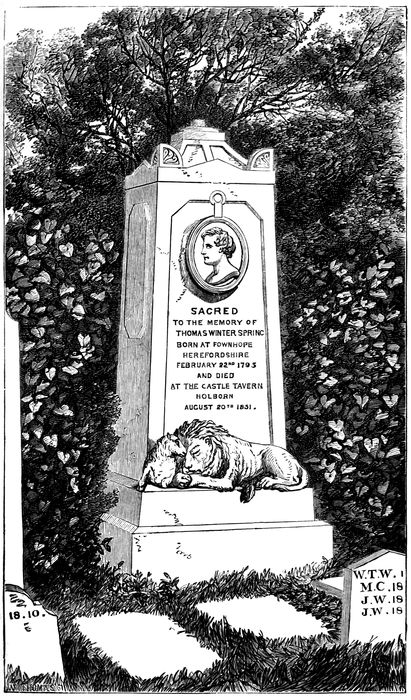
TOM SPRING’S MONUMENT IN NORWOOD CEMETERY.
51From this period to that of his death, on the 20th of August, 1851, Spring dispensed the hospitalities of the Castle, never losing a friend, except by the hand of death. In his later days, family difficulties, and too great a confidence in self-styled friends, who induced him to execute turf commissions, and when the thing went wrong were absentees or defaulters, added to his embarrassments. Still he held on, universally respected by all who knew him until his 56th year, when pale death struck him down somewhat suddenly, the blow being dealt through a heart disease of some years’ standing. His funeral took place with becoming solemnity on Sunday, the 25th of August, 1851, his remains being followed by several mourning coaches and other carriages to the grave. In the first carriage were his only surviving son, Melchior Winter; Mr. Price, of Hereford, his solicitor and executor; his firm friend, Mr. Elbam, of Piccadilly; and the writer of these pages. Poor Tom lies buried in the Norwood Cemetery, beneath the monument which we have here engraved. “Peace be to his manes!” Few men who have led a public life have less reason to dread the last call of “Time,” than Thomas Winter Spring.