Volume 2 — CHAPTER XIII. PHIL SAMPSON (“THE BIRMINGHAM YOUTH”)—1819–1831. (continued 2)
Reading edition
“The only charge that can be brought against the Ring is crossing fights; and though the members of the Press growl, and very justly too, whenever a x takes place, yet none of them attempt to point out the cause or remedy. Fighting men are not all alike, neither are kings; for who would compare the British Sovereign with the scoundrel Ferdinand of Spain? There are men in our Ring with integrity that would adorn a more elevated situation: men that would sooner drop senseless under punishment, though fighting for little more than the colours that are tied to the stakes, than receive five hundred pounds to lose wilfully. I do deny most positively that pugilistic exhibitions debase, demoralise, or brutalise us as a nation; on the reverse, I am confident they introduce chivalrous (they may be rude) notions of honour, courage, fortitude, and love of manly fair play—characteristics so strongly indented in the British character that they are known and acknowledged from pole to pole. And who will be hardy enough to say the excitement to those feelings does not originate in the very same cause which our enemies say brutalises the feelings of the country?
“Even on the score of humanity pugilism ought to be encouraged; for, wherever it does not exist, murder, by violence and treachery, more frequently takes place. Without going to foreign countries for proof, a single glance at home will strike the blindest with the necessity of its encouragement. The men of Lancashire, twenty years ago, were up-and-down fighters: then murder was almost an every-day occurrence. Indeed, some of the old ones of that day took no little pride to themselves if they could boast of having stopped the ‘smoke of a chimney’ (choked a man), after the manner of Virginius. Since pugilism has been introduced, though the population is fourfold, yet murder seldom or never takes place. Compare the population of Ireland, where the stick has been thrown aside, and the fist used, to the other parts: the difference in the number of deaths by violence will strike conviction on the dullest. In fact, though chivalry did much to smooth down the roughness of the darker ages, ’tis only the boxing-gloves can give the true polish of civilisation to the world. And, I am confident, if Adam had been a Briton, he would have taught his sons to box; then the club would not have been used, and the first murder prevented. Cain would have given Abel a good milling instead of crushing his skull: and the brothers would have been found next morning supping porridge as comfortable as the Lord Mayor’s sons on a more recent occasion.
“Greece, the birthplace of the arts and sciences, encouraged pugilism; and the first man of the day considered not only himself, but his family, honoured, if lucky enough to mill his man at the Olympic Games. Look at the effeminate beings that now parade the streets of Rome, once trod by the conquerors of England and the world; with them a boxing or a milling match would have had more charms than the finest strains of a Rossini. The Government knew the advantage of exhibitions that would excite an admiration of courage and fortitude. ’Twas this reason induced the Athenian General to stop his army, that they might look at a cock-fight—’tis this that has secured our Ring the patronage of the noblest blood, rank, and talent in the country; and long may we deserve the support of men that soar above the braying of asses or the cant of hypocrites!
“With all due submission and thanks to the ancients, as the inventors of boxing, I cannot help feeling pride at the vast superiority our Ring possesses over theirs; for death was too frequently the result, in consequence of the metal braced to their arms. When our Ring is formed the combatants are left to themselves without fear of interruption from a third person. Temperate, manly courage is loudly applauded—passion, cowardice or foul play as loudly blamed; and should either of the men display any little act of humanity to his sinking opponent (of which I could state numberless instances), his gallantry is cordially praised; but the moment the dreadful word “ENOUGH” is uttered, hostilities cease and the conqueror, shaking hands with his fallen antagonist, wishes him better luck next time, and, in a kindly voice, expresses a wish that he may soon recover.
“Man is the creature of habit, and of the force of example; and, I again repeat, exhibitions of this kind have their good effects, which can be traced to us as a nation, and, independent of fighting, influence other actions of life. Show me the man completely opposed to pugilism, and you will find his character to be a bad neighbour and a tyrant under his 481own roof. The immortal Wyndham was the staunch advocate and patron of our Ring, and champion for the abolition of the slave trade. Have dealings with any other country—will you find them, in the mass, so honest or so honourable as Britons? In every part of the known world, who are more welcome than our merchants? What flag more respected or feared? Quarrel in the streets of any other country, you will have more than one to contend with. If an object of distress is pointed out, who is more ready to assist than a Briton? In other countries murder and robbery go hand-in-hand; in ours the most desperate men never dip their hands in blood, unless to protect themselves from ill-judged resistance. And who can boast an army or a navy so gallantly brave, or so ready to extend the hand to save, as Britons? Tell me a nation that could meet our brave sons on equal terms in the field or on the wave; yet, if conquered, which of them but would sooner become a prisoner to a British sailor or soldier than any other? Theirs is not the frenzied courage like that inspired by fanaticism, ferocity, or brandy, which, after the first gust of passion, leaves its helpless, hopeless, panting possessor; no, ’tis that kind of round-after-round courage which will admit of thinking and command, and knows no abatement till wearied nature or death closes the scene. Fair play is a Briton’s motto; we would extend it to the extremities of the earth, no consequence what country, religion, or colour. The sable African, throwing aside the chains that levelled him with the beast, now walks erect, in the majesty of freedom and liberty, calling down blessings on the country that, in spite of all the world, burst his bonds asunder. If these are the symptoms that the country is brutalised by pugilism, long may she continue so! Long may she be the home for the exile—the defender of the oppressed—the best boxer—and the fairest arbiter of the world!
“TOM REYNOLDS.”
With hearty approval we commend “Old Tom’s” spirited “defence” to the careful perusal of Sir Wilfrid Lawson, Messrs. Bright, Agnew, Richard, the Stigginses, the saints and sinners of Exeter and St. James’s Halls, and the Peace (at-any-price) Preservation Society.
DICK CURTIS (“THE PET”)—1820–1828.
For skill, neatness, finish, straight, and therefore swift, hitting, no such boxer as Dick Curtis has appeared in the present century. His weight, nine stone, and his height, five foot six, as a matter of course precluded his appearance among the Champions; but, as Champion of the Light Weights, Richard Curtis has had no superior, if any equal, in the annals of pugilism.
He was decidedly the most perfect specimen of a miniature fighting man of modern times. His science was, we might almost say, intuitive, his judgment of time and distance extraordinary, his readiness in difficulty most remarkable, his change from a position of defence to that of attack instantaneous and astonishing, and his power of punishment, for so light a man, unparalleled. Curtis was patronised by the most distinguished admirers of pugilism of the period in which he lived, and throughout his long career was never defeated, with the single exception of his last battle, when with Perkins, of Oxford, to whom he was inferior by a stone and two pounds in weight, as well as in length and height, he fell before youth and stamina.
482Richard Curtis was born in Southwark, on the 1st of February, 1802. He came of a fighting family, his brothers John and George having both figured in the ring. Young Dick’s first public appearance was at the age of eighteen, on the well-known battle-field of Moulsey Hurst, where on Tuesday, June 27th, 1820, in the same ring in which George Cooper had just defeated Shelton, he entered the lists with Watson, a Westminster boxer, of about ten stone. Watson was game, and fought desperately for twenty-five minutes, when he cried “Enough!” and Curtis was hailed the conqueror, almost without a mark. Curtis’s skill was so remarkable in this rencontre that two months afterwards some Corinthians, previously to leaving town for the shooting season—which was then September—as railroads had not brought grouse and the Scottish moors within hail of the Metropolis, determined to see the smart young Bermondsey lad again show his prowess. A match for £40 was accordingly made for him with a well-known light weight, Ned Brown (the Sprig of Myrtle); and on Monday, the 28th of August, 1820, Brown, waited on by Jack Martin and Paddington Jones, tried to throw his hat into the ring on Wimbledon Common, in such a smart gale that it blew it over, and away across the heath. Shortly after, Curtis, attended by Josh Hudson and Tom Belcher, approached the ropes; but his lily-white beaver shared the same fate, so that the omen was negative. Both men were in good condition. The colours—a canary yellow for Curtis, and a blue bird’s-eye for Brown—being tied to the stakes, the men shook hands and began
THE FIGHT.
Round 1.—Brown, full of confidence, made an offer to hit, but Curtis was awake, and nothing was done. A long pause took place, each endeavouring to get an opening, when Brown rushed in to work; a change took place in the struggle to fib each other, when both went down, Brown undermost. (Great shouting; and Curtis for a trifle.)
2.—This round occupied thirteen minutes, and the amateurs were delighted with the science and manliness displayed on both sides. Curtis hit at a longer distance, and nobbed Brown in great style. Both of these little ones displayed as much caution as if a million of money depended upon the event. To describe the stop-hits and getting away would occupy a page: suffice it to say that Brown’s right eye was nearly closed, and, after some desperate milling, Brown went down undermost. The great length of this round showed the good condition of both the combatants. Curtis appeared the weaker man.
3.—Brown proved himself a fine and game fighter, but Curtis out-fought him, put in nobbers with the utmost dexterity, and also damaged his other eye. (Tom Owen sung out, “Go it, my white topper; it’s as right as the day.”) Both went down, Brown undermost. Two to one on Curtis.
4.—This was a short round; in closing, Brown endeavoured to fib his opponent, but Curtis got down. (Any odds upon the latter.)
5.—Brown displayed good tactics, and at in-fighting was quite clever. Curtis made some good nobbing hits, and Brown went staggering away; but the latter returned to the charge, and, in struggling for the throw, Brown dragged Curtis over the ring and downed him. (Brown for £20. Curtis seemed weak.)
6.—This was rather a long round. Fibbing on both sides. Both down, Brown undermost.
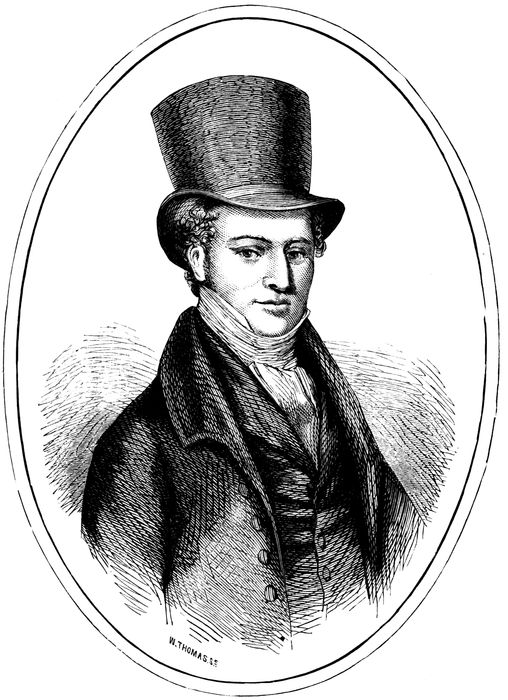
DICK CURTIS (“The Pet”).
4837.—Curtis not only stopped in good style, but nobbed Brown away. After some exchanges at the ropes, Curtis dropped Brown by a blow on the side of the latter’s head.
8.—This was a famous round; and, in closing, Brown broke away twice with great activity. The punishment was severe on both sides. Brown was ultimately hit down, as if shot, from a tremendous blow on his forehead. (Great shouting. The “Sprigs of Myrtle” all drooping, and the denizens of Caleb Baldwin’s dominions upon the fret. “It’s all over.”)
9.—Brown, however, came first to the scratch. A severe struggle took place at the ropes, each too game to go down. (“Go down, Curtis,” from all parts of the ring.) Both at length fell, but Brown was undermost. (Here a near relative of Brown came close to the ropes, and told the seconds they were not doing right in not letting Brown “go in.”)
10.—Brown recovered a little, made a rush, and the change was considered in his favour. Curtis got down cleverly.
11, 12.—Both combatants excited the admiration of the ring by their fine fighting. In the last round Brown was hit down from a severe hit in the ribs. (Two and three to one.)
13 to 15, and last.—Brown was floored in all these rounds on coming to the scratch; he was terribly punished, but the game he displayed was of the first quality. Here the patron of Brown stepped forward (a more gentlemanly, liberal, or distinguished character for humanity of disposition does not exist, nor a greater admirer of true courage is not to be found) and said, “My man shall not fight any more.”
Remarks.—A better battle has not been seen for many years; 57 minutes of complete good fighting. Brown has fought eight prize battles, and proved the conqueror in the majority of them. Curtis, although a mere boy, bids fair to prove a teaser to any of his weight; he is a cautious boxer and a severe hitter. The amateurs never expressed greater satisfaction at any fight. It was the general opinion that although Curtis appeared weak two or three times in the conflict, yet the scale of victory was always on his side. It is true that Brown had no other chance to win but “going in;” yet the clever defence of Curtis rendered that plan equally dangerous.
Curtis’s next match was with Lenney, at Moulsey Hurst, on the 24th of October, 1821. “At one o’clock,” says the reporter, “young Curtis, in a white upper-benjamin, which would have set off a Regent-street ‘pink,’ a brilliant canary round his throat, and a white beaver of the most fashionable mould, showed arm-in-arm with the President of the Daffy Club,[55] and threw his natty castor into the ring.” Lenney soon after appeared, with the Gas-light man and Curtis’s old opponent, the Sprig of Myrtle, and replied to the signal of defiance. Spring and Hickman seconded Lenney; Tom Belcher and Harry Harmer officiated for Curtis. The odds, within the previous two or three days, had changed in favour of Lenney, on whom five to four was laid. The colours were tied to the stakes by Spring and the President, who observed to the former, “I’ll bet you a trifle that I take them down.”
THE FIGHT.
Round 1.—The condition of Curtis was that of the finest racehorse; blood and bone were conspicuous, and he appeared as confident as if the battle were over. Lenney was equally fine; he commenced the fight with the most determined resolution of being declared the conqueror. Curtis was in no hurry to make play: Lenney was also on his guard. After some little manœuvring, Curtis let fly on the nob of his opponent, without return. This hit operated as a sort of stopper, and some little sparring occurred. Lenney endeavoured to go to work, and some blows were exchanged. The science displayed by Curtis was fine in the extreme, and he planted two sharp facers, right and 484left, that floored Lenney on his face, and the claret trickled down his cheek. (Loud shouting, and two to one all round the ring.)
2.—Lenney came to the scratch with a severe cut under his right eye. Curtis planted a severe body hit without a return; he also put in two severe facers. It was evident that Lenney could not protect his face from the out-fighting of his opponent, and to go in seemed equally dangerous. Curtis kept nobbing his man, and getting away with the utmost ease. In closing, Lenney was fibbed down, and Curtis fell upon him. (Thunders of applause, and “You’re a pretty boy, Curtis.”)
3.—This was a short round; a close took place, and the fibbing tactics went on till Lenney went down.
4.—The coolness of Curtis was the theme of the ring. He measured his distances with the accuracy of a mathematician, and nobbed his opponent with the severity of a hammer-man at an anvil. Lenney could make no impression on the mode adopted by Curtis. The latter followed Lenney up to the ropes, and, with his right hand, planted such a tremendous facer that it was heard all over the ring. In the struggle for the throw both combatants were hanging on the ropes; Curtis’s nose touched them, as they both came to the ground; but previous to this he put in some heavy blows on his opponent’s loins.
5.—Lenney came like a gamecock to the scratch; but his nob had undergone a strange alteration. Some exchanges occurred. Curtis, by a dreadful right-handed blow, sent down his adversary like a shot. (Three to one. “What a beautiful fighter!” exclaimed Randall.)
6, 7, 8.—Lenney stopped several blows with considerable skill; but his head was completely at the service of his opponent. Oliver made so sure of the event that he asked if any gentleman would oblige him by taking ten to two.
9, 10.—The fine fighting of Curtis now rendered the battle quite safe to him; so much so, that he could take his time about it without danger. Curtis astonished the ring with his execution as well as his science: he put such a tremendous blow on Lenney’s mouth that his ivories were on the chatter like dice in a box, and he felt it so seriously that his left arm dropped for an instant. (“It’s all safe now—it’s the Bank of England to a screen,” was the chaffing throughout the crowd.)
11, 12.—Lenney received so much punishment about the nob that he was quite groggy. Twenty to one was offered.
13, 14, 15, 16, 17.—All these rounds were nearly similar to the preceding ones. Any odds.
18 to 29, and last.—Lenney was game to the backbone, but he had not a shadow of chance. He ought to have been taken away several rounds previous to the last. He was hit out of time; and remained in a state of stupor for a short period. The battle occupied thirty-eight minutes and a half.
Remarks.—A more elegant or scientific fighter than Curtis was never seen in the Prize Ring. He could have won in half the time if he had wished, but he was determined not to give half a chance away, consequently no long rally took place in the battle. Curtis also proved the stronger man, and left the ring without a scratch upon his face; but his hands were much bruised from the severe punishment he had administered to his opponent. Lenney was carried out of the ring and put to bed. The attitude of the latter was not a judicious one; he leaned too far back, not only to do execution, but such a position must have distressed him much: in fact, Lenney could not reach Curtis with any degree of certainty. It seemed to be the general opinion of the Fancy that no one on the list of Curtis’s weight can beat him.
Dick at Epsom Races.—Although it was nearly five o’clock before the last race—the Maiden Stakes—was over, on Thursday, May 26th, 1822, and most excellent sport had been afforded, yet numbers of the sporting fraternity seemed to think the day was not exactly complete—that it wanted a sort of finish. As some of the lads from the Metropolis were upon the look-out for a little job, a mill was proposed by way of dessert, and a subscription purse of £16 was collected in a very short time. Little Dick Curtis, with as much blood as any horse upon the course, made his bow to the amateurs, and said he had not the least objection to peel, more especially as he had been cleaned out of all his loose rag by backing Deaf Davis on the previous Tuesday. “You’re a good lad,” replied a 485swell; “and it is a thousand pities you should be suffered to remain idle.” A gipsy pricked up his ears upon hearing these remarks, and offered himself to the notice of the “Pink of Society,” just to have a small taste, for the amusement of the company, if his honour had no objection. “Why,” said the pink, “you seem to have been a little bit about the hedges lately. By your looks you are a gipsy. What set do you belong to?” The brown-visaged hero, with pride, answered, “The Coopers.” “That will do,” replied the swell; “show yourself at the scratch without delay.” Dick Curtis was seconded by Ould Tom Jones and Harry Holt; and Cooper was handled by Gipsy Cooper and another “traveller.” Seven to four on Dick.
THE FIGHT.
Round 1.—The Gipsy stripped well, and was what the fair sex term rather a handsome young man. He seemed, by the attitude he placed himself in, to meet his opponent as if he knew something about milling. Dick measured the Gipsy from head to foot with much confidence; but he was in no hurry to go to work. The Gipsy at length let fly, and missed, when Dick, lively as a dancing-master, put in some telling hits, and in the struggle the Bohemian went down amidst thunders of applause. (“Two to one!” lustily roared out.)
2.—Dick came laughing to the scratch, as keen as a stockbroker and cunning as a fox, giving the wink to his friends it was all right. Still he would not hit first. The Gipsy was again gammoned to make play, when his domino box got as much slashing as if seven had been the main. The rattling of the ivories was repeated, and the Gipsy floored. (Five to one, and no takers.)
3.—This round took the conceit out of the Gipsy, who ran furiously at Curtis, but the latter, with the utmost ease, stopped him, by giving him the pepper-box on his sensitive plant. Dick now commenced fighting, and put in four such complete facers that they made the Gipsy all abroad; he went down like a log. (Ten to one, and the multitude chevying from one end of the ring to the other, “What a prime little fellow Dick is!”)
4.—This was short and sweet to Curtis; he sent the Gipsy down to cool himself on the turf for half a minute. (Any odds, but no takers.)
5.—It was clear to the judges that it must be soon over, and that the Gipsy must be milled off-hand. Curtis again drew his cork, and the hero of the bush once more embraced his mother earth. It was all stuff to offer odds, for no person seemed inclined to take ten to one.
6.—The pepper-box and vinegar cruet were again made use of by Dick, till the Gipsy had nearly let it escape out of his mouth that it was no go. Gipsy down.
7, and last.—The Gipsy napped a rum one on his canister, and he went down immediately, saying “he would not fight any more, as he had not room enough for his strength.” Curtis gave a jump, and pocketed the purse almost without receiving a hit, exclaiming, “Success to Epsom Races!”
Remarks.—It is true it was a very bad ring, owing to the vast multitude that pressed in upon the boxers from all sides; but if the Gipsy had had the whole of Epsom Downs to shift in he would never have been able to defeat Curtis. The latter is decidedly one of the best boxers of the day; no commoners must think of having a turn with him, and first-rate fighters must make a pause before they enter the lists with Dick. Two bystanders gave Dick a sovereign each for winning, which he generously made a present of to the Gipsy.
It would unnecessarily swell the bulk of the present volume to reproduce the numerous ring encounters in which Curtis was engaged during the succeeding years, in which time he fought with Peter Warren no less than five times, defeating that boxer on four occasions, and on the second the contest terminating in a drawn battle. The dates and duration of these are here given:—
4861. Beat Peter Warren, 20 min., 10 rounds, £30 a-side, at Colnbrook, July 23rd, 1822.
2. Draw with Peter Warren, £25 a-side, 16 min., Moulsey, April 16th, 1823. On this occasion a wrangle and riot ended in the stakeholder returning the stakes to each party’s backers. A third contest was therefore arranged, for £50 a-side.
3. The third battle was decided at Crawley Hurst, July 8th, 1823. On this occasion Warren was defeated in one round, occupying nine minutes only, having sprained his kneecap so severely as to put him at once hors de combat.
4. After defeating Dick Hares, as we shall presently detail, Curtis beat Warren (£20 a-side) on Epsom Downs, in six sharp rounds, occupying eight minutes only, and finally—
5. Defeated his pertinacious opponent at Warwick, in 7 rounds, time 16 minutes, for a stake of £100 to £90, on July 19th, 1825.
Dick Hares was in the interim matched with Curtis, for £50 a-side, to come off April 13th, 1824, but the affair was prevented by an information laid at Bow Street, and two officers were sent down to Moulsey to stop the fight. It will perhaps raise a smile if we state the “reason” assigned for this prompting of the magisterial energy. The information of the “impending breach of the peace” was laid by a theatrical manager, who, his house being shut up because it was “Passion week,” did not see “why other public amusements should be tolerated”! Hinc illæ lachrymæ, the laying of the information, and the disappointment of the Fancy.
A new match was accordingly made, as neither party desired a “draw;” and on Tuesday, July 8th, 1823, on Moulsey Hurst, on the ring being cleared after Ned Neale had defeated Gaynor (see ante, Life of Neale, Period IV., Chap. V.), Hares, attended by Peter Crawley and Tom Shelton, threw his hat within the ropes. Curtis followed, waited on by Josh Hudson and Tom Owen, the Sage of the East, whose admiration of Curtis as a boxer had been long loudly expressed. Curtis’s hat was about to go over the ropes with the wind, when Bill Moss caught it cleverly in both hands, and dropped it within the enclosure. Curtis fought under a yellowman, and Hares sported an emerald green flag. Six to four on Curtis.
THE FIGHT.
Round 1.—On stripping, the condition of Hares was the admiration of every amateur present. He looked like a new man, instead of an old one. Such are the advantages of training, if an athlete is not absolutely used up. “Curtis must be licked to-day; he has not stamina enough to get rid of Hares,” was the cry. We also heard Jack Randall 487express the same opinion. On setting-to, Curtis appeared well in health; but he looked thin, boyish, and little compared to his opponent. The attitudes of both men were pretty, and the anxiety of Curtis to get the first advantage remarkable. Hares too was eager to let fly, but he could not get an opening. Not so with the Pet; he embraced the first opportunity that presented itself, and his left hand alighted very heavily on the nose of Hares. An exchange of blows followed, in which Curtis received a small grain of pepper on his left cheek; but Hares napped a full dose. Standing still for a minute, nothing to be done. Curtis again let fly his left hand, which nearly sent Hares’s teeth on a journey down his throat. The men closed soon afterwards at the ropes, when the fibbing of Curtis was terrific—he spoiled the look of his man, got Hares down, and fell upon him. A deafening shout for Curtis, the “Bermondseys” nearly out of their senses with joy. Two to one on the Pet.
2.—Hares was bleeding at the nose, his face much disfigured, and Curtis a little distressed and winking. Hares made an excellent stop. (“Well done, Hares!”) Dick put in another nobber, the claret following. Counter-hits, and Curtis received a heavy blow on his cheek. An exchange of blows, and no light play. Hares made another good stop. Curtis slipped a little near the ropes, when Hares ran up to him, and planted a heavy body hit; the Pet endeavoured to retreat, when his opponent stuck close to him, and put in another blow. Curtis recovered himself, and let fly his left hand in the middle of his opponent’s head. Counter-hits. Two more terrific, stupefying facers by Curtis, and no return. In closing, the fibbing administered by the Pet was tremendous, and Hares went down, Curtis uppermost. (“What an extraordinary little fellow! He hits as hard as Cribb. The other man has no chance; take him away.”)
3, and last.—Hares came up game as a pebble; but his head was quite altered; and his seconds, with all their industry and attention, could not keep his face clean. Both offering, but nothing done. Hares stopped a tremendous nobber. Rather a long pause. “Go to work, Hares.” The latter made a second and also a third attempt with great skill; but after this time the execution was so decisive on the part of Curtis that it was positively one hundred pounds to a farthing. The left hand of Curtis went flush into the middle of Hares’s head; a profusion of claret followed. (“What a limner this Pet is!” said the Sage of the East to Josh. “I never saw such a painter before. Why, he is a master of colour! What an artist!”) The succession of hits planted by Curtis in the middle of Hares’s head, without return, was surprising. It was a nobber, and claret—ditto—ditto—ditto. “Take the brave fellow away,” said his backer—“I will not suffer him to fight any more. He has no chance.” But Hares, regardless of the humane entreaties of his friends, stood up to receive punishment till Nature deserted him, when he fell in a state of stupor. Curtis jumped for joy, but immediately ran up to shake the hand of the fainting Hares. He was at once carried off the ground, and medical advice procured. It is but justice to say that Shelton and Crawley deserve great praise for the humanity and attention they paid to the brave but fallen little man.
Remarks.—We have no hesitation in pronouncing the execution of Curtis the most decisive thing we ever witnessed in the Prize Ring. He won the fight with his left hand only, as he never made but two blows with his right hand during the battle. The Pet is the very first of boxers, and we think all pugilists will accede to the remark. He won the fight in twenty minutes, but did not prove the conqueror without receiving some heavy blows. Three or four tremendous hits were made by Hares. Although Curtis won the fight in such superior style he was certainly overmatched in weight and strength. The position of Curtis was so extremely fine that he was guarded at all points. Curtis dressed himself immediately, and walked about the ring receiving compliments from his friends. His left hand, however, if not quite gone, was terribly damaged.
Barney Aaron, whose weight was 10st., and who had beaten in succession Ned Stockman, Lenney, Frank Redmond, and Peter Warren, now challenged Curtis, and articles were signed for £100 a-side. The battle was to have been decided on Tuesday, November 23rd, 1824, on the stage at Warwick, after Josh Hudson and Cannon had settled their differences; but on this occasion Curtis received forfeit of the battle-money, under very suspicious circumstances as regarded some of the Israelitish speculators, who had calculated on “getting at Curtis” in such a way as to secure what was then called “a slice of ready-made luck.”
488Soon after the match was made, Curtis being the favourite, such eagerness was shown in certain quarters to take the odds, and subsequently to lay even as much as six to four on the Jew “rather than not do bishnesh,” that strong suspicions were excited, and a x, in which Curtis was to “chuck the fight,” was publicly talked of. Alarm spread at the sporting houses, and on inquiry Curtis came forward and declared “that he had rather lose his life than his fame.” Upon this declaration the odds veered about, and Curtis was the favourite at five to four, giving chance, at any rate, of hedging. Then the assertions of dishonest intentions became stronger, and Barney was declared a safe winner. Thus matters stood when, some days previous to the big fight, Barney Aaron and his backers left London for Leamington, and made their headquarters at the “Crown.” In due time, also, Curtis and his friends arrived at Warwick. Still such doubts existed that betting was at an end, until some heavy stakes were sported on the night before the fight, at the “George,” at Warwick, and Barney again taken for choice. At an early hour in the day a report was circulated through the Race Stand that “the fight was off.” This circumstance created regret among the true sporting men. However, in a few minutes after Hudson and Cannon had left the stage, Curtis appeared, attended by Tom Belcher and his backers, and threw up his hat amidst loud cheers. Aaron was called for, but not showing himself, Curtis addressed the multitude. He said, “I attended here according to the articles, and I call upon Barney Aaron to face me according to articles.” He repeated the challenge twice without reply being made. Curtis then declared that “he would wait one quarter of an hour, and if Aaron did not appear, he should claim the stakes, £100, as a forfeit.” Previous to the quarter of an hour having elapsed, Curtis wished it to be known that he would fight any man of his weight in the world, for £200 a-side, and give half a stone.
Tom Belcher said he was the stakeholder, and the forfeit being claimed, he considered it his duty to give the £100 to Curtis, according to the rules of sporting. (“Perfectly correct, Tom,” from the spectators.) Belcher then presented Curtis with a new £100 Bank of England note, which the Pet smilingly deposited in his pocket. Belcher then took the nattily shaped “Pet” on his back, and lightly carried him, amidst laughter and applause, through the mud to the Grand Stand, where his health was drunk in sparkling “cham” by his friends, backers, and the admirers of straight-forward honesty.
At Ned Neale’s benefit at the Fives Court, two days after this fiasco, 489Curtis and Aaron met in the most friendly manner. Curtis said: “I would rather have fought for the money; but I am sure, Barney, it was not your fault.”
Aaron then proceeded to explain. He said he was told the place was Oxford, and there he was taken by his backers in a post-chaise, contrary to his intention, which had been to meet Curtis. He had with him his drawers and shoes. “Had I been licked,” said he, “which I don’t think I should have been” (a laugh from Curtis), “I should have got some blunt; but I have been regularly dished.” “I hope you will get backed,” replied Curtis; “I know you’re a brave man, and I hope next time we shall have a comfortable fight!”
Some chaffering about the amount of stakes followed this interview; Curtis proposing to fight for £200, and Aaron’s backers modestly suggesting that Curtis (in consideration of the forfeit of £100—the forfeit was only £50) should fight Barney £200 to £100. The subjoined stanzas, conveying the challenge, seem of sufficient merit to deserve snatching from oblivion:—
THE PET’S INVITATION.
Richard Curtis to Barney Aaron—Greeting.
Come, Barney, ’tis Curtis, the Pet, who invites thee;
No longer to fight for two hundred refuse;
For while all the pride of “the Peoplesh” excites thee,
You can’t need the needful, my star of the Jews!
Remember the glories of ancient Mendoza,
And hard-drinking, hard-hitting, shifting Dutch Sam;
Think on old Ikey Pig, and Big Bittoon, who knows thee,
With the rush of a lion, yet mild as a lamb.
What though Mrs. Aaron thy mug may delight in,
And thinking of black eyes, turns fretful and wan?
She’ll say, when convinced that you really mean fighting,
“Mine husband, Cot plesh him, ’s a brave little man.”
I’ll own that as good as e’er pulled off a shirt is
The lad I now call to the old milling game;
And remember, friend Barney, though challenged by Curtis,
No Cur-’tis invites to combat for fame.
Then try all the good ones who live in the Minories,
Kick the shins of the dwellers in Petticoat Lane—
Get blunt, which of all sorts of milling the sinew is;
Drop chaffing, and take to fair fighting again.
August 28th, 1825.
THE STAR’S ANSWER.
Barney Aaron to Richard Curtis—Greeting.
I come, Mr. Cur-’tis the Star of the Sheenies
Who advances to pluck from thy brow the high crest,
With a sufficit quantum of courage—and guineas—
To lower thy caput, my Flower of the West.
490You fought Peter Warren a hundred to ninety,
Then why not fight me for the first-mention’d name?
But being all bounce you the scratch will not come to,
To show your much-vaunted pretensions to fame.
You say that the ochre—the metal—the rhino,
Is flush ’mong the Sheenies of Petticoat Lane;
’Tish more scarsh nor you think—I vish it vash mine, oh!
I’d fight for my losht reputation again.
Now hear! For one hundred, I’m ready to fight you,
Surely, out of mere fairness, you cannot refuse;
You’ll have to contend with no Warren, my Cur-tis,
But with brave Barney Aaron, the Star of the Jews!
Duke’s Place,
September 3rd, 1825.
These poetic effusions, with a dozen prosy letters to boot, failed to bring the men to terms.
Curtis was now indeed “the Pet of the Fancy;” no sparring exhibition of any pretension was perfect in its programme without the Light weight Champion displayed his skill in the art of which he was such a consummate master; and as Dick never hesitated to put on the gloves, and give away a stone or two and a few inches, the disparity of his opponents added a keener interest than usual to his demonstrations. The newspapers of the period are full of them. Curtis was now perforce idle, for there was no boxer near his weight who could get matched against him. Of course he was the object of envy to many of the fraternity, and as
“Envy doth merit like its shade pursue,
And by the shadow proves the substance true,”
so with one Mister Edward Savage, whose anger at the want of appreciation of his own merits, and the favour lavished on “the Pet,” carried him beyond all bounds of common civility. Edward Savage, an eleven stone man, was one of three Savages, the others named William and Cab. (or Jack) Savage, who were professed boxers. Ned Savage, on the evening of the 5th of August, 1825, entered the parlour of Tom Belcher’s, the “Castle,” Holborn, where Curtis and other friends were taking their whiff and their wet. The conversation turning upon pugilistic affairs, Mister Savage made some most insulting remarks upon the diminutive size of Curtis, coupled with regrets that he (Savage) could not get himself down to ten stone (Dick had challenged all comers and to give a stone), and concluded with a ruffianly threat of what he would do if Curtis would “give him a chance.” The Pet was about to leave when Savage, true to his name, struck him severely in the eye. The return on Mister Savage’s optic was 491made with lightning celerity, and the next instant the little one had his man round the neck, and delivered a succession of left-handers of such cutting severity that when Savage got down his head was a piteous spectacle. The company now interfered, but Curtis declared that he “must teach this Savage a lesson.” Savage rushed in blind with rage, and it is charity to suppose somewhat upset by liquor, when he was met by one, two, three steadiers in the head, his returns being parried, until he fairly staggered down. The affair now became a regular battle. Curtis threw off his upper garments, and Savage did the same. Savage rushed at his man so fiercely that Dick, stepping aside, delivered his blow on the ear of a bystander, to the man’s great astonishment and the amusement of the company, while Curtis simultaneously delivered alternately with both hands in such style that Savage turned away from the punishment. He was, however, game, if nothing else, and came up as receiver-general until the sixteenth round, when he was so completely cut up and beaten that he cried, “Enough!” Not more than sixteen minutes elapsed from the first assault to the close of this unexpected performance, the description of which by a few of the scientific spectators raised the fame of Curtis to a height hardly exceeded by that attained by his victories in the twenty-four foot. Tom Belcher’s concluding remark when narrating this little episode used to be—“It wouldn’t be lucky for some of us if Dick was twelve stone. There wouldn’t be much chaff about who would be Champion then”—a remark in which the heavy weights present usually coincided, some of them perhaps with a slight mental reservation in favour of his own brave self.
A ridiculous encounter with Ned Stockman, on the day of the fight between Gaynor and Bishop Sharpe (Tuesday, May 16th, 1826) is recorded. In this affair Stockman, after challenging Curtis and offering to fight him, laid down like a cur after a single round, as recorded in the reports of the time.
This brings us to the match at length arranged, by the concession of Curtis, for £100 a-side, with Barney Aaron. The battle came off on Tuesday, February 27th, 1827, at Andover, Hants, upon a stage erected in a field at the back of the “Queen Charlotte” public-house, opposite that where Spring defeated Neale, in 1823, one mile from the town. The stage was erected by the townspeople free of expense, and upwards of forty wagons were sent to form an outer ring by the jolly Hampshire farmers of the neighbourhood. The pugilistic division from London was in great 492force. Jem Ward, Tom Oliver, Ben Burn, Young Gas (Jonathan Bissell), Harry Holt, Ned Neale, with Fogo the Laureate and Joe Fishwick the Commissary, had joined the wagon-train. Curtis, valeted by Young Dutch Sam, took up his quarters at the “White Hart,” and Barney Aaron and Gipsy Cooper at the “Catherine Wheel,” opposite. Curtis was the favourite, at five to four. At one o’clock Barney, accompanied by Mr. Nathan and Jem Ward, ascended the stage amidst loud cheering. Curtis, attended by his backer, and Josh Hudson with Ben Burn, soon followed, and were welcomed with acclamation. The men then shook hands, and the colours were tied to the stakes; a bright yellow for Curtis and a deep red with yellow spots for the Israelite; and the battle commenced.
THE FIGHT.
Round 1.—The Pet, as he exhibited in buff, gave great delight and satisfaction to his numerous friends. His condition was acknowledged to be quite tip-top. He might have been compared to the finest racehorse for blood, game, and bone; in fact, the tout ensemble of the Pet was the picture of a fine-framed man in miniature. His arms were beautiful. The Star of the East was equally bright; he had done everything to improve his strength during his preparation, and he appeared at the scratch a robust, vigorous, athletic young man. In elegance, ease, and grace, Angelo, O’Shaughnessy, or Roland, with the foils, could not have exhibited more taste in the polite accomplishment of fencing than did the attitudes and arms of Curtis and Aaron exhibit in the art of self-defence. Both combatants were armed cap-à-pie; it was an eye against an eye, toe for toe, arm opposed to arm, caution matched with caution; if one was “down” the other was “up”—it was, “I won’t have it!” on both sides; in short, it was diamond cut diamond. Such were the boxers opposed to each other in this great trial of skill. Barney, unlike the character of his milling in his previous battles, preferred the “look-out” to the rush; he being well aware of the great talent, judgment, and finishing qualities of his opponent, and determined not to give the slightest chance away. The Pet, like an accomplished general, soon perceived that his adversary was nothing else but a difficult one, and not to be gammoned upon old suits: indeed, that nothing but the utmost skill was necessary to be with him upon any point. For several minutes the spectators were delighted with the extreme caution displayed on both sides, and at the same time the readiness which Curtis and Aaron displayed should any opening offer for the exercise of their fists. Curtis looked as it were into the “very soul” of his adversary, and the richness of the “Jew’s eye” was of an equally penetrating description. Barney waited for the Pet to commence offensive operations, but Curtis, finding that nothing could be done without great danger to himself, retreated slowly towards the corner of the stage, the Star of the East following him leisurely. The interest of the scene was intense, and every peeper on the stretch to witness mischief. Barney, with great spirit and tact, went in, and gave Dick pepper with his right and left hands on his face. (“Beautiful!” from the Sheenies.) The Pet countered slightly. Barney, in closing, endeavoured to fib his opponent, but Dick bolted (“Hallo! what’s the matter?”) and cleverly got out of trouble. The Pet turned quickly, and again met his man; an exchange of blows followed, and in closing they tried each other’s strength severely, when both went down, Curtis undermost. (Loud shouting for Barney, and “Where’s your two to one?”) The claret was seen on Dick’s mouth. “First blood” was declared in favour of Aaron.
2.—Curtis had always entertained a good opinion of the milling qualities of his opponent, but he was now completely satisfied that he was not only a troublesome customer, but a better man than any who had previously stood before him. Slow and sure appeared the order of the day on both sides. Aaron was not to be had by any stratagem practised by Curtis. The latter, however, gradually retired to the end of the stage, Barney in attendance upon him. Counter-hits were given, and both told. The Jew went to work in the most manly style, and the counter-hits were admirable. In closing Barney endeavoured to fib his opponent, but the Pet returned hard and fast, and it was difficult to say which had the best of it. Barney was ultimately thrown, but Dick also went down. The Pet-ites now began to 493let loose their red rags, and Curtis was hailed with shouts of applause.
3.—This round was “as long as Paterson’s Road Book.” Each of their mugs exhibited the handiwork of the other, and Barney’s peepers had been measured for a “suit of mourning.” The Pet was cautious, and his face bespoke that he had all his work to do to change the battle in his favour. Barney was equally shy, and kept a good look-out. Curtis, finding that he could not make an impression, tried once more the retreating system, but Barney was after him, though his blows were skilfully stopped by the Pet. Counter-hitting, and Jack as good as his master. Curtis’s right eye received a sharp taste, but the Jew had the favour returned with interest. A pause, and nothing like mischief for a short period. Barney at length let fly on the Pet’s chaffing-box, and the claret followed, which appeared rather troublesome to Curtis. The admirers of scientific fighting had a perfect treat, both men being prepared at every point. Curtis seemed rather fatigued, put down his hands for an instant, and the Jew followed his example. The truth is, the conduct of Barney in not availing himself of his weight and length not only surprised all his friends, but astonished the backers of Curtis. The disinterested part of the audience viewed it as a doubtful thing. Barney at last went to work, and planted two successful hits. Some sharp exchanges. In closing, fibbing was the order of the day, and the pepper-box changed hands in rapid succession. The men broke ground, and Dick adopted his skilful mode of retreating. The Star of the East went after him, and in the corner of the stage planted a severe blow on his throat, which made Dick gulp again. In closing, after a severe struggle, Curtis went down undermost, and Barney upon one knee. (“Vell done, Barney!” from the Sheenies.) The backers of Curtis, although not positively afraid, yet candidly acknowledged they had hitherto thought too little of Aaron.
4.—The face of Dick did not exhibit his usual gaiety of expression. His mind was at work to attack his opponent upon a new system. In short, we never saw him so puzzled before in any of his contests. The pause was long, and nothing done. Jem Ward, who had hitherto been silent, now exclaimed, “It will be—‘who’d ha’ thought it?’ We shall win!” Barney cleverly hit the Pet away, and some little workmanship took place between them, when the left mauly of Dick caught Barney’s nob, and he went down partly on his knees. It could scarcely be considered a knock-down blow. The Pet-ites were again liberal with their applause, and seven to four offered.
5.—Those persons who had witnessed the severity of execution done by Dick in his fights with gloves expected that he would have nobbed the Jew off-hand. But the science and caution of Barney astonished the ring-goers. Sharp counter-hits. The fighting was good on both sides, and both nobs were damaged. The right cheek of the Star of the East napped a severe cut. In closing the struggle was great to obtain the throw, when the Pet, by a sudden impulse, gave Barney a hoist between the ropes. He would have fallen at least six feet to the ground, but fortunately for the Star of the East a wagon had been placed near the stage for the accommodation of the reporters, umpires, and referee. Pierce Egan and another scribbler caught hold of Barney by the arm and his leg, and rescued the Jew from his perilous situation. Like one of the gamest of the game Barney jumped up and exclaimed, “I am not hurt, it’s all right,” and reascended the stage amidst thunders of applause.
6.—Of course the agitation and shock sustained by the above accident, added to the shortness of the time, only half a minute, to return to the scratch, were considerably against him. Yet he set to in the most manly way, and gave Dick not a very light one on his pimple. The latter countered as quick as lightning. Milling on both sides for a short period, until they separated. Both careful, and upon the look-out for an opening. A rally occurred, in which Dick rather took the lead, and Barney’s head received severe punishment. The Jew at length went down upon his hands. (“You have got him now, Curtis, only go to work!” said the boys of the Borough. “He knows better,” answered a Sheeny; “Curtis will be in trouble if he does!”)
7.—The countenance of Curtis now became cheerful, and he gave the “office” to his friends that the fight was his own. Dick was evidently improved, but Barney, game as a pebble, commenced fighting. The Pet retreated with advantage, and as Barney followed him he planted one, two, and a third facer in succession. The Jew, good as gold, would not be denied, went in to work, caught hold of Dick, and fibbed with all his strength; Curtis was not behindhand. In struggling for the throw Curtis went down easy, but was undermost. Two to one on Curtis, and lots of shouting.
8.—The Pet was decidedly getting the best of it, yet the strength of Barney was by no means so reduced as to indicate that the fight would soon be over. Barney went to work, and a sharp rally was the result. Some hard hits passed between them, and Curtis received a teaser on his jaw. In closing both went down. The Sheenies did not desert their man, and cheered him with applause.
9, and last.—Dick, though quite satisfied in his own mind he was now winning the fight, was as cautious as if he had yet all his work to do. The head of Barney was rather out of shape, and the nob of Curtis was a little changed. Sparring for a short time, when Dick made himself up for mischief, and mischievous he 494certainly was. With his left he put in a tremendous blow upon his opponent’s throat. Barney went down like a shot—flat upon his back—his heels up, and was utterly insensible when time was called. Curtis so well knew that he had settled the business that he went up immediately to the time-keepers to wait for their decision. The Pet jumped for joy, and was proclaimed the victor, amidst the shouts of the surrounding populace. Josh Hudson hoisted the Pet upon his shoulders and carried him to his post-chaise, huzzaing all the way. The fight lasted fifty minutes.
Remarks.—Such a real, scientific battle on both sides has not been seen for many a long day: indeed, no lover of the Fancy would have thought two hundred miles any distance to have witnessed the superior tactics displayed by Curtis and Aaron. The Pet, high as he stood before on the roll of pugilists, raised himself to the top of the tree by this victory. Curtis has now proved the conqueror in eleven prize battles. As we have already said, we never saw Dick so puzzled before, and until he had reduced the Jew to his weight the first four rounds were of a doubtful character. Without exception the Pet must be pronounced the most efficient boxer in the pugilistic world. We cannot say more. At the same time it is equally true that Barney Aaron, if not exactly at the top of the tree, is very near to it. That is to say, if Curtis ranks as number one, number two of the light weights belongs to the brave little Sheeny. He is still the Star of the East, and instead of having fallen in the estimation of his friends by this defeat, his fine fighting, manly conduct, and fair play must raise him in the eyes of the sporting world. Curtis did not weigh nine stone, and Barney just drew ten. The severity of the blow which Aaron received on his throat operated so strongly that he did not come to himself for nearly an hour. To use Barney’s own words, he said, “I do not know that I could have won the battle, but had I not received that blow on my throat, which fairly hit me out of time, I am certain I could have fought for half an hour longer.” Curtis, before he left Andover, called upon his fallen and brave opponent and presented him with a guinea, and acknowledged that he was the best man he had ever fought with. A subscription of six pounds was also made on the ground, collected by one of the backers of Curtis.
Curtis was next backed to fight Jack Tisdale for £120 to £100.
Staines, on the Windsor road, was the great rallying point, and Shirley’s, the “New Inn,” the house of call upon the above occasion. Every room was full of milling visitors. In the stables, although extensive, the prads were riding over one another, the yard filled with drags of all sorts, and lots of customers could not find the slightest accommodation. Such were the attractions of the two heroes, the Pet of the Fancy and Jack Tisdale.
Between nine and ten in the morning of Tuesday, October 9th, 1827, the men met according to appointment to ascertain their weight, as required by the articles. Curtis proved to be no more than eight stone nine pounds and three-quarters, and Tisdale eight stone eight pounds. Curtis, in the most confident style, betted two sovereigns to one with Tisdale, after which the men retired to their inns, Curtis to Shirley’s and Tisdale to the Swan Inn, near the bridge, at Staines.
Curtis was decidedly the favourite throughout the whole of the match, at seven to four, two to one, and higher odds. Tisdale was always viewed as a good little man, but it was considered he had entirely left the ring, five years having elapsed since his last battle with Lenney. Tisdale was highly respected by his numerous friends. He had made up his mind to win and nothing else, and assured his backers that if he could but get at Dick, and he thought he could, victory would crown his efforts.
495The heavy rain did not damp the ardour of the visitors, and the ring was surrounded by thousands of spectators. Within a mile and a half of the town of Staines, in a meadow in the county of Bucks, almost opposite the race-course at Egham, was the spot of ground selected for action.
At the appointed time Tisdale made his appearance, and threw his castor into the ring, followed by two good ould ones, Jack Randall and Bill Cropley, as his seconds. He was well received. In a few minutes afterwards the Pet, in a military cloak, repeated the token of defiance, waited upon by the John Bull Fighter and Young Dutch Sam. Lots of applause for Curtis. Tisdale and Curtis shook hands together in the most hearty style. The colours, yellow for Curtis and blue for Tisdale, had been tied to the stakes by Hudson and Cropley. The hands were crossed together by all parties and the battle commenced.
THE FIGHT.
Round 1.—On peeling Curtis looked extremely thin, nevertheless he was quite well. He had reduced himself during his training nearly fourteen pounds, but he was lively, strong, and well to all intents and purposes. It was a dangerous experiment for a light man like Curtis, but to use his own words, he assured his friends he was never better in the whole course of his life. Tisdale was as good as he could be made by the wholesome effects of training, and also inspired with the highest confidence that success would crown his efforts. In point of youth the Pet had the best of it. The attitude of Curtis was a picture, and he appeared to the spectators a master of the art of boxing. The style of Tisdale was not so imposing as his accomplished fistic rival, but it was firm, calculated to receive the attack, and formed an excellent outline of a scientific pugilist. Dick measured his opponent from head to foot, keeping a good look-out for squalls, anxious to give, but not to receive. Tisdale was also leary, but his guard was low. The Pet viewed his rival as a dangerous customer, and like a skilful general was determined not to give half a chance away; he not only worked hard with his hands, but he was likewise perpetually on the move with his feet. Plenty of caution was exhibited on both sides. “Do not be gammoned,” was the advice of Randall and Cropley to Tisdale. The interest was intense amongst the spectators to witness the lead taken on either side. Tisdale attempted to plant a blow, but Dick got away like a dancing-master. Tisdale repeated the attempt twice, when ditto, ditto, on the part of the Pet was the time of day. A sort of stand-still followed, both keeping prime lookouts, like experienced pilots. Curtis made an offer, but Tisdale was awake. The Pet, after manœuvring in his best style, at length let fly his right and left, when Tisdale, with admirable skill, parried both hits, amidst loud applause from the surrounding crowd. A short pause. “It will be a long fight,” said the amateurs. Tisdale made another neat parry. Dick, as if it appeared to his mind he had got his opponent, hit out one, two, reached the canister of Tisdale, then rushed in to his work and fibbed away. Tisdale endeavoured to return the compliment, but without effect, was ultimately thrown, and undermost. (It might be said not much was the matter, but the Bermondsey boys let loose their red rags, and odds to any amount were offered. This round occupied nearly nine minutes.)
2.—Tisdale wished to go to work, but Dick would not have it. Curtis with great force put in a facer without return. (“Beautiful!” from his friends.) Tisdale slightly touched the body of his adversary. Both made themselves up for mischief, and two prime counter-hits were the result. The Pet planted a ribber, which made Tisdale blow for breath. Both on the look-out. Curtis hit out right and left with effect, but in return he napped a rum one on his ear. Some exchanges occurred, when Dick, with great impetuosity, planted two blows that were heard all over the ring, and Tisdale went down. The effect was so heavy that Tisdale for the instant scarcely knew where he was, and he put up his hand to keep Dick off.
3.—The handiwork of the Pet was visible to all the ring—a lump on Tisdale’s forehead, and his left eye damaged. Dick soon planted a nobber. A pause. Dick got away from mischief. Tisdale endeavoured to plant some hits, but Dick retreated in the most masterly 496style. Tisdale again missed several hits, owing to the retreating jumps of Curtis. Dick also made some beautiful stops. Tisdale satisfied his friends that he was a brave little man, although he could not get the lead. The skill evinced by Curtis was much admired. He gammoned his opponent to come and fight, and then punished him for his temerity. Dick again made his one, two, good, which produced some severe in-fighting, decidedly in favour of the Pet. In closing, both down, Tisdale undermost. (“Odds?” cried Josh; “why, you may bet anything, and no mistake! It’s one hundred to a rump steak, and I’ll lay the hundred pounds.”)
4.—The Bermondseys were all in high spirits. Tisdale made play without effect, Dick being ready for his opponent at all points. Tisdale, rather wild from the one, two, of his opponent, hit at random. In closing Dick got the best of the fibbing, and Tisdale was again thrown. (“Meat in Newgate Market must rise to-morrow,” said the John Bull Fighter, “to cover the losses of the kill-bulls.”)
5.—Upwards of a minute elapsed before anything was attempted between the combatants, so much caution was observed on both sides. Tisdale was on the alert to effect a turn, but Dick was up to his movements. The latter also neatly, and with great force, planted two hits without return. Tisdale at length got into work, and some sharp blows were exchanged. Tisdale showed “first blood,” from the mouth, which was announced to the ring by Josh Hudson. In closing Tisdale went down.
6.—The steadiness displayed by Tisdale was much admired. He came cheerfully to the scratch, and tried to punish the Pet, but the latter stopped him with ease. The right hand of Curtis made a smashing hit on Tisdale’s left ogle, but the Newgate Market hero quick as lightning countered, and produced the claret from Dick’s ear. (“My eye,” said Cropley to Randall, “that was a teaser!”) Dick tried all his skill to draw Tisdale again into his clutches, but Jack was not to be had, and a long pause ensued. Curtis jobbed with his left hand, nevertheless Tisdale returned the charge like nothing but a good one. The men fought their way into a rally, and pepper on both sides was the order of the day, until they broke away. This round was decidedly the best that had taken place; and although it was the general opinion that Dick would prove the conqueror, it was admitted at the same time that he would have his work to do. Tisdale could not plant his hits effectually, the Pet was so good upon his legs. Curtis in great style stopped a rib-roaster, and patted his arm, laughing at Tisdale. A rally was the tie-up of this round, to the advantage of Curtis, and Tisdale fell with his back upon the ropes. Several bets were now lost that Dick won the battle in half an hour.
7.—This round was a touch of the polish. Dick had it all his own way. He jobbed and jobbed again, without any return, and closed the round by throwing the hero of Newgate Market.
8.—Dick, although so much in his favour, was still cautious, determined to make his conquest complete. The left hand of the Pet in numerous instances operated like the kick of a horse on the nob of Tisdale. The latter retreated to the ropes, followed by Curtis, when Dick took the lead in weaving, and a severe struggle for the throw took place. During the time Tisdale was balancing upon the ropes, and apprehensive of the punishment he was about to receive from Curtis, he said, “Dick, don’t hit me now.” “I will not,” replied Dick, and laying hold of Tisdale’s hand he pulled him up, and led him into the middle of the ring, amidst tumultuous applause. The battle was now severe indeed, and Tisdale hit wide and wild; the Pet planted a facer, when they both went to work like out-and-outers. Give and take, and summat the matter on both sides; the nose of Curtis appeared as if it had been scraped with a knife. The face of Tisdale had now assumed an altered aspect, and, according to the phrase of the Ring, his uncles and aunts would have doubted his relationship, his frontispiece was so completely altered. To add to Tisdale’s already damaged head, Dick again planted two jobbers, and Tisdale was floored. (Hats were thrown up, the Bermondsey coves shouting and dancing, and odds as extravagant as St. Paul’s to a cockle-shell offered.)
9.—Short. Tisdale suffering under the severity of punishment hit at random. This sort of conduct suited Curtis; he took advantage of the mistake, and by a hit on the domino box sent Tisdale to his mother earth.
10.—A brave man will always claim admiration, and a braver or better little man was never seen in the twenty-four foot than Jack Tisdale. But his superior in tactics stood before him. The coolness which had previously distinguished the conduct of Tisdale was gone by, and the repeated irritating blows had excited his passion; at all events, he threw several blows away. He would not be denied, and he bored Dick nearly to the ropes. In stopping a sort of kill-bull blow Dick slipped down on his latter end. This circumstance gave a little bit of new life to his friends, and Tisdale was loudly cheered.
11.—A few persons seemed to think that Dick was weak, but he soon convinced his partisans to the contrary. Dick got away from mischief, but was exceedingly mischievous in the return, and the nose of the hero of Newgate Market received a hit enough to have satisfied any common glutton. Tisdale, undismayed, never flinched, and returned sharply on Curtis’s chin. (“Hallo!” cried Cropley, “Master Dick, you have napped it.”) Dick, waiting for a turn, tried every move on the board to have the best of it; he planted a facer, repeated the dose, 497then tried it a third time with success. (“Blow my dickey!” said Josh; “why, I never saw a footman knock at a door half so stylish as Dick is paying his respects to Mr. Tisdale!”) The hero of Newgate Market stood up with the firmness of a brick, counter-hitting, and exerting himself to win, until Dick punished him in all directions at the ropes. In struggling for the throw Dick had the best of it, and Tisdale was undermost. (Curtis, during the time he was sitting upon the knee of his second, informed his backer he could put on the polish and win it in a canter. “No,” was the reply, “take your time; it is all your own; win at your leisure.”)
12.—This round had hardly commenced when a facer was planted by Curtis. Tisdale, quite wild, followed Dick over the ring, but Curtis put on another opera step, and nothing was the matter. Tisdale again went to work, but the skipping back of Curtis made him all right. The Pet put in a jobber, ditto, and ditto, repeated. The gluttony displayed by Tisdale called forth not only admiration, but pity. The Newgate Market hero made himself up for mischief, tremendous counter-hits occurred, and the claret was seen from the nose of Curtis. Yet nothing could take the fight out of the Pet. Tisdale wildly following him received punishment at every step. In closing Tisdale underwent fibbing, and was also thrown.
13.—This round had nearly proved a finale. Tisdale now became desperate, and plunged headlong to work, regardless of consequences. Dick stopped him, got away with ease, and punished his opponent severely. A pause ensued, Dick as cautious as when he commenced the battle. The appearance of Tisdale was really piteous, but he still kept the game alive, and did his best for himself and friends to obtain victory. The Pet soon got an opening, and hit poor Tisdale to a perfect stand-still; his hands dropped, he staggered, and fell down. (“Take him away,” said Josh; “it is a shame to let such a brave fellow be punished without the shadow of a chance to win.”)
14.—When time was called Tisdale answered it, but he was as groggy as a sailor three sheets in the wind—“yes, and worse than that ’ere,” as the John Bull Fighter observed, Tisdale scarcely knowing what he was about—in fact, he was quite abroad, dealing his blows at random. Dick hopped out of the way of mischief, then planted a facer, which gave his opponent the staggers. Tisdale fell on his hand and knee, but being too game to consider the round at end, immediately got up to renew the fight, when the Pet ran up to him and sent him down. “Foul!” and “Fair!” were the cries—the umpires disagreed, but the referee considered it fair. The conduct of Curtis might have been censured as not exactly polite or gentlemanly, as Scroggins said, nevertheless it was perfectly fair, as Tisdale rose upon his legs to renew the battle. In the first instance Tisdale was about leaving the ring, but upon hearing the referee’s decision he returned to renew the fight.
15.—The time gained by the wrangle was good for Tisdale. He put up his hands at the scratch, then recollecting himself said it was “foul conduct,” left Curtis, went up to the umpires, and asked “what he was to do?” “Why, fight on,” replied the referee, “if you do not mean to lose the fight.” It is worthy of remark that Curtis never took any advantage of Tisdale’s movements, which he might have done. Some of the spectators had now left their places in the outer ring, and all was glorious confusion.
16.—This round was all upon the bustle, and whips and sticks were at work to keep the ring clear. The battle was now reduced a horse to a hen; Tisdale was of no use, and Curtis hit him down. (“Don’t leave the ring, Dick, till you finish the fight properly,” observed his friends.)
17, and last.—Tisdale again appeared at the scratch, but it was only to receive additional punishment. Dick was at him without delay, and Tisdale was again down at the ropes. On time being called Tisdale did not appear at the scratch. Curtis went up to him, when Randall said, “It is all over,” and Tisdale also added that “he would not fight any more.” The John Bull Fighter, after putting the colours, the fruits of victory, round the neck of the Pet, hoisted him on his shoulders, and carried him in triumph to his drag, amidst loud shouting. The fight was over in fifty-eight minutes.
Remarks.—From the beginning to the end of the mill it never appeared to us that Tisdale had a chance of winning. In observing thus much it is not meant to convey an opinion to our readers that Tisdale is not a good boxer—the contrary is the fact. He is one of the best little men of his weight in the kingdom; he stands well upon his legs; he can stop like a tactician, hits hard, and possesses a capital knowledge of boxing. His courage is of the highest order, and his game unquestionable. He is not disgraced in surrendering to Curtis, the irresistible Champion of the Light Weights. Many spectators felt disappointed that Curtis did not do more with Tisdale at the beginning of the battle, as the friends of Curtis declared that Tisdale would be polished off sans cérémonie. But Curtis was not to be led away by the high praises of his backers, and like a skilful general he treated his adversary as a dangerous opponent. Curtis did not escape without some sharp punishment about the head, but in comparison with Tisdale’s it was trifling in the extreme.
Curtis, from his unbroken career of conquest in the Prize Ring, might 498now be compared to the celebrated Eclipse, who, having won all the King’s Plates he went for, was “cried down;” for the Pet was so decidedly excellent in his tactics that he was left without an opponent.
Some injudicious persons at this period began an idle newspaper controversy on the comparative merits of Curtis and Jack Randall, full of vulgar personalities; and the latter boxer, in the month of October, 1827, allowed a letter to appear with his signature in Pierce Egan’s Life in London, in which he offered to fight Curtis “in four months from the time of making the match, for £300 to £1,000 (!) either on a stage or the turf,” “money always ready at the Hole in the Wall, Chancery Lane.” To which Curtis replied that “his weight was nine stone,” but he would “give half a stone, and fight Mr. Randall, or any other man, for £100 to £300.” This buncombe of course meant nothing. Indeed, poor Jack was already doing battle with the universal conqueror, who gave him the finishing blow within six months of this ridiculous challenge.
Curtis took his leave of the Prize Ring at a benefit at the Fives Court, in November, 1827, by an open challenge for a month to any man in England, half a stone above his weight. No boxer had the temerity to come forward and “pick up the glove;” and Curtis in consequence retired from the scene of active pugilism. But although the Pet had given up prize milling, he had not given up the use of his hands to protect himself from insult. On Wednesday afternoon, January 2nd, 1828, as the Pet and his pal, Young Dutch Sam, were walking along Blackfriars Road, they passed a couple of sturdy coalheavers, one of whom, in swinging his whip round, struck Dick. The latter asked Coaly what he meant by striking him. The exact reply we must not mention—suffice it to say that Dick threatened to kick the offender on that part of his person to which he was referred for an explanation. Coaly, not knowing the Pet, threw a brave defiance in his teeth, and a set-to commenced, Sam seconding the Pet, and Coaly having his own companion to pick him up. Dick found himself engaged with a very strong fellow, who knew a little about fighting, and was moreover fully a stone and a half the heavier man. Coaly rushed in to bring his strength to bear, and Dick, as his custom was, broke ground—jobbing and retreating. One of the black diamond’s eyes was soon in darkness, but he did not take without giving; almost at the very commencement of the fight, he planted a nobber that severely damaged the Pet’s neat countenance, besides sending him back against a cart, with a force that raised a peal of bells in Dick’s cranium. The spectators of all 499sorts were, of course, numerous, and some of them expressed considerable disapprobation at Dick’s mode of getting away. Encouraged by this, the second coalheaver went behind Curtis and stopped him as he retreated; Young Dutch Sam instantly floored him, which at once took all conceit of either fighting or interfering out of that gentleman. A bystander soon after received a topper from Sam for placing his carcass where it ought not to be; he soon after came up behind the young Dutchman, returned the hit on the sly, and retreated among the mob; but Sam quickly pulled him forth and gave him three or four facers, whereupon he cried for quarter. During these proceedings the Pet was still engaged with his first antagonist, who proved himself a game man, and though told that he was fighting with the celebrated Dick Curtis, he refused to give in, but declared that he knew he could beat his man, saying, “let him be Dick or Devil, he’d sarve him out.” At length a gentleman, not liking to see a good man cut up where he had little or no chance, took Coaly by the arm, and after literally begging him to leave off, strengthened his counsel by a douceur of half-a-crown, upon sight of which the brave, though saucy, coalheaver consented to say “enough.” He was severely punished about the head—nor did Curtis escape scot-free; his nob was visibly marked.
A long letter professing to come from the coalheaver and signed “George Phillips” appeared the following week in the Dispatch, in which the writer, denying his defeat, and offering to fight Curtis for £5 (!), hoped that the Pet would meet him “for love, and the £5 as a sweetener.” Mr. Whittaker, an oilman and ex-pugilist, its supposed writer, also went about offering to back “his man” against “the Pet.”
Curtis now went on a sparring tour to Manchester and Liverpool; at the latter place, at the Circus, he was enthusiastically received. Young Sam, Jem Ward, and Ned Stockman were also of the party.
All doubts respecting the milling capabilities of Coaly were completely put to rest at Joe Fishwick’s benefit at the Tennis Court, on Monday, March 17th, 1828. The sturdy black diamond having declared, in opposition to all the statements published of that affair, that he had the “best of it,” Curtis chivalrously volunteered to put on the gloves with him. He had not the slightest chance with Curtis, who nobbed him at pleasure, drew blood from his razor-shaped nose, and knocked him down no less than six times. All he could do was, when not hit off his legs, to bore Dick against the rail by superior weight and strength; but in everything that belongs to fighting it was “all the world to nothing” on the Pet. The 500latter seemed at length ashamed to hit the man, and offered to cut it, but Coaly was foolhardy enough to wish for more, saying “he was not hurt.” Curtis therefore accommodated him with additional punishment. On pulling off the gloves the coalheaver appeared quite chapfallen. Dick was so completely armed at all points that the violent attacks of Coaly were utterly frustrated, and it might almost be said that Curtis left the stage without receiving a hit.
Though retired as a principal, Dick’s talents as a second were in constant requisition, and his name will be found, in that capacity, in many pages of our volumes. It would have been well indeed for Curtis had he adhered to his resolution of retirement; but it was not to be. A ten stone man, Perkins, of Oxford, who had received the title of “the Oxford Pet,” had so raised his name by rapid victories over Wakelin, Jem Raines, and Dick Price, in one year (1827), that a battle for £100 was proposed and accepted. In this overmatched contest Curtis was defeated on December 30th, 1828, at Hurley Bottom, Berks, as detailed under our notice of Perkins in an after-page of this Appendix.
From the period of his first and only defeat Curtis did not enter the Prize Ring again as a principal. As a second he was constantly called upon to exercise his talents, as our pages will show. On these occasions he displayed incomparable tact and judgment, often winning fights “out of the fire,” where all hope of success had been abandoned. He was second to Owen Swift in the unfortunate battle between that accomplished master of the art and Brighton Bill, as is fully set forth in the memoir of Young Dutch Sam. For this he was tried at the Hertford Assizes on July 14th, 1838, and was sentenced to three months’ imprisonment. In the later period of his life he was a martyr to the rheumatic gout, and was frequently laid up for weeks together. The life of the Pet shows no exception to that of other public favourites, theatrical or otherwise—chequered by vicissitudes, at one time in “full feather and fine song,” and at another penniless—a state of things to be ascribed to his propensity to “a hand at crib,” and other gambling practices. For a short period he was a publican, keeping the “Star,” in Blackman Street, Borough; but he had not then “sown his wild oats,” and the eccentricity of his disposition soon caused him to “retire from the business,” or more correctly the business retired from him. Notwithstanding his temporary acquaintance with the interior of Hertford Gaol, he continued to be sought as a “trump card” at all fights, and those who succeeded in securing his services had never 501any reason to regret their confidence. A contemporary, the late Vincent George Dowling, Esq., thus bore testimony to his worth in an editorial obituary notice in Bell’s Life, and the writer, from personal knowledge, can well endorse that testimony: “Long as we have known Curtis, we never heard of his having deceived a friend, and he was one of the few of his class upon whom reliance in matters of opinion could be implicitly placed. He was always grateful for obligations conferred, and in the hour of need had never-failing sources of relief, when his pride would permit him to confess his necessities. His last and fatal illness is attributable to having burst a blood-vessel, from which he never thoroughly rallied, and it has been our lot to hear him speak in terms of deep gratitude for the kindnesses he experienced whilst an inmate of Guy’s Hospital, as well from his medical attendants as from those numerous old acquaintances who sympathised in his sufferings, among whom we may rank his early pupil and protégé, Owen Swift, who was enabled to raise and contribute to his wants within the last six weeks upwards of eighteen pounds, while we know from other sources that sum was doubled during the same period. This is the best refutation of a tissue of gross falsehoods foisted upon the editor of the Morning Herald, unfortunately but too ready to adopt any statement, however absurd, which he deems calculated to throw discredit on the manly art of boxing or its professors. Young Dutch Sam, who was also introduced to the Ring by the deceased, contributed his mite, and we can say, from the best authority, that the expiring ‘King Richard,’ while he died in peace with all mankind, was surrounded with every comfort his situation required, and in homely terms testified his perfect satisfaction with all that had been done for him. ’Tis true he left no ‘stock purse’ behind, but that circumstance did not restrain those who knew and respected him in life from taking the necessary steps to secure a becoming attention to the last sad ceremonies of the grave.”
To this spontaneous testimony of the “Nestor of the Ring,” we may add that Curtis breathed his last at his own house in Dover Street, Southwark, on Saturday, September 16th, 1843. We have been more precise on this point because an eminent sporting writer, misled by the paper once known as “My Grandmother,” has left it on record, “And the once caressed Pet of the Fancy breathed his last unfriended and unattended, save by the hireling servitors of a public hospital.” “King Dick,” as his companions were wont to call him, was sensible to the last, and perfectly conscious of the approaching close of his career.
502His memory and his widow he bequeathed to his friends, feelingly deploring the reduced state of his exchequer, and hoping that his old “pals” would liberally come forward to contribute something towards alleviating the sorrows and distresses of his widow, who had been to him a careful and kindly nurse throughout a long and painful illness. For some days previous to the final flicker of the vital spark, Dick had been occasionally wandering, and the scenes of his former pursuits seemed to pass before his mental vision. He talked of battles won and lost, of the merits of his compeers, and of the qualifications requisite for his profession. When visited by Owen Swift, and others his “companions in arms,” he was cheerful, although he occasionally mistook one for another, and on reference to coming events gave his opinion pretty freely about those modern pretenders who stickled for half a stone. Turning to a friend, he observed, “My last round is come!” and sinking into a state of insensibility, shortly afterwards expired.
The remains of the departed pugilist were carried to their “narrow home” in St. George’s Churchyard, Southwark, on the Thursday next after his decease, in a manner suitable to the respect felt by his family and friends. Among the mourners who followed were his brother, a well-known veterinary surgeon, the Champion of England, Peter Crawley, Jem Burn, Owen Swift, Alec Reid, Young Reed, Ned Turner, Johnny Hannan, Johnny Walker, Reidie, Deaf Burke, cum multis aliis. His friend Young Dutch Sam was absent from illness (he died in six weeks afterwards), and such was the sympathy and public curiosity on the occasion that quite ten thousand persons lined the route of the funeral procession. While upon this subject, we may add that the proceeds of a sparring benefit at Jem Burn’s, £25, were handed over to the widow by the editor of Bell’s Life in London, with more than £50 of subscriptions from other sources, with which she was placed in a humble but profitable business in Fetter Lane, and where the factory was known as that of “Curtis’s Premier Blacking.” We therefore consider the rhetorical flourish of “Nimrod” as completely “polished off” as “King Richard” during his reign himself polished off those who disputed his “fistic” supremacy.
MONODY ON THE DEATH OF DICK CURTIS.
Farewell! a long farewell! renowned King Dick!
Well may we mourn that thou hast cut thy stick;
Victorious still in many a sharp attack,
Stern Champion, Death, hath laid thee on thy back;
503Exhausted all thy bottom and thy pluck,
Thine arm lies powerless, and thy colours struck;
Rigid thine elasticity of limb,
Deaf are thy listeners, and thine ogles dim;
Pale are those lips from which rich humour rush’d;
Spun are thy spicy yarns, thy tongue is hush’d;
Stripped are the laurels bright that girt thy brow
And dust to dust is all that waits thee now.
Yet long the Fancy’s tears thy grave shall wet,
Star of the Light Weights, all-accomplished Pet!
For thy bold spirit soared on eagle’s wing,
And shed a halo round the fighting Ring—
Acknowledged there the bravest and the best,
For craven fear ne’er harboured in thy breast;
Conquest, proud conquest, was thine only aim,
Unrivall’d still in gallantry and game.
As lightning quick to dart upon thy foe,
And in the dust to lay his glories low,
The palm of victory forcing him to yield,
And sing “Peccavi” on the battle-field;
Adieu, thou pride and wonder of the age,
The brightest star on Fistiana’s page,
Where records of your manly deeds are stor’d,
The pinks you’ve pepper’d, and the trumps you’ve floored!
Why should we mourn of Perkins the sad tale,
O’er which sad memory fain would draw a veil,
And while unfading thy brave deeds shall bloom,
Consign thine errors with thee to the tomb!
Well may we weep for these degenerate days,
As a sad trophy to thy fame we raise,
And mourn, since boxing hath become a trade,
Its honour tarnished and its flowers decay’d!
No hardy Cribb now throws the gauntlet down,
Nor brave Tom Spring, of unalloyed renown;
No brawny Belcher now for victory strives,
Nor tough Game Chicken flourishes his fives;
No Molyneux now rears his sable nob,
Nor rough-and-ready stout White-headed Bob.
Well may we grieve, as we thy fate deplore,
The golden days of milling are no more,
Exclaiming, as fresh candidates appear,
“Oh, what a woeful falling-off is here!”
But Curtis prov’d a trump, and no mistake, }
To every move upon the board awake, }
And staunch as e’er tied colours to a stake! }
When a mere boy, by two good men assail’d,
Beneath his prowess Brown and Watson quail’d;
And after combat resolute and tough,
Lenney and Cooper, sorrowing, cried, “Enough!”
Thrice Peter Warren tried to do the trick,
But found his master in triumphant Dick;
In a turn-up, from momentary heat,
Ned Savage was made savage by defeat;
And bouncing Barney Aaron, Hebrew stout,
Look’d all abroad when Richard sarv’d him out;
Tisdale our Monarch ventur’d to attack,
But all the shine was taken out of Jack;
And lastly Dick, urg’d on by insult’s goad,
Whack’d a coalheaver in the Surrey Road.
But his last fight is fought, and clos’d his reign,
And time is call’d to poor King Dick in vain;
For Death, that ruthless monarch, gaunt and grim, }
Hath cruelly hit out and finished him, }
Sent him to earth, and stiffened every limb. }
504Flower of the Fancy, yet one more adieu!
Where shall we look to find a “Pet” like you?
Sound be thy sleep, receive my last good night,
And may the turf upon thy breast be light,
For though in manhood’s prime by fate unshipp’d,
Thou wert a boy as brave as ever stripp’d;
Time shall fly forward, years shall wax and wane,
Ere “we shall look upon thy like again.”
M.
BARNEY AARON (“THE STAR OF THE EAST”)—1819–1834.
The subject of this biography first opened his eyes on the bustling world in the populous Goshen of Duke’s Place, Aldgate, on the 21st of November, 1800.
At an early age, as we are told by “Boxiana,” Master Barney distinguished himself by taking his own part, and milling with the utmost impartiality either Jew or Christian boy who might forget the law of meum and tuum in the matter of marbles, tops, kites, balls, or such other personal property as to boyhood appertaineth.
In the year 1819 one Bill Connelly (whose nationality we may suspect to be Hibernian), having assumed the title of the Rosemary Lane Champion, we presume in virtue of his talent, promised the young Israelite a thrashing. To the execution of this promise the juvenile Maccabeus put in a demurrer, and to sustain it hurled defiance in the teeth of Paddy. They met, and after sixteen rounds occupying thirty-three minutes the Philistine was routed, and the children of Israel sang “See the Conquering Hero Comes” in honour of the youthful Jewish warrior.
Aaron next laid hands very heavily on one of “the tribesh,” Manny Lyons, a heavier man by two stone, and superior in length. It was a hard battle for an hour and a quarter, when Barney, worn out by his own exertions rather than the hitting of his adversary, lost the battle from exhaustion, but not his character as a pugilist of high pretensions.
In a second battle with Lyons, Barney in half an hour got his opponent “down to his own weight,” beat him in fifty minutes, and refreshed his laurels, scarcely tarnished by his first defeat.
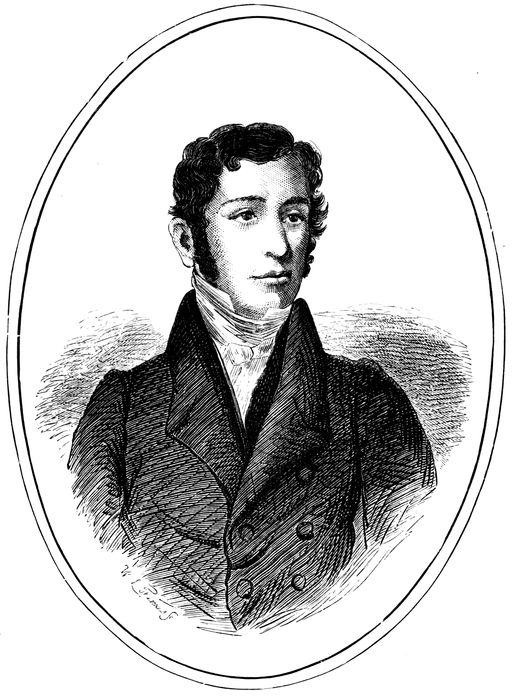
BARNEY AARON (“The Star of the East”).
505Ely Bendon, a good fighter and a game man, challenged Barney, and they met on Bow Common. As the P.C. ropes and stakes were not there the fight is not reported. Barney defeated Bendon in three-quarters of an hour.
Samuel Belasco, a brother of Aby and of Israel Belasco, and therefore of the family of “the fighting Belascos,” tried the quality of young Barney at the cost of defeat, as did Angel Hyams, a nephew of the celebrated Dan Mendoza. But the latter affair being interrupted by a magistrate at the seventh round was never brought to a conclusion.
Barney was now “somebody,” and anxious to earn a name, fame, and “monish,” so he went down to see the fights between Arthur Matthewson, of Birmingham, and Israel Belasco, and of Phil Sampson and Birmingham Hall, which took place on Moulsey Hurst on Wednesday, March 19th, 1823.
A purse was announced for a third battle, when Tom Collins (a 10st. 7lbs. pugilist, who afterwards fought Harry Jones) offered himself. There was a pause, when young Barney modestly stepped into the ropes as a candidate. The fighting was all in favour of Barney, who took astonishing liberties with the nob of Collins, so much so as to turn the odds from six to four against him to five to four in his favour. After half an hour’s sharp work Barney’s left hand was injured, and he was reluctantly compelled to discontinue the fight.
The exhibition however gained him immediate friends, and he was at once matched against Ned Stockman for £25 a-side. The battle was decided on the 6th of May, 1823, at Blindlow Heath, Sussex, after Peter Crawley had conquered Dick Acton. Stockman had for his seconds Eales and Dick Curtis; Barney was attended by Jem Ward and Rogers. The battle was gallantly contested for forty minutes and as many rounds, when Stockman gave in severely punished. He could not resist the resolute and heavy hitting of the Jew, and declared he had never met so good a man of his weight. This victory at once stamped Barney as a boxer of talent.
He was now backed against Lenney, who had seen some service in the P.R., and was known as a good and game trial horse, for £50. Their difference of opinion was decided on the 5th of August, 1823, on Harpenden Common, near St. Albans. Barney threw his castor into the ring under the care of Josh Hudson and Peter Crawley, for he had already gained the favour of the big ’uns. Lenney was advised by the learned and eloquent Harry Holt, while Davy Hudson followed on the same side.
THE FIGHT.
Round 1.—The attitude of Lenney was interesting; and he displayed himself to better advantage than usual. The Jew was in a great hurry to feel for his opponent’s nob; but Lenney said, “Wait a bit!” However, they soon went to work; Lenney had the 506worst of the milling, and also went down. (Six to four on Barney.)