Chapter IX · (continued 2)
Reading edition
“Had heard of battles, and had long’d
To follow to the field some warlike lord.”
When Shaw was a mere stripling, during the time he was fighting with a man three stone heavier than himself, at Woolaston, and in danger of being defeated, Jem Belcher, who was at Nottingham, suddenly made his appearance in the ring. That experienced hero went up to Shaw, and advised him how to alter his tactics so as to secure success. Shaw, learning that it was the renowned Jem Belcher who thus stepped forward to direct his efforts, felt inspired with fresh courage, acted promptly on the advice given him, and, in the course of a round or two, so turned the battle in his favour that he ultimately gained the victory in great style, and earned the praise of Jem Belcher. From this incident he attached himself to scientific pugilism.
Shaw possessed, in an eminent degree, many requisites for a first-rate pugilist. He was in height six feet and half an inch, weighing, when stripped, close upon fifteen stone; and he derived great advantages from repeated exercise with the dumb-bells, as a part of his military discipline; his continual practice of the broadsword also gave increased strength and elasticity to his wrists and shoulders. Discipline, too, had taught him coolness, in addition to a most excellent natural temper. He was introduced to the Fives Court under the patronage of Colonel Barton. In his first exhibitions he was considered rather slow; but from the frequent use of the gloves, in competition with the most experienced and scientific boxers, he rapidly improved. His height, length, weight, and strength, united with a heart 442which knew no fear, rendered Shaw a truly formidable antagonist. His public displays were considered far above mediocrity, and he felt great pride in getting the best of the then terrific Molineaux. In a trial set-to at Mr. Jackson’s rooms with Captain Barclay—who never shrunk from punishment, or hesitated in milling his adversary, scorning anything like the delicacy of “light play,”—the latter received such a convincing blow, that a dentist was called in to replace matters in statu quo. The best critics were satisfied he was a thorough-bred one, and it was proved to be very difficult to hit him without being returned on. In retreating he made use of his left hand with much effect, and was thought to fight something after the deliberate manner of Cribb.
In the neighbourhood of Portman Square our hero milled three big fellows in the course of a few minutes with comparative ease, for insulting him on the “stay at home” character of his regiment, at that time a favourite taunt of the vulgar. They were compelled to acknowledge their misconduct, and glad to cry for quarter.
Shaw’s first appearance in the P. R. was on Saturday, July 12, 1812, at Coombe Warren, with Burrows, a sturdy West-countryman, who had fought a good battle of an hour’s length with the tremendous Molineaux, when the athletic powers of the latter hero were undebauched and in full vigour; but, in the hands of Shaw, the West-countryman had not the slightest chance. In the short space of seventeen minutes, in which thirteen rounds were fought, the superior science of Shaw had so nobbed Burrows that he could not see his way, and he was led out of the ring. Burrows never once drew blood from Shaw, who quitted the field without a scratch.
Nearly three years elapsed before Shaw made a second appearance, during which period, it seems, from the considerable practice he had with the gloves, he was materially improved in science. On April 18, 1815, at Hounslow Heath, for a purse of fifty guineas, he entered the lists with one of the bravest of the brave, namely, Ned Painter. Victory again crowned his efforts in twenty-eight minutes, and he retired from the contest little, if any, the worse for wear. See Painter, Vol. II., Chapter III., p. 77.
It is certain Shaw had an eye upon the championship, for he now formally challenged all England. The amateurs were divided in opinion, but Shaw felt confident, in his own mind, that no boxer existed who could conquer him. Six weeks had scarcely elapsed after the above battle, and no time allowed for either Cribb or Oliver (who would not have suffered such a challenge to pass over unnoticed) to have an opportunity of entering the lists with Shaw to decide the point, when the Life-guards were ordered 443abroad, and Shaw soon found himself, with his comrades, on the plains of Waterloo. His heroism on that memorable occasion has been handed down to posterity in those glowing colours which real courage and love of country merit. Sir Walter Scott has thus sung the fame of Shaw:—
“The work of Death is done, yet still her song
In Britons’ praise the muse would fain prolong,
Would, were her power but equal to her will,
Swell to a mighty stream her slender rill,
Exalt her voice to praise each gallant son,
But chiefest thee, O godlike Wellington!
But who can count the sands? then might he name
The lengthen’d numbers of the sons of fame:
Nor ‘mongst her humbler sons shall Shaw e’er die,
Immortal deeds defy mortality.
Posterity shall read the glowing page
That paints the glories of a former age,
Then shall their bosoms burn with patriot fires,
And, if their country calls, they’ll emulate their sires.”
In “Paul’s Letters to his Kinsfolk,” Sir Walter, writing from Paris of the Battle of Waterloo, observes:—“Amid the confusion presented by the fiercest and closest cavalry fight which had ever been seen, many individuals distinguished themselves by feats of personal strength and valour. Among these should not be forgotten Shaw, a corporal of the Life-guards, well known as a pugilistic champion, and equally formidable as a swordsman. He is supposed to have slain or disabled ten Frenchmen with his own hand, before he was killed by a musket or pistol shot.”
The “science of the sword” was possessed by Shaw in a superior degree, which, backed by British strength and resolution, tended to secure the fortune of the day, in reducing the confidence of Napoleon’s hitherto invincible cuirassiers:—
“A desperate charge the cuirassiers oppose,
And thrust for thrust, and blows return for blows.
But still in vain the British sabres fall,
Whose strokes rebounded from a brazen wall.
At length more wary, with experience stor’d,
They now apply the science of the sword:
Just at the juncture of the arm and chest,
Where meet the mail-plates of the back and breast;
In gentle curve, they leave an opening way,
To fit the shape and give the shoulder play;
Some watch the moment while the uplifted arm,
Urg’d by a feint, protects the head from harm,
To reach, with lightning speed, the unguarded part
And through the opening penetrate the heart;
Some, skill’d with dext’rous art, deceive their foe,
Cut through the face and lay the opponent low;
Some at the breast-plate thrust with upward glides
Pierces the jaw, or else the neck divides;
And some, more quick, the unguarded throat observe,
Drive to the spine, and cut the dorsal nerve.”
It appears, on the first day, previous to the Battle of Waterloo, Shaw was 444wounded in the breast, and was ordered by his commanding officer to remain in the rear; but after the wound was dressed, and feeling little inconvenience from it, he nobly disdained to shrink from the post of honour, and on the 18th took part in the grand decisive charge. After having performed his duty towards his country in a giant-like manner, and exalting his character as a man and a soldier, he fell on the 18th of June, 1815, covered with glory.
It would appear, from the statement of the author of “Anecdotes of Waterloo,” that Shaw, though prostrated by a pistol shot, was yet alive on the morning of the 19th, but in articulo mortis, having received an immense number of lance-wounds after his fall from the French light-cavalry, armed Polish fashion, who galloped over the ground. A soldier of the 73rd gave the expiring hero a draught of water; but he was “past all surgery,” and soon afterwards expired without the possibility of removal to hospital.
“While martial pomps rise on the view,
And loud acclaim exalts the brave,
The tears of beauty shall bedew
The fallen victor’s laurell’d grave;
Flow, mournful flow, and sacred be the tear,
To grace the hero’s fall, whose bright career
Is clos’d in victory.”
“DULCE ET DECORUM EST PRO PATRIA MORI.”
GEORGE NICHOLLS, THE CONQUEROR OF CRIBB.
George Nicholls finds a niche here, principally from the circumstance of his early victory over the renowned Tom Cribb; his other fistic exploits, though numerous, not being of celebrity sufficient to entitle him to this distinction. Nicholls was one of the numerous offshoots of the Bristol school, and was born in that city in the year 1795. In the third volume of “Boxiana” Pierce Egan has given an account of twenty-five pugilistic engagements, but, like the exploits of heroes before Agamemnon, they find no record, save in his pages. The most remarkable of those are thus narrated.
At seventeen years of age George entered the ring with a man of the name of Hocky Harding. It was only for a guinea a-side, and it took place on Durdham Downs. Nicholls had for his seconds Applebee and George Davis. In forty minutes Harding was defeated, and the punishment he received was terrific. This latter boxer had gained considerable notoriety in having made a drawn battle, after a desperate fight with the celebrated Bill Warr.
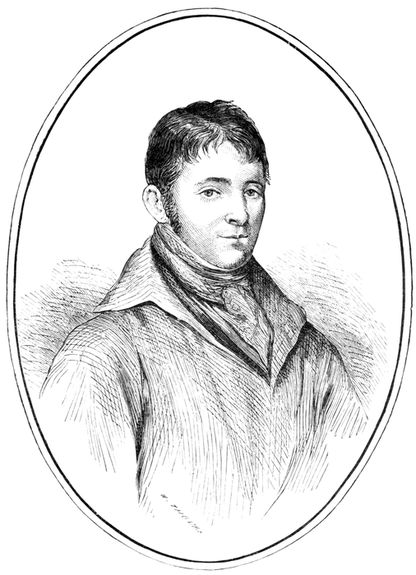
GEORGE NICHOLLS. From a Drawing by G. Sharples.
445A week after the above battle, the brother of Harding, anxious to have a turn with Nicholls, fought him on Durdham Downs for a guinea and a half a-side, but, in the second round, Harding, receiving an ugly knock, exclaimed, “I’ve had enough; George shall not serve me as he did my brother.” Applebee and Davis were also seconds to Nicholls on this occasion.
A sailor, who weighed thirteen stone, challenged Nicholls for a guinea a-side. This battle took place in the Back Fields, near Lawford’s Gate. The man of war was a troublesome customer, and did not give in till one hour had expired.
Bill Thomas, a butcher, of Chepstow, had so good an opinion of his milling qualities, that he sent a public challenge to Bristol to fight the best man in that city. Nicholls accepted the challenge without delay, and he also won it off-hand.
Leonard, the champion of Bath, was matched against Nicholls for five guineas a-side. Bob Watson and Tom Davis acted as seconds to our hero. This battle took place on Lansdown, the same day that Spaniard Harris and Bill Cox fought. The Bath champion was dreadfully beaten, and both his peepers were soon closed; while Nicholls received but a slight injury.
It is stated by Pierce Egan that Nicholls was victor in forty-nine battles out of fifty.
We will now quit these dateless records of Nicholls’s triumphs over the “illustrious obscure,” to come to his crowning achievement, the exploit which has preserved his name. It has been repeatedly urged that this overthrow occurred during the brave Tom’s noviciate; but he had previously beaten that renowned pugilistic veteran, George Maddox, Tom Blake, and Ikey Pig, all of them men of notoriety as pugilists. The success of these contests had rendered Cribb somewhat conspicuous, and he was rising fast into eminence and fame, when he entered the lists with Nicholls, for a subscription purse of £25, at Blackwater, thirty-two miles from London, on Saturday, July 20, 1805, made up by the amateurs, to compensate them for being deprived of witnessing the intended fight between the Game Chicken and Gully. Tom Jones waited upon Nicholls, and Dick Hall was second to Cribb. The odds on setting-to were greatly on the side of Cribb, who was the favourite; but Nicholls, aware of Cribb’s method of fighting, fought him after the style of Big Ben in his contest with Tom Johnson. Nicholls, like a skilful general, armed at all points, was not to be deluded by the feints of the enemy. The system of milling on the retreat, which Cribb had hitherto practised with so much success, in this instance failed. The coolness and good temper of Nicholls appeared so eminently throughout the 446fight, that not only did he preserve his fortitude, but added vigour to his judgment. Hence, both in attack and defence, the future champion found in Nicholls a steady and decisive fighter. Cribb became perplexed at finding his tactics foiled. The advantage he had derived in former contests by drawing his opponents, and then punishing and irritating them in their pursuit, so as to make them throw their blows out of distance, and consequently render them feeble, ineffective, and uncertain, was rendered entirely unavailing. George would not suffer Cribb to play round him, but, with a guard like Ben’s, firm in the extreme, his attitude was impregnable. Nicholls could never be induced to quit his position without putting in a tremendous hit, waiting with the utmost skill for the attack of his opponent, and then giving the counter with stinging severity. George scarcely ever failed in breaking through the defence of his adversary, and ultimately concluded the round with a knock-down blow. Nicholls was a tremendous hitter; and his one, two, rendered him truly formidable. The science and ability displayed by Nicholls in this contest completely astonished the sporting world, many of whom, in obtaining such knowledge, found that they had procured it at no trifling expense.
We have not met with any good or detailed account of this remarkable battle, and shall therefore add another report, which we find in “Pancratia,” pp. 237‒238.
“As so many amateurs had collected and come from town, a distance of thirty-two miles, to be present at this famous match, they were determined to knock up a fight, and Tom Cribb, the Black Diamond, who ranked very high as a pugilist, was matched against a man of the name of Nicholls, a Bristol man, and who, like Gully, had never fought on a London stage. The former was seconded by Dick Hall, and the latter by Tom Jones. At setting-to Cribb was the favourite, and odds were greatly in his favour. In the first round Nicholls, however, brought him down; but this was thought nothing of, as it was well known Cribb frequently threw himself back to avoid a blow. In the fourth round Cribb put in a most severe blow, and cut his opponent under the right eye. Nicholls still fought with great spirit, and perfectly cool and good-tempered. By the end of the twentieth round Nicholls had perfectly closed one of his antagonist’s eyes, notwithstanding he fought with great dexterity, and made several good rallies. At the end of the fortieth round Cribb appeared distressed in his wind; he, however, had somewhat recovered the sight of his eye, but began to fight very shyly, and shift: his blows were frequently short, and he several times fell back from his own hits. At the end of the fifty-second round he gave in, and the 447knowing ones were done, as they were sanguine of Cribb, even to the last. Nicholls was by all acknowledged a prime fellow: his superiority consisted of very expertly breaking on his adversary, in the style of Slack, by projecting his arm suddenly against his antagonist’s face when he swung forward to put in a blow. It has been asserted in the public prints that Cribb never has been unsuccessful throughout his pugilistic career; but this must be the consequence of ignorance on the subject.”
Nicholls now retired from the ring, and, returning to his native city, invested the money he had gained, and which had been somewhat augmented by the subscriptions of several patrons of manly courage, in a butcher’s shop, in Gloucester Lane, Bristol. Here he added another to the innumerable contradictions to those maligners of pugilism, who would identify it with ruffianism, by earning in a long life the character of a quiet, inoffensive, nay, a retiring man. In fact, all who remember him describe him as “shunning general company, rarely visiting a public house, and of a somewhat religious turn of mind;” the leisure time his business afforded him being occupied in angling, his favourite recreation. He died at his native place, June 6, 1832, in the fifty-eighth year of his age.
DAN DOGHERTY—1806‒1811.
As the name of Dogherty is continually found scattered up and down the reports of ring affairs for many years, and also in the pages of “Pancratia” and “Boxiana,” we shall devote a few paragraphs to a sketch of his ring career, chiefly from the latter work.
Dogherty’s first set-to was early in June, 1806, with a Jew, at Wilsden Green, where he proved the conqueror; and shortly afterwards, at the same place, on the 17th, he easily beat one Wall.
On Lowfield Common, near Crawley, Sussex, August 21, 1807, he conquered Dick Hall; and on his return home that day had a turn-up in the road with Jack Warr, whom he milled.
George Cribb he defeated twice. See George Cribb.
On Epsom Downs, Tom Belcher conquered Dogherty. See ante, p. 156.
Dogherty fought one Pentikin, a Scotch Baker, at Golder’s Green, Hendon, June 11, 1808, for forty-five minutes, when Pentikin gave in. Dogherty fought him forty guineas to twenty.
448At Moulsey Hurst, October 25, 1808, Dogherty fought with Jack Power for an hour and a quarter. It has been considered rather a disputed point, but Dogherty claimed it, and got the money. It should be remembered that Power was but a mere strippling at that period.
On Epsom Downs, February 1, 1809, Dogherty beat a turnpike man.
On the 18th of January, 1811, he met with a reverse of fortune in being defeated by Silverthorne, at Coombe Wood, but he was then considered in bad condition.
In November, 1811, he beat with considerable ease, at Chichester, Ben Burn.
Dogherty for a long time was engaged on a sparring excursion, not only in various parts of the kingdom, but also in the sister country. On Tom Belcher’s arrival in Ireland, the superior science of that pugilist having, it is said, taken from Dogherty a number of his pupils, a battle took place between them. On the 23rd of April, 1813, for 100 guineas, they decided the contest on the Curragh of Kildare, when Dogherty again fell beneath the conquering arm of Belcher. See ante, p. 160. This great battle is omitted from “Fistiana,” under Dogherty, though indexed under Belcher.
Dogherty, from this period, remained in his native land, where he taught sparring, and was known as a civil and active fellow: he was thus engaged as late as 1827. Pierce Egan tells an anecdote of him which we preserve.
Dogherty’s Duel.—Notwithstanding Dan’s penchant for the arbitrement of the fist, he accepted a challenge to fight with pistols, in order to place his opponent upon equal terms, he, it was urged, having no pretensions to boxing. It appears the meeting was a sort of hoax upon the combatants, as planned by the friends of both parties. The seconds, unknown to Dogherty and his opponent, merely put powder into the pistols. The adversary of Dogherty fired first, when the latter, forgetful of the “honourable” situation in which he stood, resorted to the scientific practice of the ring, by putting up his right arm as a natural stop to prevent the ball hitting his face, producing much fun to those who witnessed and contrived the duel.
449
GEORGE CRIBB, BROTHER TO THE CHAMPION OF ENGLAND.
Cribb and victory have so often been coupled, that in attaching defeat to the name we almost pause; but such is the case. While the champion, Tom Cribb, enjoyed the smiles of victory, and the patronage annexed to it, the junior hero, panting to emulate the heroic deeds of his warlike brother, encountered nothing but defeat.
George first entered the lists with Horton, near Bristol, for a purse of 50 guineas, on September 5, 1807, and notwithstanding the assistance of his brother Tom for a second, was beaten in twenty-five minutes.
On February 9, 1808, he was defeated by Dogherty on Highgate Common.
On the coast, near Margate, August 9, 1809, he entered the ring with Cropley, and was conquered in sixteen minutes. George did not let his opponent win without punishing him a good deal. It was considered an unequal match.
At a meeting of amateurs, May 1, 1810, at Bob’s Chop-House, after a sporting dinner, he again fought Dogherty, when Tom Cribb also seconded his brother. In this contest George proved himself a game man, and at times overcame the superior science of his adversary; but, at the end of an hour, Dogherty was the conqueror, and had the £20 purse. It was a severe battle.
George fought with Isle of Wight Hall, on November 15, 1810, on Old Oak Common, near Uxbridge, when the odds were six to four in his favour at setting-to; but, after a contest of one hour and nine minutes, he was reluctantly compelled to give in. He fought like a hero, and, although defeated, reflected credit on the name of Cribb.
After his brother Tom had beaten Molineaux, on September 21, 1811, at Thistleton Gap, he entered the ring, for a subscription purse of £20, with Ned Maltby, a Nottinghamshire lad. It was a determined battle for the time it lasted, thirteen rounds; but George was again not only conquered but severely punished. Maltby was not much the worse.
George, like his brother, was a slow fighter, but sparred tolerably well. In height, five feet eight inches and a half, and nearly eleven stone in weight.
450
SILVERTHORNE.
From his contests with Tom Belcher, Dogherty, and Burn, we are induced to mention Silverthorne. It appears that this boxer, who came out under the patronage of Caleb Baldwin, was a native of the county of Somerset, but not a Bristolian. From his style of setting-to, Caleb, no mean judge of such matters, formed a high opinion of his capabilities, and procured him patronage for a battle for 100 guineas, with Dan Dogherty, then in high repute. The battle came off at Coombe Warren, near Kingston, June 11, 1811, Caleb Baldwin seconding his protegé, assisted by Bill Gibbons. Dogherty was waited upon by Dick Hall and Power. We copy the report from “Pancratia,” pp. 353‒355. There is none in “Boxiana.”
THE FIGHT.
Round 1.—At half past twelve the men stood up. Silverthorne stood five feet eight inches, and weighed eleven stone two pounds; Dogherty, eleven stone eight pounds, five feet nine inches, so that there was not a great disparity. Both sparred with great caution. Dogherty tried a right-handed hit, but was short. Silverthorne returned sharply with the left. They rallied courageously, and exchanged hit for hit, until Dogherty went down on the saving suit. (Six to four on Silverthorne.)
2.—Dogherty was touched under the eye, but smiled and put in a blow on Silverthorne’s ribs that left a red mark. The latter returned at the nob, but hit round; another rally, and no best on either side. Silverthorne got Dogherty down.
3.—Both men went to work rather hurriedly, and were soon engaged in a desperate rally. Silverthorne stuck up, and though he threw away many blows by his round method of fighting, bored his opponent to every part of the ring. Dogherty exerted all his skill, and not unsuccessfully, on his adversary’s head, but being at length very weak, fell by a slight hit. (Seven to two on Silverthorne.)
4.—Dogherty bled freely; but he commenced a sharp rally, and put in a good body blow, which somewhat staggered his opponent. In endeavouring to repeat, Silverthorne dexterously struck him on the head and brought him down.
5.—Exactly as in the last round. Dogherty put in a body blow, and Silverthorne returned on the head. A rally, and Dogherty brought down his opponent for the first time by a severe blow on the head.
6.—A rally; Dogherty soon laid low.
7.—Dogherty, very gay, appeared first to his time, and successfully planted a good hit over the head. Silverthorne made play, seemed distressed, hit awkwardly, and received a severe right-handed facer. He still, however, bored in, and commenced another rally. Hits were exchanged for a minute and a half, each appearing totally regardless of blows. Dogherty’s superior science gave him the advantage, and Silverthorne at length fell through weakness.
8.—Silverthorne rallied. Dogherty threw in a good hit over his opponent’s mouth, but was afterwards knocked down.
9.—Both seemed distressed for wind, and sparred for some time. Dogherty put in a more forcible body blow than could have been expected. Silverthorne returned on the head and fell.
10.—Dogherty commenced a rally, and Silverthorne, by a tremendous blow, knocked him down.
11.—It was with difficulty Dogherty could be got off his second’s knee; he, however, went in with courage, and fought until knocked down.
12.—Dogherty was again brought to the scratch, and made play, although almost in a doubled state. The combatants managed a rally, but in a state of weakness perhaps unparalleled; they could stand, but although within arm’s length were incapable of hitting. Silverthorne, however, recovered, and knocked down his opponent for the last time.
The contest lasted twenty-two minutes. A pigeon was immediately despatched to Jem Belcher’s, but in passing over Wimbledon Common it fell a prey to the gun of some cockney spoil-sport. Both combatants were dreadfully beaten, and were immediately put to bed and bled. Silverthorne proved himself a worthy disciple of Caleb, and possesses that degree of strength which cannot fail to make him formidable to men of his own weight. Dogherty’s strength failed somewhat sooner than usual, which was attributed to indisposition.
451This remarkable success so elated Caleb and his friends that they at once proposed a match with Tom Belcher for 100 guineas. What came of this may be seen at pages 158, 159, ante.
Silverthorne, who bore the character of a steady, temperate, and well-conducted man, now publicly announced his retirement from the ring, in reply to a challenge from Dogherty, adding, he was resolved not to fight, “except when the necessity of the moment forced it upon him, when he hoped he should never be found backward to defend himself.” However, in 1812, at Coombe Warren, being provoked by Ben Burn, he departed from his resolution, and gave that boxer a thorough thrashing. From this time forth, though his name is sometimes mentioned, we hear no more of Silverthorne in the ring. In 1821 (May), we find the following in “Notices of Boxers who have retired from the P. R.”
“Silverthorne, once distinguished for his contests with Dogherty and Belcher. He is a teacher in a Sunday school, highly respected, and follows his business as a master fishmonger.”
JACK POWER.
With by no means first-rate qualifications, Jack Power is one of the examples of what personal popularity will do in exaggerating mediocrity into the foremost position. In the first volume of “Boxiana” many pages are given to Power, and in the second an obituary eulogium, from which we extract the salient points.
Power was born in London on the 8th of August, 1790, and descended from Irish parents. His father apprenticed him to a plumber, and Pierce Egan gives us the usual number of six-feet-two men, butchers, etc., who surrendered to “our hero” while yet a stripling.
Power’s first regular ring battle was with Dogherty, on the 25th of October, 1808, at Moulsey Hurst. This was the third battle on that day: the first being Tom Cribb’s victory over Gregson; the second, Tom Belcher’s conquest of Bill Cropley. The reporter simply says, “After a game battle of one hour and a quarter, Dogherty was triumphant.” Egan says, “Dogherty gave in three times during the fight; but Power being a new one, and Dogherty more experienced, it was managed in that sort of way, that the latter was pronounced the victor.” What this may mean we cannot 452tell, with “the Duke of York, the Marquis of Tweeddale, Lords Yarmouth, Craven, Barrymore, Brook, and Somerville, and Paul Methuen on the ground” (“Pancratia,” p. 322), and with Fletcher Reid as umpire.
Power’s next battle was with one Frere, April 1, 1809, which he won in twenty-one minutes.
Some ridiculous “turns-up” follow (“Boxiana,” pp. 458‒460), which we shall omit, to come to Power’s best fight, that with Joel King, for 50 guineas a-side, July 16, 1811, at Moulsey Hurst. The report is from “Pancratia,” pp. 360, et seq. “At twelve o’clock the combatants appeared. King, who was a new candidate for pugilistic honours, was accompanied by Richmond and Hall; Power attended by Bob Clarke and Paddington Jones. Odds, five to four on Power.”
THE FIGHT.
Round 1.—King attempted to plant a forcible right-hander; Power stopped him, and hit one two, left and right, well planted on the head and body. King fell. (First knock-down bets decided.)
2.—King did not appear intimidated; he again made play, and planted a good right-handed hit on his opponent’s throat; his left-hand fell short. Power with great quickness threw in a severe left-handed facer, and brought him down.
3.—A good rally, several blows well exchanged. Power scientifically planted one with the left hand. King returned with the right. They closed and both fell. (Two to one in favour of Power.)
4.—Power hit left and right, and King returned very forcibly in the throat. They closed, and Power threw his opponent again. (Betting two points more in favour of King than at setting to.)
5.—King planted a left-handed hit, but out of distance. He followed quickly with his right, which Power cleverly avoided. They closed, and Power threw King a cross-buttock.
6.—Both made play, King with his right, Power with the left, at the same instant; the former told on the head. Some good trying hits followed, and, upon the whole, the round was in favour of King: notwithstanding Power again threw him a cross-buttock. In doing this, with too much eagerness Power received a hurt on the right shoulder against a stake, which, if it did not disable him, proved a severe hindrance.
7.—In this round Power changed his mode of fighting, endeavouring to avert the punishing right-handed blows of his adversary, and getting away to hit.
8.—Power put in a good blow on the mouth, got away, repeated it, and gave an excellent specimen of science by repeating his blows, and avoiding his adversary’s, until King fell, bleeding copiously.
9.—King commenced a rally, in which he evidently had the advantage, throwing in straight right-handed hits with great dexterity. His superior strength gave him the advantage, but at length he received a violent cross-buttock.
10.—King’s face was much disfigured. Power put in a severe one two in the mouth, followed by a scientific hit on the throat, which brought King down.
11.—A good rally, and both fell.
12.—Another rally. Power hit his opponent, staggering away, with the right. King courageously renewed the rally, and returned his adversary’s hits with the gluttony of a Cribb, and at length succeeded in throwing him.
13.—Power, by another blow in the mouth, brought King again on the floor. Power continued fighting at points until he was scarcely able to administer the beating his adversary seemed to require to satisfy him. In the
26th.—Betting came to six to four; and although the left side of King’s head was a sorry sight for any feeling spectator to view, he still fought with such determined bravery as never can be forgotten by his enemies or too highly appreciated by his friends. At the expiration of the
46th.—When every one evidently saw he had no chance of success, he was urged, particularly by his backers, to resign, but still expressing anxiety for the continuation of the conflict, even in opposition to advice, he was allowed to go up, but merely to be sent down by a push. The token of surrender was made, and Power hailed the victor, after a game battle of fifty-seven minutes.
453In October, 1801, Power’s friends proposed a match with Tom Belcher, a deposit was made, but they thought better of it and forfeited.
Power now travelled through the provinces as a teacher of boxing. During this tour he ruptured a blood-vessel, and had a severe attack of pleurisy. Before his entire restoration to health, he imprudently suffered himself to be matched with Jack Carter for 100 guineas. The battle took place at Rickmansworth, Hertfordshire, November 16, 1812. Power was seconded on this occasion by the Champion, Tom Cribb; Carter by Bittoon and Tom Jones.
Pierce Egan says, “It would be superfluous to detail the rounds of this battle, which continued one hour and twenty-five minutes; suffice it to say that the conduct of Power this day was worthy all praise. Passing previously a restless night, afflicted with a cough, and somewhat nervous in his habit, he entered the ring under these disadvantages to contend against an adversary, his superior in height, strength, constitution, perfectly in health, and not deficient in pugilistic acquirements. It was a tremendous task, a daring attempt; and superlative science, and that alone, gave the victory to Power. It required something more than fortitude to act thus in opposition to nature, as well as considerable ingenuity in husbanding his strength to reduce his opponent to his own level. This Power effected, when he grappled with his opponent upon superior terms; his strength gone, and his science inferior, Carter was conquered with elegance and certainty. Upon no occasion whatever were the knowing ones so completely ‘out of their know.’ Carter, although defeated, showed that he was not without game; but Power completely astonished the most experienced of the Fancy.”
Power had a set-to with Richmond (see ante) at a sparring match at the Fives Court, on Dutch Sam’s benefit, soon after the above contest. Something about a white feather being mentioned, Power instantly mounted the stage, and addressed the spectators thus:—“Upon the day previous to the night when I fought Richmond I was following my business as a plumber, in making paint. The fumes of white lead are of so strong and poisonous a quality, that, to prevent any serious effects operating upon the constitution, we are necessitated to drink a quantity of castor oil; in addition to which I had been drinking, which rendered me then unprepared; but now,” said Power, “if Richmond can take out the white feather, as he pleases to term it, that I possess (stripping off his clothes), let him come up here, and I will fight him instantly for £50.” At his own benefit he again offered to fight Richmond.
Power’s excesses are thus leniently touched upon in “Boxiana:”—“In 454concluding this sketch, the most painful part remains to be performed. No boxer commenced his milling career with a fairer prospect to arrive at the top of the tree, or become a fixed star in the pugilistic hemisphere, than Jack Power; but, possessing a gaiety of disposition which could brook no restraint, the fascinating charms of company and the enlivening glass proving too powerful for his youth and inexperience to withstand, he plunged into excesses which induced premature debility. In this last battle, although gaining the victory, he endangered his existence. From being stripped in the open air for nearly an hour and a half, the severity of the weather afflicted him so seriously, that for several hours his frame did not experience the least warmth whatever, notwithstanding the best medical treatment was resorted to. His sufferings were acute, and he observed, ‘All the milling that he had received in the whole course of his pugilistic career was trifling in comparison with the pain he sustained on his return to a state of convalescence.’ He, however, was not long in returning to the metropolis to receive those congratulations which his noble courage had so justly entitled him to. The supporters of pugilism gave him a most flattering reception, so that Power’s time was principally occupied with the pleasures of society, and the enlivening charms of the bottle. Power was no churl, full of good humour in company, and his song was always ready when called for to support the cause of harmony.”
At a sparring exhibition which took place at the Fives Court soon after, when Jack merely looked in as a visitor, and Carter was present, several of the amateurs expressed a wish to witness a set-to between them. It proved a sharp contest; but the superiority was decidedly, in point of science, as in the fight, in favour of Power.
A public dinner, in honour of Power’s victory over Carter, took place at Mr. Davenport’s, the Three Pigeons, Houndsditch, when Jack presided, supported by Tom Cribb. Conviviality was the order of the day; and, upon the introduction of Carter, the behaviour of Power to his fallen adversary was attentive, generous, and manly, and he strongly recommended him to the attention of the fancy in general. Soon after this period he rapidly declined, and endeavoured to recruit his health by a journey to Oxford. It proved too late, and the last stage of consumption was reducing him daily. He witnessed the memorable set-to of Molineaux and Carter, and expressed himself astonished to hear it termed “fighting!” He returned to his dwelling in Plough Court, Fetter Lane, not only exhausted in person, but, to add to his afflictions, one of his children took ill and died. Mr. Jackson, ever attentive to the wants of brother pugilists, on being made acquainted with his peculiar 455situation, instantly made a collection for him among the patrons of the science. His disorder was so flattering that, at times when his spirits were good, he would observe, “Let me get but a little better, and I’ll show the lads how to fight; many of those that pretend to teach it scarcely know anything about the sound principles of milling—they are only sparrers.”
Power departed this life June 2, 1813, at the early age of twenty-three, and lies interred in the burial ground of St. Giles’s-in-the-Fields. He was in height about five feet nine inches and a half, and in weight twelve stone. He turned out several good pupils.
WILLIAM NOSWORTHY, THE BAKER.
As the conqueror of the renowned Dutch Sam, albeit in the day of his decadence, the name of Nosworthy is preserved from oblivion.
In his boyish days, Nosworthy, it appears, was not altogether unknown in Devonshire, both as a wrestler and pugilist. He was born at Kenn, a parish in the hundred of Exminster, of respectable connections, on the 1st of May, 1786. He was of an athletic, prepossessing appearance, and extremely well made. In height five feet six inches, and weighing about eleven stone. In disposition he was cheerful, good-natured, and inoffensive; but in the ring Nosworthy was a glutton of the first mould. Several sporting characters denominated him the “Young Chicken,” from some likeness he bore to the celebrated Hen. Pearce.
“The historian” having given us the usual “servings out,” “polishings off,” etc., of unknown opponents, judiciously omitted by the compiler of “Fistiana,” brings Nosworthy to town. Here it appears that “the Baker” attended a Devon and Cornwall gathering of wrestlers, and was matched against one Pentikin, whom he threw.[165] The defeated wrestler offered to post a guinea and thrash Nosworthy for the stake. The contest took place on the 3rd of May, 1808, in Pancras Fields. Nosworthy was seconded by Tom Jones and Bill Ryan. The superiority was evidently on the part of Nosworthy for the first twenty minutes, Pentikin being milled in all directions. It was presumed that, had the fight continued without any interruption 456victory was by no means doubtful on the side of Nosworthy, who had, at this period of the battle, considerably reduced the strength of his opponent. But Nosworthy was here representing a county partisanship of Devon versus Cornwall, and was moreover unknown in comparison to Pentikin. The ring, it is said, was broken in consequence, much confusion ensued, and some delay occurred before the combatants could appear in a new ring. The contest was renewed with increased ardour, and Pentikin appeared more fresh from the delay. Reciprocal fighting continued for one hour and twenty-five minutes, when Nosworthy was reduced to insensibility, and carried off the ground by his brother. The game he displayed was highly praised. Pentikin, although the conqueror, could not be induced again to face his fallen adversary, and forfeited three times to Nosworthy.[166]
After some irregular battles the bakers of the metropolis, looking upon Nosworthy as a leader in their sporting circle, a match for ten guineas a-side was made between him and Barnard Levy, a Jew, which took place at Golder’s Green. Levy was known to be a good man, and proved himself deserving of that character throughout the fight. Nosworthy was not in condition, and the Jew maintained an evident superiority for the long space of two hours. The game displayed by the Baker astonished every one present—he fought undismayed, and showed himself a “taker” of no common mould. Notwithstanding the punishment the Jew had administered, he could not take the fight out of him, and at length became exhausted. Nosworthy, contrary to all expectation, appeared refreshed, and finished the Jew in high style during the last twenty-five minutes. From this conquest the Baker gained ground. The fight lasted two hours and twenty-five minutes.
Martin, an active lively boxer, and much fancied by his own people, the Jews, was now pitted against Nosworthy for a purse of 25 guineas, at Moulsey Hurst, on the 29th of March, 1814. High expectations were formed of the pugilistic talents of Martin, but the Baker soon put his skill and manœuvres at defiance. Joe Ward and Paddington Jones seconded Nosworthy, and Little Puss and Jacobs attended upon Martin. It was two to one in favour of the Jew previous to the battle, betting brisk.
THE FIGHT.
Round 1.—On setting-to considerable expectation was formed as to the talents of the Jew, who commenced with much gaiety; but Nosworthy planted a tremendous hit on Martin’s mouth, which not only drew a profusion of claret, but he went down.
2.—The Jew, more cautious than heretofore, sparred for advantage, but ultimately he was again floored. (The two to one had 457now all vanished, and even betting was the truth of the matter.)
3.—Nosworthy began to serve the Jew in style, and his hits told tremendously. Martin made a good round of it, but fell rather distressed. The dead men now opened their mouths wide, and loudly offered six to four on the Master of the Rolls.
4.—Martin, with much activity, planted a good facer; but Nosworthy again finished the round in high style.
5.—The Israelite’s nob was peppered, and his body also much punished; and Nosworthy, with great severity, hit him right through the ropes. (Seven to four on Nosworthy.)
6.—It would be superfluous to detail the remaining rounds. Nosworthy had it all his own way, notwithstanding Martin resorted to his old method of falling, to tire out his opponent. In thirty-six minutes the Jew was completely defeated, and Nosworthy increased his fame as a boxer.
After some minor affairs, we come to Nosworthy’s great match with the Phenomenon, Dutch Sam. Pierce Egan expends pages of wonderment, conjecture, and exclamation on the fact that a strong, young, resolute man, and a good boxer withal, should have beaten a gin-drinking stale pugilist, who would not even train for the battle. We now come to the report.
Five years had nearly elapsed since Sam had exhibited in the prize-ring. The curiosity to see him once more display his great pugilistic skill drew together an unusual number of spectators. Neither bad roads nor torrents of rain could check the interest excited by this battle. Vehicles of all descriptions for weeks before were put in requisition to reach the destined spot, and pedestrians out of number were not dismayed in tramping through thick and thin for sixteen miles. The vast collection of carriages on the Hurst excited the astonishment of every one, and some hundreds were on the spot who did not even see the battle. Several marquees were erected for accommodation. The sum to be contended for, in a twenty feet ring, was £50 a-side and a purse given by the Pugilistic Club of 25 guineas. At a few minutes before one Nosworthy entered the ring, attended by his seconds, Bill Cropley and Silverthorne, and was loudly cheered for his confidence, in daring to face so acknowledged a boxer as the Jew. Sam soon followed, and received every mark of gratifying attention from the surrounding multitude. Ben Medley and Puss were his attendants. A heavy shower of rain could not delay their thirst for fame.
THE FIGHT.
Round 1.—On the combatants approaching each other, and shaking hands in the usual way, the difference of person was so manifest that an ordinary spectator must have given the preference to the Baker, from the roundness of his frame, the firmness of his step, and the cheerfulness of his countenance. He must have been a novice, indeed, not to have discovered the wretched condition of Sam upon his throwing off his clothes. His ribs were spare in the extreme; his face, which hitherto had assumed such a formidable aspect, and his fierce eyes that seemed upon similar occasions to have penetrated into the very souls of his opponents, appeared clouded with doubt and anxiety. It was altogether a different frontispiece. Dejection, arising from dissipation, was marked strongly on his features. As for his legs, as if Sam had anticipated that they might tell against him, he, for the first time in his life, preferred fighting in gaiters and breeches. The tout ensemble portrayed, a worn-out man rather than a boxer entering the prize-ring, 458prepared to vanquish youth, health, and strength. But all these objections were as a feather in the scale against the Jew. Weather could not affect him; no one could punish him; he hit as hard as Cribb; he was no mannerist; he set-to a hundred different ways; he altered his mode of fighting as circumstances required. Many seemed really to think, and plenty were forward enough to urge, that Sam was as well, if not better, without training, than undergoing the systematic precaution of invigorating the stamina. In short, he was the phenomenon of the fighting world; everything but a losing man. The recollection that he had beaten all the best men for a series of years that had been pitted against him, gave a double confidence to these sanguine opinions; and what was Sam now called upon to perform at the top of his glory? Why, to enter the lists with a boxer, who, to say the best, was but of considerable obscurity. Who for a moment would listen to a comparison made between Nosworthy and the hardy and brave Champion of Westminster, who had fallen beneath the conquering arm of Sam? or with that truly elegant scientific pugilist, Tom Belcher, who had twice surrendered up his laurels to this distinguished Jew. Cropley too, who ought never to be mentioned without praise, ranking as a superior scientific boxer, was tremendously beaten by him; and his last antagonist, Ben Medley, possessing sound fighting pretensions, true game, and science, was reluctantly compelled to acknowledge his vast superiority. The renowned Dutch Sam was once more before his friends; and his fanciers were so confident of his adding another laurel to his brow, that bets to an extravagant amount were loudly offered. To have named the Baker as having anything like a chance, was out of the question; but, at this period, to have proposed an even bet that Nosworthy won, would have been laughed at, as betraying a total ignorance in matters of sport. Such was the state of things upon the combatants facing each other; and the great superiority of the Jew was expected to be witnessed every instant. The decision was near at hand, and the Baker, eager to commence the attack, displayed more of valorous spirit than scientific precision. In making play, his distances proved incorrect, and two blows fell short. Sam gained nothing by this opening. Nosworthy, full of resolution, followed up the Jew, appearing rather too rapid in his manner to take any particular aim, and seemed to prefer going in, to trusting to those advantages that are sometimes obtained in sparring. Sam made a slight hit upon the Baker’s nob, but ultimately went down.
2.—The eagerness of the Baker appeared to supersede every other consideration. He again hit short; but Sam did not miss this opportunity, and returned right and left, drawing the cork of the Master of the Rolls. Nosworthy, it seemed, had made up his mind to smash the Jew, and, in his haste to get at Sam, slipped and fell.
3.—The Baker, determined in his mode of warfare, resolutely made up to Sam, but the Jew warded off the force of the blows with much adroitness. Nosworthy received a hit from Sam, and went down, but his fall was attributed more to the slippery state of the turf than to the severity of the blow.
4.—This round commenced with severe fighting, and much activity was displayed on both sides. Some good hits were exchanged. The Baker drove Sam before him to the ropes, and here it was that Nosworthy showed his superiority by putting in three tremendous blows. Sam fell, evidently distressed, and his breath was nearly hit out of his body, by a terrible blow he received upon his breast. His friends, however, thought that his conduct was a mere ruse de guerre. In fact, nothing could shake their opinion that the Jew was playing a sure game, by letting the Baker make the most of his strength, in order that, at a more advanced stage of the battle, he would become exhausted, when he might be easily “kneaded” to answer the purpose of the Israelite.
5.—It was in this round that Sam found out what sort of a customer he had to deal with. He was also convinced, too late, that the chance was against him: he could not resist the hardy blows of the Baker, nor had he room enough to get away from him. Sam’s hits produced no effect upon the courage of Nosworthy, who went in in such an unusual manner to anything the Jew had experienced with any of his other competitors, that he was confounded. His wonted fortitude seemed to have deserted him, and dismay taken possession of his mind: he went down quite exhausted. But however Sam might feel that he was sent down against his will, it did not appear in that light to his backers, who generally looked upon this as nothing more than artifice of the Jew to weaken and tire out his adversary. A few persons who were not quite so infatuated with the appearance of things, hedged off a little of their four to one. Some others ventured upon even betting; but this latter circumstance was by no means general.
6.—Sam was scarcely upon his legs and set-to, when Nosworthy put in a blow that sent him down.
7.—The Baker, always ready, proved himself a resolute and skilful boxer. He did not wish to lose time by any useless display of scientific attitudes. The proud name of Sam proved no terror or drawback to his exertions: he went in with as much gaiety as if he had been only contending with a novice, instead of fighting with a boxer who had performed such wonders in the pugilistic annals. Nosworthy planted some good blows, and the Jew was again down on the turf.
4598.—The science of Sam was conspicuous in this round, but the strength of his opponent was not to be reduced. The Jew put in some good hits in a smart rally, but he could not divert the Baker from his purpose, and Sam went down again much exhausted.
9.—Nosworthy commenced this round with his usual spirit, by driving Sam again to the ropes, where he punished him severely. Sam, notwithstanding, planted some hard blows, but the impetuosity of the Baker carried all before him. The best efforts of the Jew, however well directed, seemed as useless as if he had been trying to stem a torrent. At this period the deeply-interested ones perceived something in the Baker they had not expected. That a chance must not be thrown away when four to one had been betted. A bustle now commenced, and the outer ring was broken. The populace pressed heavily against the roped ring, bearing down all opposition to keep them off, and many persons crossed the ropes, to the confusion of the combatants. However we might be disposed to attribute this disorder of the ring as the effect of accident, owing to the great concourse of spectators, to what account can we place the conduct of a strong man endeavouring to force out of the ground one of the stakes which supported the ring, and which attempt was only prevented by the manly interference of the Champion of England? Nosworthy appeared at the mark, and called out to Sam to observe he was ready, but the Jew declined setting-to till the ring was cleared out. It may not be improper here to remark that, if Sam had decidedly felt in his own person he was, or must be eventually beaten, if he continued the contest, it is natural to infer that he would have saved the money of his friends by taking the advantage of this interruption in making at least a drawn battle; but the Jew wished to fight it out. In clearing out the ring, the confusion beggared all description. The whips and sticks were laid on heavily. In the course of about twelve minutes the desired object was attained, when the combatants once more commenced operations.
It would be superfluous to detail the remainder of the rounds, in number thirty-eight. Complete sameness pervaded the whole of them; and Sam, who had hitherto portrayed the hero, now scarcely exhibited the traits of a second-rate pugilist. The ferocity which had so terrified his opponents was no longer visible; indeed he exhibited weakness and distress early in the fight. It is curious to remark that he never once knocked down Nosworthy; but, on the contrary, was either floored or went down every round, with the exception of about three. Still the friends of Sam, and particularly those denominated “the flash side,” relying on his experience and judgment, flattered themselves it was all right, that he was aiming to bring down Nosworthy to his own pitch, to obtain any conquest, and give a good opportunity of betting. But they wofully deceived themselves; the wished for change never arrived.
Remarks.—Nosworthy proved himself a confident boxer. If his movements were not equal to the scientific precision of Tom Belcher, his undaunted resolution and courage, from the commencement to the termination of the fight, reminded many of the spectators of that peculiar forte of Bill Hooper. The Baker was a two-handed hitter, and seemed perfectly awake to the business before him. From this mode of attack the debilitated Jew stood no chance whatever. The strength of Sam, once so much the theme of his backers, was missing, and he appeared a mere shadow of his former self. He could not knock down Nosworthy, or even hit him away. This defeat of a great favourite may operate as a useful lesson: youth and strength must be served; and never was the position more clearly and decisively shown than in this instance. Sam was turned of forty-one years of age, and his irregularities of life must have dilapidated as fine a constitution as was ever possessed by man. His opponent, a young man of twenty-eight, was in good health, of great strength, and weighed a stone and a half more than the Jew; besides, we are to take into the scale that Nosworthy was not destitute of skill, and possessed unimpeachable bottom, which had shown itself in all the battles he had fought. But calculation was out of the question. The game of chance, even, was completely lost sight of. “To a certainty, to a certainty,” was the cry of nearly the whole of the fancy; and any opinion expressed in favour of the Baker was instantly silenced by four to one, treated as a want of judgment, and laughed at with derision and contempt. Upon Sam’s resigning the contest, a general consternation took place among the backers of the hero. If the Jews were weighed down with grief, the Christians were equally miserable and chapfallen at this unexpected defeat. So complete a cleaning out, it is supposed, had not taken place in the boxing world, since the conquest obtained by Slack. It is computed that, in different parts of the kingdom, £100,000 at least were lost upon this battle. In the dismay of the moment, the exclamations of the losers were loud and vehement. “’Tis impossible!” said many. “It must be a cross!” The combatants did not appear to be so much punished as might have been expected. But the case was altered; instead of giving, as heretofore, Sam now received punishment. Sam must have suffered terribly from the repeated knock-down blows he experienced; but his frame was of so close a texture that it did not exhibit marks of punishment like most other men. This was an important point towards victory on his side, by disheartening his antagonists, who, however they might mill him, could not see the result of their efforts, from Sam’s 460appearing fresh and unhurt. Had Sam properly attended to his training, had he viewed the consequences of the battle in the light of an experienced veteran, bearing in mind that he had everything to lose, and but little to gain, the sequel might have proved different. His experience and judgment should also have pointed to him, that youth, strength, science, and determined resolution were not to be disposed of as matters of course; that it was not a mere sporting article he had to pink for his amusement—one who had presumptuously dared to enter the lists against so mighty and renowned a chief. Some caution, it might be presumed, was necessary when it was also known to him his antagonist was above a novice; that Nosworthy was an energetic boxer, aspiring to reach the top of the tree. But the conquests of Sam had made him forget himself. Fame and flattery had cheated him. The whole race of pugilists viewed him as a phenomenon, and impressed with this character, it should seem, latterly, that poor Sam “had crept so much into favour with himself,” that he vainly imagined he had only to appear in the ring, and his name alone was sufficient to vanquish any pugilist who might have the temerity to oppose him. He at length fell a victim to “self-conceit” and ill-timed flattery.
The fame which Nosworthy earned on this occasion led to several challenges, among others to one from the renowned and hardy Scroggins, which he accepted, and they met on June 16, 1815, at Moulsey Hurst. The details of this battle will be found in the Life of Scroggins, p. 416, who was on this, as on many other hard fought fields, the conqueror. His friends attributed this defeat to bad condition; but the truth seems to be that in Scroggins, Bill Nosworthy met a miller of his own stamp.
Bill was afterwards matched to fight George Curtis, but the latter paid forfeit from ill-health.
Nosworthy felt his defeat by the hardy little tar, and never recovered his usual spirits. Dissipation and excessive drinking hurried him into a consumption, and in the last stage of this frightful disease, he, with the assistance of a few friends, left London for Lympstor, in Devonshire; but, in October 26, 1816, while resting at Exeter, he received his final knock-down, scarcely surviving the Jew three months. His connections in Devon were very respectable, and his manners, until depraved by excessive drink, pleasing, while his appearance was prepossessing.
BEN BURN (“UNCLE BEN”)—1810‒1834.
There was nothing in the pugilistic exploits of the first of the Burn family (“Uncle Ben,” as he was afterwards termed, on account of the higher merits of his “nevvy”) to deserve particular record. He was well known as a sparrer with the “big ’uns” at the Fives Court, a match-maker, a second, a ring attendant, and a sporting publican. He beat J. Christie on Highgate Common, January 1, 1810, for 40 guineas. Fought Flanagan for 100 guineas, 461March 27, 1814, whom he also defeated. His after fights were with Dogherty, Silverthorne, Palmer Jones, Tom Spring, and Tom Oliver, by all of whom he was beaten. He also had a set-to with “Gibletts” (Charles Grantham), whom he beat in twenty minutes in a room fight in Bow Street, June 13, 1821. His last appearance (which is omitted under his name in “Fistiana”) was with Old Tom Oliver, in 1834, who defeated him at Hampton in six rounds, twenty-four minutes, for £25 a-side, as will be seen under the Memoir of Oliver.
HARRY HARMER, THE COPPERSMITH—1812‒1815.
This scientific pugilist was allied to the family of the Belchers, and was born in the place known as the Horse Fair, Bristol, in 1784. His sparring was for many years the theme of admiration. His height, five feet eight inches and a half; his weight, eleven stone and a few pounds. It does not appear that Harmer, although reared in the hot-bed of pugilists, exhibited in any public scientific contest previous to his arrival in the metropolis.
The superior style he displayed in his first battle with Maltby, the latter having vanquished George Cribb and Cope, brought Harmer into notice with the admirers of pugilism. With Jack Ford, in his second contest, he also rose a step higher; and in his third and last battle, with Shelton, he established his reputation as a game and first-rate boxer.
Harmer entered the lists with Maltby on Thursday, June 12, 1812, at Wilsden Green, for a purse of £25 guineas. Maltby was the favourite six to four, and nearly a stone heavier than Harmer, who was a stranger to the ring. Tom Jones and Cropley seconded Maltby, and Belcher and Richmond attended upon Harmer. At one o’clock the men set-to.
THE FIGHT.
Round 1.—Both the combatants seemed intent on fighting, and began without ceremony; they, however, soon disengaged from a close, and Harmer, with great dexterity, planted a severe right-handed hit on one of Maltby’s peepers without receiving any return. Maltby, with much determination, fought his way into a close, and, in a trial of strength to obtain the throw, they both fell, Harmer uppermost. (The odds rather lowered, and Harmer became attractive.)
2.—Harmer commenced in grand style, and planted a left-handed blow upon Maltby’s nose, which, added to his already damaged eye, changed the appearance of his face. A desperate rally occurred, and hit for hit took place, when Maltby was floored from a severe blow on his forehead. (The partizans of Harmer began loudly to applaud, and offered five to four upon his winning.)
3.—The men were both on their mettle, 462and considerable execution was done on both sides. Maltby stood up like a hero, and satisfied the spectators he had not a particle of flinching in his composition. A rally ensued, and much reciprocal hitting occurred. The right hand of Maltby punished Harmer’s body so severely that, from one tremendous hit, he went staggering away like a drunken man; but the latter, to the astonishment of the ring, returned hastily upon his opponent, and, in a finishing style of execution, Maltby went down. It was now seen that the reach of Harmer gave him the superiority, and his friends sported the odds without hesitation.
4 to 15 and last.—At this early stage of the fight Maltby was reduced. Harmer made play in every round, and kept the lead in gallant style. From the quickness of Harry, he literally beat his man stupid. Maltby contended, in the most determined manner, for thirty-seven minutes, when nature was so exhausted, that he was carried out of the ring by his seconds.
From this manly specimen Harmer became the object of considerable conversation in the pugilistic circles; his length, quickness, and punishing hitting deterred a few of the fighting men from entering the lists with him, till Jack Ford was matched with him for a purse of 25 guineas.
This battle took place on the 23rd of August, 1813, a mile to the eastward of St. Nicholas, in Kent, upon the land of Mr. Neale, a Kentish yeoman, a short distance from Margate. The veteran Joe Ward and Hall seconded Harmer; Paddington Jones and Clark attended upon Ford.
THE FIGHT.
Round 1.—Harry commenced fighting with great confidence by making play right and left, but without much effect, Ford having stopped and returned. In closing, they both went down. The betting, which had been previously rather high upon Harmer, was now rather reduced, it appearing that Ford would not let his nob receive that severe punishment which Harmer had dealt out so liberally upon Maltby. (Five to four upon Harmer.)
2.—A good rally, and both the combatants upon their mettle. Ford most conspicuous, but did not like the right hand of Harmer. Strength on both sides was resorted to in falling; but the advantages in this round appeared on the side of Ford.
3.—The right hand of Harmer got into work, and the forehead of Ford received a severe taste of his quality. The game of the latter, however, was not so soon frightened as to deter him from attempting to adopt his favourite mode of in-fighting; and several teasers did not frustrate Ford from boring in upon his adversary, yet he still lost by comparison, and was thrown.
4.—The truth must be told: the bad training of Ford could no longer be concealed. His wind was treacherous, and he was sparring to gain time; but he guarded himself so scientifically, that a short time elapsed before any opening occurred whereby Harmer could derive any advantage, when he at length put in a heavy body blow on his opponent, and Ford, with considerable dexterity, returned a “sender” on the head of Harmer. Equality was preserved in this round; but Ford went down from a terrible blow. (Brisk betting upon Harmer two to one.)
5.—Ford, full of pluck, rallied with spirit, slashing away without any care respecting himself; and Harmer was no ways behind hand in hammering his opponent. Their hitting told, and the round was not terminated without considerable execution being manifest. Harmer threw Ford. Weakness now appeared on both sides.
6.—Harmer received a severe hit in the body and went down.
7.—In going in to rally, Harmer was repulsed by Ford, when the latter for a short period had the best of the milling. On getting near the ropes, Harmer got Ford’s nob under his left arm and fibbed him so terribly that he was glad to put an end to it by falling through his hands. Harmer was now the favourite in every point of view.
8.—Ford, always brave, showed he was determined not to lose his character, and the fortitude he exhibited in this round claimed universal praise. Punishing without ceremony took place upon both sides; and the right hand of Harry, from a terrible hit he planted upon Ford’s eye, was much injured. The combatants stuck to each other hard and fast, pelting away in all directions; but the strength of Ford was leaving him, and he held by the ropes, where the mastery of Harmer was evident, by holding up his opponent with his left hand and with his right putting in some weighty blows. The 463betting amateurs were now satisfied it was all their own way, and offered to lay any odds upon Harmer.
9.—Ford had now received so much severe punishment that it was evident he was losing ground rapidly. He had given such decided specimens of game in his other contests, that it was well known he would not relinquish fighting while anything like a chance remained. He therefore summoned all his courage to get a turn in his favour, but was reduced to that state where superior science and strength must be served. Ford, from one leg being shorter than the other, fought under peculiar disadvantages in this respect, and when retreating, it appeared very conspicuously. It now appeared that he fell without a blow, but it was owing to this defect.
10.—Humanity of character should never be forgotten, and it ought always to be recorded as an example to other pugilists. Ford was in an unfortunate situation against the ropes, where a blow must have finished him; but Harmer nobly disdained to take any advantage of a brave competitor while a more manly path presented itself; and he never could show manhood in a finer style than in walking away and leaving Ford to go down himself.
11.—Harmer now punished his antagonist with ease and address till he went down, and Ford was more enfeebled every round; but, notwithstanding the milling he met with, he could not be prevailed upon to give in until the twenty-third round, when he was completely told out.
Remarks.—Ford, although defeated, showed that his pretensions to boxing were good and scientific, and that he was not to be got at without some difficulty. The importance of training does not seem to operate on pugilists in general; or, if they do understand its value, it should seem that, in too many instances, they do not strictly comply with its regulations to obtain those essential requisites toward victory—sound wind and good condition. It was evident that Ford suffered considerably from this neglect. As an in-fighter he was able to do considerable execution, but the length of Harmer was too much for him. With Oliver, Ford contended for two hours and ten minutes; and, notwithstanding it was thought that he had generally improved, yet with Harmer he was disposed of in thirty-five minutes. Ford’s body exhibited some severe marks of punishment, and he was bled before he left the ground.
Harmer, after a year and a half had elapsed, was matched with Tom Shelton, the navigator. It may not be improper to premise the occasion of this battle. Shelton was introduced at the Fives Court, and ascended the stage with Harmer, at Cribb’s benefit, on May 31, 1814, as a complete novice. Shelton appeared determined for a downright mill, and attacked Harmer furiously, endeavouring to show his abilities. Harry, with skill and dexterity, parried off his strength, and put in some touches that drew forth the claret. To call it sparring would be erroneous, it was complete roughing. The impetuosity of Shelton was astonishing, and it was also curious to observe the decided mode in which Harmer drove the former away from him. During the contest Shelton was so sharply met by his antagonist, that he turned completely round twice, and recommenced his attack. The science of Harmer, however pre-eminent, was not enough to convince Shelton of his superiority, and it at length became necessary for Harry to add strength to his efforts to abate the rushing of his opponent. Harmer, at arms’ length, gloved him severely, but, upon Shelton rushing in to mill, Harry got his nob under his left arm, and with his right hand fibbed him so tightly that, to prevent its proceeding to an actual fight, it was deemed prudent that no more such sparring should take place between them in the Court. This was Shelton’s first appearance; and, from the spirit he displayed, he was much fancied by several of the amateurs. An opinion was entertained that he only 464wanted a better knowledge of boxing, in addition to his other requisites, to make him a dangerous customer for any of his weight. In the course of a twelvemonth he acquired considerable science; and, notwithstanding the character Harmer maintained as a first-rate boxer, the capabilities of Shelton were not viewed with indifference by many of Harry’s friends. The match at length being made for 100 guineas, it created considerable interest in the sporting circles, and on Tuesday, April 18, 1815, they met, in a twenty-four feet roped ring, on Hounslow Heath, near the rivulet which divides the heath from Twickenham Common. Shelton was the heavier man by some pounds. Seven to four on Harmer eagerly taken by the friends of Shelton. The spectators were exceedingly numerous. Richmond and Oliver were for Shelton, and Tom Belcher and Bill Gibbons with Harmer. At one o’clock the men shook hands and set-to.
THE FIGHT.
Round 1.—The determined quality of Shelton was well known to the amateurs, and great anxiety was manifested. The navigator, eager to commence fighting, endeavoured to plant two left-handed blows, but his distance proving incorrect, Harmer floored him in a twinkling, and the claret was visible upon his face. (Loud shouting, and two to one freely offered against Shelton.)
2.—The Navigator, from his eagerness to do something, again hit short, as did Harmer in returning. The men now got into a sharp rally, when Harmer, from a slip, fell down upon his knees, and received an accidental blow from the suddenness of his situation. “Foul!” “Fair!” was vociferated, but the umpires knowing the real state of the case, the battle did not suffer the slightest interruption.
3.—This round was resolutely contested on both sides, and the combatants, in a tremendous rally, exchanged hit for hit with a firmness that claimed applause from all parts of the ring. Harmer, in point of quickness, put in the most blows, and finished the round by sending his man down. (It was current betting five to two upon Harmer.)
4.—Good reciprocal boxing, when, in closing, Harmer was thrown.
5.—Shelton, full of gaiety, made play, and Harmer, from a slight hit, was again on the ground.
6.—The science of Harmer was seen to much advantage in this round. From the Navigator’s hitting short, he received tremendously left and right from Harmer, and was ultimately floored. (This changed the betting again, and seven to four was sported upon Harry.)
7.—The blows upon both sides were so hard and fast as not to be described. It was a long round, and Harmer went down rather distressed.
8.—The time appeared to be called rather too quick for both men, as both showed symptoms of distress. Some sparring occurred, when Shelton was missing in an instant: he received a blow under his left ear, and he appeared stunned, lying on the ground.
9.—It was astonishing to see with what pluck Shelton again met his man. Another desperate rally took place, at the end of which Shelton went down.
10.—Some good blows exchanged, and both down.
11.—The Navigator was on the grass from a slight hit.
12.—A short round, and Shelton thrown cleanly by his adversary.
13.—Both the combatants were no strangers to the hammering they had received. However, they got into work, and desperation seemed the order of the round. Harmer manfully strove to take out the fight of his opponent, while the latter seemed to have that precise object in view. It was hard work on both sides; but the round closed to the advantage of Shelton, who sent Harmer down. The head of the latter unfortunately, in falling, came in contact with a stake.
14.—The appearance of Harmer was against him on coming to the scratch; and none but an extraordinary man could have returned so quickly to have commenced the round. His right hand appeared also to have given way, and some alarm was felt from this circumstance. Harmer went down from a slight hit. The backers of Harry were rather puzzled, and the partizans of Shelton now boldly offered six to four upon him.
46515.—Affairs were materially changed. Shelton was now decidedly the favourite; he again sent Harmer down.
16.—Harmer was still in the back ground, notwithstanding he exerted himself to change this unfortunate aspect. Shelton again had it his own way, and Harry went down from a slight blow. The friends of Shelton looked upon victory as a matter of course, and betted seven to four without hesitation; many still greater odds.
17.—This round, to all appearance, seemed to have decided the fight. A rally took place, but Shelton was quite a hero in it; he planted blows in all directions, and, from a dreadful one that Harmer received on his nob, he was floored in a twinkling. (Five to one upon Shelton.)
18.—Harmer came up to the scratch in a tottering state. He merely placed himself in a fighting position, but was soon sent down.
19 to 21.—The game exhibited by Harmer under these circumstances astonished every one present. In all these rounds he seemed bewildered, and the advice of his seconds lost upon him. It was all against him, and in the twenty-first round Shelton was so much the superior man, that Harmer was hit out of the ring. (The odds were now so great, and the termination of the battle considered so certain in favour of Shelton, that no takers were to be found.)
22.—Harmer came almost reeling to meet his man. It was desperation in the extreme, or, in the bold language of the hero of Bosworth Field,
“I have set my life upon a cast,
And I will stand the hazard of the die.”
It was thought next to an impossibility that Harmer could last a round longer; but such is the uncertainty of battle, that he made a tolerable bout of it, and also had the good fortune to hit his opponent down. The surprise this circumstance occasioned cannot be described; even betting was the fact.
23.—Harmer appeared first upon his legs, and, strange to state, so sudden was the falling off of the Navigator that, on being brought to face his man, he seemed insensible to every object around him. Harmer hit him down.
24.—Considering the exhausted state of both the combatants, this might be considered a good round. The Navigator seemed to recollect himself, and ultimately sent down Harmer. (Shelton was again the favourite, and seven to four against his opponent was viewed as safe betting.)
25.—Harmer still persevered, in spite of all obstacles, and from the advantage of giving Shelton a dreadful cross-buttock, victory turned in his favour. The fall was so heavy that the breath seemed to be all shaken out of the Navigator, and one of his shoulders received a violent contusion.
26.—Shelton was completely stupefied from the effects of the last round, and Harry merely pushed him down. (The odds now rapidly changed again, and Harmer for anything.)
27, 28, and last.—The Navigator was all but done, and a blow from Harmer on the side of his head put a period to the contest, which was decidedly finished in thirty-five minutes.
Remarks.—It was impossible for superior courage to have been shown in any battle whatever than in this between Harmer and Shelton; a more truly sporting fight was never witnessed. It is true the amateurs felt some degree of surprise at the sudden falling off of the Navigator; but Harmer raised his fame from his manly conduct, and only won the battle from his unbounded game and perseverance.
Harmer, shortly after the above combat, in company with Fuller, crossed the water, in order to give the natives of France some practical ideas on the national sport of English boxing, and were liberally received. Their efforts were thus delicately announced in the French papers:—“Two English boxers have already given several representations in the Rue Neuve des Petits Champs. Persons of the most refined sensibility may be present, for these boxers do not strike so as to do each other any injury. In England, after every battle, one or two of the assailants must be declared hors de combat, and when they are obliged to carry him off the field in a wheel-barrow or on a shutter the pleasure is complete. At Paris we are not so greedy: we content ourselves with a few blows, and the demonstration of them is enough.”
Harmer set-to with Fuller upon a stage erected on the race-course, near Montmartre, between the heats. The Duke of Wellington was one of the 466spectators upon this occasion, and ordered five Napoleons to be put into the hat. This was shortly after the occupation of Paris by the allied sovereigns, and a number of distinguished characters belonging to various nations attended. At some of the minor theatres in Paris the sparring of these boxers not only contributed to fill up the ballet of action, but was loudly applauded. The liberality of Monsieur, however, was far behind the contributions of the amateurs at Moulsey. One lively instance presents itself. An English officer, a Captain of the Guards, went round to the spectators on the race-course with a hat, to collect subscriptions for Harmer and Fuller, and upon coming up to a fashionably dressed Frenchman, he generously threw in a single sous. The officer, by way of a set-off for the liberal donation, immediately held it up in his hand and, walking round the stage, exclaimed, “Behold this very handsome present given by a French gentleman!” This nouvelle mode of ridicule had the desired effect, and the Frenchman, not possessing nerve enough to encounter such an exposé, instantly took the hint and galloped off the ground, amidst the shouts and laughter of the assemblage, which was a complete mixture of English, French, Austrians, Prussians, Russians, etc.
From the conflict of opinion respecting the battle between Harmer and Shelton, the friends of the latter were induced to give him another chance. He was accordingly backed to fight Harmer, on the 26th of June, 1816; but Shelton, during his training, fell off altogether in constitution, and paid forfeit.
In December, 1817, Harmer’s ring career was ended by a severe ophthalmic disorder, which so affected his eyesight as to compel him to decline all challenges. As Harry had never been defeated, he was the object of some envy. He began business as a publican at the Plough, in West Smithfield, which he kept for many years. Shelton, having called at Harmer’s and quarrelled with him, he thereafter published a challenge, to which Harmer sent the following reply:—
“Sir,—
“I have only to observe, in answer to your challenge to me in Bell’s Weekly Dispatch, that you know the cause which compelled me to take off my coat and waistcoat in the affair to which you allude. It was to resent an injury; nay, more, it was to recover my money, the wager not being decided. Under the like circumstances, I hope I shall be always ready to resent an injury. Respecting my fighting again in the prize ring, it is well known to you and the sporting world that, from my defect of sight, I have left the ring. Indeed, I regret my defect of sight most seriously, that I am not able to meet you again in the ring, as I feel equally confident respecting the termination of it as it occurred about three years since in our battle.
“H. HARMER.
“The Plough, Smithfield, October 21, 1820.”
Harmer died in 1834, well respected by numerous friends.
467
HENRY JOSIAH HOLT, THE CICERO OF THE RING—1816‒1820
Harry Holt was born at Islington on the 17th of May, 1792. In early life he was articled to a surveyor, but his master having failed, he was turned over for the remainder of his apprenticeship to a builder, in St. Martin’s Lane. Here he seems to have imbibed a love of “arms,” and, disdaining the jog-trot operations of the plane and saw, he appears to have determined to chisel his way through life in a more exciting path. That this resolution was prudent we are by no means disposed to believe, but “every one to his taste,” as the old woman said when she kissed her cow; and if he was unable to build for himself a fame equal to Sir Christopher Wren, he at least obtained a fame in other respects which, to the day of his death, made him acceptable in the eyes of the fancy circles.
Upon all occasions in the prize ring he evinced a tact and gallantry which obtained for him well-earned commendations; and his literary ability for some time made him the support of the milling department of the second sporting paper of the kingdom, the Era.
The first recorded conflict in which Harry Holt engaged was with a hero of the trowel, in the Five Fields, Chelsea, in the year 1810. His opponent was well known in the neighbourhood as a determined miller, and flattered himself he could dispose of the pretensions of the slight and fair-haired youth without giving him half a chance. But the science and quickness of Harry turned the scale, and he not only astonished the bricklayer, but carried off the laurel of victory in triumphant style. His next trial was with a life-guardsman (as recorded in “Boxiana”), and here again, despite the disparity of height and weight, Harry milled the swordsman till he laid down his arms.
The skirmishes of Holt ere he was out of his teens will be found related in “Boxiana,” vol. iii., pp. 372‒5, in the usual loose, skimble-skamble, ungrammatical style of the uneducated editor of that undigested hotch-potch.
At the age of twenty-five Harry first shied his castor within the twenty-four feet ring (so called, upon the lucus a non lucendo principle, from its shape being a parallelogram), on the 20th of August, 1816, with Joe Parish, the waterman. This was indeed a manly, as well as a scientific, contest; and, although defeated, Holt earned “golden opinions” from all those whose good opinion was worth having. The victory was gamely disputed for ninety 468minutes, during which seventy rounds were fought. At the commencement Holt was thought to have the advantage, but the tide of fortune soon changed, and he “got into trouble,” out of which he never again was able to struggle. On one occasion during the fight Parish had Holt upon the ropes, in a position where he might in all probability have “finished” him, but he manfully threw up his hands and walked away, amidst loud and well-merited approbation from all parts of the ring. Holt felt so impressed with this generous behaviour of his adversary, that while his adversary sat upon his second’s knee, he shook him by the hand, saying, “I thank you, Joe, for your conduct.” After an hour and ten minutes, the termination seemed extremely doubtful, when Parish, like a true aquatic, watching the turn of the “tide which leads to fortune,” went in so strongly and determinedly that poor Harry, despite the most heroic efforts, was forced to succumb, and was led from the ring completely beaten. The result of this contest raised both men in the esteem of the milling circles, and Parish (this was his first appearance in the prize ring) was shortly after matched against the Nonpareil, Jack Randall, who, we need hardly say, in turn defeated the victor.
Holt now devoted some nine months to sparring, and acquiring a still further knowledge of his art. His manners were pleasing, his address engaging, and, as he sung a song somewhat above mediocrity, his company was sought, a dangerous thing for a young man in the great metropolis. Harry, too, from having received an education somewhat above the average of the society with which he mixed, and being moreover gifted with a command of words and a power of expression rather beyond the ordinary range, was generally elected to address the public on the occasion of benefits, etc., by such of his brother pugs who were “slow and halt of speech,” a deficiency to which those readiest with hands and feet are often doomed. From these oratorical displays, he soon acquired the sobriquet of “Cicero,” and, as the Cicero of the ring, Harry Holt for some quarter of a century figured in the public prints.
Holt’s next appearance in the prize ring was with Jack O’Donnell (said to be a relative of the once celebrated Irish pugilist of that name), at Arlington Corner, near Hounslow Heath, after a harassing journey of some miles across the country, in consequence of the interruption which took place on the day the first fight between Scroggins and Turner occurred, at Hayes, Middlesex. This was on Wednesday, March 26, 1817. The combatants stripped in a heavy shower of rain, and commenced fighting at a quarter before six o’clock in the evening. Tom Owen and Dolly Smith seconded O’Donnell; and Painter and Harmer attended upon Holt. Five to four on the latter.
469THE FIGHT.
Round 1.—Upon setting-to the attitude of Holt was extremely elegant, and his appearance altogether rather interested the spectators in his behalf. He commenced play without ceremony, by planting a severe facer under O’Donnell’s left eye, and got away with much dexterity. The latter endeavoured to return the compliment, but hit short. It was one of the most manly rounds ever witnessed, the men fighting at arm’s length; and, notwithstanding the rain descended in torrents, the combatants seemed insensible to its chilling effects, and opposed each other with the utmost gaiety. A number of good blows passed between them, materially to the advantage of Holt, who nobbed poor Paddy most successfully. Near ten minutes had elapsed, nothing like closing had occurred, and both appeared quite exhausted, when O’Donnell rushed in, and Holt was sent down. Such a first round was scarcely ever seen before. (Seven to four on Holt.)
2.—O’Donnell, finding that keeping out from his opponent was disadvantageous, endeavoured to bore in, but Holt stopped him by a tremendous blow on the jaw, that made his pimple rattle again. The Irishman was not to be dismayed, and he succeeded in marking one of Holt’s peepers. Some reciprocal fighting took place, when, in a struggle to obtain the throw, both went down, but Holt undermost.
3.—Holt hit and stopped with great facility, and his science was loudly admired throughout the ring. O’Donnell did not want for courage, and showed himself to much advantage in this round. A desperate rally took place, and in closing, O’Donnell endeavoured to fib Holt, but the latter resolutely broke away, and knocked O’Donnell’s head about like a spinning top. Both ultimately went down.
4.—A smile sat upon the countenance of Holt: he had all the coolness about his actions of the experienced pugilist, and he scarcely threw a blow away. O’Donnell’s mug, from the repeated attacks made upon it, appeared rather out of shape. Both again down. (Two to one upon Holt.)
5 to 17 and last.—It was most manly boxing throughout the whole of these rounds. O’Donnell put in some good hits, and always had the best of his opponent in throwing, but he never could keep his head out of chancery. The seventeenth round was truly desperate. O’Donnell repeatedly attempted to go in, but was as repeatedly kept out by a stopper on his nob. Holt put in six facers without any return. The jaw of O’Donnell was terribly battered, part of his chin laid open, and a tremendous blow, put in under his ear, brought out the claret instantaneously, and his senses seemed almost beat out of him. He could not come again.
Mr. Jackson made a collection of £9 to be divided between them. This battle proved a treat to the admirers of scientific boxing; so good a fight restored good humour to the amateurs for their disappointment at Hayes; and they retired well satisfied. The ring was kept in good order, although neither ropes nor stakes were used to protect the men from the crowd. The unpropitious state of the weather had not the least effect upon the feelings of the spectators, who never shifted an inch of ground in consequence of being so drippingly assailed.
The friends of Holt, from his decisive victory over O’Donnell, and the general improvement which had taken place in his fighting, were induced to match him with a better man, and, on the 20th of May, 1817, the sporting world was on the qui vive to witness the decision of the match between Harry Holt and the Nonpareil of the ring, the celebrated Jack Randall, who long preceded the subject of this sketch in his journey “to that bourne from whence no traveller returns.” Indeed, the friends of Holt and many of the most distinguished amateurs were much prepossessed in his favour, and, notwithstanding the known excellence of Randall, it was very generally thought that Holt would prove a worthy competitor. Coombe Warren was the locus in quo, and, on the appointed Wednesday, Colonel Berkeley (the late Earl), Captain Barclay, Mr. Jackson, and a muster of Corinthian patrons of popular sports, assembled at the above-named place. The combatants were equal in weight and height, namely, each about five feet six inches and a half, and 470ten stone two pounds to four pounds. Randall was backed by his patron Colonel Barton, and Holt by several amateurs of eminence. The stake was £50. This battle will be found in the Life of Randall, p. 332.
It was urged by many of Holt’s friends that he displayed no fight at all in this contest with Randall; but this complaint will vanish on a slight examination. Randall assumed the offensive throughout the battle, and his punishment was so electrifying and severe that he never gave Holt any opportunity of showing himself, save in the defensive department of fistic strategy. Holt did, in the earlier part of the battle, occasionally stop his opponent’s left; but the fact was, as Holt frequently afterwards observed, the fight was decisively hit out of him in the third round. Indeed, if Holt had not been a truly game man, he never could have stood before Randall twenty-five minutes, after the heavy milling he received at the outset, and in consequence of this opinion a few amateurs present collected £10, which they presented to him as the reward of his bravery.
After the battle between Turner and Cy. Davis at Wallingham Common, on Friday, June 18, 1819, a cessation of hostilities for upwards of an hour took place, during which period a purse was subscribed, but went begging for want of a couple of good ones. Sutton, the black, who had defeated the brave Ned Painter, wished to have a shy at Carter (once the soi-disant Champion of England), but the latter boxer pleaded indisposition. Hall, Jack Martin (the Master of the Rolls), and others were named, but it was “no go.” At length Harry Holt, to adjust all difficulties, shied his castor into the arena for any ten stone man, declaring (unlike our cavilling pugilists, “those of the modern time”) that he was not nice to a few pounds. His challenge was speedily accepted by David Hudson. Randall and O’Donnell waited on Holt, and Josh. Hudson and Tom Owen upon David Hudson. The purse was 20 guineas, and the odds on Holt five to four.
The “game” of Holt had been proved on more than one occasion, and his character stood high as a neat stopper, a pretty rapid hitter, and a well-scienced man. He was not, however, by any means in condition, and had walked all the way from London that morning to see the first fight. Hudson, too, was out of condition; nevertheless, they set-to with a spirit which might put to the blush mills of far higher pretence and more careful and expensive preparation, Holt taking the lead, and nobbing Hudson down.
Harry contested this battle up to the eighty-ninth round, but he could not stand the hitting of Hudson, and went down repeatedly; while, on the contrary, Hudson seemed to be getting fresher, and often ran and jumped to get in at Holt. The latter would not give in, and he was taken out of the 471ring by the desire of a noble lord and other amateurs. The fight occupied an hour and three-quarters.