Chapter I · (continued 2)
Reading edition
Spring now mounted the stage, and thus addressed the spectators:—“Gentlemen, I once more present myself to your notice; but as my old dad has retired from the stage and the prize ring altogether, and as I have stood next to him for some time past, I mean now to stand in his place, till I am beat out of it!” An amateur and Spring went up to Tom Belcher, and 272informed him that Spring was ready to fight Neate for £300. “Very well,” replied the hero of the Castle; “now I know what you mean, we will talk about it. I shall name it to Neate.” The result of this challenge will be fully recorded in the Life of Tom Spring, opening the next period.
From this time Tom led the life of a retired veteran, but his house was the rendezvous of sporting men. Cribb, however, occasionally figured in the public prints, for then, as now, noisy, troublesome, and drunken fellows annoyed licensed victuallers in their business. The Morning Herald thus reports a “Morning at Bow Street.”
“Cribb and his Customer.—The Champion brought a little shrivelled tailor before Sir Robert Baker, on Tuesday, December 12, 1820, at Bow Street, and charged the ninth part of a man with calling him, the said Champion, ‘a great big fighting cove;’ with exclaiming, ‘Oh, that I was but big enough to whop you!’ and with frequenting his house, the Union Arms Tavern, Panton Street, for the purpose of abusing him and annoying his company. In reply to this, the little remnant of shreds and patches looked up in the champion’s face, and humbly begged his pardon, promising most solemnly, before his worship, never to offend in the like manner again. Cribb’s placability is well known; he, who has so often stood unshaken before the stoutest hearts in the ring, could not stand this pathetic appeal from a forlorn little tailor, and, relaxing his features into a smile, he confessed himself appeased, but trusted Master Snip would get rid of his bad habits in future, and never more measure his way to the Union Arms: or else if he did, Cribb said he would cut his cloth in a way that he would not like. The hero of the needle was in consequence discharged. The magistrate observed that he had heard the various houses kept by the champion to have always been conducted with the utmost propriety. Cribb moved his castor and retired.”
Here is another of Tom’s magisterial interviews.
“The Three Tailors.—Three natty tailors were charged, at Marlborough Street Police Office, in September, 1826, with creating a disturbance, and assaulting Thomas Cribb, the ex-champion of England. The defendants went into Cribb’s house, where they partook of some liquor. After a few minutes they commenced a disturbance, and he requested them to be quiet; but they swore at him, and challenged him to fight. One of them being pot-valiant, struck him. The example was followed by the others, who insisted on his having a turn with them. A person said, “No, Cribb, don’t strike the three tailors, who are only the third part of a man!” The astonished tailors, on hearing his name mentioned, took up their clothes and 273ran quickly out of the house; but Cribb, determining to teach them better, pursued and lodged them in the hands of the watchman. Sir George Farrant: ‘Did they beat you?’ Cribb, smiling: ‘No, their blows were something like themselves—of little importance.’ Sir George Farrant: ‘Did you return the blow?’ Cribb: ‘No, sir, I was afraid of hurting ’em; I should not like to do that.’ The tailors in their defence, said they were sorry for what had occurred; at the same time, they were not aware that the person whom they had challenged to fight was the Champion: on finding their mistake they instantly left his house. Sir George Farrant: ‘Aye, you thought you had better try the lightness of your heels than the weight of his fists.’ Cribb declined making any charge against them, and they were discharged on paying their fees.”
“Cribb and the Cobbler.—In the same month the ex-champion again made his bow before the beak; but, on this occasion, Bow Street was honoured with his portly presence, where he charged a cobbler with causing a disturbance in his house. Cribb said that the prisoner was, about two years ago, very annoying, and he ordered him never to enter his house again. A few days ago he renewed his visit; and on Wednesday night he was most riotous and abusive. He (Cribb) did not care much for his abuse; but he could not contain himself when the cobbler had the impudence to begin abusing the king: he seized him under the arms, and dropped him gently in the street. The magistrate told Cribb that he had on this, as on all other occasions, evinced great forbearance, and directed the warrant to stand over; and, if the prisoner annoyed him again, he would be committed to prison.”
Cribb’s declining years, however, were disturbed by domestic troubles and severe pecuniary losses; and after a long struggle against adverse circumstances, produced by lending money and becoming responsible for a relative, he was forced to give up the Union Arms to his creditors. His last appearance was on November 12, 1840, when under the auspices of the Pugilistic Association, he took a benefit at the National Baths, Westminster Road. At this time, and for some years previously, Cribb had resided at the house of his son, a baker, in the High Street, Woolwich, where he died on the 11th of May, 1848, aged 67.
CRIBB’S MONUMENT.
The editor of Bell’s Life (Vincent G. Dowling, Esq.), and some friends and admirers of the champion, having resolved to erect a monument to his memory, the matter was thus spoken of in the columns of the leading sporting paper of England, in the beginning of 1851.
274“Among the interesting incidents connected with the approaching season of the Great Exhibition, we have much pleasure in announcing the completion of the long promised monument to the memory of Tom Cribb, one of the most justly esteemed champions of the pugilistic school of England. As a professor of his art he was matchless, and as a demonstrator of fair play, in principle and in practice, he was never excelled. He had still a higher virtue, displayed in sustaining throughout his gallant career, independent of indomitable courage—a reputation for unimpeachable integrity and unquestionable humanity. His hand was ever open to the distresses of his fellow-creatures, and whether they befell friend or foe, he promptly, by relieving them, exhibited the influence of the charitable and kindly impulses of a truly benevolent heart—an example well worthy of imitation, and justly entitling him to the present distinction, which, while it cherishes his memory, will show to others of his class, who follow in his steps, that their good deeds will live beyond the grave.
“It will be remembered that poor Cribb, after enjoying the sunshine of good fortune for a series of years, respected by all classes, from the prince to the peasant, o’erstepped the bounds of prudence and self-consideration, fell into distress, and retired to the house of his son, at Woolwich, where after a lingering illness, he died on the 11th May, 1848. Happily, through the sympathy of those who felt as we felt, his last moments were soothed by the enjoyment of every comfort, and he departed in peace, deeply grateful to those whose kindness he had experienced. The last sad duty of consigning his remains to their final resting place was performed in Woolwich churchyard, his ashes mingling with those of naval and military heroes honourably distinguished in their respective vocations. We took care that every expense connected with his illness and death was defrayed, but we still felt that such a man should not depart from among us without some lasting token of the estimation in which the noble qualities by which he had been distinguished were held, and therefore suggested the erection of a monument to his memory—such a monument as would honour and preserve it. This suggestion received a ready response. Our work is now nearly accomplished, and we would fain hope it will be found to fulfil our desire, that of showing to our expected foreign visitors, as well as to our countrymen, that, however humble our heroes, where valour is accompanied by sterling honesty and humanity, we have pride in commemorating their deeds and their virtues....
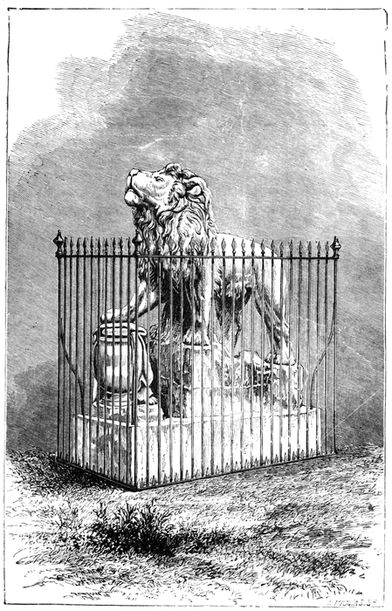
CRIBB’S MONUMENT IN WOOLWICH CHURCHYARD.
275“The grave over which this monument is to be erected has long since been bricked and covered with a suitable slab. Upon this will be placed a plinth, also of solid Portland stone, about two feet in height, to receive the statue. On the edge of the plinth will be engraved this impressive sentence, ‘Respect the ashes of the brave.’ The grave being on an elevated bank close to the path leading to the church from the town of Woolwich, the whole will command the attention of all persons entering the burial ground from London, or passing along that thoroughfare immediately in front, which at all hours of the day is thronged with soldiers, sailors, dockyard men, and civilians.
“We hardly doubt that this monument, from the moral it is calculated to enforce, will be without its beneficial effects on the minds of all those by whom it is seen, and we trust it may be gratifying to those strangers who on their visits to the Arsenal will have an opportunity of witnessing the veneration in which Englishmen hold the memory of those who, although not ‘licensed’ warriors, are yet honest types of our national principles and character.”
On the eve of the first of May, 1854, the monument, of which we here give an engraving, was placed in the position it now occupies in Woolwich Churchyard, and its first view by the public was coincident with the first opening of the first Great Exhibition in Hyde Park. We again quote Bell’s Life:—“Far be it from us to connect this simple occurrence further than in point of time with the Exhibition in question; but the coincidence is fortunate, and the object creditable to those by whom it has been carried out—that object being to testify the respect entertained for the memory of a man who, in his position, entitled himself to universal respect for his unimpeachable honesty, indomitable courage, and unquestionable humanity. Exception may be taken to the sphere in which those qualities were exhibited, but those acquainted with English feeling, English character, and English habits must hold in estimation the memory of a man who, in his own person and by his own acts, impressed on thousands, we might say millions, those principles of fair play, combined with gallant bearing, which have been the distinguishing features of our countrymen, soldiers, sailors, or civilians, in whatever circumstances placed. From these feelings sprung a desire to erect the present monument, for the double purpose of perpetuating the memory of the most distinguished of his class, and of impressing on those who followed in his footsteps the sense entertained of the virtues he so prominently displayed. A subscription was commenced, at the head of which were the names of noblemen and gentlemen of the highest rank, swollen by more humble contributors. The work has been accomplished, thanks to the unceasing assiduity and generous devotion of Mr. Timothy Butler, the sculptor, who has performed his task in a manner that must increase his 276reputation, and entitle him to a distinguished position in the profession of which he is so bright an ornament. The design is simple yet grand in its conception. It represents a British lion grieving over the ashes of a British hero; for, putting aside all prejudice, Cribb was a hero of whom his country might well be proud. The drawing affords a correct idea of the monument, but falls short of the effect of the original; for we do not believe there is in existence a more beautiful specimen of animal sculpture, whether we regard the exquisite proportions of the figure, or the deep impression of sorrow expressed on the countenance. The paw of the lion, it will be seen, rests on an urn supposed to contain the ashes of the dead, over which is lightly thrown the belt which was presented to Cribb as ‘the Champion of England.’ For obvious reasons—principally the close proximity to the House of Peace—all allusion to the circumstances which have led to this distinction is avoided, and the inscription is simply this:—‘Sacred to the Memory of Thomas Cribb, born July 8, 1781, died May 11, 1848.’ On the plinth beneath are the words—‘Respect the ashes of the brave’—an inscription which, it is hoped, will prevent those encroachments in which idle visitors to a churchyard but too often indulge. The lion, of colossal size, stands on a rock, and the whole was sculptured from a solid block of Portland stone weighing twenty tons, from which some idea may be formed of the labour and perseverance with which such a chef d’œuvre has been accomplished and removed without accident from the studio of the artist in Middlesex Place, New Road, to its present position. The monument stands on a plinth which elevates it among surrounding tombs, rendering it visible even from the river Thames; while from the footpath, in front of the churchyard, it invites immediate attention as well as admiration—a sentiment which has been unequivocally expressed by thousands.
“It is fit we should state that there are some fastidious persons in Woolwich, the town in which poor Cribb breathed his last, who find fault with the erection of such a monument in such a place. It is due to the rector of Woolwich, to state, that although he may in some respects participate in the feelings of the parishioners, his objections were removed by the statement of the fact, that before the monument was commenced, the drawing of the design was submitted to his predecessor, by whom it was so heartily approved that he regretted it could not be surrounded by an iron railing, to protect it from trespassers, who are but too apt to treat with indifference the most exquisite specimens of art.[143] There were, however, some words in the inscription to which the rector did object, and which at his request have been omitted. 277Respect for this gentleman’s impressions has induced us to omit the following not inappropriate epitaph:—
“‘When some proud earl or rich patrician dies,
Unmoved we mark the storied marble rise,
Unmoved we read the praises blazoned forth,
And doubt the meed if giv’n to wealth or worth;
But truth shall guide this record, and proclaim
Who raised himself without a crime to fame;
Whose heart was tender as his arm was strong;
Who still upheld the right, abhorred the wrong;
Who stood unconquered champion in that field,
Where hardy heroes nature’s weapons wield—
’Twas poor Tom Cribb—beneath his ashes lie:
Peace to his spirit’s immortality!’”

278