THE P.R.B. JOURNAL, 1849-53
Reading edition
THE P.R.B. JOURNAL, 1849-53.
The facts regarding the formation of the Præraphaelite Brotherhood, or P.R.B., have been frequently summarized ere now in print, by others and by myself: but I must run them over again briefly, in order to make the P.R.B. Journal the clearer.
In 1848 there were four young students in the Royal Academy Schools—John Everett Millais and William Holman Hunt in the Life-school, Thomas Woolner in the Sculpture-school, and Dante Gabriel Rossetti in the Antique-school. Woolner, born in 1825, was the eldest; Millais, born in 1829, the youngest. These young men were all capable and ambitious: they had all, except Rossetti, exhibited something, to which (more especially in the case of Millais) the Art-authorities and the public had proved not wholly indifferent. They entertained a hearty contempt for much of the art—flimsy, frivolous, and conventional—which they saw in practice around them; and wanted to show forth what was in them in the way of solid and fresh thought or invention, personal observation, and the intimate study of and strict adherence to Nature. The young men came together, interchanged ideas, and were joined by two other youthful Painter-Students, James Collinson and Frederic George Stephens, and also myself, who was not an Artist. So there were seven men forming the Præraphaelite Brotherhood. I will not debate at any length why the term Præraphaelite was adopted. There was much defiance in it, some banter, some sense, a great deal of resolute purpose, a large opening for misinterpretations, and a carte-blanche invitation for abuse. After thus constituting themselves, what they had to do was to design, paint, and model, and one of them in especial, Dante Rossetti, to write poetry; and they did it with a will.
Some little while having elapsed, it was determined that one of the P.R.B.’s should be Secretary, and should keep a journal; and I, as not being taken up by art-work, was pitched upon for the purpose. I accordingly began the P.R.B. Journal.
This Journal was entirely my own affair, and was compiled without pre-consulting any of my fellow-members, and without afterwards submitting it to them. At the same time, the object of it was understood to be a record, from day to day, of the proceedings of all the Members, so far as these were of a professional or semi-professional character, and came within my knowledge; it was not in any sense a diary personal to myself (save in so far as I was one P.R.B. among seven), nor deriving from my own thoughts or feelings. The Journal was producible to any Member who might choose to ask for it—I don’t think any one ever did. I used to make it a rule to myself to mention only the Members of the Brotherhood, along with some few other persons who came into close relation with them, their purposes, and their work.
The compilation, as will be seen, extends from 15th May 1849, soon after the Exhibitions had opened containing the works of the first year of Præraphaelitism, to 29th May 1853; by which date, mainly owing to Millais’s picture of A Huguenot on St. Bartholomew’s Eve, the Præraphaelites had practically triumphed—issuing from the dust and smother of four years’ groping surprise on the part of critics and public, taking the form mostly of thick-and-thin vituperation. There are various gaps in the Journal, owing to my own laches; and several more, owing to a performance by my Brother, justifying the designation once (I think) applied to him by a cabman, “a harbitrary cove.” After the Journal had been finally (though not of any set purpose) discontinued, it lay by me unnoticed for a number of years. When at last I had occasion to re-inspect it, I found that several pages had been torn out by my Brother, and several others mutilated. I never knew accurately—never at all enquired—why he did this. I suppose that at some time or other he took up the MS. in a more or less haphazard way, and noticed in it some things which he did not care to have on record regarding himself, and also in all likelihood regarding Miss Elizabeth Siddal, to whom he was then engaged. Not that I recorded anything whatever in a spirit of detraction or ill-nature concerning either of them—far from that.
Thus the P.R.B. Journal is now much more fragmentary than it need have been—for the portion destroyed by my Brother amounted, I dare say, to a fair fifth of the whole. In what remains a good deal is mere plodding journey-work, of no interest to myself, still less to others. The extracts here presented may constitute something like a half of the extant MS.—less rather than more.
I am aware that even these extracts are not written in an entertaining style: the Journal was intended to be simply, and rather servilely, a compendium of facts. It is however a highly authentic account of the early stages in a movement which proved of great importance, and to which much and increasing public interest has attached—a movement in which men of staunch achievement and eminent name bore the leading parts. As such, I suppose that the P.R.B. Journal may be regarded in some quarters as a document not undeserving of attention.
May 1849.
Tuesday 15th.—At Millais’s—Hunt, Stephens, Collinson, Gabriel, and myself. Gabriel brought with him his design of Dante drawing the figure of an Angel on the first anniversary of Beatrice’s death[148] which he completed in the course of the day, and intends for Millais. Millais has done some figures of the populace in his design of The Abbey at Caen[149] since last night, and has also continued painting on the beard in the head of Ferdinand listening to Ariel, being that of Stephens. He says he has begun his “Castle-moat” poem[150] and is to continue it after we left (one o’clock). The plan of writing this diary was fixed, and will, I am in hopes, be steadily persevered in. We minutely analysed such defects as there are in Patmore’s River from Gabriel’s recitation; who also read his poem (in progress) intended as introductory to the Vita Nuova[151]....
Wednesday 16th.—Gabriel began redesigning Kate the Queen[152]....
Thursday 17th.—Millais called on us in the evening. He has gone on with his Caen Nunnery design, and has put in some fat men, finding his general tendency to be towards thin ones. He is also progressing with his poem (the Castle-moat subject)....
Saturday 19th.—... Hunt ... is getting on with his Monk succoured by the ancient Britons in time of persecution. Woolner has done four of his heads commissioned by Cottingham[153]—Raphael, Michelangelo, Titian, and Leonardo—and is engaged on Vandyck.... I understand that the Court Journal, speaking of a picture by one Walters that has been rejected, exclaims against the injustice, considering that such works as Hunt’s and Millais’s,[154] which can have been admitted only for charity, are hung.
Sunday 20th.—Gabriel made considerable progress to-day with his Kate the Queen design.... Woolner came in the evening, and showed us two verses of a new song he has begun, having the burden, “My Lady rests her heavy, heavy rest”[155]....
Monday 21st.—Millais called in the evening, to take Gabriel with him to Mr. Bateman’s (the Illuminator): they also picked up Woolner on the way. The visit ... afforded unqualified satisfaction. Gabriel recited lots of Patmore, Browning, Mrs. Browning, etc.... We (Gabriel and myself) presented Bernhard Smith, on his departure, with a Browning, bearing the following inscription—“Ichabod, Ichabod, the glory has departed. Travels Waring West away?” Smith leaves on Wednesday[156]....
Wednesday 23rd.—... Hunt ... has completed his design of the Ancient Britons and Monk, and has resumed the one from Isabella, “He knew whose gentle hand was at the latch.” ... Millais has made considerable progress with the Caen Nunnery, having put-in the greater part of the populace. He says his poem is considerably advanced, and that he will work hard on it to-night. He having informed us, almost as soon as we entered, that he had been reading Patmore’s Woodman’s Daughter and Sir Hubert,[157] and had found several faults of diction etc. therein, we proceeded to a most careful dissection, and really the amount of improvable is surprisingly small—as he also agreed in thinking.... In the course of conversation, Millais said that he had thoughts of painting a hedge (as a subject) to the closest point of imitation, with a bird’s nest—a thing which has never been attempted. Another subject he has in his eye is a river-sparrow’s nest, built, as he says they are, between three reeds; the bird he describes as with its head always on one side, “a body like a ball, and thin legs like needles.” He intends soon to set about his subject from Patmore, Sir Hubert and Mabel, “as she issues from the trees”[158]....
Thursday 24th.—... Millais came; soon after which we fell to portrait-taking. Millais’s, of Woolner, Hancock, and Hunt, have come highly successful. He has done something to his poem....
Sunday 27th.—Gabriel and I went in the morning, by appointment, to Dickinson’s,[159] where we met Ford Brown and Cave Thomas. Dickinson says that, when Cottingham first mentioned to him his intention of buying Gabriel’s picture, he descanted glowingly on his genius, and expressed his horror at having “found him in a garret.”[160]
Monday, July 13th.—Hunt, with Gabriel’s co-operation, removed the majority of his property to Brown’s study, etc.... A most cheeky letter received from Cottingham, in answer to a civil enquiry relative to the price payable for the Morning and Evening,[161] left him in a state of profound disgust; when he was relieved therefrom by a note from Egg[162] informing him that he had sold the Rienzi picture for 160 guineas to Mr. Gibbons, and requesting to see him to-morrow morning on some other business. Hunt swears that he’ll cut Cottingham altogether, and leave him to find another man of talent (of whom Cottingham asserts that he knows plenty) to do two fair-sized pictures for £50. In the evening Gabriel and I went to Woolner’s with the view of seeing North[163] (whom, however, we did not find at home) about a project for a monthly sixpenny magazine[164] for which four or five of us would write and one make an etching, each subscribing a guinea, and thus becoming a proprietor. The full discussion of the subject is fixed for to-morrow, at Woolner’s.... Woolner has been working at the Euphrosyne.
Tuesday 14th.—Hunt called on Egg, and received the money for his picture. Mr. Gibbons is also to give him a commission for not less than another 100 guineas; and Egg thinks that, after seeing the picture of the Early Christian which Hunt is now engaged on, he will probably select that. Gabriel has settled to go with Hunt to Paris, passing by Ghent and Bruges, which Egg strongly recommends them to see. A second letter to Gabriel from John Orchard,[165] the painter, has been received. He had written for the first time nearly a week ago, expressing the most intense admiration for the Mary Virgin, and entering into a long metaphysical disquisition on the principle of adopting the mode of thought and the practice of any preceding age, which he condemns. In his present letter, in answer to Gabriel’s reply, he says that he hopes to call and see the picture on Saturday.... We went to Woolner’s to settle on our contemplated magazine. The title is to be Monthly Thoughts in Literature and Art, with a sonnet on the wrapper....
Wednesday 15th.—... It was proposed that the magazine should be increased to forty pages, two etchings, and 1s. each No. I wrote the first eight lines of a sonnet for the wrapper, to be considered with others....
Thursday 16th.—Gabriel made a study, from a girl whom Collinson recommended to him, for the head of the angel in his picture,[166] which head he means to do over again....
Friday 17th.—Gabriel began painting the head of the angel; and he wrote two stanzas of a French song, La Sœur Morte[167]....
Sunday 19th.—Hunt ... has taken his Rienzi picture to Brown’s study, and is engaged giving it some finishing touches. At Ewell he made a study (in colour) of a cornfield.... I finished my sonnet, begun on the 15th, with reference to the wrapper of the proposed magazine. In the morning Gabriel worked a good deal on the angel’s head, and wrote the concluding stanza of his French song.
Monday 20th.—Gabriel still at the figure of the angel. Orchard, the Painter, called in the afternoon, and left Gabriel two sonnets he has written on his picture....
Saturday 25th.—Gabriel’s picture was sent off to the Marchioness of Bath. The daguerreotype will be ready on Monday....
Sunday 26th.—Gabriel wrote a sonnet entitled For the Things of these Days[168]....
Tuesday 28th.—... Gabriel thinks of taking, as the incidents for the two side-pieces in his picture, the Virgin planting a lily and a rose, and the Virgin in St. John’s house after the crucifixion,[169] as illustrating the periods of her life before the birth and after the death of Christ. For the middle compartment, to represent her during his life, he has not yet settled an incident. He went to see Woolner, who has finished the first part of My Lady, and the poem is therefore now altogether completed....
Wednesday 29th.—Gabriel thought of taking for the principal compartment of his commission-picture the eating of the passover by the Holy Family, in which he proposes to make Zachariah and Elizabeth joining, as it is said that, if a household were too small for the purpose, those of a neighbouring household were to be called in. He made a preliminary sketch of this....
Sunday, August 22nd.—... That this drama[170] gained him great reputation in many literary circles, though not extensively known by the public. That Wells married some time after a sister of Williams’s wife, and settled in Brittany, where he is become a great hunter and fisher: that, having fallen into some embarrassments, he sent over to Williams, for him to find a publisher, part of a novel named De Clisson, and other things in prose and poetry; but that he (Williams) failed generally in his endeavours,—an article entitled Boar-hunting in Brittany having however been inserted in Fraser. That Mrs. Wells came over recently to offer the Stories[171] and Joseph for republication; but did not succeed. Gabriel hereupon proposed to make etchings for a new edition, if that might seem likely to be of any avail, and engaged for Hunt, Millais, and Woolner, to do the same after Christmas; and Williams says that he has little doubt but what, with that attraction, a publisher might be procured; also that he is certain Wells would commit the care of the edition to Gabriel with complete confidence. Gabriel thinks that, if each were to do five etchings, and he were to write an elaborate preface (assuming as an undisputed point the very high character of the work), and if I, as having more leisure, were to write a full and minute review soon after the publication, this arrangement would do. Wells is a most fervent Catholic, but has not (as rumoured) retired into a convent; which he has compelled two of his daughters however to do, and urges the third, who was till lately residing with Williams, to follow their example, to which she is most strongly opposed. Williams is reader to Smith and Elder, to whom Browning’s Poems had been offered for republication; when he told them that the work, as a work, ought to be published, but that he could not advise it as a pecuniary speculation: he believes that it was published at the expense of Chapman and Hall, not at Browning’s own cost....
Tuesday 24th.—Gabriel was engaged in the morning looking over and finishing up his Vita Nuova.
Thursday 26th.—I composed a sonnet[172] a few lines of which had come into my head yesterday, entitled For the General Oppression of the better by the worse Cause in July 1849.... Hunt has been making the designs for the Morning and Evening commissioned by Cottingham, which he intends to complete to-morrow morning and present to him. He says it is his intention, after leaving his present lodging (which he will do some three weeks hence), to go for a fortnight into the country, and work on the landscape of his Early Britons picture, and from there to Paris for about three months to paint the commissions.
Wednesday, September 12th.—After writing a letter to Woolner[173] I sat down to think as to a subject for a poem, and without much trouble invented one, but it is as yet very incomplete and meagre. I composed 21 lines of it in blank verse....
Thursday 20th.—I had letters from Woolner and Gabriel. Woolner ... says that he is to receive the money for Euphrosyne from Cottingham to-day; and that Cottingham has actually advised him to execute in marble the figure of St. Luke which Gabriel designed some time back for the picture he contemplated doing of St. Luke preaching, with pictures of Christ and the Virgin[174].... Gabriel writes that a printer named Haynes, a friend of Hancock,[175] has introduced him to Aylott and Jones the publishers, who are quite willing to publish the Monthly Thoughts, on condition of a percentage of ten on the sale; and that Deverell is making enquiries as to the equity of this demand....
Sunday 23rd.—A letter arrived from Woolner, informing me that, as difficulties in keeping back the ardour of our new proprietors begin to rise up, he and Gabriel have determined on at once making me Editor, and that the prospectus has been sent off to the printer’s with my name accordingly, and the title altered to Thoughts towards Nature (Gabriel’s idea), to obviate the many objections that have been made to the old title; that he was to dine to-day with Patmore,[176] who had read his poems, and praised them so much that he won’t tell me what he said; that he has just returned unsuccessfully from Cottingham; and that he doubts whether he and Gabriel will join me here, considering the heavy travelling-expenses. I answered him, pointing out several reasons why I think the proposal of publishing my name as Editor should be well reflected on before being carried out....
Tuesday 25th.—I had a letter from Gabriel in answer to my last to Woolner. He says that the words “Conducted by Artists,” recently proposed to be inserted in the title of our magazine, are now to be left out; and that therefore, as he thinks, there is no further ground for arguing the question of my name being published as Editor; that a definite agreement has been made with Aylott and Jones, the publishers, and that the prospectus is now being printed; that the 1st No. will not appear till December; that he wrote the preceding night to W. B. Scott, requesting his co-operation; and that Patmore has seen and appears much pleased with the prospectus, and has given us a little poem named The Seasons for our 1st No., but with the proviso that his name shall not transpire, as he means to keep it back in all instances till the appearance of his new volume. He praised Woolner’s poems immensely, saying however that they were sometimes slightly over-passionate, and generally “sculpturesque” in character.... Gabriel and Hunt are to start shortly for the continent....
Wednesday 26th.—... Another letter from Gabriel, saying that, as further delay in starting would inconvenience Hunt, they are to set off for France and Belgium to-morrow; and that they will, if possible, pass through Brittany, either going or returning, to see Charles Wells[177]....
Tuesday 27th.—I had a letter, with a message from Gabriel in answer to my enquiries, that the table of contents for No. 1 of the Thoughts remains as before settled, with the addition of Patmore’s poem and Stephens’s paper on Early Art ...; also that several are proposing to alter the title of the magazine to The P.R.B. Journal, and desiring me to write my opinion on the subject to Stephens. This I did accordingly, representing many objections which appear to me quite decisive, especially connected with the share in the magazine of some who are not P.R.B.’s. I also wrote Gabriel in the same sense, requesting his and Hunt’s views of the matter. In these letters I brought up an old proposal to get “P.R.B.” printed somewhere on the wrapper—a course to which the same objections do not apply. I did 116 lines more of my poem....
Friday 28th.—Gabriel left yesterday morning with Hunt for the continent....
Monday, October 8th.—Collinson, to whom I went in the evening, is getting on with his Emigrant’s Letter; he has done a considerable part of the window and its adjuncts, finishing up the trees outside to a pitch of the extremest minuteness; he is advanced with the heads of the boy writing, and the girl. He has made a sketch in colour for the picture, and has introduced another boy looking over the one writing....
Wednesday 10th.—A letter came from Gabriel, who gives me an elaborate criticism of my blank-verse poem, and sends me five sonnets he has written—the first suggested by hearing the bells while ascending to the summit of Notre Dame; the second written leaning against the July Column, and musing on the Place de la Bastille; the third concerning “the rate of locomotion which the style of the Old Masters induces in Hunt and himself at the Louvre”; the fourth on a picture by Giorgione, of two naked women and two men with musical instruments; the fifth excited by the disgust he experienced at witnessing the cancan at Valentino’s. In reference to this last scene, he declares Gavarni to be “a liar and the father of it.” He has been to see the working of the Gobelins tapestries, which has so altered his ideas concerning the matter that he says he shall probably make an entirely new design for Kate the Queen,[178] when he is prepared to paint the subject....
Saturday 13th.—At Stephens’s I saw Hunt’s and Gabriel’s letters. The former says that they are to leave Paris on Saturday for Brussels. The latter sends three sonnets—the first, Whilst waiting for the train to Versailles, being imitated from the introduction to Tennyson’s Godiva, the second, On the road to and in the Garden of Versailles; the last, On a Dance of Nymphs by Mantegna....
Sunday 14th.—I read through Joseph and his Brethren, which is a glorious work, but, in passages, decidedly too full of images, laboured description, &c. From my old schoolfellow Nussey—to whom I went in the evening, and who is to subscribe to the Thoughts, and get as many subscribers at Oxford as he can—I heard some particulars of the poet Clough,[179] who had been Tutor in the College to which he (Nussey) belongs....
Monday 15th.—I called at Millais’s house, and was told that the period of his return is quite undecided. He is now at the house of a Mr. Wyatt,[180] having left Mr. Drury’s some weeks ago—who offered to fit up for him a suite of apartments where he might establish himself and work.—Ford Brown, to whose study I went in the evening, and Cave Thomas whom I met there, will subscribe....
Thursday 18th.—Woolner ... has begun a medallion portrait of Patmore, who has given him three sittings, beginning on Sunday, and who says he thinks he may probably induce Tennyson, when in London, to sit to him likewise.... Being alone together (with Hunt, Millais, and Gabriel, out of hearing), we had some conversation concerning republicanism, universal suffrage, &c....
Thursday, 1st November.—In the morning Gabriel called on Millais, and saw a design he has made of the Holy Family. Christ, having pricked his hand with a nail (in symbol of the nailing to the cross), is being anxiously examined by Joseph, who is pulling his hand backwards, while he, unheeding this, kisses the Virgin with his arm round her neck. Millais thinks of painting this for the Exhibition[181]....
Friday 2nd.—Woolner’s “character” was sent him by Donovan.[182] It embodies generally the observations he made at the time of the consultation, and ascribes to him a large amount of caution, which Woolner considers to be a correct judgment. In some points, however, he appears decidedly mistaken. After discussing this, we went together to Coventry Patmore’s. The first thing we heard was that his doctor had forbidden him to write in the evening for some time. He is now about to read up for two articles on Russia he intends to write for The North British and The British Quarterly respectively. He says he has some doubt whether one of the little poems he has given us for the Thoughts—which of them he is not certain—did not appear in some musical magazine. We had an argument as to whether Browning would be the man some twenty years hence, Patmore expressing an adverse opinion. He remarked that Browning appears to him like a chip from a very perfect precious stone; intense, but not broad in range of subject, nor sufficiently finished. He considers A Soul’s Tragedy to be a splendid title spoiled(!). Sordello he has never read. Paracelsus he admires with a reservation. Two of the short pieces he particularly remembers with pleasure are How they brought the good news from Ghent to Aix, and Saul.... He does not place Browning so high as Tennyson. I saw Tennyson’s MS. book of elegies on young Hallam, which are to be published some day....
Tuesday 6th.—Looked over a house in Cheyne Walk, Chelsea,[183] with which they, and Stephens who was with them, were greatly taken. It is capable of furnishing four good studios, with a bedroom, and a little room that would do for a library, attached to each. There is also an excellent look-out on the river. The rent, £70. In the evening, we all (except Millais) congregated at Woolner’s, and discussed the matter. Gabriel, Hunt, and myself, think of going at once, and Stephens and Collinson would join after April. We think likewise of getting Deverell. “P.R.B.” might be written on the bell, and stand for “please ring the bell” to the profane. Among other subjects, we spoke of not admitting anything at all referring to politics or religion into our magazine, and decided on cutting out the sonnets For the Things of these Days[184] we have hitherto intended to insert in the first number....
Wednesday 7th.—This was the evening fixed for Millais’s and Gabriel’s introduction to Patmore, at Woolner’s study. Gabriel and I went, and Patmore came, but Millais appeared not. We conversed a good deal of Woolner’s poems, which Patmore says are so good that he is surprised they should not be much better. He insists strongly on the necessity of never leaving a poem till the whole of it be brought to a pitch of excellence perfectly satisfactory; in this respect of general equality, and also in regard to metre, he finds much to object to in Woolner’s poem of My Lady, and considers that these defects are far less prominent in some passages of Friendship[185] that were read to him. Henry Taylor, he says, ought to devote ten more years to Philip Van Artevelde, and it would then be qualified to live. He himself spent about a year (from the age of sixteen to seventeen) on The River, with which, and The Woodman’s Daughter, he is contented in point of finish. Lilian and Sir Hubert were written in a great hurry for the Publisher. He read Gabriel’s sonnets on Ingres’s picture of Roger and Angelica, and was much struck with the character they possess of being descriptive of a painting....
Thursday 8th.—Deverell will manage to join us at once in the house at Chelsea; but on reflection the expense begins to look rather formidable. I called on Millais, to ask him to Patmore’s.... I saw his design of Christ in his childhood, to be painted for the next Exhibition, and the calotype made of his last picture.... Patmore, talking of Philip Bailey, remarked that he seems to be “painting on clouds, not having his foot on reality.” Burns he considers more perfect than Tennyson. Gabriel wrote three stanzas of Bride-Chamber Talk. At Patmore’s we heard of the reported death of Edgar Poe, concerning which some suspicions of suicide exist.
Friday 9th.—... As the feasibility of taking the Chelsea house looks very questionable now, considering the expense, Gabriel and Hunt spent all the early part of the day looking for lodgings and studios about Chelsea, Brompton, etc.
Saturday 10th.—Gabriel found a studio at No. 72 Newman Street. The rent asked is £30, but he succeeded in bringing it down to £28. He is to see further about it to-morrow. He wrote to Hunt to ask whether he can join him in his tenancy....
Sunday 11th.—I went to Millais in the morning, and find that he has altered the position of the legs of Ferdinand. Last night he wrote some stanzas of his poem, of which he says he has now done certainly upwards of a hundred lines—perhaps much more, as he has never counted. In the afternoon Gabriel came, and read all the poetry he wrote abroad. He had been to Newman Street, and decided on taking the study. We went to Harris’s[186] in the evening, and were told that he had occupied the same study some time at a rent of £40, whereas Gabriel has made the landlord accept £26....
Monday 12th.—... Woolner has been hard at work these two days on his new figure in sculpture, which he has blocked out in clay. Patmore called on him yesterday, and talked of my poem,[187] in which he finds a most objectionable absence of moral dignity, all the characters being puny and destitute of elevation. He means nevertheless to read it through again, that he may be able to judge of it in detail without looking so much to the scope—or want of scope. These are very much the objections that we had all foreseen, and acquiesce in....
Thursday 15th.—Gabriel got the paper stretched for of his study. He and I saw Hunt, who has suited himself somewhere in Bayswater....
Thursday 15th.—Gabriel got the paper stretched for the nude cartoon he intends to make for his picture of the Passover, and began drawing the figure of Christ from a little boy whom Collinson discovered some time ago, and whom he has painted in his Emigrant’s Letter. Gabriel wrote to Miss Atwell to come to-morrow, as he wants her for the figure of the Virgin. We went in the evening to Calder Campbell,[188] who offers his services for our Magazine, and will hunt up subscribers....
Sunday 18th.—Gabriel began at his design for Paolo and Francesca, but did scarcely anything. We therefore read away at Browning, Tennyson, Lowell, and the Stories after Nature.
Monday 19th.—Gabriel was occupied about his design.... To-night was a P.R.B. meeting at Millais’s, at which we were all present with the exception of Woolner.... Millais means to make the spirits in the air[189] half human and half like birds. His brother has begun painting a little from still life etc., and Millais intends to get him to do landscape-pieces. Hunt has gone on with his etching. Stephens is still engaged during the day at the Museum. He offers to draw-in the perspective scale in Gabriel’s picture.... We discussed two or three points concerning the magazine. First, that of advertising; and it was unanimously considered that, as anything of the kind would, to be effective, swallow up some £10 or £15 without doubt, it will be as well to drop it altogether. In the second place, as regards the big “P.R.B.” printed at the head of the prospectus. To this Hunt now most strenuously objects[190].... After our return Gabriel continued making sketches for his design. He intends that the picture should be in three compartments. In the middle, Paolo and Francesca kissing; on the left, Dante and Virgil in the second circle; on the right, the spirits blowing to and fro....
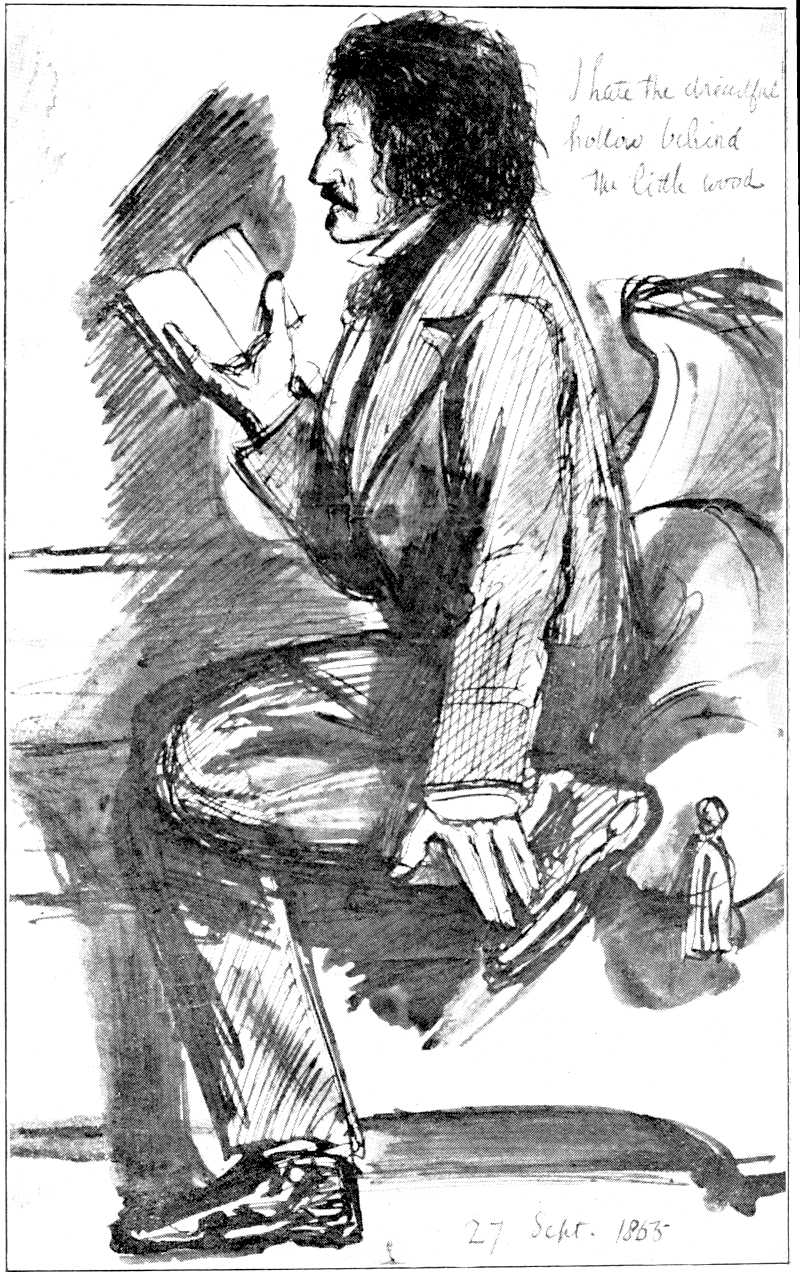
Alfred Tennyson reading Maud aloud. Pen-and-ink Sketch by Dante Gabriel Rossetti, 27 September 1855. Details as to this matter are given in my Memoir of Dante Rossetti. Mr. and Mrs. Browning, being then for a while at No. 13 Dorset Street, London, invited a few friends to hear Tennyson read Maud, as he had undertaken. Miss Browning, my Brother, and myself, were present, and perhaps one other. My Brother, unobserved by Tennyson, made a pen-and-ink sketch of him, and gave it to Browning. He also made a duplicate of the sketch, which belongs (or used to belong) to Mr. Cosmo Monkhouse. The present version is a triplicate, which he sent to Miss Elizabeth E. Siddal, then in Paris: she had started (I think only a few days before 27 September) for Paris and Nice, for the sake of her health. This triplicate had remained in the possession of the Siddal family until September 1899, when her Brother was so good as to present it to me.
Thursday 22nd.—Patmore, Cross, Millais, Gabriel, and myself, were at Woolner’s; Hunt did not appear. A long argument was maintained concerning poetry—Patmore professing that Burns is a greater poet than Tennyson, in which opinion Tennyson himself fully concurs. Patmore instanced, as a line of unsurpassable beauty, “With joy unfeigned brothers and sisters meet,” from The Cottar’s Saturday Night. He says that Tennyson is the greatest man he ever came in contact with, far greater in his life than in his writing—perfectly sincere and frank, never paying uncandid compliments. Browning takes more pains to please, and is altogether much more a man of the world. Patmore thinks that Browning does not value himself at so high a point as he is rated by Gabriel and me. Patmore holds the age of narrative poetry to be passed for ever, and thinks that probably none such will again appear; he considers Peter Bell, though most vexatiously imperfect, to be the opening of a new era. He looks on the present race of poets as highly “self-conscious” in comparison with their predecessors, but yet not sufficiently so for the only system now possible—the psychological. The conversation taking a religious turn, he said that the devil is the only being purely reasoning and analytic, and therefore is the devil; and he would have every man hold to the faith he is born in, as, if he attempts to get beyond its bounds, he will be far more likely to be a rebel than a seeker after truth,[191] and should not attempt to pull down without having something to build anew. He thinks Millais’s picture far better than anything Keats ever did,[192] and that he is adapted to usher in a new style which will eventually educate the people into taste, and make his works some day as popular and saleable as Barraud’s We Praise Thee, O God.[193] One of the chief curses of the day he considers to be that every one is critical. Of the poets of this and the last generation he says that they are “all nerves and no hearts.” He fraternized with Cross, in whom he sees some resemblance to David Scott, the recently dead brother of W. B.... We had some talk of ghosts, to a belief in which Patmore does not see any obstacles. Millais related a singular story on the subject he heard at Oxford, and Woolner some experiences of his own immediate relations and friends. Millais, as we walked home, unburdened himself of his observations and conclusions, and declared that, if he had seen Patmore’s hand alone cut off, he could have sworn to it as that of a man of genius. His sayings concerning Burns, Keats, Tennyson, etc., are bitter in his belly as wormwood. Gabriel and I sat up to read the Cottar’s Saturday Night, and failed to realize to our apprehensions its extraordinary excellence....
Saturday 25th.—Gabriel began making a sketch for The Annunciation. The Virgin is to be in bed, but without any bedclothes on, an arrangement which may be justified in consideration of the hot climate; and the angel Gabriel is to be presenting a lily to her. The picture, and its companion of the Virgin’s Death,[194] will be almost entirely white. At Stephens’ two Tuppers only were present. John Tupper read his poem, which is exceedingly clever:[195] it borders nevertheless on the ultra-peculiar.... Hunt, who came late in the evening, is getting on with his etching, of which there remains now not much to be done....
Friday, December 7th.—... Just as Tennyson was leaving, Patmore fixed him, and made him promise to sit to Woolner.... Millais has redesigned the subject of Christ in Joseph’s Workshop; the picture of Ferdinand is not very far from finished.
Saturday 8th.—Gabriel had Maitland to sit to him for the angel Gabriel in The Annunciation. He has recently written various new stanzas of Bride-Chamber Talk. Woolner came in the evening, when Gabriel read The Princess through to him, and both of them pronounced it the finest poem since Shakespeare, superior even to Sordello. To this latter opinion I demur....
Monday 10th.—... Collinson, after he shall have finished his paintings for this year, means to set to work on the subject of St. Elizabeth of Hungary taking off her crown before the crucifix. We talked about the magazine, and are quite unanimous in considering that the first number must appear; but all except Stephens and myself are somewhat inclined to drop it after that, whether successful or not. We are also disposed to abide by the title Thoughts towards Nature, notwithstanding Cave Thomas’s proposal of The Seed. We debated the propriety of having an article explanatory of the principles in Art of the P.R.B.; but, as so many papers in the first number are to treat of Art, and as the point will necessarily be brought forward incidentally, it is not thought needful.
Thursday 13th.—... Patmore was at Woolner’s last night, and read him Poe’s tales to his own great satisfaction. He considers Poe the best writer that America has produced. He is in a state of some indignation at a book that has been lately published in America by Thomas Powell; wherein himself, Tennyson, Browning, and others with whom he is not conscious of Powell’s having ever met, are spoken of. Gabriel showed him My Sister’s Sleep, which he approves in respect of sentiment, but says that it contains several lines that will not scan, and that it is too self-conscious in parts, as in the “I believe” of the first stanza, and in “I think that my lips did not stir.” Among the new things Tennyson is putting into The Princess are, I was told, passages to show where one person leaves off and another takes up the story; the alterations will be not in abridgment but in extension. He is to leave London shortly for a little while, and to return about Christmas, close upon which the new edition of The Princess will be published....
Saturday 15th.—... We settled to print the magazine with George Tupper. An objection was raised by Stephens to the publication of his name, and it was arranged that the question should be submitted to the arbitration of the P.R.B.... On making out a list of the materials actually at our disposal, we find that we have enough for the second and half of the third numbers, by making a somewhat different arrangement from that at first contemplated; as there is some fear of Gabriel’s being unable, through press of time as regards his picture, to get the Bride-Chamber Talk finished for number two.... Woolner was prevented from coming to Stephens’ by having a sitting from Tennyson for to-night....
Sunday 16th.—... Gabriel ... drew a little on the design of Giotto painting Dante’s Portrait, which he is finishing up for Stephens. Millais dropped in, and says he has been again to the Carpenter’s shop for the picture of Christ in his childhood, and that he will begin at it on Thursday.... In the evening Stephens came to Gabriel’s study to do his perspective....
Monday 17th.—... Gabriel ... resumed writing at his tale, Hand and Soul, and did some little in continuation. Woolner ... is to have a sitting again to-night from Tennyson....
Tuesday 18th.—Woolner not having made his appearance, I went again to try my chance of finding him, and at last succeeded. His delay has arisen from the second part of his poem not having yet been copied out or considered for final revision. The former task I performed, and the latter was achieved by our joint exertions. His medallion of Tennyson is well forward, the head requiring but little more: the hair, however, is only begun. It will have to be suspended for a short time, as Tennyson has left town, and will not be back till about Sunday, when he thinks of remaining for a month or so longer. His poem of King Arthur is not yet commenced, though he has been for years past maturing the conception of it; and he intends that it should occupy him some fifteen years. His poem, “Thou might’st have won the poet’s name,” was, he says, written in a fit of intense disgust after reading Medwin’s book about Byron. He has seen the poem I have reviewed in our first number, The Bothie of Toper-na-fuosich, and considers it to be execrable English. He likes Woolner’s bas-relief of Iris, but says he cannot understand the Puck.[196] Gabriel began to paint the head of the Virgin in his picture of The Annunciation.
Wednesday 19th.—I delivered to George Tupper Woolner’s poem and Patmore’s Seasons, with which he will make a beginning; but he warns me that we must get our materials together with all possible speed, as, next week being Christmas week, it is almost impracticable to get his people to work. In the evening we had a meeting in Gabriel’s study, where, besides the whole P.R.B., the two Tuppers, Deverell, Hancock, and Cave Thomas, as being persons interested in the magazine, were present. The latter brought the commencement of an opening address he is writing for No. 1.... Ford Brown came in at a late hour, and showed us a sonnet which he has composed on The Love of Beauty, and which we will find room for in the first number. I gave George Tupper my review, which will (he calculates) occupy at least some eighteen pages; also our sister’s poem of Dreamland. It was proposed by Woolner, and carried without opposition except a very strong one by myself, that our names should not be published; and another point in which all present came to the vote was the title to be finally adopted. The Seed was set aside in favour of The Germ; and this was near being superseded by The Scroll (also Thomas’s invention),[197] but was finally fixed on by six to four. Gabriel is to do his best to have Hand and Soul completed in time. His morning had been devoted to painting on the Virgin’s head.
Thursday 20th.—Gabriel set hard to work at Hand and Soul; or at least the spirit was willing, but the flesh was weak against Maitland in the morning, who was engaged in putting together a screen, and against Clayton, North, and Bliss, in the evening.[198]
Friday 21st.—... I went to Seddon’s, where Cave Thomas had arranged to meet me with his contribution; but, as he did not come, ... I called in at his house. I found him writing the last words of the prefatory address, which I took with me.... Gabriel had been all day at his tale, and sat up at it all night as well, without going to bed. By this means he was enabled to finish the narrative, and nothing remained except the epilogue. I copied out such part as required it to be fit for printing....
Saturday 22nd.—The proof of the first sheet ... comprises Thomas’s address, Woolner’s poem, Brown’s sonnet, and begins Tupper’s contribution. As Woolner’s poem commences at the back of Thomas’s address, and as it is thought desirable that the etching should front what it belongs to, we agreed that it should be inserted opposite the first page of the poem, instead of immediately inside the cover.
Sunday 23rd.—Gabriel ... has again got some idea of painting the subject of Francesca of Rimini, instead of what he is now doing; making an alteration in the action, and relinquishing, for want of time, the two proposed side-pieces, of Dante and Virgil, and the spirits in hell. His reasons for thinking of giving up the Virgin subjects for the present are the fear of being too late to get them finished, and the want of a satisfactory design for the Annunciation, and of any design at all for the Death....
Monday 24th.—... Hunt has been told by Millais that Mr. Wyatt, of Oxford, wants to have some proof-impressions of the etching, for sale; and Hunt thinks of having some fifty or so printed on fine large paper, to be sold at 3s. or 4s. each. A third impression has been made of the etching, which Gabriel has seen, and considers a most striking improvement. Hunt is about to leave his lodgings at Brompton, which he finds inconveniently small for painting, and will look out for others in the same neighbourhood or at Bayswater.
Wednesday 26th.—... Gabriel continued painting on the head of the Virgin, having resolved to go on with that picture.
Thursday 27th.—To-night we had the proof of the last sheet, containing the end of Gabriel’s tale and my review. The latter however is still, after all my reductions, too long, and exceeds the limits of the number by about a page and a half. Under these circumstances it is thought advisable to omit Thomas’s opening address, especially considering certain strong objections urged against it by Hunt and Stephens. This, besides making room for the whole of the review in its present shape, will enable us to insert Tupper’s little poem, A Sketch from Nature, and our sister’s An End.... Gabriel ... did four stanzas of Bride-Chamber Talk.
Friday 28th.—Hunt called here. Having been disappointed of a model this morning, he has been catching sparrows in a trap, and painting from them—afterwards decorating their heads with green, and sending them on their way rejoicing.... He understands from Millais that the printseller at Oxford is likely to want not more than some ten or twelve copies of his etching.... Aleck Tupper brought us the second proof of the last sheet.... Thus then, after many changes and counter-changes, will stand the contents of The Germ, No. 1.—Woolner’s My Lady, Ford Brown’s Love of Beauty, Tupper’s Subject in Art, Patmore’s Seasons, our sister’s Dreamland, Gabriel’s My Sister’s Sleep and Hand and Soul, my review of The Bothie, and sonnet Her First Season, Tupper’s Sketch from Nature, and our sister’s An End. Gabriel wrote a short poem, Lines and Music.
Saturday 29th.—... Millais ... says he has begun his picture from the childhood of Christ, and is going to have a bed in the carpenter’s shop he paints from, so as to be able to set to work early in the morning.... Millais’s brother continues to paint still life and objects in Nature with great success, and is determined to become a professional Artist. John is to bully him into doing nothing all next summer but paint out in the fields. Gabriel had Maitland to sit for his picture, but found him useless, and he thinks of beginning to paint from me to-morrow....
Sunday 30th.—Gabriel drew-in the head of the Angel (from me) in his picture. In the evening we went to Bateman’s with Millais, who has finished the Ferdinand and Ariel, all except something more he means to do to the background. He is going to send to the British Institution a small painting he did at Oxford, of Mr. Drury and a grand-daughter of his, for which he asks me to write an illustrative sonnet.[199]
Monday 31st.—To-day before noon fifty copies of The Germ were in the hands of the Publishers; I took home with me twelve.... I wrote to Thomas explaining the circumstances which compelled us to omit his article....
1850.—Tuesday, January 1st.—The fifty India-paper copies of the etching printing off for the magazine having been bound in, I took some of them home: however they are not generally superior to those on common paper. This was the day appointed (in lieu of yesterday, which was found unsuitable) for our first anniversary meeting at Stephens’s—fixed on the last day of 1848 for the last day of each succeeding year. Millais and Woolner were prevented from attending. We settled to what magazines and newspapers to send The Germ, and to what private gentlemen and authors—viz.: Sir Robert Peel, Lord John Russell.... [here comes a tear in the MS.]
Saturday 5th.—Gabriel went to see Hunt, who removed this evening from Brompton to Prospect Place, Cheyne Walk, Chelsea....
Monday 7th.—... Deverell called on Gabriel, and told him that the porter at Somerset House, who supplies the School of Design Students with stationery &c., would be very likely to get off some of The Germ; and it is arranged to let him have fifty, on the understanding that, if he succeeds with the whole number, he is to have 10s., in which case we might probably try it on with another fifty. Hunt, in coming to Gabriel, sold twelve copies out of nineteen; and I left three with a bookseller on trial. I had a letter from Mr. Clapp,[200] the American we met at Patmore’s, sending me for insertion a short poem of his own, My Gentle Friend, which he says has already appeared in an obscure provincial Temperance-paper. If we should not be inclined to put it in, this will be excuse sufficient. I paid for the insertion of a second advertisement in the Athenæum.
Tuesday 8th.—George Tupper suggested to me the great propriety of sending about The Germ to the principal Club-houses. I accordingly made out a list of twenty-one, which I gave to the Publisher.... Another letter from Mr. Clapp, who says he has “enlisted on our behalf some of the most enlightened minds he has met with in England,” and that he intends to make The Germ subject of “inter-friendly correspondence” in Scotland and America. Gabriel borrowed a lay figure from Barbe’s, and began on the drapery of the Virgin....
Thursday 10th.—Gabriel had a large meeting at his studio, including—besides the P.R.B.—Thomas, Brown, Tupper, Dickinson, &c. &c. Collinson brought the remainder of The Child Jesus.[201] Two or three matters concerning The Germ were resolved on: such as to send out more copies to literary men &c., and to magazines, and to try to introduce it among Artists’ Colourmen. Ford Brown also will write for No. 2 an article on the painting of a historical picture....
Friday 11th.—I copied out and left with Tupper, in conjunction with Collinson’s poem, two little songs of our sister’s, one of which is to be introduced into the 2nd No. Another thing to be put in is a sonnet that Calder Campbell has sent Gabriel.
Friday 11th.—All the P.R.B. was at Ford Brown’s, with several others, to induct him properly into his new rooms in Newman Street.... Millais has been knocked up these two or three days with colds caught at his carpenter’s shop. He has sent off his picture to the British Institution, with my sonnet as title. He has thrown up the commission for his Ferdinand and Ariel, as Mr. Wethered, among other things on which they did not come to terms perfectly satisfactory to Millais, expressed some doubts of the greenness of his fairies, and wished to have them more sylph-like.... Stephens says he has by this time disposed of thirty Germs....
Tuesday 15th.—W. B. Scott (to whom Gabriel wrote some days ago, sending a copy of The Germ, and requesting contributions) answered, enclosing two poems, viz.: a sonnet, Early Aspirations, and a blank-verse piece, Morning Sleep. The latter, which is gloriously fine, must absolutely come into No. 2....
Wednesday 16th.—... Gabriel ... in the evening began a rough sketch of a design for my Plain Story, which (it is likely) may appear in our 4th No., and which he thinks of illustrating. Collinson was at his studio all day, working on the etching[202].... I had a letter from Stephens, giving me a list of the subscribers he has obtained, and suggesting that we need not print so many as 700 copies of No. 2: 300 would, he thinks, suffice. In answering him I concurred in the reasonableness of the suggestion, but consider that 400 will not be too much....
Thursday 17th.—George Tupper ... advises that 500 copies should be published of the 2nd No., to which I agreed....
Friday 18th.—This was to have been a P.R.B. meeting at Collinson’s, but the day turned out so intensely sloshy that only Hunt and I kept the appointment.... We had some argument concerning the limitability of the P.R.B.: Hunt maintaining that it ought inviolably to consist of the present Members, for which Collinson and I do not see any very cogent necessity....
Monday 21st.—By enquiry at the Publisher’s I learn that he has sold 120 or 130 copies, which is at least as good as I looked for. He sent me a letter he has received from a Mr. Bellamy, Secretary to the National Club (to which I sent a copy), advising him to send one to the Proprietor of The John Bull.... Yesterday’s Dispatch contains a few words in praise of No. 1....
Tuesday 22nd.—Ford Brown showed Gabriel his article On the Mechanism of a Historical Picture. He will finish it and copy it out, and is to let Gabriel have it back to-morrow. After dinner I went for the first time to see Hunt at his new lodgings, 5 Prospect Place, Cheyne Walk, Chelsea, where he seems very comfortably settled. He has made a good deal of substantial progress with his picture; of which, since I saw it last, he has done some more figures in the background, the boy listening on the floor, the straw &c. on the roof, with some sparrows in it, and something of the view outside the hut. The figure he is now painting at is that of the foremost man pushing at the door. Whilst I was there he went on working upon a stump of a beech-tree which forms one of the supports of the hut, and on which he means to paint a net hanging.... Stephens came with John Tupper, who read, and left with me, a poem of his written on Penge Wood. This, should there be room for it, will come into No. 2[203].... At half-past ten o’clock Hunt was requested to allow his gas to be turned off, as the family were about to go to bed!! which did not exactly meet his views or intentions....
Wednesday 23rd.—... A letter to “The Editor of The Germ” reached me through the Publisher. It is from a Mr. G. Bellamy (a relative, I presume,[204] of the other Mr. Bellamy) addressed from the British Museum, expressing the highest admiration of the poetry of the magazine, and begging the favour of an introduction to the author, as he conceives it to be all by the same person. I answered to thank him, and to say that I would call with Woolner as soon as I could find time....
Friday 25th.—... Gabriel finished up his Blessed Damozel, to which he added two stanzas. A letter came from “Shirt-Collar Hall,”[205] acknowledging the receipt of a copy of The Germ which was sent him on Saturday; complimenting those engaged in it, who will, he says, be “the future great artists of the age and country”; and promising that it shall be reviewed in the Art Journal for March, as it came too late for next month’s No.
Saturday 26th.—... A note also came from Heraud[206] acknowledging a Germ which Campbell had left with him, and asking me to tea on Tuesday. Gabriel sent Tupper an additional stanza for The Blessed Damozel....
Sunday 27th.—Gabriel went on with the drapery of his picture. Stephens called on him in the evening, when it was determined that the authors’ names shall be published in our future Nos. For our Sister Gabriel invented the name “Ellen Alleyn.” ... I had a letter from Clough, conveying his thanks to me for the copy of The Germ and the criticism.[207]
Monday 28th.—Collinson saw Gabriel, and showed him the new impression (the fourth) of his etching, which is a great advance on all the preceding ones. Gabriel wrote one more stanza of his Blessed Damozel....
Tuesday 29th.—At Heraud’s, to whom I went, I met Westland Marston, who asked me to his house for to-morrow. Heraud complimented us a great deal on The Germ.... Hervey, the Editor of The Athenæum, came in rather late. Soon after we had been introduced, he explained to me that the reason why he had neglected many months ago to answer the letters that I sent him concerning certain poems had offered for The Athenæum,[208] was that he wished to call and explain personally why he felt unable to insert them, viz.: on account of their being too Tennysonian; and that his many engagements had prevented him from fulfilling his intention till too late. He asked me to call on him any Saturday or Sunday.... George Patten[209] was there, and Miss Glyn the Actress, who promised to subscribe to The Germ.
Wednesday 30th.—I found the invitation to Marston to be to a regular evening party. On leaving I presented him with a copy of The Germ, and he asked me to call some day when I might find him alone. Hervey, in talking with me, maintained that Sordello is absolute nonsense, and said he has no patience with men who write in that style. He tells me also that before publishing it Browning asked his friends whether it was intelligible, and that they informed him it was; in consequence of which, the result having proved the contrary, he became somewhat indignant against them. I left with the Publisher a list of twenty-five newspapers, magazines, &c., to which No. 2 is to be sent. He tells me that he has sold some 70 copies of No. 1—not 120 or 130, as I heard some time back....
Thursday 31st.—Appeared No. 2 of The Germ—containing Collinson’s Child Jesus; A Pause of Thought, A Song, and the Testimony, by our sister; Stephens’s article The Purpose and Tendency of Early Italian Art; Scott’s Morning Sleep; a sonnet by Calder Campbell; Patmore’s Stars and Moon; Brown’s Mechanism of a Historical Picture; my Fancies at Leisure (including the Sheer Waste, for which room was found at last), and my review of The Strayed Reveller; Deverell’s sonnets, The Sight Beyond; and Gabriel’s Blessed Damozel. Stephens figures as “John Seward,” as he does not wish his own name to appear. Tupper’s articles in the 1st No. also remain by his desire anonymous.... George Tupper gave me his bill for No. 1, amounting, on a scale even below his original estimate, to £19. 1s. 6d., from which he will deduct five per cent. for discount, leaving £18. 2s. 6d. It now becomes a most momentous question whether we shall be in a position to bring out a 3rd No. The chance seems but very doubtful—quite beyond a doubt, unless No. 2 sells much better than its predecessor, and of this we see but little likelihood. Even if it does appear, we shall probably have to postpone the publication of Bride-Chamber Talk, which Gabriel cannot write at much, having to paint his picture: in which case, my Plain Story of Life will probably be substituted. I spoke to the Publisher about pushing the sale of No. 2, and he promised to introduce it, on sale or return, among his customers in the trade.
Friday, 1st February.—... By Campbell’s advice I left one of each No. at the house of Mr. Cox, Editor of The Critic, to whom Campbell had spoken of it.... Gabriel finished the drapery of the Virgin in his picture; whereupon he immediately deranged the position of the lay figure, so as to preclude himself from the possibility of working at it any more....
Saturday 2nd.—... In the evening we had a full P.R.B. meeting at Gabriel’s.... Millais has had his picture back from the British Institution—on account of its being in reality a portrait, we conclude—and will send it to the Academy.... Millais has had an offer from Oxford to paint a copy of a portrait by Holbein; which, as he does not feel disposed to accept, he offered to Stephens, who will do it after the opening of the Exhibition. We consulted about The Germ, and are unanimously of opinion that it will not reach another No. Calculating the number of copies sold among ourselves as ninety-five (not I think more than in fact) and by the publisher as seventy (from which profits we shall have to deduct some few personal expenses, which can scarcely amount to 15s.) it seems that the expense to each of us beyond the receipts will be £1. 15s. 5¼d. This is a kind of experiment that won’t bear repetition more than once or twice.[210] The next meeting is fixed for Monday at Millais’s. On coming home I found a letter from Mr. Cox, of The Critic, proposing that, in case The Germ should not continue (as he considers probable), one of the Art-writers in it, or I, should write on the same subject for his paper; in which case he says he would resign the entire management of the articles on Art, the exhibitions &c. He would not be able, however, to offer any remuneration in cash. His proposal is not, I think, disadvantageous for the P.R.B., as it would enable us to review the exhibitions in our own feeling, and might besides lead to some other literary employment. I answered that I would consult the others (Brown, Stephens, and Tupper), and, if they should not undertake it, that I would accept....
Monday 4th.—Gabriel and I went together to the British Institution, of which this is the first day, as I wish to write something in the way of notice in the event of my being retained on The Critic....
Tuesday 5th.—I began writing my notice of the British Institution. Gabriel assumed the responsibility of F. S.[211] and a few others....
Wednesday 6th.—John Tupper resigns in my favour; and Stephens wrote me to the same effect, but offering his co-operation in any way he might be wanted....
Thursday 7th.—Woolner and I went to Patmore’s, to whom I gave some Germs, and his own poems. He likes the Testimony, which is he says in the style which should be adopted in hymns &c., to make them good. Says that there are very fine things in Gabriel’s Blessed Damozel, and speaks highly of Stephens’s article.... He says that William Allingham has promised some contributions; but these will probably not be available....
Saturday 9th.—I saw the publisher about the sale of the 2nd Germ, and am informed that some forty copies or so have sold, and that the 1st No. also continues to go off every now and then. This is the last knockdown blow. We certainly cannot attempt a 3rd No. Woolner and I went to Stephens. He showed us the design he has made of The Marquis dining in Griseldis’ Father’s House, Griseldis attending, which he means to paint; also two other designs from Chaucer—Griseldis parting from her Child, and The Revellers meeting Death. Gabriel got some stuff for the chasuble in which he means to drape his angel....
Monday 11th.—... This was a P.R.B. night at Millais’s, where all were present except Collinson.... Millais has very high accounts, from Oxford and elsewhere, of the estimation in which Collinson’s poem is held....
Tuesday 12th.—Gabriel ... in the evening ... was engaged with Hannay, Clapp, North, and others; and I with the Museum Mr. Bellamy, who has got us reviewed in The John Bull—the critic himself not having looked at the book, but trusting entirely to Bellamy’s report....
Friday 15th.—... I went in the evening, by invitation, to the house of Mr. Bellamy, where I read the John Bull notice of The Germ. Mr. Bellamy seemed really to regret the apparently inevitable death of The Germ; and took a copy of each No. to send to Justice Talfourd, with whom he is intimate, and who might, he thinks, probably do something for it....
Saturday 16th.—My review of the British Institution Exhibition (first half) appears in The Critic of to-day; also a notice of The Germ, quoting four of the poems. George Tupper called on me in the morning, and said that he and his brother,[212] looking with regret at the Germ failure, propose to carry it on at their own risk for a No. or two longer, to give it a fair trial; when it would have a better chance of success, through their being able to send about the subscribers’ copies, to advertise by posters, &c. This I consider a very friendly action on their part. I wrote at his request to convene all the hitherto proprietors, and saw the publisher about the sale of Nos. 1 and 2. It appears from what he says that he must have sold not much less than 100 of the 1st, but the 2nd he states goes off less well. All the P.R.B.’s came to Gabriel’s study at night to talk the matter over.... It seems more than doubtful whether the 3rd No. can come out at the end of this month. Another point raised was about the publisher. There was some talk of Tupper’s publishing himself, but this does not seem very likely to be carried out....
Sunday 17th.—... We thus find ourselves docked of the two poems on which we had to rely for Nos. 3 and 4. However, as there was no help for it, we set to thinking how to manage with this deficiency. The first thing thought of was Gabriel’s Dante in Exile, but this he is unwilling to have printed until he shall have been able to give it full consideration as a whole—besides its connexion with his translation of the Vita Nuova, separated from which, he thinks some allusions in the poem scarcely intelligible. His Jane’s Portrait[213] was then discussed. This however is too much like Woolner’s My Lady in Death as regards subject; nor does Gabriel think it good enough as a specimen of his powers. The last suggestion was that Woolner should look up that part of his old poem of Hubert,[214] which describes the lovers’ meeting, and see whether it can be got into shape as complete in itself....
Monday 18th.—In default of any adequate poem, I looked up my sister’s old thing, named An Argument,[215] which is at least long enough and in a narrative form. Tupper, to whom I read it, is very much delighted with it; but the fact is, it is not quite up to the mark.
Tuesday 19th.—... Gabriel, coming home from Brown’s, told me he had there met Robert Dickinson, who has undertaken the publication of The Germ. This is the best thing that could have happened for it perhaps.
Wednesday 20th.—Patmore sent me his paper on Macbeth; which is devoted to showing that the idea of obtaining the crown was not suggested to Macbeth by the Witches, but had been previously contemplated by him. It is very acute and well written, and will fill some twenty pages. Our difficulties as to illustrations continue. The only plans we have thought of are either to make an etching for our sister’s poem in two compartments—one of the girl spinning, and the other of the battlefield, or (as Tupper thinks preferable) of the avalanche; or else to take some subject from Gabriel’s Hand and Soul in the first No. Tupper decided to call on Gabriel at his study, to talk this over; but it so happened that Gabriel stopped at home, touching-up his Dante in Exile.
Thursday 21st.—... I called on Millais, and asked him whether he was able to do the etching for next month—in which case the No. would at all events have, of course, to come out later than usual in the month: but he says he is now so fully engaged with his picture, having just set a white drapery, that he cannot undertake it: and this is perhaps best. We shall now miss a month altogether, and come out in April properly prepared. Millais has done (or begun) the heads of the Virgin and of Christ. Gabriel received from Orchard the first part of a Dialogue on Art, being one of a series he will write, if found suitable. Gabriel read it to Stephens and John Tupper, by whom, as well as himself, it was highly admired.... W. B. Scott’s book about his brother David arrived; this we mean to review as soon as may be for The Germ....
Friday 22nd.—We settled that it is impossible to bring out a No. for March.... Woolner, Stephens, and Bernhard Smith, were at Gabriel’s study in the evening; and Ford Brown also came in later. He read us the second of his papers on The Mechanism of a Historical Picture,[216] and has thoughts of writing something on the choice of subject. He warned me against being too downright and sarcastic in the art-notices I write for The Critic. Gabriel having asked him to do us an etching for the next or some early No., he proposed one of his designs from King Lear[217] which he would execute double the size of the other etchings, requiring a fold down the middle. The subject we last stopped at was The Leave-taking of Cordelia and her Sisters. Gabriel proposes to write an illustrative poem for it. This etching of Brown’s would do capitally for show in Dickinson’s window. Gabriel has painted the chasuble of the Angel, and the Virgin’s arms: he and Brown discussed the background, the bed, and other of the accessories....
Saturday 23rd.—Gabriel spent the evening at Dickinson’s, where Brown, Woolner, Thomas, and Hunt, were also present. Hunt brought a Hastings paper, in which there is a very cleverly-written review of The Germ, not altogether laudatory. On leaving Dickinson’s, Gabriel went home with Hunt to see the picture. There is some thought of changing our magazine’s name to The Artist or something of the kind; Gabriel is the chief advocate for this; and, if it is to be done, now is the time certainly, when we are about to begin with a new publisher, etc....
Monday 25th.—I got home, from Tupper’s, Orchard’s Dialogue on Art, which Gabriel and I read over, making a few alterations in style &c. as authorized by a letter from himself that Gabriel has received. Gabriel continued touching up and adding to his Dante in Exile.
Tuesday 26th.—This was the evening appointed for me to call on Marston.... I met Hervey, and Bedingfield, author of The Peer and the Blacksmith, &c. What Hervey admires most, and that very highly indeed, in the 2nd No. of The Germ, is Gabriel’s Blessed Damozel, which he has read to Marston, who agrees in admiring it. We talked of Bailey’s new poem, The Angel World, just come out, of Browning, Mrs. Browning, &c. Marston says that Browning, before publishing Sordello, sent it him to read, saying that this time the public should not accuse him at any rate of being unintelligible (!!). Browning’s system of composition is to write down on a slate, in prose, what he wants to say, and then to turn it into verse, striving after the greatest amount of condensation possible; thus, if an exclamation will suggest his meaning, he substitutes this for a whole sentence. Mrs. Browning, I find, had published a volume of original poems before her Prometheus—An Essay on Mind &c. which came out in ’26. Of this, Marston showed me a review with extracts, in an old magazine called The Sunbeam, to which he had contributed....
Thursday 28th.—Gabriel went to Brown’s in the evening, to have a sketch of his head made on copper as an exercise for Brown in etching.[218] This was done with much freedom of hand....
Sunday, 3rd March.—Gabriel had White, the model, to sit to him for the arms of his Angel Gabriel. He is now looking out for a woman with red hair[219] for the Virgin. I went to see Millais’s picture, at which I found him working—his brother standing to him for the chest of the man knocking out a nail. The figures of St. John and the Virgin, the head of Christ, the legs of the assistant and of St. Joseph, are done, as well as the ground and some other accessory portions; Alexander Tupper is to be the assistant. Millais has sold his Ferdinand to Mr. Ellison, the collector, for £150—£50 more than it had been at first commissioned for. I saw the kind and patronizing review which The Art Journal gives of The Germ; saying that he (The Art Journalist) must doff the critic, and not dwell on minor faults, lest the Germ should not fructify....
Wednesday 6th.—I went to see Collinson and Hunt. Collinson, ... after this year, ... has made up his mind to cut the Wilkie style of art for the Early Christian; and what he has in his head for the subject of his next picture is his old design (in the days of the venerable Cyclographic)[220] The Novitiate, into which he would probably introduce another figure—that of the Lady Abbess.... Hunt has just finished the wolf-skin on the foremost savage at the door.... The models who sit to him &c. take the boy on the ground for an unnecessarily ugly girl, and the hindermost savage (his friend Collins) for an old negress (!). “Sloshy”[221] comes now to see him frequently, and is beginning to look on himself as quite a P.R.B.—talking of “we,” and saying that Collinson seems quite one of “us.” It seems, however, that he is really labouring to free himself somewhat from the slough of slosh Hunt found him in at first, and has in consequence quite offended some amateur Lord’s son (or some person of the kind) to whom he showed one of his recent attempts.... I finished reading for the first time Bailey’s Angel World, which must be reviewed for The Germ as soon as possible. It is nothing very wonderful—very far less great and powerful than Festus.
Thursday 7th.—... I got a letter from R. H. Horne, to whom we had sent the two Nos. of The Germ. He expresses himself pleased with it, and hopes it may succeed, but does not at all expect it will do so as regards sale.
Saturday 9th.—Gabriel went to see Woolner, who has been sticking hard to his statue of late. Here Gabriel met Cross, who knows some one who will do for the head of his angel.
Sunday 10th.—Cross’s man called on Gabriel, who found him to have a most splendid head. Not being very well, he did not paint much to-day. He has begun altering the position of the embroidery-stand, and doing the bed, and has nearly finished the blue curtain behind the Virgin’s head....
Tuesday 12th.—A copy of Howitt’s paper, The Standard of Freedom, was left us by Bateman, in which there is a very favourable review of The Germ.
Wednesday 13th.—The Tuppers came to Gabriel’s study to have a talk about our next No. In the first place it was decided, after a good deal of discussion, to change the name of the magazine, and Aleck Tupper suggested Art and Poetry, being Thoughts towards Nature, as a title. This we all think better than The Artist, and it was accordingly adopted. Brown expressed some apprehension that he might fail in getting his etching ready; and proposed that Gabriel, Woolner, and Hancock, should each set about one, and that whichever is finished in time should come into this No. Gabriel will take as his subject the painting by Chiaro of his own soul, from the Hand and Soul which appears in No. 1.: of this he had thought before as a frontispiece to the volume—if one ever were to be completed. Some poems were read over, among them John Tupper’s “Sixteen Specials”;[222] to which I still object, as being too jocular and technical in style. Hunt is getting quite confident about finishing his picture, and even in very comfortable time....
Thursday 14th.—Gabriel having to think about his etching, the task of writing a poem illustrative of Brown’s design has been transferred to me....
Wednesday 20th.—Orchard sent Gabriel a second portion of his first Dialogue on Art, treating herein chiefly of early Christian (or, as he terms it, Pre-Raphael) Art, and seeming to out-P.R. the P.R.B. The word is impolitic, and must be altered. Tupper gave me the first proofs of No. 3.... He has written out also a new prospectus, which he gave me to consider.
Thursday 21st.—I went to Patmore’s with the proof of his Macbeth. He has got one out of some half-dozen copies of Tennyson’s Elegies that have been printed strictly for private perusal; the publication of the work being postponed for some while, till about Christmas. Patmore says Tennyson is too lazy to go to Woolner’s for his portrait, but will be at home for him any evening he may call. He learned Italian so as to be able to read Dante, Patmore says, in one fortnight’s study. Patmore himself is desirous of making the experiment; and would, if he thought he could succeed equally well. He has been occupied the last month with his poem on Marriage,[223] of which, however, he has not meanwhile written a line; but, having meditated the matter, is now about to do so. He expresses himself quite confident of being able to keep it up at the same pitch as the few astonishing lines he has yet written, and which he read us some time ago. He is now anxious to have published as soon as possible his papers advocating certain principles in architecture, as the subject has of late been treated by others, and he is fearful of finding himself in a certain manner forestalled. He was a good deal struck with the quotations in my notice of The Strayed Reveller;[224] and has also a great desire to hear Gabriel’s Bride-Chamber Talk, of which he has heard Woolner and Millais speak. Brown finished to-day his design for the King Lear etching, and Gabriel his of Chiaro’s painting. He is now engaged, as regards writing, on a tale entitled An Autopsychology,[225] originally suggested to himself by an image he introduced into Bride-Chamber Talk....
Saturday 23rd.—... In the morning Gabriel had been at work repainting the Virgin’s head in his picture. He has begun his etching—as also has Brown. To-day’s Athenæum contains an announcement of “the new poem by Mr. Browning”—Christmas Eve and Easter Day—to appear on the 1st April, price six shillings. There is also a review here, among Poetry of the Million, of a volume by a Rev. Mr. Harston, containing decidedly good things, and which deserves to be reviewed in Art and Poetry.[226]
Monday 25th.—I called on Collinson on my way to see Hunt, and the latter himself came in while I was there. He has been on a foraging expedition to Battersea Fields after Gipsies, on the recommendation of one who sat to him for his Druid’s head, and as he wants to get some woman with good hands of a proper savage brownness. He finds himself quite disabused of old ideas concerning “sloshiness” and commonplace of gipsies, having fallen in with some of the most extraordinary-looking people conceivable. He found a very beautiful woman for what he wants, fit for Cleopatra; she consented to sit for £5 an hour, but finally came down to a shilling, and fixed a day to come. His Cleopatra asked him for a pot of beer, over which she and a most hideous old hag, her mother, made their bargain....
Tuesday 26th.—Gabriel and Brown continued at work on their etchings. A letter came telling Gabriel of the death of Orchard on Saturday: it might be well to see about getting together any MSS. he may have left, and publishing them. His death seems to have resulted from the general state of low health in which he always was, as no particular cause is mentioned. If I could get at sufficient materials, I should like to write a notice of him for The Critic.[227]
Wednesday 27th.—... The two etchings were to have been sent in to-day, but have been delayed, as Brown and Gabriel think it better to have proofs taken by some printer without sending the plates all the way to Clement’s Lane for the purpose. The biting-in was done by Shenton, by Seddon’s advice.
Thursday 28th.—Brown had his proof taken; which he sent in the evening, together with the plate, to Tupper’s. Gabriel’s also was taken, but disgusted him; whereat he tore up the impression and scratched the plate over.... George Tupper, being inclined to retain Aylott and Jones as joint Publishers with the Dickinsons, went to see them about it, and settled matters accordingly. He is of opinion that, as Dickinson is a Print Publisher, it is better to have in the concern some one whose business is strictly in books.... Brown, not thinking very highly of his etching, stipulated at first that his name should not be published; but was finally persuaded to allow it—every one else thinking the work excellent.
Friday 29th.—Gabriel painted at the feet and arm of the angel from White. He had Miss Love[228] to sit for the Virgin’s hair, and is also repainting the head entirely. He has finished the embroidery-stand; and of the background done a curious lamp Brown has got, and a vase. The angel’s head is being painted from a model, Lambert, of whom he has had two or three sittings. We went to Stephens’s in the evening, when, finding he had gone on to Tupper’s, we followed him thither.... The family lived through a whole act of Paracelsus, Tennyson’s Daydream, The Raven, and several of Browning’s lyrics, for which Gabriel was called on by John Tupper....
Monday, 1st April.—Gabriel touched-up the head of his Virgin. I went to the British Artists’ Exhibition (Suffolk Street), where there are some astounding Anthonys—about the only things not bad in the place. Browning’s new poem is out, and Stephens beat us in getting it first. I began reading....
Sunday 7th.—For this morning I was engaged to sit to Hunt, ... the working of the head and hands of the principal figure.... There remains now scarcely any uncovered canvas: he has however a tremendous deal still to do for so short a time, two or three heads requiring much yet. His frame with four Bible-mottos has arrived.... I did not get home till too late to sit to Gabriel, who had wanted me for a final re-touching of the Angel’s hand. He has got some spirits of wine and chloride of something, to make the flame for the Angel’s feet....
Monday 8th.—... Gabriel went to see Millais’s picture, which is finished. He himself had to work hard at his background all day, besides doing something to the Virgin’s head; and had Deverell to assist him in doing certain things. I finished reading Browning’s new poem, and read it the second time aloud to Deverell.
From 8th April, up to to-day Sunday July 21st, I have neglected the P.R.B. Journal. My excuse is, plenty else to do—the impelling cause, idleness. But I hope henceforth to persevere.
Firstly, The Gurm[229] died with its fourth No.—leaving us a legacy of Tupper’s bill—£33 odd, of which the greater part, I take it, remains still unpaid. Our last gasp was perhaps the best—containing Orchard’s really wonderful Dialogue, Gabriel’s sonnets on pictures, etc. etc.; with an etching—not very satisfactory in comparison with the standard of our promise—by Deverell. Placards were posted and paraded about daily before the Academy—but to no effect. The Germ was doomed, and succumbed to its doom.
Millais’s sacred subject, his Ferdinand and Ariel, and his Portrait of Mr. Drury and his Grandchild—Hunt’s Converted British Family sheltering a Christian Missionary from the Persecution of the Druids—and Collinson’s Answering the Emigrant’s Letter—went to the Academy, where they are still exhibiting; Gabriel having at the last moment elected to send to the National Institution—formerly Free Exhibition. The “Carpenter’s Shop” of Millais, which has now become famous as “No. 518,” sold, the morning before sending in, for £350—Mr. Farrer the picture-dealer being the purchaser. Hunt’s picture and this are hung half on the line, the portrait on the line, and the Ferdinand on the ground; Collinson’s, at a height where all its merits are lost. Millais’s picture has been the signal for a perfect crusade against the P.R.B. The mystic letters, with their signification, have appeared in all kinds of papers; first, I believe, in a letter, Town Talk and Table Talk, in the Illustrated News, written by Reach, who must have derived his knowledge, we conjecture, from Munro.[230] But the designation is now so notorious that all concealment is at an end. The Athenæum opened with a savage assault[231] on Gabriel, who answered in a letter which the editor did not think it expedient to publish; and a conversation which Millais had with Frank Stone, and in which the latter (speaking of the picture) introduced several of the observations of The Athenæum, coupled with some other circumstances, make it tolerably evident that he was the author of that and subsequent critiques. In noticing Hunt and Millais, nearly a whole page was devoted to a systematic discussion of (assumed) P.R.B. principles—which F. S. rather overthrew and demolished than otherwise. In all the papers—The Times, The Examiner, The Daily News, even to Dickens’s Household Words, where a leader was devoted to the P.R.B., and devoted them to the infernal gods—the attack on Millais has been most virulent and audacious; in none more than in A Glance at the Exhibition, published by Cundall, and bearing manifold traces of a German source[232]. Indeed, the P.R.B. has unquestionably been one of the topics of the season. The “notoriety” of Millais’s picture may be evidenced by the fact, received from undoubted authority, of the Queen’s having sent to have it brought to her from the walls of the R.A., which her recent accouchement had prevented her from visiting.—Hunt’s picture, Gabriel’s, and Collinson’s, remain unsold.
Not long after the opening of the Exhibitions the Brotherhood had the misfortune to lose one of its members—Collinson, who announced his resolution thus, in a letter addressed to Gabriel:—“Whit Monday.—Dear Gabriel, I feel that, as a sincere Catholic, I can no longer allow myself to be called a P.R.B. in the brotherhood sense of the term, or to be connected in any way with the magazine. Perhaps this determination to withdraw myself from the Brotherhood is altogether a matter of feeling. I am uneasy about it. I love and reverence God’s faith, and I love His holy Saints; and I cannot bear any longer the self-accusation that, to gratify a little vanity, I am helping to dishonour them, and lower their merits, if not absolutely to bring their sanctity into ridicule. I cannot blame any one but myself. Whatever may be my thoughts with regard to their works, I am sure that all the P.R.B.’s have both written and painted conscientiously; it was for me to have judged beforehand whether I could conscientiously, as a Catholic, assist in spreading the artistic opinions of those who are not. I reverence—indeed almost idolize—what I have seen of the Pre-Raphael painters; [and this] chiefly because [they fill][233] my heart and mind with that divine faith which could alone animate them to give up their intellect and time and labour so as they did, and all for His glory who, they could never forget, was the Eternal, although he had once humbled Himself to the form of man, that man might be clothed with and know and love His divinity. I have been influenced by no one in this matter; and indeed it is not from any angry or jealous feeling that I wish to be no longer a P.R.B., and I trust you will ... [something torn off], but believe me affectionately yours, James Collinson. P.S.—Please do not attempt to change my mind.”
24th October.—Another long gap in this Journal, even after having made a beginning with the resumption of it. Let me record no more intentions or promises, but set to work at its continuation once more, being as brief as possible regarding the interval.
Deverell has worthily filled up the place left vacant by Collinson.[234] His work at the National Institution this year[235] was a strong ground of claim; and this has been confirmed by what he has since done, and is doing. He hopes to exhibit two pictures next year: Rosalind witnessing the Encounter of Jacques and Orlando in the Forest, which is pretty nearly finished, and The Ordering of Hamlet’s Departure for England, of which Gabriel has seen an uncompleted design. Other recent designs of his are The Converse of Laertes and Ophelia, Claude du Val Dancing with a Lady of Quality after attacking her Carriage (in the possession of Stephens), James II. in his Flight Overhauled and his person rifled by Fishermen (given to Gabriel), and The Flight of an Egyptian Ibis.
Millais left town about the beginning of June, and has continued in and about Oxford ever since. He had made a design for—and I believe had begun painting before he left—Tennyson’s Mariana; in the country he has been engaged on his picture from Patmore:
He sometimes, in a sullen tone, Would offer fruits; and she Always received his gifts with an air So unreserved and free That half-feigned distance soon became Familiarity.
His brother William Millais is also turning his attention to art; and produced, when in Jersey during the summer, some excellent and most promising landscapes, which he will probably exhibit. I heard from Patmore the other night that Tennyson, on being told that Millais was doing something from The Woodman’s Daughter, observed, “I wish he’d do something from me.”
Hunt’s Converted British Family is now sold, having met with a purchaser at £150 in Mr. Combe, of Oxford; to which place it was sent, on Millais’s recommendation, to be kept in view at Mr. Wyatt the printseller’s. Necessity makes us acquainted with strange Art-fellows. Before this, Hunt had—in conjunction with Stephens on his introduction—been cleaning and restoring a ceiling &c. at the Trinity House by Rigaud, an old R.A., representing the Junction of Father Thames and Father Severn, or some such slosh. A guinea a day for cleaning, and two guineas for restoring, were not however to be thrown away. Immediately on the opening of the exhibition, Hunt had set about a picture of the interview of Isabel and Claudio in prison from Measure for Measure, a commission from Mr. Gibbons, the purchaser of his Rienzi. This is now nearly finished, and he has made a design for the last scene of the Two Gentlemen of Verona—“Ruffian, forbear thy rude uncivil touch.” He left London about a fortnight back, for Sevenoaks, in the neighbourhood of which, at Knowle Park, he is now painting the forest-background of this subject. His other chief designs since the exhibition opened have been the breaking of the spell, from The Lady of Shalott, and one, not yet finished, of Ruth at meal-time receiving corn from Boaz to eat. He has also completed his old design from Isabella,
“He knew whose gentle hand was at the latch, Before the door had given her to his eye.”
Hunt talks of going to Jerusalem when he can set about the Ruth, and painting it on the spot, and Gabriel is to accompany him; a project which has become a hissing and a reproach between Woolner and myself, who are infidel concerning it. Stephens is with Hunt, for the purpose of painting part of the background in his picture of Griseldis and the Marquis, to which he has just returned. Gabriel has a study now in 74 Newman Street....
Thursday 24th.—A most wet, miserable, dreary day, one uninterrupted drench. This style of thing began yesterday, the very day Gabriel left for the purpose of out-of-doors painting, and seems now regularly set in. A nice damper for a man’s enthusiasm when every moment must be turned to the uttermost account....
Friday 25th.—A letter came from Gabriel, saying that he and Hunt were soaked through and through yesterday in painting, and requesting a further supply of clothes to meet a similar emergency.... Brown has done a very great quantity of his Chaucer picture since I saw it last....
Saturday 26th.—I had a note from Mr. Cox, of The Critic, purporting to accompany three volumes of poems for me to review—Death’s Jest-book, Cassels’s Eidolon, and another.... I spent the evening at Brown’s.... Woolner and I had to fight fiercely for Tennyson and Browning, against Thomas, Lowes Dickinson, and Brown, chiefly, as champions for Byron, Pope, etc....
Sunday 27th.—... In the evening accompanied Woolner to Patmore’s. Found that Woolner had just had a cast taken of his medallion-head of Mrs. Patmore.... Patmore, when we arrived, was reading a translation by Charles Bagot Cayley, with whom I have lately become acquainted,[236] of some cantos of the Inferno, left by me with Patmore, who promised to see whether The Palladium would be willing to publish it. He thinks very highly of the translation, and will write fully to the Editor on the subject. He had also just read Browning’s Christmas Eve and Easter Day, and is evidently deeply impressed with it—more than with any other of the great man’s works—though he does not exactly know “what to make of it.” He says that Mrs. Browning published in Blackwood, very soon after the onslaught there on his own book, an imitation (in incident and termination) of The Woodman’s Daughter, calling it Maud at her Spinning-wheel....
Tuesday 29th.—Woolner and I, with Hannay, spent the night at Bernhard Smith’s.... Hannay ... saw Bon Gaultier[237] lately, and found him a wild admirer of Gabriel’s sonnet to his Mary Virgin picture, published in the Free Exhibition catalogue; saying that it is one of the finest sonnets in the language, and having even gone so far as to distribute copies of it among his friends....
Friday, 1st November.—Brown, I was informed, called last night, having something particular to say. On seeing him in the evening, I learn that on Wednesday he met at Dickinson’s Mr. Williams (the brother-in-law of Wells, author of Joseph and his Brethren) who is desirous of finding a substitute for writing the art-criticisms in one of the weekly papers—either The Examiner or The Spectator. The remuneration would amount to about £40 or £50 a year. Brown kindly mentioned me; and I should certainly be glad to do for something, and with better prospects, what I am now doing for nothing. The critic, I understand, would not be pledged to any party, nor under any vexatious control. I wrote to Mr. Williams at Brown’s suggestion, stating my views, and with the object of calling on him. Brown’s picture[238] is sold to the Dickinsons—for what sum I did not ask....
Sunday 3rd.—... Spent the evening at Patmore’s, with whom I left my notice of Allingham:[239] his in The Palladium is out.... Patmore does not believe we have any really great men living in the region of pure intellect; not even Tennyson, though he might have thought him such, had he not written. He spoke of Gabriel’s poem Dante in Exile, which he considers full of fine things; the stanzas on Republics he admires particularly. He talks of keeping open house on every alternate Saturday, and has given me and all the P.R.B. a general invitation....