MADOX BROWN. SOME LETTERS FOLLOWED BY A DIARY.
Reading edition
Madox Brown To Elizabeth Brown, Hastings.
LETTER I.
Brown and his first wife (his cousin, Elizabeth Bromley) married at a very early age, and lived for a while in Paris. They left Paris and settled in England in the summer of 1844. The state of her health was such as to require her to live out of London, and she went to Hastings; he occupied a studio in the Regent’s Park or Camden Town district, in the same house with the painter Charles Lucy and his family. Another inmate was Frank Howard, an artist of rapid facility and some cleverness, who engaged in the cartoon-competitions for the Houses of Parliament. “My coloured sketch” was (I take it) the same design as Brown’s cartoon, The Spirit of Justice, sent to the second of these competitions. The name of the painter, William Etty, explains itself. Martin must be the celebrated John Martin.
35 Arlington Street, Camden Town. [? December 1844.]
My Blessed Lizzy,
You can’t think how I was pleased to receive your long letter.... I am in no mood to write a long letter. I am bothered and anxious. This is a horrid place: that study is a regular castle of indolence, and it is catching—indeed, nothing is more so. The study is continually full of all of them, gabbling, and it distracts me. That infernal Howard is a pest, and yet he is so good-natured one can’t feel offended at him. It is a curse to be in such a place. Nothing would surprise me less than to want time just at the last. I have got more work than I can get through. I ought to have done it all before the new year. I have showed my coloured sketch to Etty and Martin; they were both pleased with it, which is a rare feeling for Etty to express. God bless you. I have no time or humour to write more, but believe me, your husband loves you as the first day. God bless you.—F. M. Brown.
LETTER II.
The letter from which I here extract appears to be incomplete—there is no signature to it. The oil-picture of Parisina represents the jealous rage of the husband consequent upon the words of love murmured by Parisina in her sleep—a dramatically treated subject, painted in a dark continental style, not at all hinting of “Præraphaelitism.” It now belongs to Mr. Henry Boddington, of Manchester. The last thing on the sheet of letter-paper is the sketch (a slight affair) of The Banks and Braes of Bonny Doune. I am satisfied that Brown did not ever paint this intended subject. We see here that he “modelled” a little boy; but I think the process of modelling was still almost a novelty to him when, after Dante Rossetti’s death in 1882, he undertook the bas-relief subjects for his grave-cross, and afterwards the bust-monument in Cheyne Walk, Chelsea.
35 Arlington Street, Camden Town. [? February 1845.]
My dearest Lizz,
I write you from the Studio again, as I had no paper this morning. I have been out and executed all your commissions.... I went to the British Institution yesterday, as it was varnishing-day, and saw all is a noble-looking man. They have not hung my sketch, but the Parisina looks very well, as it has got a good light.
I saw Mr. and Mrs. MacIan, a Scotch artist and his wife, whom I met at Mr. Etty’s. He was in perfect rapture with Parisina, said the price I asked was perfectly preposterous, fifty guineas. He said it was worth six times as much. You will be surprised but not displeased to hear that I have almost begun a picture for the Royal Academy—The Banks and Braes of Bonny Doune—one full-length figure the size of life. As it will be a very pretty thing, it might sell; at all events, it will be something to send there. But after some reflection I have decided not to begin it till three weeks before the exhibition opens, as I will then be better able to judge if it will have time. Besides, if I can get the old Judge Best to sit, I would not have time for both for certain.
I have made an outline from nature for it. She is bare-foot, seated on the bank and with the water at her feet, looking round at the birds at play, which awakes a pang.
I have modelled a little boy, and drawn him from Mrs. Christie’s little boy....
LETTER III.
Brown was at this time preparing to work on his specimen of fresco, for the Westminster Hall competition; he was also engaged upon his cartoon of The Spirit of Justice for the same competition, and upon a water-colour reproducing the composition of that cartoon. The other cartoons, which he had been removing from Westminster Hall, were proper to the competition of the preceding year—namely, William the Conqueror gazing on the body of Harold, and Adam and Eve after the Fall.
All three cartoons remained in his possession up to his death in 1893, and were sold shortly afterwards to public institutions. In connexion with these cartoons, Brown names “Pickham.” I do not know who Pickham may have been, and suspect that he meant Pickford (the carrier), for he was always celebrated for mauling surnames. “The wax sketch” must have been an encaustic painting from the Harold subject, exhibited along with it in Westminster Hall. Mrs. Lucy was the wife of Mr. Charles Lucy, the painter, in whose house Brown then occupied a studio. Mr. Lucy is now almost forgotten, but was at one time an artist of some prominence, popular from the engravings after two of his large works—Cromwell at the Deathbed of his daughter Mrs. Claypole, and Nelson in the Cabin of the Victory.
35 Arlington Street, Camden Town. 6 May 1845.
My blessed Wife,
... I have got my fresco-ground prepared at last, and brought home. My sand and lime is all mixed, and I am only waiting for tracing-paper to begin my fresco. In the mean time I have finished off the top part of the Cartoon, ready to paint from it. I have also finished the Knight and the Lawyer and the Widow, and have begun the Father of the Knight. I am getting on, and so is the time,—I hardly know which the faster.
I had to go to the Westminster Hall, [and] roll-up my Cartoons, as they were clearing the Hall for next exhibition. It took me a day’s work nearly; but they are now safely packed up, thank goodness, and hid away by Pickham, as I did not know where to have them brought to....
I have just been writing to Manchester about sending Parisina there, and the wax sketch....
I will tell you an amusing anecdote. Mrs. Warton, the Model, came to sit to Mr. Lucy the other morning; she came while I was gone to breakfast. She is rather a pretty girl. When I was there, Mr. Lucy left the room a moment, when the girl asked me if Mrs. Lucy was jealous of her husband. I said I did not think so—but why?—“Why,” says the woman, “while I was waiting for Mr. Lucy here this morning, Mrs. Lucy came into the room, and pretended to look for a book. And says she, ‘Are you come here to sit for Mr. Lucy?’ Says I, ‘I don’t know, I’m sure, which of the gentlemen I’m wanted [for],—I believe it is for Mr. Lucy,’ says I. So says she, ‘Are you going to sit undressed to him?’ And I answered her, ‘I’m sure I don’t know if he wants me to.’ ‘Well,’ says she, ‘I’m sure I can’t think how ever a woman can be so nasty undelicant as to take off all her things before a man; it’s a filthy disgusting thing to do, and I can’t think how they can get any woman to do [it]. I wouldn’t’, says she—‘No, that I wouldn’t.’”—Mrs. Warton answered her not a word to increase her choler; “so with that she flounced out of the room, with her face as red as a turkey-cock’s.”
Mrs. Warton would have it that she was on the tiles, peeping down through the skylight; because it rattled with the wind, and Mr. Lucy looked up once now and then, and told her it was the wind. But nevertheless the story is sure to go unimpaired all over London, as Mrs. Warton, being pretty, seemed to derive satisfaction from the idea of Mrs. Lucy’s being jealous....
Your affectionate dear Husband, Ford M. Brown.
LETTER IV.
[35 Arlington Street. May ? 1845.]
My blessed Lizz,...
I shall have done my fresco to-morrow: I shall then have more than a fortnight to finish my cartoon and sketch. I can’t say how it looks till dry, but I think it is better than last year. If it does not dry well, I shall retouch it a great deal. I lay the plaster myself over-night, and work all next day from five in the morning till dark, I shall have done it all in fourteen days. I have hired an alarum that always wakes me at half-past four. I go to bed at eleven....
God bless you over and over again. How cruel of you never to say a word about your health!
Your ever affectionate husband, Ford M. Brown.
LETTER V.
The picture mentioned is, I infer, the Parisina. The date of the letter is but obscurely indicated. “Our child,” named at the close of the letter, was Lucy Brown, born in 1843, who became my wife in 1874.
35 Arlington Street, Camden Town. ? 18 May 1845.
My dearest Lizz,
I promised you yesterday to finish my letter by this post, as I had so little time to write you a decent letter yesterday—what with Mrs. Lucy’s making me eat of the inside of a sheep, and Mr. Howard’s infernal tongue, which went at such a rate that I was obliged to leave him and his studio in which we were working (as the stove is being mended in ours) and go in the middle of his argument into our cold room to be able to finish the letter at all; and then I had to run a good way after the bellman, who had just left the office. Tell me next letter if you have to pay for it—I mean yesterday’s letter. My own dear Lizzy, I am now in peace and quiet by mine own fireside, and have time to say all I wish to you, my dear wife. I must, as you wish, give you all the news, such as it is: but first and foremost make yourself happy and quiet. As for myself—but for you, I never was in better spirits, particularly since I have seen Mr. Solly, and, but for the wish to see you, I should be quite happy.
Our prospects seem brighter to me than ever. It may be a kind of excitement, but I feel sure that in a few years I shall be known, and begin to be valued, and in the meantime I shall be increasing reputation daily. The artists seem to be pleased with the picture now exhibited, as I hear from divers models; and this (as it was never painted to suit public taste) is as much as I can wish: all the artists seem to notice it. Don’t mention much about my artistic affairs to Miss A—, as she is such a friend of the Claxtons,[4] who seem queer people....
I am colouring the sketch of my cartoon, and will get it all right, I think, but it is the most difficult part. The figure of the Knight in brown burnished armour looks splendid now it is coloured: it is not the sketch for sending in that I am doing. I have been drawing from the model a great deal also, and will soon get through all that, but will not have time to paint the Banks and Braes of Bonny Doune. I am altogether pleased with my work, and am doing it more carefully than I did the last cartoon; but am not so satisfied with the quantity I have done these few last days, I seem to have so many things to do.... Mr. Lucy is very kind and mightily taken with me and you, which is as well as otherwise. What lies you wrote about their child! I have now told you pretty near all. God bless you, my dear Wife, and bless our child....
Your affectionate hubby, Ford M. Brown.
MADOX BROWN’S DIARY, 1847 TO 1856.
Brown seems to have first begun keeping a Diary on 4th September 1847. I possess five copy-book sections of this Diary, going on (but with considerable intervals when the day-by-day work was neglected) up to 6th January 1856. Later sections are in the possession of Mr. Ford Hueffer, and have been used in his book entitled Ford Madox Brown. I have said elsewhere that, had I at the proper time been conscious of housing the earlier sections, I should at once have placed them at his disposal—but I never knew anything about them until October 1896, when the above-named Biography was already fully in type. I am satisfied that the reader, conversant with art-matters, will find a good deal of interest in my extracts from the Diary, offhand though they mostly are: these form perhaps hardly a half of the whole. The footnotes are always mine. When the name Lucy occurs the reader should be on his guard to remember that it sometimes means Brown’s daughter Lucy, but more generally the Painter Charles Lucy. Brown was punctilious in noting down at the end of each day the number of hours during which he had been occupied in actual professional work. Taking at random the month of November 1847, I find the total to be 171¼ hours, or upwards of 5 hours per day. This, allowing for interruptions, meals, and demands upon him for other than artistic purposes, is a good tale of diligence: but at some other periods the numbers of hours was much larger—we read of 10 hours, 12, and even on occasion 15 and 18.
4 September 1847.
As the work I am at present engaged upon is the most extensive, as well as the most interesting to myself, of any that I have yet undertaken, I shall begin this book by a short retrospectory glance at the events which have led to my undertaking it.
In the summer of ’45 I went to the British Museum to read Sir James Mackintosh’s History of England, having heard that it was of a philosophical nature, with a view to select some subject connected with the history of this country, of a general and comprehensive nature. I was already wavering in my mind between two that struck me; one was “The First Naval Victory,” and the other “The Origin of our Native Tongue.” The former subject had first engaged my attention; but the sight of Maclise’s cartoon of Chivalry, and the wish to handle more luxuriant and attractive materials, afterwards changed the current of my thoughts.
In this mood, glancing over the pages of the above-named history, I fell upon a passage to this effect as near as I can remember: “And it is scarcely to be wondered at that English about this period should have become the judicial language of the country, ennobled as it had recently been by the genius of Geoffrey Chaucer.” This at once fixed me; I immediately saw a vision of Chaucer reading his poems to knights and ladies fair, to the king and court, amid air and sunshine.
When I arrived at Rome, from the library of the English Academy I procured the works and life of our first poet, and fortunately I found that the facts known respecting him perfectly admitted of the idea I had already conceived of the subject,—to wit, Chaucer reading his poems to Edward III. and his court, bringing-in other noted characters, such as the Black Prince etc. I immediately set to work; and, after many alterations and great labour, I brought the composition to its present state.
At first I had intended calling it “The Seeds of the English Language,” and putting Wiclif on one side (as a wing) and some one else on the other; but I could find no one to suit. Gower was too poor a character; and John of Gaunt, for the harmony of ideas, would not suit—it being inappropriate to put the patron on one wing, and his protégés one in the centre and the other on the other side-compartment. I then changed my idea to that of “The Seeds and Fruits of the English Language”; but I soon found that in doing so, after having given a place to our greatest poets, there would be none left for the prose-writers: and, little liking the trouble of cutting and contriving for them, I determined on leaving them out and calling the work the “Seeds and Fruits of English Poetry.”
Such is the exposal of the train of ideas which led to the composition of the work in its present state. Whether it may ever deserve the pains I am now taking about it remains to be seen; very likely it may only add one more to the many kicks I have already received from Fortune. If so, I am quite able to bear it and despise her. Of one thing she cannot rob me—the pleasure I have already extracted—distilled, I may say—from the very work itself. Warned by bitter experience, I have learned not to trust only to hope for my reward, nor consider my toil as a sacrifice, but to value the present, the pleasure that I have received and daily yet receive from the working out of a subject after mine own heart, a love-offering to my favourite poets, to my never-faithless Burns, Byron, Spenser, and Shakespeare. Never can I forget the pleasure with which I could muse over my work in Rome, at a time when visited by the most bitter afflictions and apprehensions for the future,[5] at a time when all other satisfaction was impossible; never can I forget that she gave it her unqualified approbation, prophesied that it would ensure me ultimate success, regretted that she would never live to see it, and ordered me to complete it after her death. In fulfilling her behest I am breaking one of her strongest recommendations—I have parted from Lucy.[6] O God! ought not that thought to make me strive and struggle against indolence? Oh the hell of poverty!
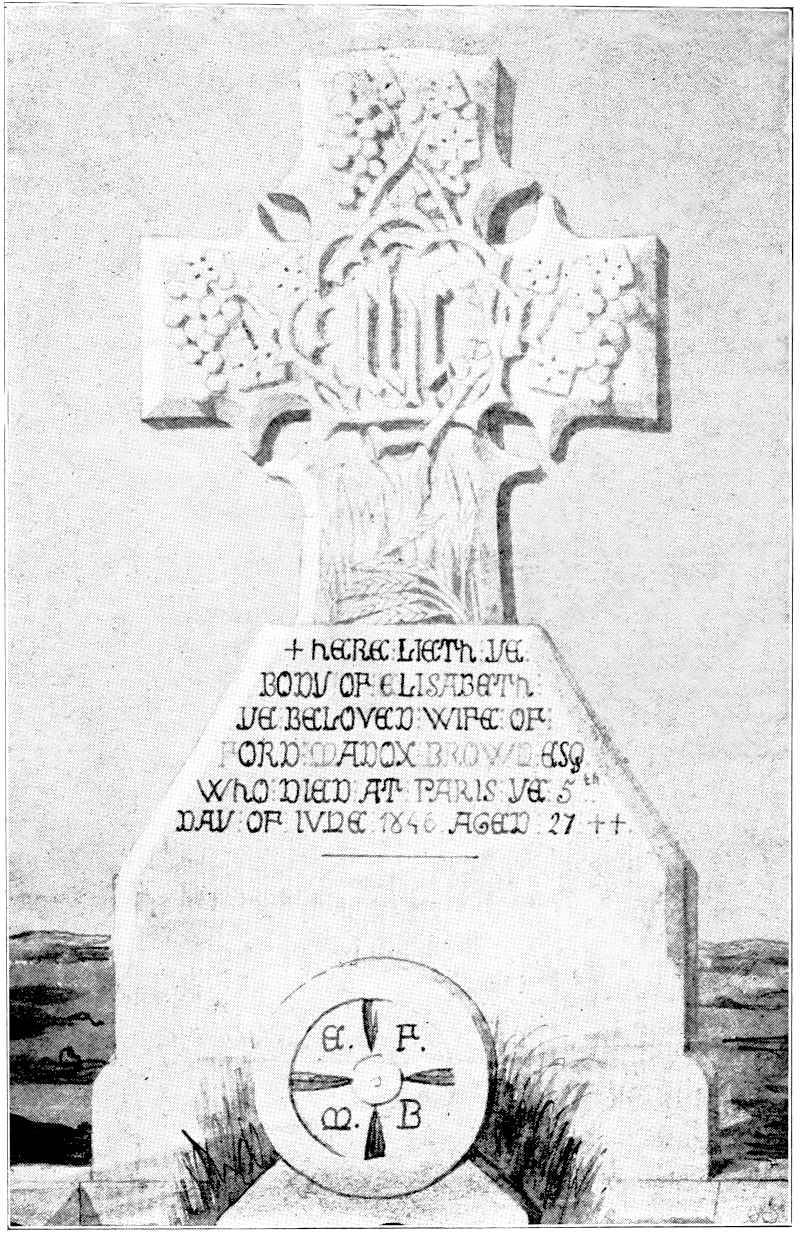
The Gravestone of Elizabeth Brown, Madox Brown’s first wife, Highgate Cemetery, designed by him. Print taken from a Drawing which he made in Colour-wash. A Grandson of Mr. and Mrs. Brown, Michael Ford Madox Rossetti, who died in infancy in 1883, is now buried in the same Grave.
To-day I have done little or nothing but sketched-in the figure of Chaucer in white chalk, and have been to the Strand about some costumes, after writing out a list of them.
I must not omit to say that in Rome I painted a sketch of it in oil, afterwards made a drawing of it in chalk, and then an outline of the whole as it now is; since which I began first to fill it up in colour at Southend, afterwards went on a little with it at Hampstead, and since touched it and marred it at Tudor Lodge.[7]
I have long intended beginning this journal; praise be God it is begun at last.
5th September.—Got up late, got to work late, did little, scratched-in three figures in white chalk; left off at half-past two, dressed and went out to dinner. Then went to the Cemetery:[8] found it full of cockneys: walked over to Hampstead, saw a glorious sunset....
6th.—Have not worked to-day—tried to do so but could not, having been out all the morning to the costume-shop and other places.... Got a lay figure from Barbe’s at last, bought ten yards of flannel for draperies, engaged a model for to-morrow. Lost myself in Somerstown; got into a place where there was no gas; thought I should get my throat cut. Persevered, and after almost breaking my neck got into the King’s Road at last.... Went to Cooper’s, and ordered a moveable seat for my painting-steps....
7th.—Got up at seven, model came, worked well all day—drew some legs....
8th—... John Marshall[9] came in; went out with him, and then called to see my aunt Brown. Lost a day like Titus, but dined (like Lord Byron on his birthday) on eggs and bacon and ale. Am very sulky with myself.
9th.—... Bought some plaid draperies, and set about arranging the draperies for Robert Burns[10] on the lay figure—sweated over it till dark, but got it to do at last. Went out till bed-time....
11th.—... Painted-in part of a study for Robert Burns’ tartan with copal varnish; worked till quarter to six.
13th.—Went to Gravesend to see Lucy dear.
14th.—Got up later, at eight. Finished the plaid, and began a drawing for the robe of Robert Burns. Mr. and Mrs. Lucy came in: afterwards Thomas interrupted,[11] and I didn’t do much. Have bought a rat-trap: studio[12] swarms with them....
16th.—Got up at half-past seven. Cut out a fresh mantle for Milton. Set it and began drawing it. Went out in the evening. Set about preparing a togam;[13] bought more flannel for it.
17th.—Got up at quarter to eight: worked all day at the cloak for Milton, and all the evening till twelve at the togam....
18th.—... Cut out the togam, and arranged it on the lay figure for Lord Byron....
20th.—Got up very early for a wonder: got to work at quarter past seven. Worked very hard all day; finished the drapery for Lord Byron. Dined, and walked round Regent’s Park with Thomas. Left him about to go and tell them, at a Shakespeare meeting of the Church Mason Society, that he thought it all humbug, and that the old House[14] had better be pulled down, and monument put in its place. Afterwards I came home, and had the energy to arrange the lay figure for Shakespeare before going to bed. I am honouring him in the right way.
21st.—Got up at seven, worked pretty well all day. The Lucys came in, and in the night the rats ran away with a mutton-chop—could find no trace of it, not even the satisfaction of seeing the bone....
23rd.—Got up late—painted till five.... Find that, when I have painted some hours, I get tired and cannot see the colour, but can see the shape. Memo., ought not to paint too long if I want to do good....
25th.—Got up early—and got to work late. Fumbled till twelve o’clock over the hood of the left-hand-corner figure of the knight; made a liripipe for it. About twelve set to work at a small drawing of ——;[15] had not finished it by dusk. Am a very swine—shall never get the painting done in time—am a beast and a sleepy brute.
26th.—Finished the drawing of the hood, and a drawing of a cloak for one of the men next him, the Chamberlain....
28th.—Got up at eight. Arranged the cardinal’s cape again; began a drawing of it. Lucy came in about one: made me go out with him. Did nothing more, but went to Richmond; back with him to tea. Came home by eleven. Read Shelley, and got to sleep about twelve.
29th.—Got up past nine, worse and worse; it is horrible to reflect. Finished the cape about one. Went out to see Thomas and my aunt; came back, and began arranging the hood for Alice Perrers, old Edward’s mistress: found the hair of the lay figure wanted curling—put it in paper, and made a fire to heat the tongs, and curled it; then oiled it. Alas! did nothing afterwards. Went for a walk with Thomas....
4th October.—Got up late; felt low and dejected, never feel happy. Got to work about twelve. Arranged the white capuchon for the lady with her back to you; nearly finished it....
5th.—... Went to Thomas to make a sketch of some vine-leaves—found him at work on his designs of the Penseroso for the Art-Union, but out of sorts and dejected. About three left off, and went to the cemetery at Highgate.
6th.—... Went out to see after stuffs, and a portrait of Chaucer published by C. Knight; could get nothing; tired and dejected....
7th.—... Dined too late to begin anything; went to sleep. Thomas came in, and we had a walk. He thinks of going to Cambridge, to become wise and learned in all matters. I am a brute and a sleepy beast.
8th.—... Began, and painted the white-silk head-cushion with copal varnish and drying-oil in equal parts; find it dries quick, and does not sink in on retouching. Went and drank tea with Lucy: engaged Miss Chamberlayne for Tuesday. Began making a green velvet hat of the time of Edward III.
9th.—... Have been suffering eight or ten days from indigestion; live upon mutton-chops and tea and coffee, quite a teetotaler....
12th.—Finished the furred cap; went and bought stuff for a blind, to have two lights if necessary, to give the appearance, to those figures which are not in sunlight, of being in the open air.[16] Lawrence did not come to put it up.
13th.—Finished the green hat. Wrote four letters, and called on Thomas to see some sketches of his; some fine ideas; one in particular, a scramble for laurels—grandly satirical. Came back to the studio, and put up the blind with Lawrence. Afterwards walked half over London in quest of draperies; bought some crimson cotton-velvet.
14th.—Got up at half-past seven. Miss Chamberlayne came. Worked till four, in spite of her talking propensities. Made outlines of the nude of the two figures of Muses of impassioned and satirical poetry,[17] and several other central figures. Dined, and called on my Aunt Brown. Walked down Holborn in quest of stuffs, and found some German velvet a bargain, 10¾d. a yard: took six yards of it for the gown of Chaucer. Came back, and am now writing this....
16th.—... With Thomas to the Princess’s Theatre, to see Miss Cushman and Cooper in The Stranger, both nature to the life; and She Stoops to Conquer, a fine fine play. Went and supped with Thomas, and stopped till half-past one....
19th.—Got up at half-past five; went to Gravesend to see my sweet child; found her quite well. Came back, and went to bed....
22nd.—Got up at half-past five, got to work by seven. Painted-in the King’s cloak (study). Workwoman came; set her to make the gown for Chaucer; myself made ears for the jester’s hood, and began a drawing of it. In the evening began drawing-in the draperies of Milton on the canvas.
27th.—Got up at—past seven. Went out to seek for velvet and brocades: got some velvet to suit, and an old yellow satin dress; saw some fine old brocade; told the Jew to bring it me to my study, to bargain some old clothes against it. Came back very tired. Drew a little at the jester, and in the evening at the draperies of Robert Burns.
28th.—Got up at quarter to seven; workwoman came at nine. Worked at the jester’s head. At ten Master Lawrence came in, and the poor brute became insolent, and wanted to fight me because I wanted him to be off again. Had to kick him out at last; and then he came to the window and abused me—threatened him with the police. Richard Bromley came to see me on his return from Ireland,[18] for a few days. The Jew came, and went off sulky, because I would not give him his price and the old clothes into the bargain. Did little all day but superintend the workwoman. Went to see the Lucys: came back and worked at Robert Burns on the canvas.
29th.—... Drew Chaucer and the old King in on the canvas. Am writing this and going to bed, twenty minutes past ten....
31st.—Sunday. Got up very late; painted at the sideless gown, and then at the hair and cap of the troubadour in the centre of the picture. Laid-in the study for it. Called on Mark Anthony,[19] stopped there till twelve. He told me that Hurlstone[20] had wished to get me to join the Suffolk Street set, which has been trying to regenerate.
1st November.—Got up at seven, felt very tired. Walked half over London: bought a portrait of Lord Byron and some yellow brocade, and hired some ermine. Came in about three. Finished the hair of the troubadour—dined, felt very tired; John Marshall came in—stopped till eleven (one hour’s work.)
2nd.—Got up at seven, and to work by eight. Painted the study of the ermine cloak of “ye ladie with ye sideless gown”; workwoman all day; cut out the yellow brocade hood and cape, and muddled away the rest of the evening (six hours’ work).
3rd.—Got up at quarter to seven, and to work by half-past eight. Finished yesterday’s work, and painted at a study of the ermine cloak of ye Black Prince, and at two had to leave off in consequence of the fog—which, like Foggo, was nogo.[21]
6th.—Got up at seven; have not slept last night. What is the reason of it? Drank some tea just before going to bed. Hope I shall sleep to-night. Got to work before nine, finished the hair. Arranged the lay figure for the figure in the yellow brocade hood, began painting it; did little before four. At seven went with Lucy to a meeting of the Shareholders of the Free Exhibition. We both refused to be on the committee. Martin in consequence is afraid they will turn him off,—poor Martin, hon. sec.![22] We have written to him to say that, if they do, we will have nothing more to do with them. Marshall Claxton and his party want to make Dibdin secretary;[23] what a set of muffs! What will be the upshot of it I don’t know and don’t care.—Went to bed at twelve (five hours’ work).
12th.—Got up at seven, and to work by nine—painted at the green gown till quarter past three.... Went to see Mark Anthony about a Daguerreotype: think of having some struck off for the figures in the picture, to save time. Came back, and set to work at a drawing of the head of Spenser: work from nine till twelve (eight and a-half hours’ work)....
16th.—Got up quarter to seven, and to work by quarter past eight. Worked at the study of yellow sleeve till half-past ten. Called on Thomas: came back to dine by five. He is hard at work, knocking metaphysical art on the head, and bringing each thing sentimental to a positive state. Lucy called on me; did not get to work again till nine. Worked at the head of Byron two and a half hours (seven and a half hours’ work).
17th.—Got up at quarter past seven, and to work by nine. Cogitated on what I was to do till half-past ten. Drew at the Cardinal and the two ladies till two. Set to work at seven: painted the first bit on the canvas: worked till I laid-in the head and neck of Lord Byron (ten hours’ work)....
22nd.—Got up at half-past seven, felt ill. Went out on business; wasted my time, and took a walk till twelve. Came back, and worked a very little—about one and a-half hours—wasted my time, and dined. Martin has just dropped a note in my letter-box, which seems to say that they have ejected him from the place of secretary to the Free Exhibition: if so, we have done with it, and there is no necessity for me to get this work finished: it has rather cooled my working-ardour. Worked a little in the evening, about two hours....
26th.—Got up at eight, began work at half-past nine. Worked till twelve at the head of Shakespeare; did nothing fit to be seen. Went out—wretched weather. Lucy came back and dined with me. About half-past six I set to work at drawing heads, but could not work: drew one: worked little better than two hours. I have been reflecting seriously about my large composition, that I had better paint the middle compartment small for next year’s exhibition, and recompose it for the large one on a grander principle. I have been reflecting on the subject, and have almost made up my mind to do so. I have sat up thinking of the new composition, to see if I could make a better one, so as not to risk sacrificing the present one to no purpose, and I believe I have succeeded to my satisfaction—(two hours’ work, two hours’ thought: three wasted).
27th.—Got up I know not at what time. Have been thinking about my change, and have decided to go and order the small canvas....
29th.—... Thought of a subject as I went along: Wiclif reading his translation of the Bible to John of Gaunt, Chaucer and Gower present. Arranged it in my mind. Called on Lucy; saw Martin, in a precious stew about the Free Exhibition. Dined, came home: made a slight sketch of it (three hours’ work).
30th.—Got up at quarter to eight. Went out to see about the Museum for consulting authorities; called on Mark Anthony; went to the reading-room of Museum; saw Lewis’s Life of Wiclif, Southey’s Book of the Church. Met Lucy there in search of documents for his Landing of Puritans in New Plymouth.[24] Came home, dined, and sketched a little at the subject (three hours’ work).
1st December.—Got up at eight; went out to the print-shops and to the National Gallery. Then to the Museum; read Godwin’s Life of Chaucer....
2nd.—Got up at half-past seven. Went out to the British Museum; got there by ten; made a drawing of a Gothic alphabet; read Knight’s Chaucer. Dined, called on my aunt Brown. Set to work by eight, worked till twelve, the sketch....
3rd.—Got up at eight. Went to the Museum by half-past nine; finished the alphabet, and consulted Pugin on Furniture. In the evening worked at the composition till half-past twelve (five hours—six hours Museum).
4th.—Went to Highgate and to Gravesend, to see my sweet child.
5th.—Slept at Gravesend, and drew a little head of my beautiful babe; it is to-day eighteen months since the death of my poor dear wife. These are thoughts that I must banish; it unnerves me. I have dedicated the day to my child and the memory of her mother. Yesterday I brought her fuchsia down from her grave, and have given it to Mrs. Lucy to take care of for the winter. I left Gravesend by the five o’clock boat, and have come back, intending perhaps to do some work (two hours).
9th.—Got up at eight. The night before I had finished the drawing of the sketch. About ten I began to draw a tracing of the sketch, to make it in oil; muddled and worked and muddled till half-past three. Went out, half inclined to work no more. Came back, dined. Mr. and Mrs. Lucy came in to see me; good excuse; I went home with them, and stopped till one!...
11th.—Got up about eight. Set to painting by ten; painted till half-past three at the figures of Wiclif, Chaucer, and Gower, and that side of it.... Did little good (eight hours’ work).
12th, Sunday.—Got up at eight, set to work before ten. Painted till three at the figure of John of Gaunt, etc.; went out and dined, and spent the evening with Lucy (three hours’ work).
13th.—... Called on Lucy. Buss[25] has been bothering him about the Free Exhibition. Went with him to Rowney’s: came back, dined, and set to work about six. Wasted one and a half hours cleaning a damned pipe. Worked till eleven (five hours’ work)....
16th.—... Set to work about twelve; worked till three, chalking-in the figures on the canvas. Went out for a model, unsuccessful; got Smith coming to-morrow. Set to work about quarter past six; left off for want of chalk. Am writing this, and going to write damned letters for money, etc. Can do no more work for want of chalk: have been as far as Oxford Street, but can get none. Drew a little at the ornamental part of the design (four hours).
27th.—Came up to London [from Gravesend]; did nothing all day. Called on the Lucys in the evening. On coming home to my studio at past twelve, found a drunken man groaning in one of the workshops with a candle amid the shavings. Fetched a policeman and the master; got him safe out.
28th.—Tried to work: did nothing all day but arrange the lay figure for Wiclif, and superintend the making of a gown for Chaucer; I am sadly idle!...
1848—1st January.—Came back to London and dined at Lucy’s. In the evening Thomas came in, and we settled to illustrate Pope’s Essay on Man between us; I proposed the subject.[26] Came to bed by one....
3rd.—... Worked till eleven at the outline of the painting; afterwards fiddled at a piece of poetry till quarter to one (eight hours’ work)....
10th.—Got up at half-past eight and to work by half-past nine; drew my two hands in the glass for Gower’s.... I afterwards drew a little at one of my hands for Wiclif, when that devil Miss Chamberlayne called. Walked round Regent’s Park, dined. Thomas came in, and with Lucy we went to Dickinson’s Academy, Maddox Street: saw Foley there, and Paris and Salter[27] (five hours’ work)....
12th.—Breakfasted in bed; drew all day at the canvas. Lucy came in to go to Dickinson’s with me: found I was making my figures of Chaucer and Gower too short—quite took me aback. Went and began a pencil drawing at Dickinson’s. Walked home with Lucy, came back; bought a bottle of whisky to drown care with (eight hours’ work).
15th.—I went to Greenwich,[28] to collect rents, and to Gravesend.
16th.—Gravesend still. Made a little study of Lucy in sunshine[29] (one and a half hours’ work).
17th.—Came back by the half-past eight boat: went to see John Bromley,[30] and to make a sketch of the hand of his little girl for the female in this painting.... Came back and set to work drawing at the figure of Wiclif. Went to Maddox Street; came back again at ten, and worked till past eleven (five and a half hours’ work).
18th.—Got up at half-past eight. Set to work by ten at drawing-in a hand and the sleeves of Wiclif. Began Painting. Laid-in the head and feet of Wiclif. Turned my canvases of the Poets round to the wall, so as to be able to admit persons if necessary.
19th.—... Called on Mark Anthony: saw his large Village Festival in progress; called on Lucy (five hours’ work).
21st.—Breakfasted in bed; got up at ten, and to work by eleven. Drew-in the head of Chaucer from myself in two looking-glasses; altered that of Gower, and reduced one of Chaucer’s hands.
22nd.—... Painted-in the sleeves and upper part of Chaucer’s gown (à premier coup): shall not want to retouch it much, I expect; worked till four.
26th.—Wednesday. Got up at half-past eight: went out for a walk; found it too cold. Went and bespoke Miss Ashley, and came back. Miss Ashley came by eleven: stopped till four, let the fire out three times, and talked all day; will never do.—In the evening I worked at the head of the female, drawing it in in water-colour; could not succeed (four hours’ work)....
31st.—... Went to Suffolk Street, to hear Professor Ansted tell us that the colour of the air is blue, and that of mist grey, etc. etc.; this they call geology! (two hours’ work).
1st February.—... I afterwards set about composing the furniture for my painting; did not do much (two hours’ work). Got a note from Helen Bromley, enclosing one for Miss Ensgrubber[31] to her, to ask my poor wife’s address. Oh dear! hers has been for upwards of nineteen months the cemetery of Highgate; mine, this rascally barn of a studio. To think that we once had a home together! in Paris how different, and even in Rome how different! Bless you, my poor child!
2nd.—Got up at eight, worked from ten till four at composing the chair of John of Gaunt....
3rd.—Going to set to work for about three hours at the chair. Did little good; what a muff I am! (three hours’ work).
4th.—Breakfasted in bed; set to work about ten. Recomposed the chair, and composed the lectern, and began painting it. Worked till half-past four. Walked round the Park. Set to work again at seven, when Thomas and John Marshall came in, and I did no more work. Thomas accused Marshall of having spoken about our London University project,[32] at the College. Marshall denied it, but said that he had heard that another body of artists had proposed the same thing about a year ago. Thomas stopped till eleven, and we drank two glasses of grog each (six hours’ work).
5th.—Breakfasted in bed; set to work about half-past nine. Worked at the lectern: altered it, painted at it till four. Dined etc. A wet day; did not go out. Began work again at seven till eight, and from nine till half-past eleven, painting at the lectern—what snobbish work! (nine hours’ work). Forgot to go to Highgate—alas my poor wife!...
7th.—Got up at quarter to eight; breakfasted, and went to Highgate. Had iron stakes put to the standard roses. Called on Lucy; went to London University, to see about Capbell’s bust of Potter.[33] John Marshall, on behalf of the Committee, commissioned me to make a drawing of it, for [which] I am to receive five guineas. Dined; set to at my accounts. Thomas called in to know if I would accompany him to-morrow to a meeting of the Freemasons of the Church, to hear a lecture on Beauty by a Baronet M.P. He for the first time explained to me his views on beauty, and the explanation thereof. Wonderful fellow! I hardly know what to make of him, his talents are so wonderful and varied. Stopped till half-past eleven.
8th.—Got up at half-past eight. Went to the British Institution; saw a wonderful piece of light by Inskip,[34] a beautiful marine by Danby (calm after a storm with a heavy ground-swell). I stopped one half-hour looking at this picture. Lance, Frost, Copley Fielding, etc. Afterwards I went to the University, and began the drawing of the bust; came back after two and a-half hours’ work, dined. Sam Bamford[35] called in, then Thomas; when we went to hear a most absurd lecture by a Bart.—beside whom was seated the Duke of Northumberland; after which some antiquarian controversy....
17th.—Breakfasted in bed; Miss Ashley called in. Composed the chair of John of Gaunt, and began it. In the evening went to hear Leslie’s[36] first lecture on painting: twaddle (six hours’ work)....
21st.—Got up at half-past seven, walked over the Park. Set to work about ten, painting at the arch. Got a letter from my Uncle Madox,[37] asking me to go and speak to him in the City on business. Left off about two; went to the City. Found he wanted to sell his one-eighth of the Tan Yard, and, if I would sell mine, he would get me £700 for it, £200 more than I thought it worth: no unpleasant news. Decided to sell it in order to buy a house....
25th.—Got up late. Rainy morning, did not go out. Set to work by ten. French Revolution[38] proclaimed. Worked at the balustrade, and laid-in the pavement.... In the evening I went to see the papers, and to hear Professor Ansted lecture on geology. Afterwards went again to get a sight of the papers, and went at eleven at night to see Lucy. Found him in great excitement about Paris; Fenton[39] his pupil, in a sad state about it. We all three have associations with Paris. Came back, and got to bed by one (seven hours’ work).
26th.—Got up at half-past seven, went out before nine. Called to see Thomas, and talk over the revolution. Came back to work. Maitland[40] came in by half-past ten; worked at laying-in the legs of John of Gaunt till half-past one; laid them in with light yellow and cadmium. Afterwards I could do nothing more, but went to see the newspaper. Called on Marshall and Lucy; and Thomas came and took me to an artists’ conversazione at the Bricklayers’ Arms: saw Scharf, Collingwood Smith, and Oliver there.[41] Had some more information about the Free Exhibition. Art-Union has joined, and members must be proposed and seconded. Went in and had supper with Thomas (three hours’ work)....
28th.—... Composed one of the figures for the spandrils over again; a young girl (instead of a child) to impersonate the Protestant Faith. Determined to make the figures fill up the whole of the spandrils without tracery-work. After dinner composed the other figure, of the Romish Faith; a figure holding a chained-up bible and a torch, with a hood (like the penitents at Catholic funerals) showing only the eyes, with burning fagots and a wheel of fortune for accessories.[42]...
8th March.—Got up at quarter past seven. Finished the cloak; began the woman’s head-dress. My aunt Brown called in. Walked out to the Strand and Trafalgar Square, to the scene of the riots. Came back by nine. Thomas called in. Began one of the flowers on the spandrils (nine hours).
9th.—... Set to work at making lions and fleurs-de-lys, of paper, for the jupon of John of Gaunt till twelve (eight hours’ work).
10th.—Got up at seven; set to work sewing on the arms on to his coat. Did nothing (when Smith came), all day, but paint the two crimson-damask sleeves, and badly too.—Set to work again about nine at the Gothic flower (eight hours’ work, three preparation).
11th.—... Arranged the lay figure I had made of the child; took up much time; did nothing more....
17th.—Got up at quarter past seven, to work by quarter to nine. Painted at the ivy till quarter past two, and from half-past three till six at the damask back of the chair. Arranged the lay figure for John of Gaunt. From half-past seven till ten painted-in the ground afresh for the jupon; yellow for the blue, and white for the red; nothing like a good coating of white to get bright sunny colour: (nine hours’ work, two and a-half arranging)....
22nd.—Rose at seven, to work by nine. Painted-in the Page with the books, all but the sleeves. Head very successful; rubbed out the legs. From seven till nine at moulding of frame, from half-past ten till two, modelling ornaments for ditto (ten, and three preparing)....
24th.—Got up at quarter past seven, to work by nine. Painted the head and one hand of John of Gaunt; my eyes so dim and weak I could hardly go on with it.[43] Painted till half-past two. Went out to the City: came back, painted the cap of John of Gaunt....
25th.—Got up at seven, to work by nine. Painted till twelve at the head of fair Page. Maitland came. Painted the hose of John of Gaunt; did not do, rubbed it out again. Had interruptions. Elliott, Thomas, and Rossetti called;[44] the latter my first pupil. Curious enough—he wrote to ask me to give him lessons, from his opinion of my high talents; knew every work I had exhibited and all about [them]. Will see what we can make of him. Worked from ten till twelve at correcting the arms of Wiclif (nine hours)....
27th.—Got up at eight; to work half-past nine; till six painted the water behind the pages, etc., and the heads of the two boys, with part of the railing: heads in shadow very difficult. Dined and walked out, and wrote two notes. Set to work by nine, designing ornamental work for the spandrils, and also the figure of Catholicism, much to my satisfaction, till eleven o’clock. Writing this, and mean to work one hour more at the spandrils (eleven hours’ work)....
2nd April.—Got up at seven, to work by nine. Till twelve, at the head of John of Gaunt from Smith (bad): glazed a sleeve, and the blue velvet of the same. Painted at the head of Chaucer from Hewlett from three till six (bad). Worked from nine till ten at setting the lay figure for the monk’s draperies, drew part of them till quarter to twelve (eleven hours)....
5th.—Got up at six, to work by seven. Till ten at the shoes of Gower, and the steps; from half-past ten till half-past one at the head of Wiclif from Krone; eyes so dizzy obliged to leave off. Went for a walk, bathed my eyes; began again at three till six—not the thing. Dined, went to sleep. Mr. and Mrs. Lucy called in. Set to work at ten, at one of the cinqfoil ornaments. Have not yet finished it, twelve o’clock; must finish it before I go to bed—finished it by one (twelve and a half hours’ work).
6th.—Got up at half-past six; to work, by a quarter to eight till one, at the figure of Wiclif. Glazed his gown and part of his cloak, and repainted a long time at the head. Eyes very bad; walked out over the Park. Began again at the head at two till three; then painted till six at the hands of John of Gaunt. Lucy came in, and drew-in the figure with lily in the spandril. I began work again at nine, at one of the cinqfoils; finished it by eleven; must try and do the other and last one. Did nothing more (eleven hours).
7th.—Got up at quarter past seven; to work by half-past eight at the third head of Chaucer; made it worse than before. Had Mrs. Yates for it. Worked till eleven at it—quite horrible. Afterwards painted the two hands rather well; then painted the hands of Gower and one foot of Wiclif pretty well. John Marshall called in: talked a great deal about the approaching revolution; what is to be the upshot of it? Thomas called in. I set to work again at half-past nine till eleven, and drew-in the figure in the spandril with the lily (ten hours’ work)....
14th.—Up at seven; to work by eight. Painted the head of Wiclif till half-past ten from old Coulton. My uncle Madox called at twelve. Began retouching the arch; worked at it till six. Went to the Free Exhibition: began painting the female in the spandril at nine: worked till half-past twelve (eleven hours’ work).
16th.—My birthday; twenty-seven to-day, alas! Got up at seven; to work by eight. Painted the red cross and rosary of Chaucer, then the hose of the Duke. Muddled at them; could not succeed. In despair rubbed them out again partly, and made them another colour, yellow and grey. Will do, must do, but not very well. Glazed the archway, and began marking-in the stones. Did a little to the cloak of Wiclif, and the hassock of the female. Began work again by eight till two in the morning; painted a host of little odds and ends (fifteen hours).
17th.—Got up at six; to work by half-past eight. Finished the Pages and Chaucer and Gower and Wiclif: painted the green rushes: finished the ground, the reading-desk, and the female’s chair. In the evening painted at the letters from nine till eleven. Then again at the female and the mosaic work till four in the morning (seventeen hours).
18th.—Got up at six; to work by half-past seven. Repainted the whole of the flesh, glazing the shadows with yellow lakes and madder, and repainted the lights with their white tints. At three began at the general effect. Worked till half-past six, then again till three at the mosaic work and sundries (eighteen hours).
19th.—Got up at six: set off with my picture to the gallery, Hyde Park Corner. Got there by nine. Ten o’clock before framed, and that did not fit. Thought I had all day to work, but found we were all to decamp at ten. Got leave to wait till the sweeping was done, and set to work again at twelve till six. Improved the general appearance much by glazing etc. Slept next door at a tavern, to be able to be at work next morning at six, to finish it before the private view (six hours).
20th.—Up at quarter to six; to work by half-past. Painted at the hose of John of Gaunt, and put-in some trees—too green.... Then fetched Thomas for the private view. Afterwards spent the evening and slept at Bamford’s (four hours).
21st.—Went to the gallery at about eleven: repainted at the trees till two.
4th May.—Had my pupil Rossetti here; working for about six hours on a head, to show him (six hours).
6th.—Got up at half-past six. Began work at nine till five from Maitland: began a study of his head in sunlight, and painted the black silk legs for Shakespeare and Milton[45] (eight hours).
7th.—Got up at eight; to work by nine till four. Did little but a drawing (of his head) for the courtier next to the one in the yellow hood in the foreground, for which also is the study in oil (six hours).
17th.—Up at five. Six till eight at the study of Mrs. Yates [a hand]: the rest of the day made alterations in the figure and head of Lord Byron (eight hours).
18th.—Up at five. Six till eight at Mrs. Yates. Walked till eleven with Thomas. Had an argument; tried to persuade him that, to imitate the true tone of the model, it must be painted so that, when held up beside it, it would not be like it in colour. Did nothing but try to write down what I had been speaking of; afterwards went to see Lucy....
22nd.—Up at half-past eight; to work by eleven. Altered the head of Burns, and drew-in that of Pope. Walked over the parks with Thomas (five hours’ work).
15th June.—Cleaned the dog, and shaved his head and paws....
17th.—They want to engrave Wiclif for The People’s Journal.[46] Laid-in skirt of Robert Burns’s gown; worked about four hours till five o’clock. Called on proprietor of People’s Journal; supped at Mr. Bamford’s....
25th.—Came back. Heard of the revolution in Paris; spent the evening with Lucy....
17th July.—Went to Paris, to see my old friend Casey,[47] and buy a lay figure. Did both; enjoyed myself much. Painted a portrait of Casey: worked about seven hours at it. Came back to London on the 6th [August].
28th August.—Set to work, about half-past two till six, at the architecture of the Byron compartment; afterwards at the same by lamp-light. Thomas has begun working by night in my studio....
30th.—Walked out over the Park; then to see Lucy. He told me of another kick-up at the School of Design: he had been applying for one himself; I began to think of it.[48] Called to see Thomas, and talked the matter over: worked but little at the architecture (three hours).
31st.—Set to work about twelve till two, and from three till five, at the architecture. Rossetti called with Hunt,[49] a clever young man (three hours).
10th September.—Read Keats,[50] and spent the day with Thomas.
11th.—Ill in bed with a bad cold; Lucy called....
13th.—Up late; could not get to sleep. Out to see Thomas: could not get well; who knows but it may be the death of me? Damned wretched, but only because not occupied.
21st.—Started for the Lakes of Cumberland in company with Lucy: saw the Exhibition of Manchester.
25th.—Began painting a view of Windermere: worked six days at about four hours a day, last day in the rain under an umbrella.
2nd October.—Started on foot for Patterdale; then over the mountains past the Greenside lead-mine to Keswick.
3rd.—Through the Borrowdale pass to Wast-water.
4th.—Rain all day; stopped there.
5th.—Started in the rain over the mountains by Eskdale to Windermere.
6th.—By rail to Liverpool. Saw my Wiclif there up high: looked damned bad.
7th.—To Chester, thence to Birmingham; saw Exhibition, and back to London that night.
8th.—Went to Gravesend to see my darling.
9th.—Went to City; afterwards painted at my view of Windermere at the sky (two hours’ work).
10th.—All day writing a letter to Builder about Thomas....
12th.—Began a portrait of R. Bromley’s daughter (four hours).
13th.—Portrait not dry enough to go on with. Sent for Mrs. Ashley and child, and began a sketch of them for a little picture of a mother and child.[51] Made a sketch in the evening, in black and white, of the view of Windermere (three hours’ work).
14th.—Laid-in the view of Windermere with a thin coating of asphaltum, and white for the high lights: drying-oil and copal. After dinner sketched the outline of a small sketch for Mother and Child: after tea worked on the helmet and sword of Lord Byron[52] (eight hours’ work).
15th.—Painted a sketch of the Mother and Child: in the evening worked at the Byron’s sword (seven hours).
16th.—Worked at the portrait of John Bromley about four hours....
18th.—Went out with Rossetti to see his picture.[53]
28th.—Painted other arm of Julia Bromley (two hours), and in the evening wrote a defence of Thomas’s Lectures for The Builder.[54]...
31st.—Wrote all day at the letter to Builder....
4th November.—Tooth all day; in the evening wrote about influences of antiquity in Italy.[55]...
12th.—Did very little; painted a copy of Lucy’s head[56] (two hours).
13th.—Drew a portrait of Mrs. Ashley’s baby, and wrote in the evening on Italy and Art (three hours)....
16th.—Worked at the little picture: laid-in the background, and altered the legs of the child. In the evening thought a great deal about the subject (four hours).
17th.—Wasted half the day, and composed Lear and Cordelia.[57]
18th.—Went to Pratts’s, and subscribed for armour and old furniture: tried to work, but did little....
19th.—Began work late; composed Lear and Cordelia (six hours).
20th.—Wrote an answer to “Amateur” in The Builder, and started for Gravesend.
21st.—Came home by 8 p.m. Drew at sketch of Lear (three hours).
22nd.—Went to Pratts’s. Set to work at one till half-past three at the mirror; spent the evening studying grammar (three and a-half hours).
23rd.—Began work at ten till half-past three, at mirror and gilt leather: asphaltum, cadmium, lemon-yellow, ivory-black, sienna, etc.; magilp and copal. In the evening worked at the composition of Lear and Cordelia (six hours’ work)....
25th.—Up late. To work by eleven till one at the gilt leather. John Marshall came in: did little more but arrange a bunch of keys, and begin them. In the evening worked at the Lear, but have not yet settled it (five hours).
26th.—... In the evening worked four and a-half hours at Lear; going on well (eight hours).
27th.—... In the evening wrote three notes, and worked from seven till eight at Lear; finished the outline of the sketch (five hours)....
30th.—Painted at the sketch. Went with Lucy to see Elliott’s picture and Rossetti’s (four hours)....
5th December.—Spent the day in divers ways; bought a large oak door, and scraped it with glass, and varnished it; in the evening composed the panels of the little picture (three hours’ work).
6th.—Had a King Charles spaniel; paid 4s. 6d. for it. Painted it in three hours: evening, began chalking the outline of the Lear on canvas (seven hours’ work).
7th.—Painted at the panel five hours. In the evening had a model, to draw the nude of Cordelia (seven and a-half hours)....
19th.—Bought mittens and a rose, and made a fan; arranged it, and began the gown. In the evening Maitland for two hours: sketched the figure of Lear (seven hours)....
30th.—Drew at the outline of Lear till three.
1849—11th January.—Painted the sea, cliffs, ships, and tents, in Lear; in the evening painted the four little figures, and drew-in the nude of warrior resting upon his shield, from Maitland (nine hours)....
16th.—Up till four night before. Supped with Lucy and Mark Anthony at an oyster-shop. Began work at one, till four; painted body of dress from Mrs. Ashley;[58] in the evening rubbed it out, and drew four hours at the head of Cordelia; made it beastly (seven hours’ work)....
27th.—Laid-in the Jester’s hands,[59] and re-painted the flesh of the child in little picture. In the evening, laid-in the head of the fool, from Rossetti (seven hours).
28th.—Re-painted one arm and hand of mother in the little picture, and re-touched it generally; in the evening laid-in one hand of the physician, and retouched the expression of the jester (eight hours).
31st.—Laid-in the head of Lear from a cast of Dante’s, and a drawing of Coulton. Called on Lucy, and ordered a frame in the evening. Again in the evening (eight hours).
1st February.—Worked all day at the head of Cordelia from model: in the evening rubbed it out, and retouched the head of Lear. Found a dog in the rain, and brought him home with me (seven hours)....
6th.—Finished the little picture.
17th.—Altered the head of Cordelia; painted-in head of Lear, and head and hand of Kent: evening, re-touched heads of Kent and jester and Cordelia (eleven hours).
18th.—Sunday. Painted-in the head of Cordelia from model, and one hand; evening at Lucy’s (seven hours)....
1st March.—Painted the head of the jester from Dante Rossetti, and the hands from Mrs. Ashley; so muddled away the day. In the evening Bell Smith, of Free Exhibition, called to inform me that I might keep it till private view; also of secret machinations to form a fresh society and so get rid of the muffs (seven hours).
2nd.—Went to Greenwich, and then to Free Exhibition to ballot for places; evening at Thomas’s....
13th.—Re-painted one hand of Lear (bad), and his head (not too good): bad day. Evening, carpet (eight hours)....
21st.—Re-painted and finished the head of Cordelia at last; painted the carpet and flowers and shield and divers (eight hours).
22nd.—Took Lear to the Free Exhibition. Found a large white sky came directly beneath it: kicked up a row, and got it taken away, then worked at the picture at divers (three hours).
23rd.—Re-painted the sky, and re-touched many things, and finished it definitely (six hours).
24th.—Went to private view: picture much liked. Started for Gravesend: my child in bed.
28th.—Went to see Baily’s Graces at his studio, and Nichols’ sculpture for the pediment of the Hall of Commerce, Manchester; bad but effective. Also to see some magnificent Dutch pictures at Mr. Theobald’s.
29th.—Went to see young Hunt, and thence to see Millais’s picture, Isabella; wonderfully painted, full of expression, sentiment, and colour, and extreme good painting, but somewhat exaggerated in character, and careless in drawing.
31st.—Painted at the view of Windermere.
2nd April.—Evening spent at Rossetti’s: saw his designs and his brother, all up in his little room, fifth storey[60]....
5th.—Painted at Windermere, cows and foreground (five hours).
6th.—Painted at idem, horses, etc. (five hours)....
10th.—Painted in the day-time, and in the evening from nine till eleven: finished it, and carried it to the Royal Academy (seven hours’ work)....
27th.—Worked at the outline of Poats:[61] drew-in the page in the foreground from nature (four hours)....
5th May.—Worked at the water-colour sketch;[62] began re-painting it in oil (four hours)....
8th June.—Began painting on the centre compartment of the picture. Painted at the yellow hood in the foreground; painted-in the head of it ...; lemon, chrome, cadmium, and yellow lake, with copal; vehicle, copal and drying-oil (five hours)....
21st.—Painted-in one hand and the head; laying-in the shadows with emerald-green and white and much copal, and the lights with pure white and copal; the outline drawn with water-colours, much hatched (ten hours).
22nd.—Painted-in one hand from Maitland in sunlight: find I can put the models in the sun (three hours).
23rd.—Painted-in the neck and hair and draperies of the admiring courtier, also one hand of the foreground page, always laying-in the flesh with pure white (eight hours)....
25th.—Painted a study of the head of Maitland for the Black Prince, and the head of page from young Deverell[63] (seven hours)....
29th.—Touched the Page’s head, and painted-in the Jester’s from John Marshall (nine hours)....
2nd July.—Set off to Shorn Ridgway. Found some fine scenery overlooking the Thames and Essex; began a study of it for my background to Chaucer (three hours)....
[Towards end of August].—Painted about twelve days at the picture of King Lear: altered the head of Cordelia, shortened her hands and arms, enlarged the head, thickened the figure (sixty hours).
Painted four days at the little picture of Mother and Child before sending it home (twenty hours)....
Spent three days arranging the sleeves of the Page. Went to Margate with my daughter, and stayed there two weeks, during [which time I] had three sittings for her portrait[64] (nine hours)....
5th October.—Began a portrait of Mr. Seddon;[65] to be painted, and that of Mrs. Seddon, for a sofa; went to a conversazione with them....
3rd November.—Finished Mr. Seddon’s Portrait. Drew-in the Jester, and painted his hands, sleeves, etc. Drew at other parts. Composed a subject for Beauty and the Beast; ... drew a figure of Beauty from nature. Wasted about two months changing into a new studio. Began the portrait of Shakespeare for the Dickinsons: painted a sketch of it, made a drawing of the head, and a study from Mr. Barker for it. Drew a cartoon of it.... Drew a figure of the Lord Jesus for the Dickinsons.[66]
1850—2nd March.—Worked at it and the cartoon of Shakespeare to-day (four and a half hours). In the evening three hours at The Lord Jesus (border-work)....
4th.—... To meet S. C. Hall,[67] at Lucy’s, meeting of the committee of the North London School of Drawing and Modelling (two hours)....
6th.—Painted at the forehead and hair of Shakespeare, and drew the border of thorns of the Christ (eight hours)....
12th.—Went to a committee of North London School (six hours).
13th.—Idem. Went to Fenton to paint his dead child (six hours)....
16th.—Painted at the head of Shakespeare and background, and drew at the Cordelia for etching[68] (10 hours)....
Diary resumed on the 16th August 1854.[69]
Idle day: morning spent musing in bed; afternoon walked out with Emma and Katy;[70] evening, garden and dim reflections. Much study of Blue-book of Department of Art and Science (impudently called “of Science and Art”). In the interval which the diary shows (to the best of my recollection) I painted in the year 1850, still in Newman Street, first the remainder of the Shakespeare portrait, for which I was paid sixty guineas; then I finished the etching for The Germ, which cost me 31s. 6d. and brought me in nothing. Afterwards I designed a card for the Dickinson Exhibition of Shakespeare, on which I worked several days for no remuneration. The drawing of The Lord Jesus was paid me £2: they afterwards lithographed it in shameful style, so as to cause me much annoyance.
For the remainder of the year I worked at the large picture of Chaucer, and studies of landscape for it, one of which I afterwards finished up, and gave to Seddon. In 1851 I finished the centre compartment of The Fruits of English Poetry,[71] having determined to abandon the wings. To get this part finished for the Academy, I had to labour very hard, and at the last worked three whole nights in one week, only lying down with my clothes on for a couple of hours. Emma sat for the Princess, which was done in two sittings of two hours each.... Elliott, a pupil of Lucy’s, the cardinal. John Marshall, of University Hospital, was the Jester. Miss Gregson, since Mrs. Lee, was the fair princess behind the Black Prince. Her friend Miss Byne sat for the dark one, but much altered. The scoundrel (and afterwards thief) Maitland, then under Marshall’s hands for operation, sat for the Black Prince. The fine woman below looking round was a portrait of Julia Wild, celebrated as model, ... also for black eyes; the boys were mostly portraits, but the other heads ideal chiefly. I sold this picture to Dickinson for 85 per cent. of whatever he might afterwards sell it for, to be paid after he should have received the money. I have since urged him to put it up to auction, which he has done, but no one would buy it; so he still has it. This year 1854 he paid me £20 on account of it, which was all I ever had for it.
After finishing this picture (which I forgot to say the Academicians hung in such a way as to shine all over, and without the frame), I took a house at Stockwell.... I went for three days to the Isle of Wight with Anthony and Hunt. The first day we marched for five hours in the rain; the second and third, revelled in the enjoyment—liberty, novelty of scene, fine weather, and huge appetite. The fourth we returned home. At Stockwell this year I painted one month at the sketch for the Chaucer, begun on paper and water-colour. Anthony was to give me a work for this, but I afterwards asked him to give me twelve guineas instead, which he did. I then began my picture of the Baa Lambs, which I finished in five months of hard labour; during which time I was very hard up generally, owing to McCracken not paying me all at once for the picture of Wiclif, which he purchased of me at this time for fifty guineas and a very bad Deighton[72]—a do in fact. During this time I painted Mrs. Seddon’s portrait, which turned out bad and a curse: this was the second portrait for the sofa, which they valued at thirteen guineas cost-price. During this time I also finished the landscape-study of Shorn, which I gave to Tom Seddon; he having kindly lent me money about this time, £12, I think; £5 of which I borrowed to lend Lucy. But Seddon was the first to borrow of me, £10 once. At this time I also finished the sketch of Wiclif, and the first of Chaucer (since given to John Marshall); about a day’s work between the two.
The Baa Lamb picture was painted almost entirely in sunlight, which twice gave me a fever while painting. I used to take the lay figure out every morning, and bring it in at night or if it rained.... My painting-room being on a level with the garden, Emma sat for the lady, and Kate for the child. The lambs and sheep used to be brought every morning from Clapham Common in a truck: one of them ate up all the flowers one morning in the garden, where they used to behave very ill. The background was painted on the Common. The medium I used was Roberson’s undrying copal (flake white). After getting rid of these works I went to Foot’s Cray for Michaelmas with my daughter Lucy, where I painted my picture of Paul’s Cray Church in ten days. This I have sent to Robinson’s Auction a few months since, and it fetched £2. 8s. inclusive of frame. It was exhibited at Grundy’s and Liverpool in 1852.
After these works I began my picture of Christ washing Peter’s Feet, painting this one at my painting-rooms in Newman Street: at the same time I began the study for the small picture of Waiting,[73] working at it in the three evenings a week I used to sleep in Stockwell—the other three being passed at the studio to save time. Twelve days before sending in the Christ picture I had given it up in despair, none of the heads being yet done: so I returned to Stockwell to alter the head in the Baa Lambs picture, being dissatisfied with it. I afterwards took up the Christ again at the instigation of Millais, and painted the heads of Peter, Christ, and John (this one the only one laid-in), also all the other figures of apostles, in ten days, and sent it in. This picture was painted in four months, the flesh painted on wet white at Millais’s lying instigation; Roberson’s medium, which I think dangerous like Millais’s advice. Having got rid of these pictures (which were hung, one above the line so as to shine all over, the other against the window in the octagon room), I immediately began the picture of Waiting; from Miss Ryan[74] the head, the remainder copied from the study painted at night. I all but finished this little picture before leaving our house at Stockwell: ten weeks’ work at least....
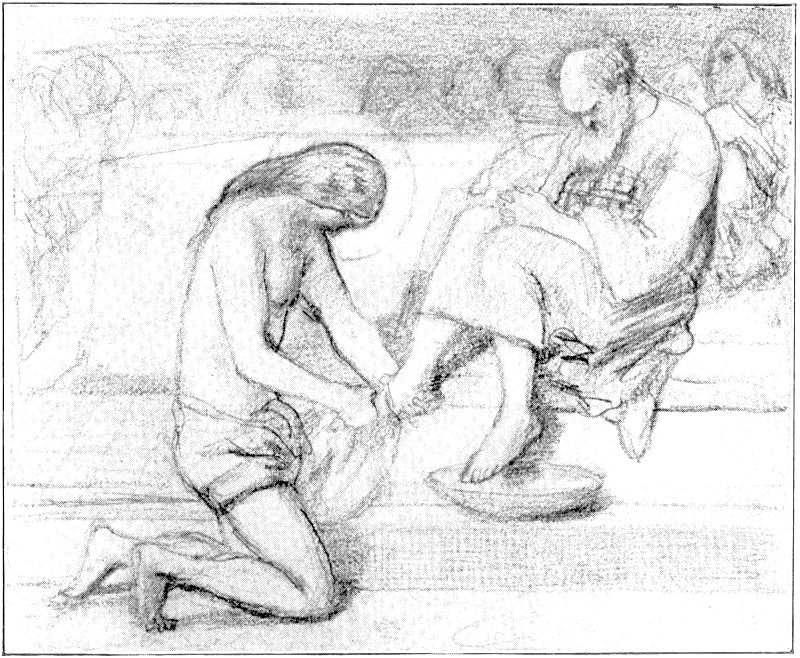
Christ Washing Peter’s Feet, by Madox Brown, Pencil-sketch for the Oil-picture now in the National British Gallery. The Picture seems to have been begun towards the winter of 1851, and was exhibited in 1852: this Pencil-drawing is probably the first sketch made to try the composition.
In June I left Stockwell and Newman Street for Hampstead, Emma going to Dover for the summer. At Hampstead I remained one year and nine months; most of the time intensely miserable, very hard up, and a little mad. During this time I was Head Master of the North London Drawing School for nearly a year. I once received £5 from the Secretary as a loan, which I returned to him a short time after; this was all I ever saw of my salary of £60 a year. The first work I undertook at Hampstead was the design for my picture of Work, still unfinished save the background. I also made a small copy of the Baa Lambs, and painted two small portraits; one for nothing, not even thanks, the other for £5. I began the background for Work in the Streets of Hampstead, painting there all day for two months, having spent much time in inventing and making an apparatus. This, and finishing the picture of Waiting, took up till the beginning of October, when I commenced the Landscape of English Autumn Afternoon; which I had to give up after a month’s work, in consequence of Mrs. Coats’[75] being ill and her bedroom being required. Having given this up about the end of October, and decided that I should not have time to finish the Work for the next Academy Exhibition, I designed the subject of The Last of England, at the coloured sketch and cartoon of which I worked till Christmas. During this period I worked about ten days at the cartoon of Our Ladye,[76] etc., and the picture of the Baa Lambs. About this time I also got the twelve guineas from Anthony, and sold the sketch of Wiclif to McCracken for ten guineas, also the sketch of The Infant’s Repast to some scoundrel at Bristol for £5. At the beginning of ’53 I worked for about six weeks at the picture of Last of England, Emma coming to sit to me in the most inhuman weather from Highgate. This work representing an out-door scene without sunlight, I painted at it chiefly out of doors when the snow was lying on the ground. The madder ribbons of the bonnet took me four weeks to paint. At length, finding that at this rate I could not get it done for the Academy, I gave it up in much disgust, and began re-painting the sketch of Chaucer to give to John Marshall; on this I worked about two months, also a little at the painted sketch of Cordelia from the etching in Germ.
About this time I lost many days through interruptions of a domestic nature, but resumed work again about the 15th May at the pictures of King Lear and Baa Lambs; doing about two months’ work to the King Lear, which I sent to Manchester along with the Waiting, and perhaps five weeks’ work to the Baa Lambs for Glasgow, all of which returned unsold. During this period we were residing at Hendon till the 1st September ’53, when we removed here at Church End.[77] About the 15th September I recommenced painting on the English Autumn picture, and finished the view from the back window about the 20th October. From this period till the 10th of June 1854, I must have wasted four weeks through Lucy’s holidays, two through nervous disorder of the brain, and about one through Emma’s illness. Of the remaining time, about two months was taken up again repainting the King Lear; one month on the picture of The Last of England; three days on repainting the picture of Winandermere (since sold to White[78] for £5); ten days on a lithograph of Winandermere (a failure);[79] nearly a month on an etching of King Lear, yet unfinished;[80] six days on a lithotint of Baby (a failure); and the rest of the time on English Autumn Afternoon, which last (which took about six months) was sold at Phillips’ Auction for nine guineas to Dickinson, the frame having cost four. He has since sold it to Charles Seddon for £20, and declares he will not make any profit by it, but put it to my account. The King Lear was sold at the same time for fifteen guineas to John P. Seddon, having cost eight months’ work, and the frame £3. 10s. Shortly after this, White, who had just purchased the two Wiclifs from McCracken, came here, and bought the Cordelia sketch for £10; picture of Waiting, £20; sketch of Baa Lambs, £5; and Winandermere, £5; in all £40. Since which I have spent one month in finishing the Cordelia for him along with the others. Having finished these and got the money, I wasted about a week, and have since been engaged finishing-off a study (two views of the same girl’s head, painted at Southend in ’47)—one day at this, and the rest at making a picture of study of Windermere painted in ’48, when with Lucy at the Lakes. I must now endeavour to keep up this diary more accurately, but have become lazy through discouragement—yet not so much so as some people think—but broken in spirit, and but a melancholy copy of what I once was. “Ah what to me shall be the end?”
1854—17th August.—Rose at a quarter before nine—garden after breakfast, shower-bath before. To work by eleven till one at the view of Windermere.... This evening I intended drawing, but instead reflected on alterations to be made in the picture of Christ and Peter, which I think of sending to Paris[81] with the Chaucer, if the English Committee accept it (six hours). The Christ in its present state I consider to be a failure—too much melo-dramatic sentiment, not sufficient dignity and simplicity of pose. What to do with it, however, I scarce know. To suit the public taste, however, it should be clothed;[82] to suit my own, not; but then the action suits me not to alter, which would be more trouble than to clothe the figure. Aureoles they must all have. The St. John is all right. The Peter would be perfect if the carnation were redder and deeper in tint, and the cloak a better green; also a bit of the right arm should be shown; but how? Judas requires a fresh head of hair, his present one having been dabbed in from feeling in the last hurry of sending in. Memo.: his garment to be a paler yellow. Four of the other apostles require more religious feeling, which must be done—William and Gabriel Rossetti in particular require veneration to be added to them. The table-cloth will require alteration, and the tiles of the floor. Health and spirits tolerable to-day, nerves quiet.
18th.—Worked from nine till half-past ten at the charcoal sketch of Beauty before she became acquainted with the Beast. Read Antony and Cleopatra in bed this morning; found it more interesting than ever, was deeply affected and strengthened; such is the effect of all history-reading. The moral the play seems to imply, if any, is that there is in shame and degradation a pitch than which self-inflicted death is more to be tolerated. Pity when any one with modern notions of the criminality of such act is driven to it. With poor Haydon it was the only atonement he could make to humanity degraded in his personal conduct. How can degraded things be still interesting?
20th.—Yesterday one of degrading idleness. Out for a longish walk with Emma; came home tired, dejected, and nervous. Tried to work at drawing of Beauty for about one hour; contemptible state (three hours). This morning have written notice of sending Chaucer, King Lear, and Christ, to Paris (will the Committee permit!?!?)....
22nd.—Yesterday I worked at the little picture till six or half-past; re-painted the child’s hands from the studies, and the head from feeling; till I became thoroughly disgusted with the work, as I have with the Windermere. Both are now put by till the inspiration come on again. When nothing hurries, this is the best plan....
This morning I felt incontrollably disgusted with everything; could literally do nothing, not even summon energy to go into London; when Emma started the bright idea that we should go to St. Alban’s. As soon as dinner over we started on foot for Colney Hatch station.... The rail only goes to Hatfield, we found; but there, got a ride on the top of the ’bus here, in the most lovely weather—Emma in a state of buoyant enjoyment. We should have thought more of the fields, no doubt, were we not so much used to them of late. However, one field of turnips against the afternoon sky did surprise us into exclamation, with its wonderful emerald tints. And then we passed a strange sight; two tall chimneys standing separately in a small space of ground (about a rod, I suppose); the rest covered with black-looking rubbish, some of it smoking, some children looking at it. This, the day before, had been a house, the home of a young couple married some three months, the man a wheelwright. Fire surprised them in bed the previous night, it would seem, and they had to escape as they were, in their bed-clothes. And here lay all that they possessed, flattened down into black ashes. I broke a tooth a day or two ago, and the gap seemed for some days hard to reconcile with my impressions of what forms ought to surround my tongue. If so it is with the remains of a decayed tooth, the gap caused by the loss of all one has must be harder still to realize at first. However, they are young, and no life was lost; and, as the man is not an artist, there is yet hope of prosperity in store for them. And now we are at the Peahen, and Emma has just gone to bed, and I am writing God knows to what purpose (but vanity). And we have spent six shillings getting here, which is sheer madness in the present state of our prospects; besides one bob wasted on a description of the Abbey—certainly the silliest little book that fool ever penned, the most complete do that ever I was subjected to; fifty pages of the most complete vacuity that ever small-country-town-bred numbskull, without a shade of learning, ingenuity, or imagination, could possibly have put into circulation. And now to bed. Not even one line of the Battles of St. Alban’s!
23rd.—We arose at twenty minutes past seven, and bullied the chambermaid for not waking us,—at least I did. Breakfasted, and off to the Abbey. Bill at the Peahen most gloriously small, by the way; we expected at least sixteen shillings; it was only nine: bed one and six, no wax lights. What meekness on the part of the woman of the Peahen!—a woman keeps it. We paid one shilling for two tickets to the Abbey; not to go up the tower, which would have been two bob. Emma’s tender state made it a matter of prudence, more than economy, not to go: and well we did not pay the other shilling, for mark the sequel. We two (nothing buckram about us as yet) went, and found ourselves opposed by one abbey-door which would not open; then one rector’s maidservant came towards us two, and said that it did not open till ten, and moreover that service began at half-past, and that, if we wished to see the place, she had better go for the verger. Well, we two, being there quite in the dark as to what all this meant, naturally concluded that the rector, his maid, the verger, and the whole conclave, were of a plot to rob us; so we declined the offer, saying it was scandalous conduct, and that we would go to the verger’s. So, having got there, a stout woman told us plainly no verger should open the door before ten o’clock. So, seeing there was no remedy, we wandered forth to spend the time somehow: and at ten we got in, bullied the verger—who confessed they had been shown up but a short while before in the papers. I of course promised a most venomous letter to The Times: but somehow, looking over these workings-up and scrapings-down of so many centuries, our little tiff about half an hour was forgotten, and, before we saw half the wonders of the place, we were excellent friends. However venerable masonry many hundred years old may look—be it free-stone or rubble, plaster or Roman tile—somehow the stones of then are like the stones of now, only a little time-eaten; but there was a thigh-bone and skull belonging to the good Duke Humphrey that seemed to me more speaking in its age than all the rest. It might have been any one else for all we could tell, but we took it on trust: and there, good Heavens! is part of the man we read of in history, who was too good for this country 400 years ago, who was therefore got rid of, and the Duchess made to walk in her shift—a great-grandson of Edward III., brother to Henry V., Protector of England, and an honest man; and it is not a dream, for this is his thigh-bone. This is more interesting than stones and mortar after all. How I could have wished for a little more of the same! but no. Next in interest were puritanical mutilations, comical in their consistancy but lifelike.[83] I had been here with Mark Anthony some years ago, so it was not new.—Back to Hatfield; ruins still smouldering, but cold in interest already. Rail to Barnet, walk home. Lazy, sad, nervous again; hopes gone, unspeakably flown. Onions for supper. Stupid state. The trip in all cost £1. 6s. 6d. Sheer madness—but que voulez vous? the thing is done.
26th.—I hope I shall keep this one[84] more regularly up than hitherto. Having now recommenced, I must be in earnest, one would think, after such a pause. Should every one keep a record of his daily acts and sentiments, the history of the world would be made out in a way that no historian could distort. However illiberal or enthusiastic in his nature, however stupid a man might be, could he be persuaded to set down what he thought or did, something would accrue from it. To judge by myself, however, many would have day after day to record blank. I have had a trouble to remember if it is one or two days that I have omitted to fill in, for want of a book; and, now I know it to be two, I can remember yesterday but not the one before. I know them both to have been idle ones. A loathing of my vocation has seized me. I must rest. Work, work, work for ever muddles a man’s brain, and mine at times is none of the clearest. What have I done to-day? Worked in the garden, and weeded the back yard. Yesterday I turned a servant out of doors.... About this girl turned out of doors, let me record the fact; and, if wrong, so confess, if not atone. We took her from Barnet Union; she was hard-working and reasonably good in her behaviour. But she seemed to be cursed with the devil’s own temper, which made her incontrollably surly at times, also at times insufferably insolent.... Yesterday we were going into London, and she was to take Katty for a walk while we were absent. On account of the cholera now everywhere, I cautioned her not to take the child into any house. She answered, “I won’t take the child out at all.” She stuck to this; I to the fact that servants must do what they are told, or leave. She was obstinate; I told her she should leave the house that minute.... Before one she was gone. I gave her wages up to the day, and one month clear; so she went off with 12s. 6d. Her wages were £5 a year, everything found her. If this is poor wages for a girl, I myself am very poor, and cannot help it. She had a good place in all except wages, but wanted sense to keep it. Where she is gone I know not. And now for my share. Was I right? Custom says yes—conscience says no. Discretion says, “What would it have come to at last, had you put up with such rebellion in one instance?” Charity says: “Better put up with it a dozen times than turn a poor girl out, because she is a fool by nature, with 12s. 6d. in her pocket.” I feel like a scoundrel. Yet it was her own fault—I was not even cross with her to draw forth her insolence. I don’t know what to think of it; I must endeavour to forbear passion in future and all haste. Had I not been angered, I might have found some way to adjust matters without proceeding to extremities....
28th.—I went into London early, walking to Hampstead. Called on old White, a serious too-long-deferred visit. He says he’ll come and buy the Lady of Saturday Night Cartoon for £20. This will save our bacon for a little while longer; I do begin to think that the run of ill-luck is out for this time, and that good will continue to be the order. Saw there Etty’s Robinson Crusoe, one of his four or five really fine works. Saw a little picture of Millais’ quite recent—a waterfall with a little lady and gent, and a child in the background. The figures very pretty. The foliage and foreground icy cold and raw in colour; the greens unripe enough to cause indigestion.... Thence to see Cave Thomas. He showed me a study of a Russian Merchant that quite astonished me, a most noble painting, equal to anything modern or ancient. Thomas will paint great works yet, I now am convinced. Afterwards dined at Tom’s Coffee House, then Blackfriars.[85] Rossetti out, so I came home very tired and exhausted, and did not work yesterday in consequence, but lay the greater part of the day on the sofa in a state of fish out of water. The new servant came on Monday; promises well; splendid black eyes and brows, and colour to paint. To-day I have been industrious, and hope to remain so for a time. Heat still intense.
1st September.—Out by quarter to eight to examine the river Brent at Hendon; a mere brooklet, running in most dainty sinuosity under overshadowing oaks and all manner of leafiness. Many beauties, and hard to choose amongst, for I had determined to make a little picture of it. However, Nature, that at first sight appears so lovely, is on consideration almost always incomplete; moreover there is no painting intertangled foliage without losing half its beauties. If imitated exactly, it can only be done as seen from one eye, and quite flat and confused therefore.... Set to work on the female head of the Emigrant picture from Emma, a complete portrait....
2nd.—... Out by half-past nine to the river Brent; after trouble, selected the place, and began work at quarter past one....
On Sunday I began work about half-past eleven; scraped out the head of the man in the Emigrant picture, because it had cracked all over. This is the first time a head has ever served me so—three days’ work gone smash because of the cursed zinc white I laid over the ground. The female head has healed. Drew-in the man again, and worked at the expression of the female till half-past six....
Monday.—Up late, shower-bath—to work at Brent by ten till half-past one,—dinner and sleepy. About three out to a field, to begin the outline of a small landscape. Found it of surpassing loveliness. Corn-shocks in long perspective form, hayricks, and steeple seen between them—foreground of turnips—blue sky and afternoon sun. By the time I had drawn-in the outline they had carted half my wheat: by to-day all I had drawn-in was gone. At night, Beauty, till eleven.
This morning up late.... After dinner, contrived an apparatus for slinging my work round my neck while at painting. Set off with it; began a little landscape in a hurry and fluster—attempting to paint corn-sheaves and cart while they are going; I fear it will not repay the trouble, for I cannot paint in a hurry....
Sunday.—... Cholera all round. Worked all day at sketching the charcoal of Beauty; twice missed it, at last all right. About 4 p.m. set some accessories, and drew them in this evening: at it for about two hours; all well yet (five hours). On last Friday, some frames came home; and I passed the evening in great glee, putting-in the pictures—all old rubbishing things saved to sell to the dealers or others. The study for Waiting finished into a picture. The study of a little girl’s head, painted in two views at Southend in ’46 on a table napkin, now lined and re-touched. The drawing for the Emigrants, and the charcoal of Beauty.
12th September.—yesterday.... To work at the Brent by 11 a.m. Emma and the child brought me my dinner there at two, in a little basket. Hot hashed mutton and potatoes in a basin, cold rice pudding, and a little bottle of rum and water, beer being bad for cholera. Very delightful and very great appetite.... This evening worked at the kitten in Beauty, for which Emma and I went out after dark and stole one yesterday. White cometh not; only £5 in the money-box. This is all till the quarter’s rent of the wharf comes in, £26, not for five or six weeks yet. What to be done I scarce know. I ought to go and take Lucy a pound’s worth of things, and can’t. I ought to buy shoes, and can’t. We ought to send money to Emma’s mother. To-morrow Emma means to send her a parcel of things by the carrier, with five bob as a breather. This is all can be done just at present (seven and a-half hours).
14th.—Yesterday up at eight.... This morning up at half-past eight.... Rain all day; so worked at the confounded charcoal of Beauty, which seems as though it never could get done. No doubt people would accuse me of folly for wasting so much time over it, but work to the best of one’s power is never wasted. I am true to my intention of finishing everything I have begun, to the best of my power; and moreover whatever an artist works at with pleasure to himself must be good if he is worth anything. It is near done, thank goodness; and the figure and face of Beauty pleases me, though I shall not paint the picture. The idea is now safe and intelligible. I intend it for what the story is—a jumble of Louis XV. and Orientalism. The glories of Eastern luxuriance mixed with household common appurtenances to tickle the fancy at both ends; nothing serious, yet nothing without purpose. Works of this kind should be intentionally full of anachronisms: to endeavour after unity is to injure the subject and not illustrate it (ten and a-half hours).